 By Charles
I nearly bought the wrong table twice before I got this right.
The first time, I measured the room, not the chairs. Picked a four-leg rectangular table that technically fit on the floor plan — and then discovered that pulling out four chairs at dinner meant someone was always bumping the wall or the person across from them. The second time, I went round but cheap, and the single-column base wobbled enough that every time my dog brushed past, the water glasses trembled.
Here’s what I actually needed to think through: base type, diameter, chair clearance, and how a pedestal interacts with a round top specifically. If your dining room is tight — under 120 sq ft, or part of an open-plan zone where space does double duty — this guide is for the decisions that matter. Not whether a pedestal table “looks elegant.” Whether it actually works.
Is a Pedestal Dining Table Right for Your Room?
Let me cut to the answer first.
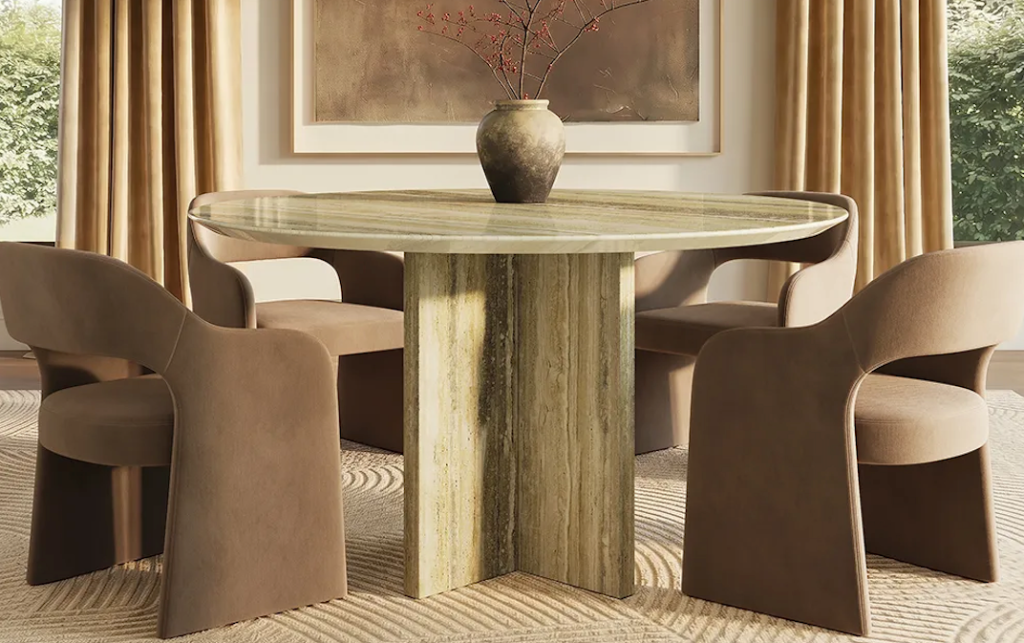
A pedestal dining table is a strong match for small dining rooms because it solves two specific problems at once: it removes corner legs that eat into chair push-in space, and it lets you seat people at any point around the table without anyone straddling a leg. That second point matters more than most product descriptions let on.
With a standard four-leg table, the legs sit roughly 3–6 inches in from each corner. On a 48″ round table, that means four zones around the edge where chairs can’t sit flush — you’re either offsetting the chair or someone’s ankles are fighting the leg all dinner. A pedestal puts one column in the center. The entire perimeter is open.
That’s the functional case. Here’s the real-life case: if you’re regularly fitting 4–6 people in a room under 10’×10′, the chair push-in space you recover from a pedestal base is the difference between a room that feels full and one that feels jammed.
Best Rooms for Pedestal Tables
Small Dining Rooms
The sweet spot for a pedestal round dining table in a small dining room is a diameter between 42″ and 54″. Here’s the math that actually matters:
The NKBA’s Kitchen & Bath Planning Guidelines recommend a minimum of 36″ clearance between the table edge and any wall or obstruction — enough for someone to edge past a seated diner. For comfortable passage (carrying a dish, getting up during a meal), 44″ is the practical target.
That means in a 10’×10′ room (120″), a 48″ round table leaves 36″ on each side — right at the minimum. Workable, not generous. In a 10’×12′ room, you’re at 42″ on the short sides and 48″ on the long sides. That’s where things start to feel genuinely comfortable.
I’d tape out the footprint before buying anything. Seriously — grab painter’s tape, mark a circle on the floor at the exact diameter you’re considering, then pull chairs around it and try to move. You’ll learn more in 10 minutes than any room visualizer will tell you.
Round Table Layouts
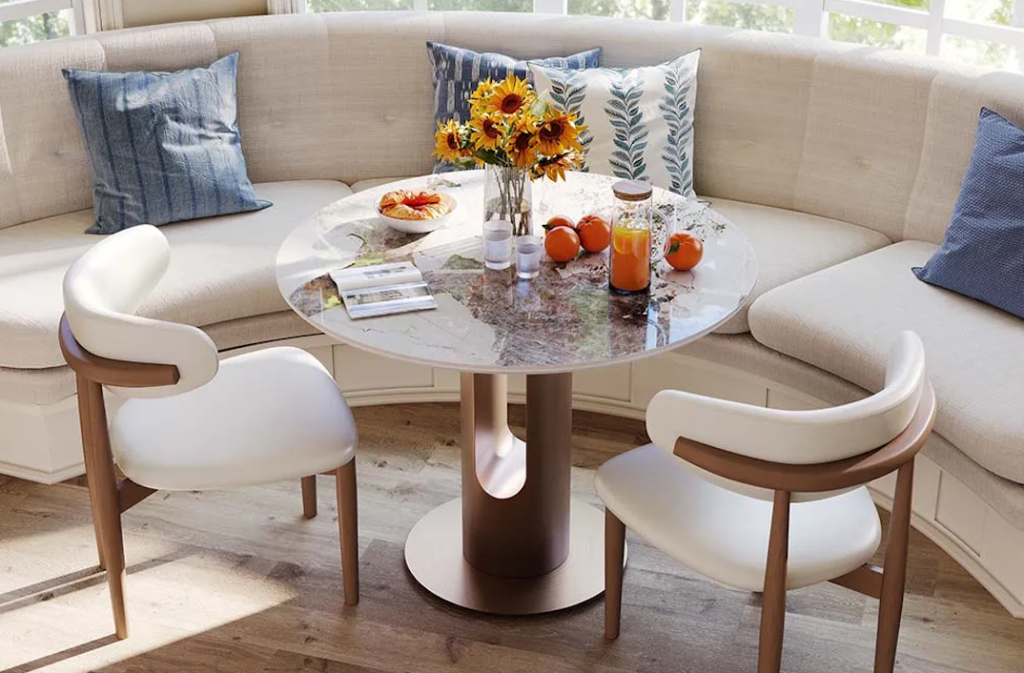
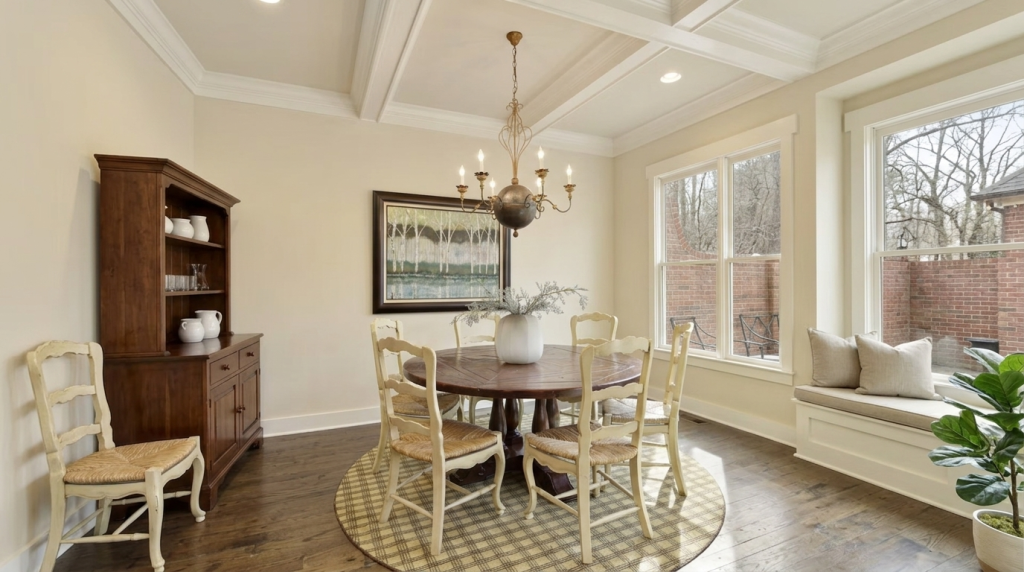
Round tables work particularly well in rooms that are roughly square, in breakfast nooks, or in open-plan areas where the dining zone isn’t defined by four walls. The reason is circulation: there are no corners blocking the visual and physical flow, so the eye — and your body — moves around the table naturally.
One thing worth understanding about round layouts: chairs don’t tuck completely under the way they do with a rectangular table against a wall. A pedestal base helps here because there’s no center leg to prevent a chair from being pushed most of the way in, but you still need to account for about 6–8″ of chair depth that stays outside the table edge when fully pushed in. Factor that into your clearance math.
Pedestal vs. Four-Leg Dining Tables
Here’s where I want to be honest about the trade-offs, because both base types have genuine advantages.
The legroom and chair flexibility advantages of a pedestal are real and meaningful. But so is the stability question — which I’ll get into in the next section.
The other factor: a four-leg table is harder to expand with a leaf in a small room, because adding length usually means the legs shift toward where chairs need to be. A pedestal extendable table can accommodate a leaf more gracefully because the base doesn’t move. If you ever entertain more than your day-to-day count, that’s worth thinking through.
Seating, Stability, and Base Trade-Offs
Let’s talk about what actually determines whether a pedestal table is stable enough for daily use — because this is where a lot of online descriptions go vague and a lot of buyers get burned.
The base-to-top ratio is the key spec. A general rule of thumb is that the base spread (measured at its widest point, whether that’s a single column flare, cross-base, or splayed legs) should be at least 50% of the tabletop diameter. On a 48″ round top, you want at least 24″ of base spread. Many budget pedestal tables use a narrow column that looks elegant in photos but has maybe 16–18″ of spread at the base — that’s where wobble comes from.
Base weight matters as much as spread. A heavier base lowers the center of gravity and resists lateral movement. Solid wood or cast iron bases in the 40–60 lb range are significantly more stable than hollow-formed bases. When you’re shopping online, ask specifically: how much does the base weigh? Not the whole table — the base. If that number isn’t listed, that’s a signal.
What about family use? A well-built pedestal table — with adequate base spread, solid column joinery, and a tabletop weight that counterbalances the base — handles daily family use without issue. I’ve had 6 adults leaning on a 54″ pedestal round at the same time, hot pot going, and zero movement. But that was a table with a 55 lb base and 28″ spread. A $280 version with a 14″ column? Different story.
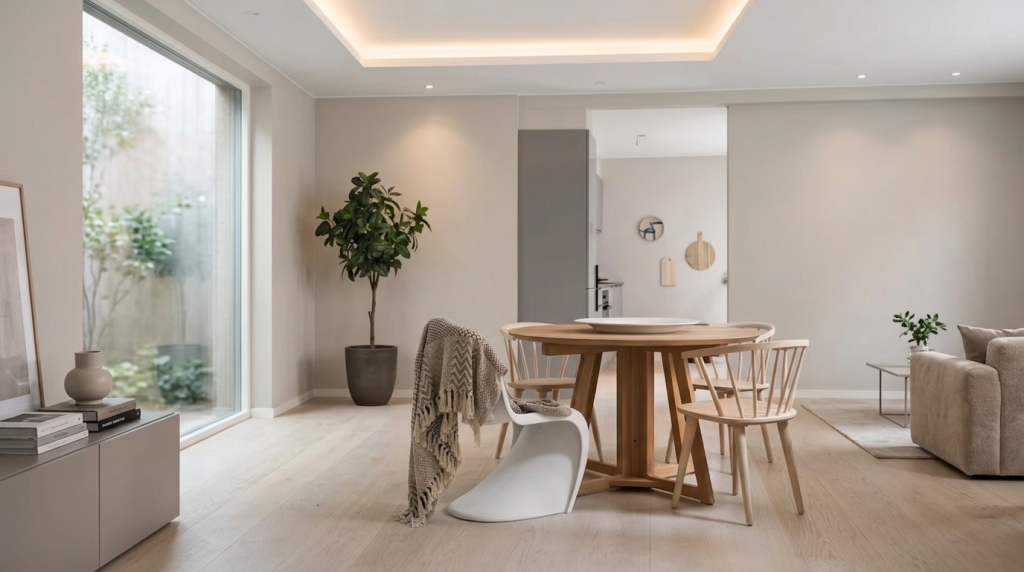
For seating capacity specifically: a 42″ round seats 4 adults at 24″ per person (the comfortable benchmark). A 48″ round comfortably seats 4–5. A 60″ round can seat 6, but only comfortably with slim side chairs — armchairs at 22–24″ wide will start to crowd.
POVISON’s round pedestal dining tables ship fully assembled — the base and tabletop connection is factory-set, which eliminates the most common source of instability in pedestal tables: an incorrectly torqued column-to-top bolt that loosens after the first few uses. If you’re comparing options, that’s a practical difference worth noting. Browse POVISON’s round pedestal dining tables and check the base spread spec before you commit to a size.
What to Check Before Buying Online
This is the part that saves you a return. Before you click buy on any pedestal dining table, verify these five things:
- Base spread (in inches, not “sturdy” adjectives). You want ≥ 50% of tabletop diameter. A product page that only says “solid base” without a measurement is not giving you what you need.
- Base weight vs. total weight. Total weight includes the top. If a 48″ table weighs 85 lbs and the base is listed at 20 lbs, that’s a lightweight base carrying a heavy top. Ask customer service if the breakdown isn’t listed.
- Chair clearance with your specific chairs. If you have armchairs (22″+ wide), run the capacity math yourself. Divide the table circumference by 22″ or 24″ per person, not the product claim.
- Material certification. If the table is going near kids or in an enclosed dining room, look for FSC-certified wood and a non-toxic finish call-out — ideally CARB Phase 2 compliance. A table that off-gasses in a small room is a real concern, not a checkbox.
- Delivery and handling specs. Large pedestal tables can arrive in two boxes — base and top separately. For a fully assembled table, confirm what “assembled” means: is the base-to-top connection pre-set at the factory, or does it require customer assembly on arrival? That’s the difference between a 7-minute placement and a 45-minute puzzle.
FAQ
Is a pedestal dining table the best choice for a small dining room or open-plan space?
Yes, especially in rooms under 120 sq ft or tight open layouts. The central base gives you full perimeter seating without corner legs blocking chair placement, making it easier to seat 4–6 people comfortably. It works particularly well in square rooms or areas where traffic flows around the table. However, if your room is very narrow or you prefer a more structured, anchored look, a four-leg table might feel more stable in daily use.
How do I choose the right size pedestal table for my space and seating needs?
Focus on diameters between 42″ and 54″ for most small spaces. A 48″ round typically seats 4–5 adults comfortably. Always calculate clearance using the 36–44 inch rule from the table edge to walls, and tape out the full circle plus chairs on your floor for a couple of days. Consider your chair width too — wider armchairs reduce seating capacity more than many listings suggest.
How can I keep my pedestal dining table stable and wobble-free over time?
Stability depends heavily on the base spread and weight. Avoid dragging the table or overloading one side. Periodically check the connection between the base and top, especially in the first few months. For daily family use, choose models with a heavy base (ideally 40+ lbs) and at least 50% base spread relative to the tabletop diameter. Gentle use and proper leveling feet help maintain performance for years.
What should I do if my pedestal table starts to wobble after some use?
First, ensure the floor is level and adjust the feet if available. Tighten any factory connections between the column and top. If the issue persists, it often comes from an undersized base spread — in that case, adding a stabilizing pad or contacting the manufacturer for support is recommended. Quality pre-assembled tables tend to have fewer of these issues long-term.
Conclusion
The pedestal base earns its place in a small dining room specifically because of what it doesn’t have: corner legs that block chairs, fixed seating positions that constrain the table’s perimeter, and a footprint that fights circulation in a tight space.
But “pedestal” is not a single spec — it’s a design category that ranges from genuinely solid to structurally marginal. The questions that separate the two: How wide is the base spread? How heavy is the base? And how is the column-to-top connection made?
Get those three answers before you buy, tape out the diameter on your floor before you commit to a size, and run the clearance math with your actual chairs. The 36″ NKBA minimum is a floor, not a target — 44″ on your primary traffic side is where daily use starts feeling genuinely comfortable.
A round pedestal dining table in the right size, with a solid base, in a room with adequate clearance: that’s the combination that makes a small dining room feel like it was designed to host people, not survive them.
Related Reading:


