 By Stephanie

After an overnight guest leaves, you may need to clear the living room or home office and put the spare bed away. Knowing how to deflate an air mattress correctly helps you release the air without forcing its valve, pump, or seams. The right method depends on whether the mattress has a built-in pump, connects to an external electric pump, or uses a manual release valve. This guide takes you from identifying that setup to removing trapped air, folding the mattress, and storing it without unnecessary bulk.
Table of Contents
Step 1: Prepare the Mattress and Identify Its Deflation System
Remove sheets, blankets, pillows, and any mattress topper. Move the air mattress away from furniture corners, bed frames, or other objects that could catch the material as it collapses.
Next, locate the pump and every valve. Some mattresses have a built-in pump with a dial or switch. Others have a separate connection for an external pump, while simpler models use a manual stopper. Check the label or owner’s manual before opening anything.
| Mattress setup | What to identify | Deflation route |
| Built-in electric pump | Control dial, switch, or release opening | Use the model’s Deflate setting |
| External electric pump | Separate valve and compatible nozzle | Connect to a pump with a deflation outlet |
| Manual release valve | Main stopper or quick-release cap | Open the designated valve and release air manually |
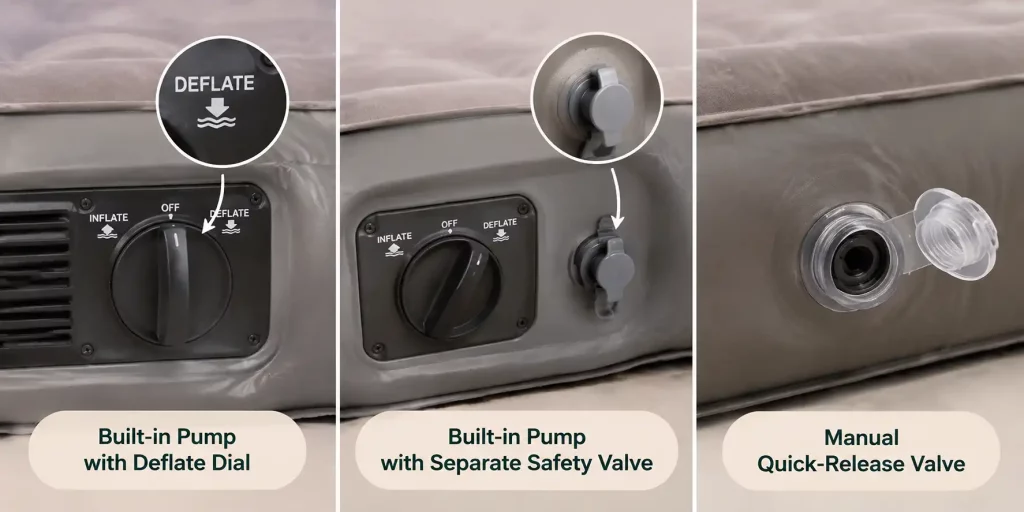
Built-in pump designs vary. Some release air through a separate safety valve, while others use an opening in the pump dial. Check your model’s instructions to determine which valve should be open or closed before starting, as using the wrong setting may prevent air from escaping.
Step 2: Release Air Using the Correct Method
With the deflation system identified, follow the matching method below. Each approach releases air through a different route, so use only the controls and connections designed for your mattress.
Using a Built-In Pump
- Locate the pump control panel or dial.
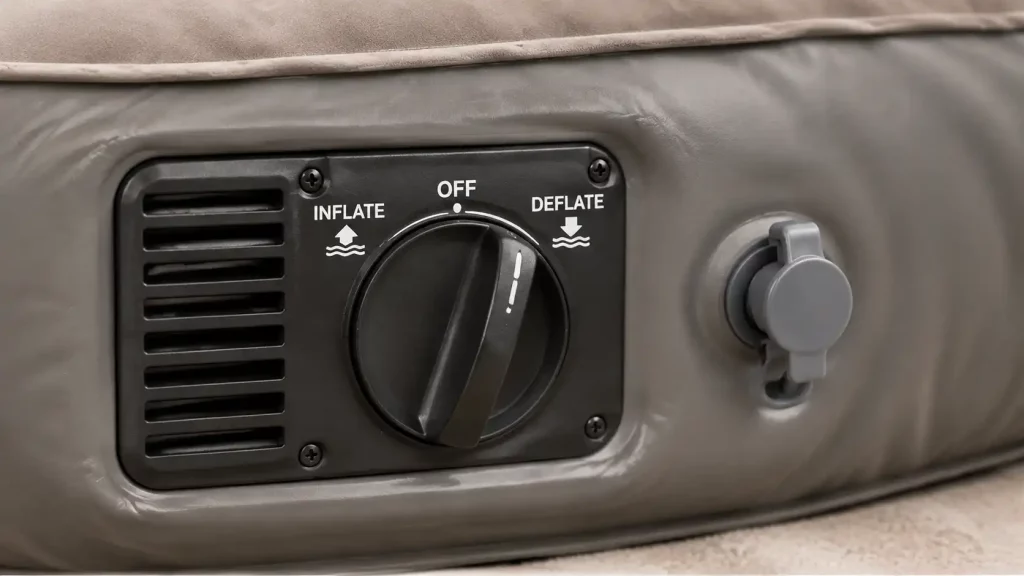
- Check the owner’s manual for the correct valve position. Some models require a separate safety valve to be opened, while others release air through the pump’s central opening.
- Connect the power cord if the model requires it.
- Turn the control dial or switch to Deflate or the designated release setting.
- If the pump has a separate power button, operate it as directed.
- Let the pump remove the air, monitoring the process until the mattress is mostly flat.
- Switch off and disconnect the pump as instructed.
If you’re learning how to deflate an air mattress with a built-in pump, pay particular attention to the valve arrangement. Some models release air through a separate safety valve, while others use an opening in the pump dial. These designs require different valve positions during deflation (Bestway). Coleman’s instructions also specify using the Deflate setting on compatible built-in electric pump models (Coleman). Follow your mattress manufacturer’s instructions rather than assuming every control dial works alike.
Using an External Electric Pump
- Find the mattress’s designated deflation port.
- Not every electric pump can remove air. Choose a model with a designated Deflate outlet or reverse-airflow function. Some one-way valves require manual release rather than pump-assisted deflation.
- Choose an adapter that fits the mattress valve without stretching or forcing it.
- Connect the adapter to the pump’s deflation side and attach it to the mattress.
- Turn on the pump and monitor the airflow.
- Switch it off when the mattress is sufficiently flat.
Deflating Without a Pump
- Open the mattress’s designated release valve fully, following its instructions.
- Allow air to escape naturally.
- Once the airflow slows, move to the next step to remove the remaining air.
Some quick-release valves have an internal stopper that must be pulled outward after the cap is opened. Others use a different mechanism. Avoid forcing the valve if it does not move easily.
Step 3: Remove the Remaining Air
A mattress may look flat while still holding small pockets of air in its folds or sections. These pockets can make the folded bundle bulky and prevent it from fitting into the storage bag.
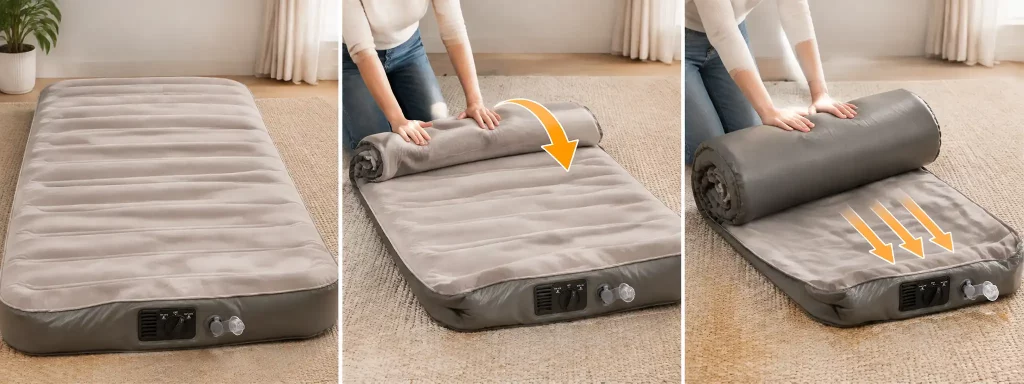
To remove the remaining air, follow the manufacturer’s recommended release direction. If rolling toward an open valve is permitted, start at the end farthest from the outlet and work gradually toward it. This is an air-release pass, not necessarily the final storage fold.
- Smooth the mattress flat before rolling.
- Apply gentle, even pressure with your hands.
- Move along the mattress in sections rather than pressing hard in one spot.
- Pause if the roll becomes springy, then unfold it slightly to let trapped air escape.
- Continue until the mattress is sufficiently flat for its recommended storage method.
Keep the release outlet open during rolling only if the manufacturer’s instructions allow it. Some models require a specific valve position or folding direction, so do not assume that one rolling method works for every air mattress.
Step 4: Fold and Pack the Mattress
Once the mattress is flat, follow the manufacturer’s folding pattern. Some models are designed to fold lengthwise before rolling, while others use a different arrangement. Avoid sharp creases, twisting the pump housing, or placing pressure directly on the valve.
Before putting it away:
- Make sure the mattress is clean and completely dry.
- Close the valve or return the pump dial to its storage position as directed.
- Coil the power cord loosely and place it in its compartment, if applicable.
- Slide the mattress into its original storage bag without forcing it.
- Store it in a cool, dry place away from sharp objects and heavy items.
If the mattress was used in a home office that doubles as a guest room, planning where the packed bedding goes can help keep the workspace usable after visitors leave. These home office guest room ideas offer practical ways to organize a room that serves both purposes.
What to Do If Your Air Mattress Won’t Deflate
If your air mattress won’t deflate, check the valve and pump setup before assuming the mattress is damaged. Use this table to identify the next step.
| Problem | What to Check Next |
| The release valve will not open | Identify the locking mechanism and check the model instructions. Never pry it open. |
| The pump runs but no air escapes | Confirm the correct Deflate setting and outlet. If the pump still fails, follow the pump troubleshooting process. |
| Air stops escaping while the mattress remains bulky | Check whether the outlet is obstructed, then repeat the recommended air-release roll. |
| The mattress still will not fit its storage bag | Check the manufacturer’s folding pattern instead of forcing the mattress into the bag. |
Never pry a stuck valve open with a knife or screwdriver, and do not dismantle a built-in pump to speed up deflation. If the pump also fails to operate normally, follow these air mattress pump troubleshooting steps rather than repeatedly switching it on.
A Power Sofa Bed to Avoid Repeated Air Mattress Setup
When putting an air mattress away after every visit becomes a recurring chore, a power sofa bed offers a more convenient guest setup. It stays in the living room as everyday seating, then adjusts at the touch of a button for overnight use. There’s no separate bed to inflate, fold, or store between stays.
For households that host regularly, the Povison Aurora Power Sofa Bed offers more flexibility through its adjustable seat depth, which extends from 27 to 45.5 inches. You can keep a more compact seating position for everyday use and give guests extra room to stretch out when they stay over. Its water- and scratch-resistant white chenille also helps the sofa handle the spills and everyday wear that come with family use.
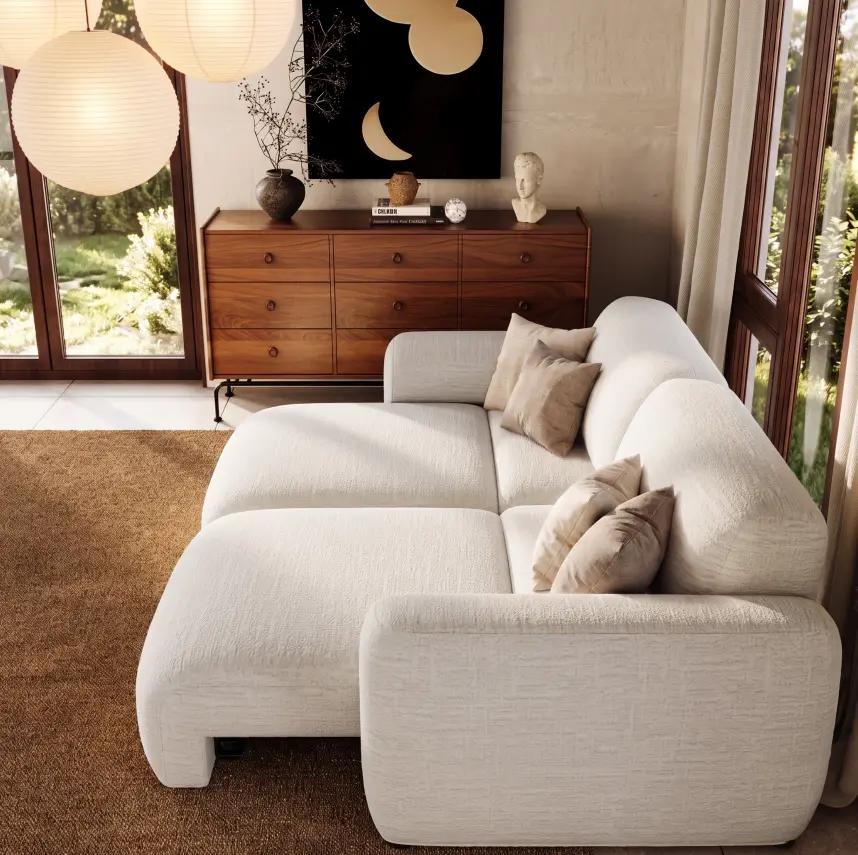
Aurora Power Sofa Bed
A practical fit for frequent hosts who are ready to move beyond a temporary, pack-away guest bed.
If you’re comparing a permanent seating-and-sleeping setup with a portable guest bed, consider how often you host and whether the room needs to return to everyday use after each visit. The sofa bed and air mattress comparison can help you assess that decision.
Conclusion
Deflating an air mattress is easiest when you identify its release system before opening the valve. Use the pump or manual release method specified for that model, then guide remaining air toward the outlet and fold the mattress according to its storage instructions. Make sure it is clean and fully dry before packing it away. Following the correct sequence helps prevent unnecessary strain on the valve and makes it easier to return the room to everyday use.

More Ways to Host Overnight Guests
Explore power sleeper sofas for different room sizes, guest needs, and everyday comfort.
FAQ
Can You Use a Vacuum Cleaner to Deflate an Air Mattress?
Only if the mattress manufacturer permits it and the valve is compatible with the vacuum attachment. A household vacuum may not seal correctly, and forcing a hose into the opening can damage the valve. Use a pump with a designated deflation function whenever possible.
Can You Leave an Air Mattress Inflated Between Guest Nights?
For a visit lasting several nights, you can leave it set up if the manufacturer allows it and the room remains clear of sharp edges, heat sources, and heavy pressure. Check firmness before each use, then deflate and store it when the visit ends.
Can You Store an Air Mattress in a Garage or Attic?
Only if the space stays dry and within the temperature range recommended by the manufacturer. Garages and attics can experience heat, cold, and humidity changes that may affect the material. A dry indoor closet is generally a more predictable storage location.
Can You Use a Hair Dryer or Air Compressor to Deflate an Air Mattress?
No. A hair dryer adds heat rather than removing air, and high-pressure compressors are not designed for low-pressure airbeds. Do not connect either unless the manufacturer explicitly approves the equipment. Use a compatible pump with a Deflate function or the mattress’s manual release valve.
Is a Self-Inflating Camping Pad Deflated the Same Way?
Not usually. A self-inflating pad contains foam that expands when its valve is opened, so it requires a different compression and rolling process from a standard inflatable air mattress. Open its valve and follow the manufacturer’s instructions rather than automatically using regular airbed steps.


