 By Stephanie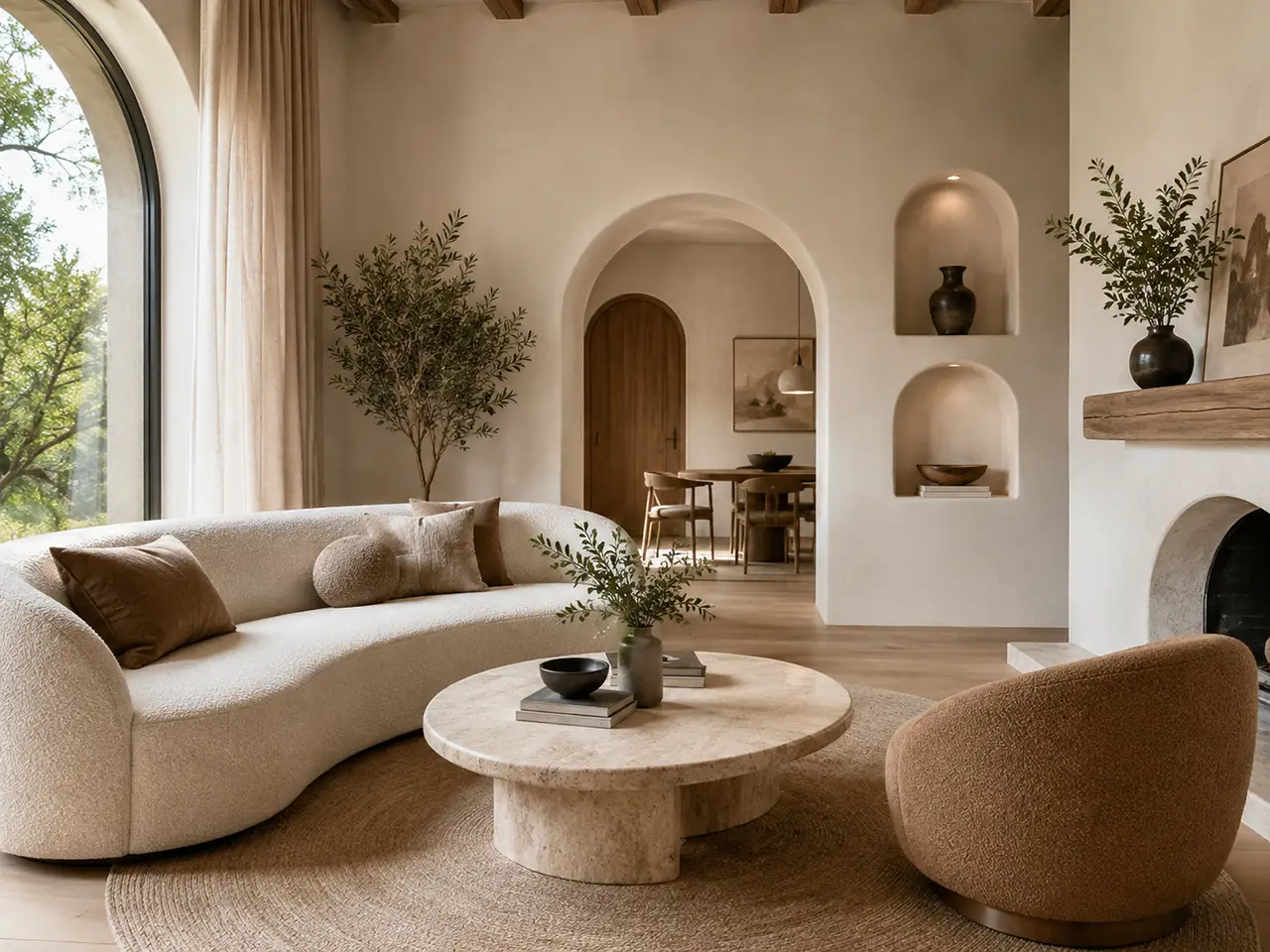
Curves can soften a boxy room, improve how furniture relates to a walkway, or give an open layout a clearer focal point—but not every room needs a curved sofa. If you are researching curved lines in interior design, the useful question is where a curve should go and how strong it should be. This guide helps you choose between smaller rounded pieces, oval tables, curved seating, and subtly rounded storage based on the room problem you are actually trying to solve.
Table of Contents
What Do Curved Lines Do in Interior Design?
Curved lines in interior design include arcs, circles, rounded edges, and flowing outlines that contrast with the straight geometry already built into most rooms. Walls, windows, TVs, cabinetry, and rugs naturally create horizontal and vertical edges, so a curve is most useful when it introduces deliberate contrast.
In practical terms, curves can soften repeated right angles, guide the eye more smoothly across a room, and remove projecting corners from furniture people regularly walk around. Their value comes from where the curve is placed, not from making every object round.
Curves are only one part of how different furniture lines shape a room; horizontal, vertical, and diagonal lines influence furniture choices in different ways.
When Should You Add Curves—and When Should You Not?
Before choosing curved furniture, decide whether the room actually needs another curve. Look first at the shapes already created by the architecture and the largest furniture pieces. A room dominated by rectangles may benefit from contrast, while a space with arched openings, rounded windows, or curved walls may need straighter furniture to keep the composition grounded.
| What You See in the Room | Add a Curve? | Curve Level | Why |
| Most large furniture and architectural lines are rectangular | Usually | Low to medium | One contrasting shape can break up repeated right angles |
| An open seating area lacks a clear boundary | Consider it | Medium to strong | A larger curve can help define the zone without adding a divider |
| A walkway repeatedly passes close to furniture corners | Usually | Medium | Rounded or oval edges remove projecting corner points |
| Arches, rounded windows, or curved walls already dominate | Usually not | Low | Straighter furniture can provide needed visual structure |
| Major furniture must sit tightly against a straight wall | Be cautious | Low | Pronounced rear curves may leave difficult-to-use space behind them |
How Much Curve Does Your Room Need?
A curve can make a small adjustment to a room or become one of its dominant shapes. Judge its strength by how much of the furniture’s outline actually bends—not simply by counting the number of curved objects. This keeps the decision focused on visual weight before you choose a specific sofa, table, or storage piece.
Low Curve: Soften the Edges
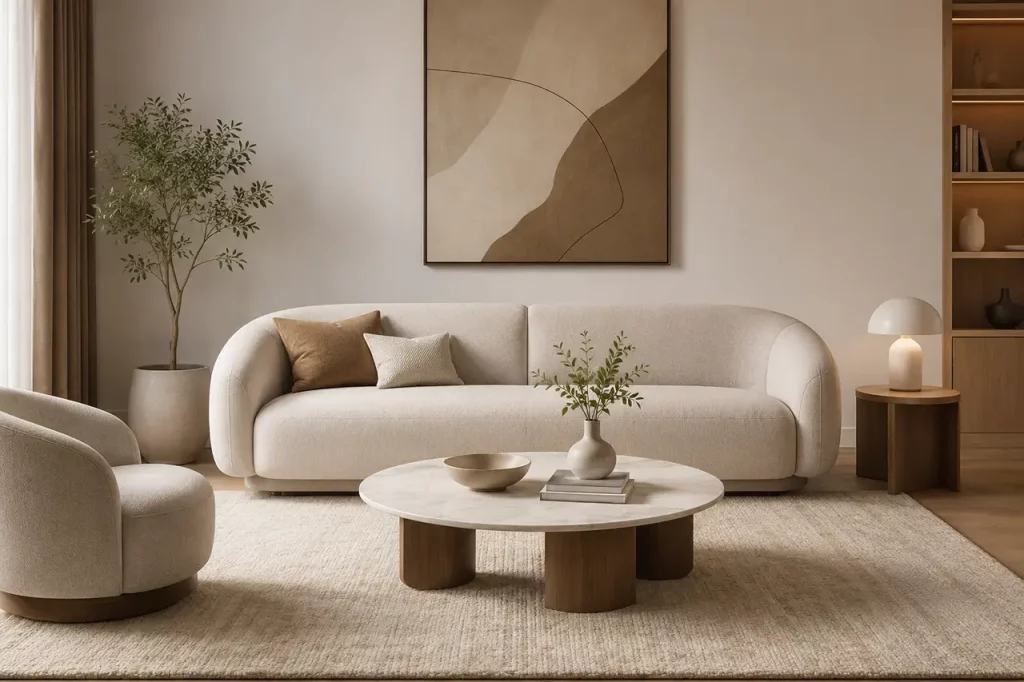
At the lowest level, the furniture still has a mostly straight silhouette but uses rounded corners, softened arms, or a gently bowed front. This works when the existing layout functions well and only needs relief from hard transitions.
Because the overall footprint stays relatively familiar, subtle curves are easier to combine with existing furniture.
Medium Curve: Change One Major Outline
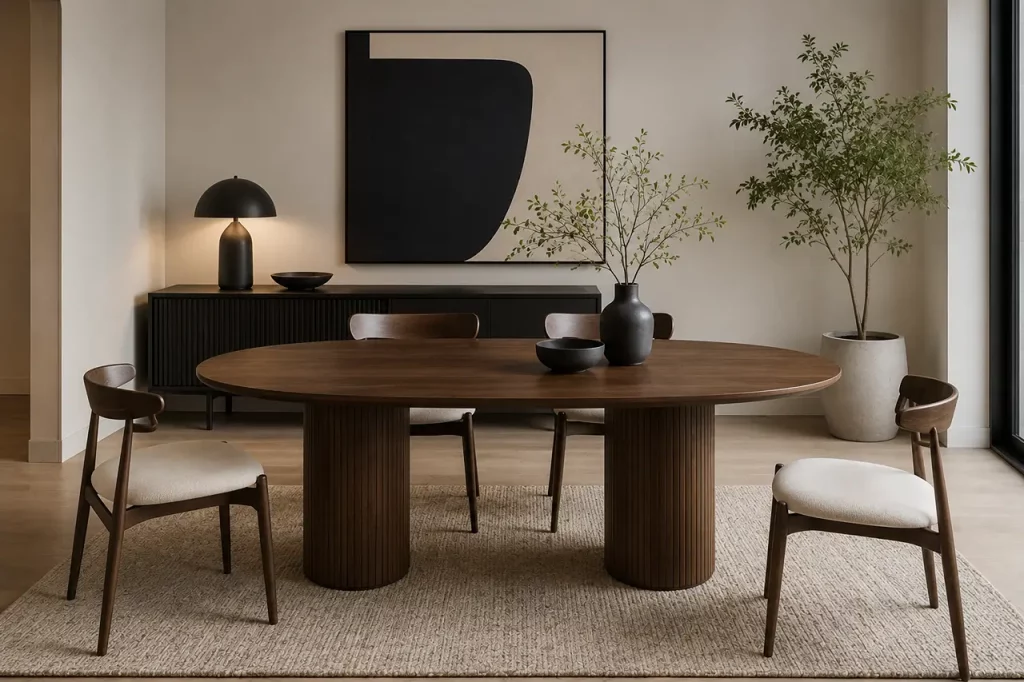
A medium curve changes a clearly visible part of the furniture’s overall shape rather than just its corners. It creates enough contrast to break up a room dominated by straight edges without becoming the shape that controls the entire layout.
At this level, keep nearby furniture simpler so the curve remains easy to read.
Strong Curve: Let the Shape Affect the Layout
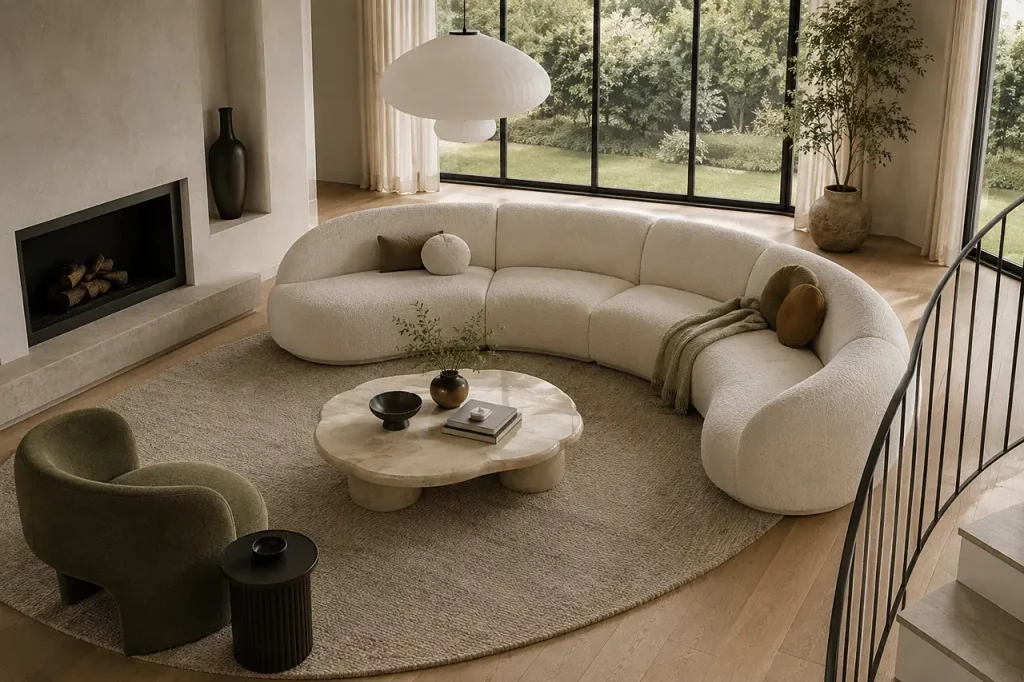
A strong curve bends much of the furniture’s silhouette and can change how the surrounding space is organized. It needs more breathing room than a softened edge because the arc itself becomes visually important.
Use this level only when the room can accommodate the irregular space created around the curve without compromising the way the room functions.
Keep One Geometry in Control
If the strongest piece is curved, let larger surrounding surfaces provide straighter structure. If the architecture and main furniture are already linear, one clearly curved form may provide enough contrast.
There is no useful universal 70/30 rule. Balance depends more on scale, placement, and visual weight than on counting curved and straight objects.
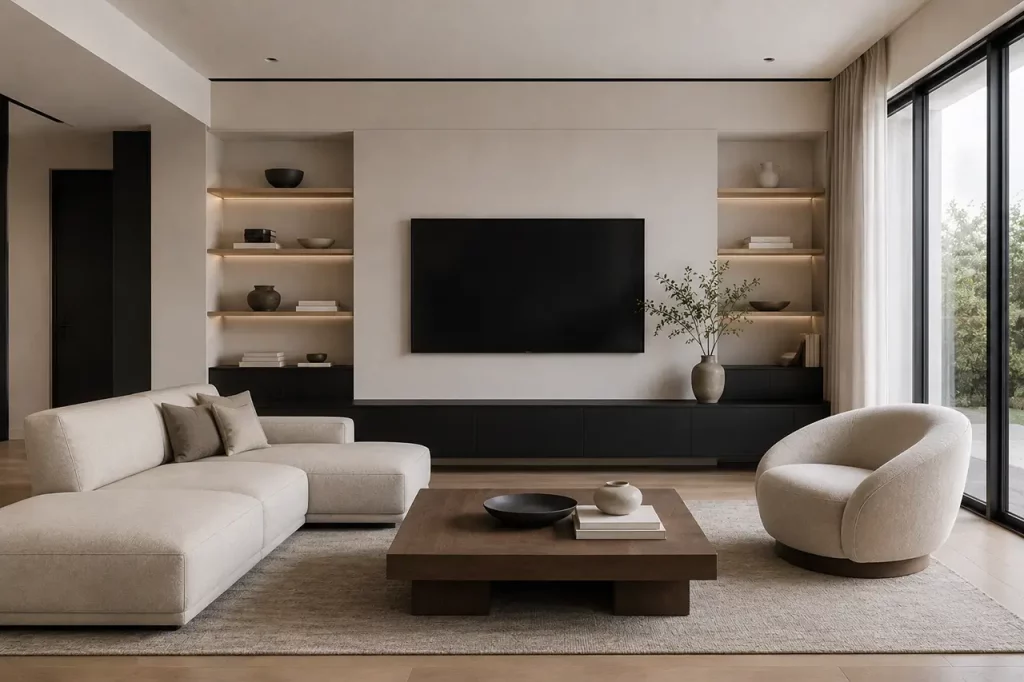
Which Curved Furniture Solves Each Room Problem?
The most useful curved piece depends on how much commitment the room can handle. A coffee table changes the center of a seating group with relatively little disruption. A sofa reshapes the whole living area. Dining tables affect circulation and chair placement, while rounded storage can introduce softness without changing where anyone sits.
Round Coffee Table for a Boxy Living Room
When the seating layout already works but the center is dominated by rectangles, the Silva Lifting Top Round Coffee Table introduces a meaningful curve without changing the sofa arrangement. Its 31.5-inch circular footprint removes projecting table corners, while the lift top rises to 23.2 inches for laptop or snack use. Two drawers and hidden storage keep everyday items out of the center sightline.
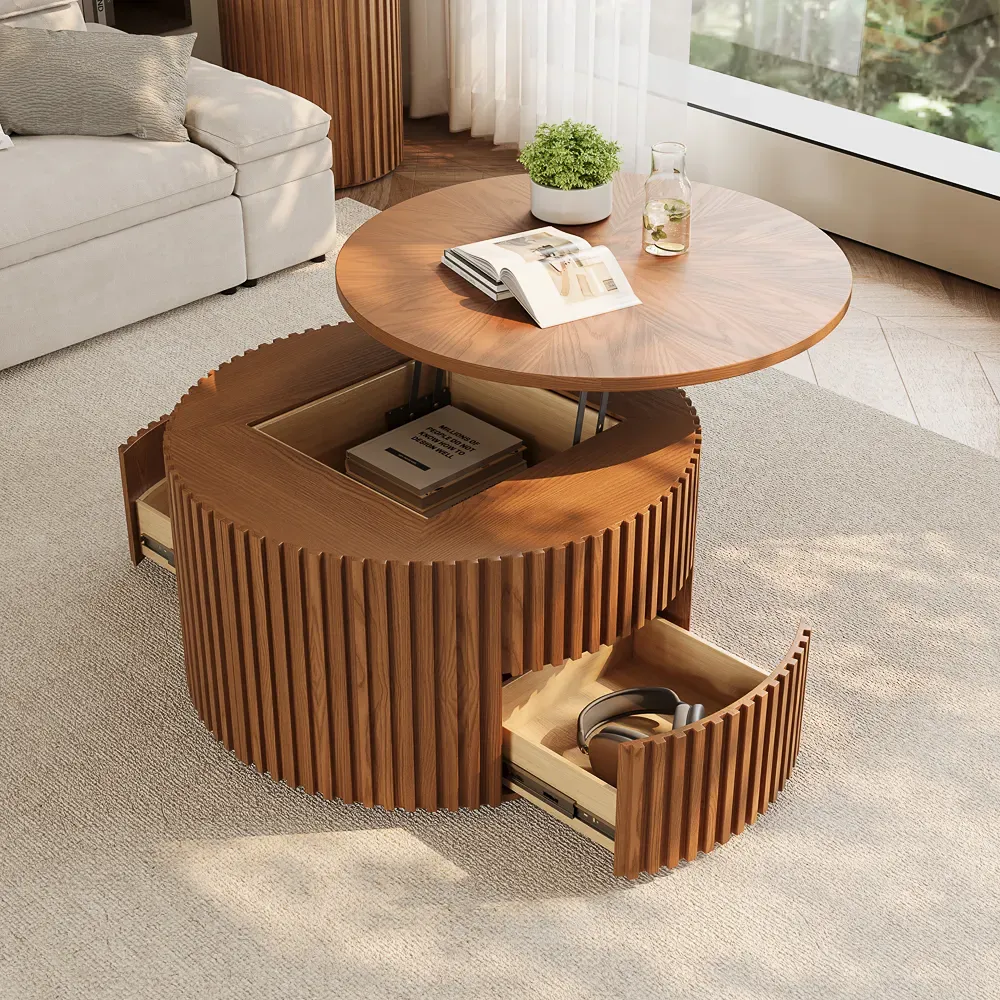
POVISON Silva Lifting Top Round Coffee Table
A smart first curve when the room needs contrast, not a full layout reset.
Curved Sectional for an Open Seating Zone
A larger open seating area can support a more pronounced curve. The Nest Modular Curved Sectional Sofa uses rearrangeable modules to create a softer boundary around the seating zone, which is especially useful in open-plan rooms where a straight sofa can feel visually rigid. Its modular design also gives you more flexibility to adjust the curve as the layout changes.
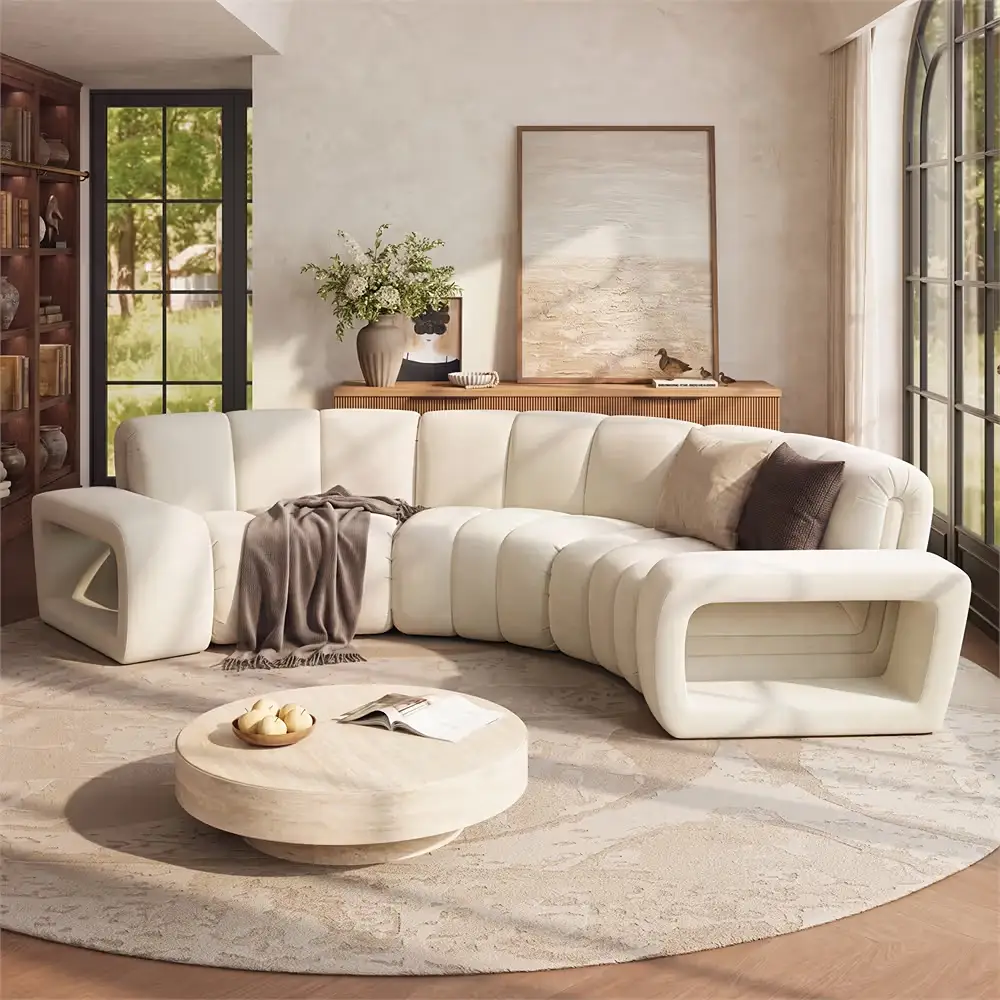
POVISON Nest Modular Curved Sectional Sofa
Use this when the curve needs to define the seating zone, not just decorate it.
Oval Dining Table for a Busy Dining Route
In a long dining area, the Silva Oval Dining Table places the curve where it matters most: at the table ends. The 94-inch version seats up to eight, giving you the generous surface needed for everyday meals and larger gatherings while replacing projecting corners with a smoother outline. That makes it easier to move around the table without giving up useful dining space.
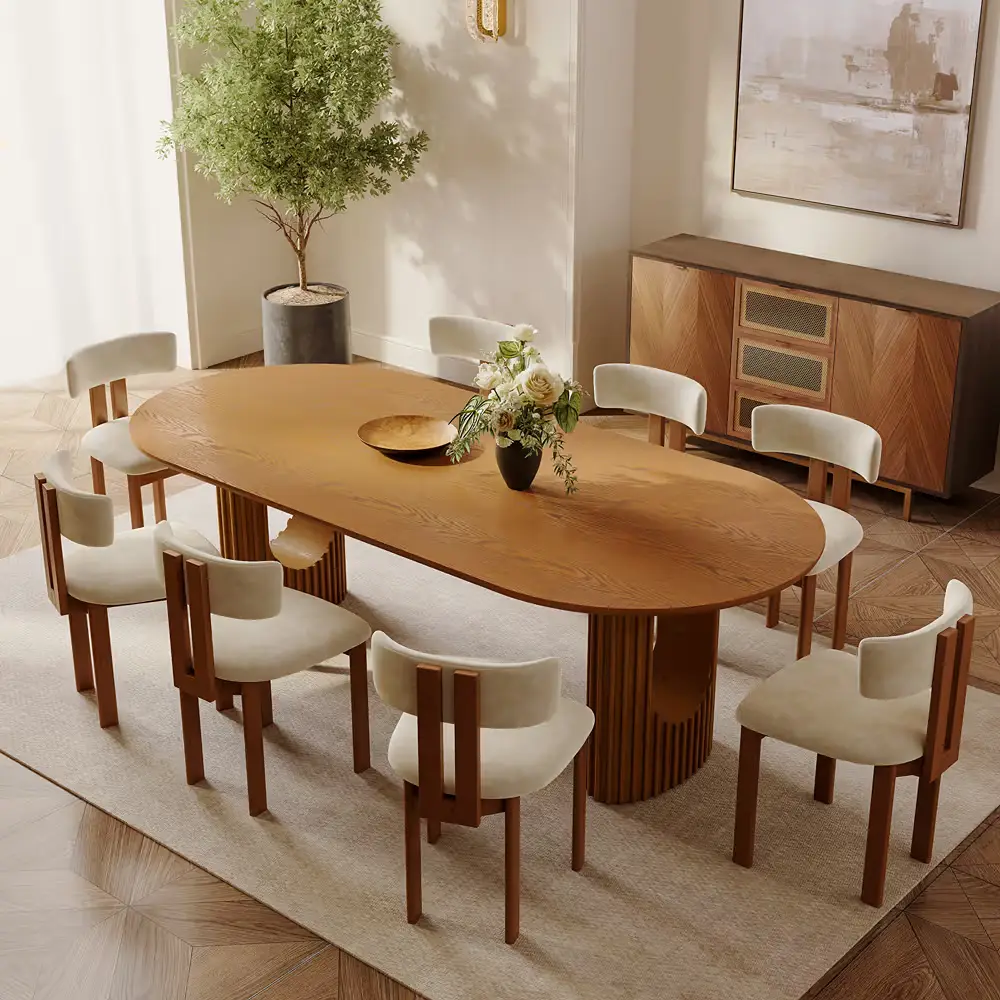
POVISON Silva Oval Dining Table
A strong fit when the dining table needs presence without making the room feel harder to move through.
Rounded Media Storage for a Straight TV Wall
If the seating layout already works, the curve can come from storage instead. The Curved Slatted Wood TV Stand uses curved solid-ash tambour doors to soften the long horizontal line created by a TV and media wall. At about 71 inches wide, it has enough visual presence to change that wall’s geometry without requiring a curved sofa or a complete seating rearrangement.
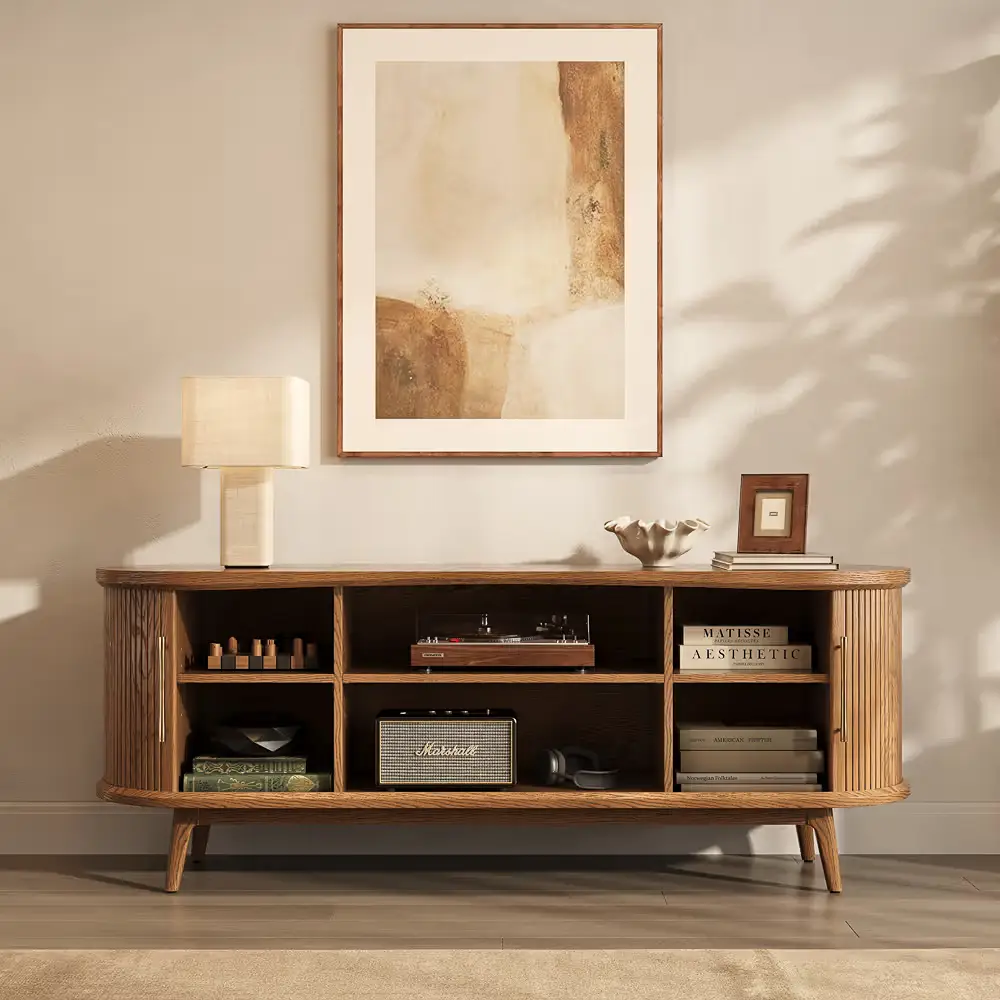
POVISON 71″ Curved Slatted Wood TV Stand
A subtle way to carry curved geometry across a wide media wall while keeping the rest of the room linear.
How Do You Check Whether Curved Furniture Actually Fits?
Published width and depth can tell you whether a piece fits in the room, but they do not always show how a curved edge will interact with a straight wall or a daily walking path. For curved furniture, focus on the shape itself: where it projects the farthest, how much space it leaves behind, and where it comes closest to surrounding furniture.
- Mark the deepest point of the curve. A crescent sofa may project farthest at the center, while an oval table is widest through the middle. Mark that maximum point on the floor rather than judging clearance from the narrower ends. This shows where the furniture will come closest to another piece or a walkway.
- Check the gap against a straight wall. A pronounced curved back will not sit evenly along a straight wall. Use painter’s tape to outline the rear curve and include the floor space left behind it. That gap may be reasonable in a large room, but in a compact space it should count toward the furniture’s overall footprint.
- Test the tightest passing point. For a round or oval table, measure where the edge comes closest to the sofa, kitchen island, doorway, or nearby furniture. With a dining table, repeat the check with a chair pulled out. A piece can technically fit in the room while still making an everyday route feel too tight.
These curve-specific checks complement broader form, function, and footprint considerations for sculptural furniture, especially when a piece has an irregular silhouette or moving components.
Conclusion
Using curved lines in interior design works best when the curve has a clear job. Start by identifying what feels too rigid, disconnected, or awkward to move around. Then choose the lowest level of curve that solves that problem, whether it is a round coffee table, oval dining table, rounded cabinet, or stronger curved sofa. Finally, measure the real footprint before buying. The most useful curve is not necessarily the most dramatic one; it is the one that improves both the room’s geometry and daily use.
FAQs
Are Curved Lines Only for Modern Interiors?
No. Curves also work in transitional, mid-century, Art Deco, traditional, and organic interiors. What changes the style is the material, scale, detailing, and strength of the curve. A gently rounded wood cabinet reads very differently from a large sculptural sofa even though both use curved geometry.
Can You Use a Rectangular Rug With Curved Furniture?
Yes. A rectangular rug can provide useful structure beneath a curved sofa or round table. Size it around the full seating zone rather than matching the furniture outline. When several major pieces are already curved, a straight-edged rug can also keep the composition from feeling visually loose.
Are Curved Lines Still in Style in 2026?
Yes, but restrained curves generally carry less trend risk than exaggerated silhouettes. Rounded cabinet edges, oval tables, and softly curved seating can work beyond a single trend cycle, while highly sculptural pieces make a stronger stylistic commitment. Choose the latter when the surrounding room has enough visual restraint.
Are Rounded Furniture Edges Safer for Families?
Rounded edges remove projecting sharp corners, which can reduce one common bump hazard in busy rooms. They do not make furniture childproof. Families should still consider stability, tip-over risk, moving mechanisms, material durability, and whether the piece narrows a frequently used walkway.


