 By Charles
My sister has two cats and a two-year-old, and she still bought velvet dining chairs. I thought she’d lost it. Then I sat in them, spilled coffee on one on purpose (with her permission), and changed my mind. If you love the way velvet dining chairs look but you’re scared of the upkeep, this is the honest version — real seat comfort, real cleaning, pet hair, kids, and which rooms actually suit them.
I measure before I commit to anything. So before her set arrived, we taped out the chair footprint on the floor with painter’s tape — 19 inches wide, 22 inches deep — to make sure four of them wouldn’t turn her dining nook into an obstacle course. That tape-out habit has saved me from more bad furniture decisions than I can count.
Are Velvet Dining Chairs Right for Daily Use?
Short answer: yes — if the velvet is the right kind and the frame underneath is built for it. The fabric you sit on matters less than the foam and frame you sit in.
For everyday meals, comfort comes down to three numbers. A seat height of 18–19 inches pairs with a standard 28–30 inch table and leaves roughly 12 inches between the seat and the tabletop — enough knee room that you’re not eating with your chin near your plate. A seat depth of 16–18 inches supports your thighs without cutting in behind the knees. And high-density foam (1.8 lb/ft³ or higher) is what keeps a chair comfortable through a two-hour dinner instead of going flat by dessert.
Frame durability is the part nobody photographs. A reinforced hardwood or powder-coated metal frame is what stops the wobble that flat-pack chairs develop after a few months of being dragged across the floor. Serious makers build to ANSI/BIFMA seating durability standards, which run static and cyclic load tests simulating years of real sitting. POVISON ships its chairs fully assembled, which sidesteps the loose-bolt wobble that creeps into self-assembled seats — no hex key, no 47-screw Saturday.
Best Rooms for Velvet Dining Chairs
Velvet earns its keep in some rooms more than others. The deciding factor is traffic — how often the chairs get knocked, dragged, and climbed on.
Low-Traffic Dining Rooms
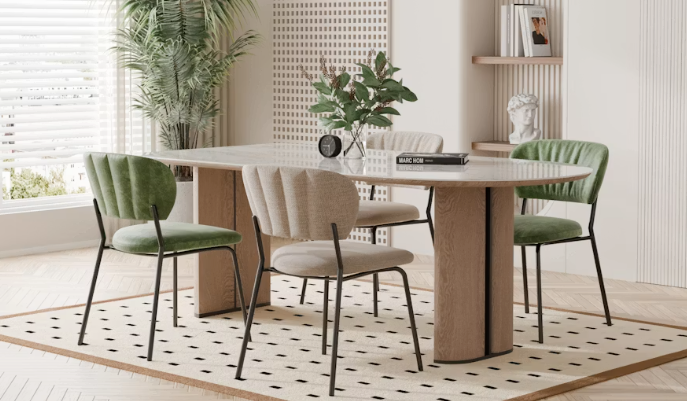
In a dining room you use for dinners rather than homework, snacks, and craft projects, velvet dining chairs are close to ideal. The pile catches light beautifully, the sit is soft, and light wear stays invisible because the chairs aren’t getting abused daily. This is also where lighter colors — sage, blush, cream — actually survive, since spills are rare and you can spot-clean before anything sets. If you want to compare finishes that hold up in this kind of room, POVISON’s fully assembled velvet dining chairs collection lets you put colorways side by side against your own walls.
More Formal Dining Spaces
A formal dining space is where velvet does its best work. It reads richer and warmer than leather or plain weave under dimmed lighting, which is exactly the mood you want for a holiday table or a dinner party. Because these chairs sit unused most of the week, even a natural-fiber velvet (which is fussier to clean) is a reasonable bet — the wear-and-spill math is in your favor. Pair a matching set in one finish family rather than mixing brands, and the whole room speaks the same language instead of looking improvised.
Velvet vs Bouclé vs Other Upholstered Chairs
People agonize over velvet vs bouclé like it’s a personality test. It’s really a maintenance-and-comfort trade-off, and the right pick depends on your household, not a mood board. Here’s the honest side-by-side:
| Fabric | Feel | Pet hair | Stain handling | Best for |
| Velvet (performance/synthetic) | Soft, smooth pile | Sheds easily with a brush; shows on dark colors | Spot-clean with water (W code) | Style-forward homes, some pets |
| Velvet (natural cotton/silk) | Plush, luxe | Same shedding | Water-sensitive (S code), trickier | Formal, low-traffic rooms |
| Bouclé | Nubby, cozy | Loops can trap hair and snag claws | Hides crumbs, but texture grabs spills | Cozy rooms, no clawing pets |
| Faux leather | Smooth, firm | Wipes off instantly | Wipes clean in seconds | Toddlers, daily chaos |
| Cotton-linen | Casual, breathable | Sheds easily | Spot-clean, wrinkles | Relaxed everyday dining |
One spec to check before you fall in love: the abrasion rating. Upholstery durability is measured in “double rubs,” and the Association for Contract Textiles’ abrasion guidelines put roughly 15,000 double rubs (Wyzenbeek method) at heavy residential use and 30,000-plus at commercial grade. Performance velvet often clears 30,000, which is why it survives daily dinners far better than its delicate reputation suggests. Bouclé feels cozier, but its looped surface is the one to avoid if you own a cat that treats fabric as a scratching post.
How Do You Clean Velvet Dining Chairs, Pet Hair, and Stains?
This is the part everyone’s actually worried about, so let me get specific.
First, find the cleaning code on the tag under the seat. W means water-based cleaners are safe, S means solvent only, W/S means either, and X means vacuum or brush only. Performance velvet is usually W or W/S — the easy camp. Natural velvet skews S and is the fussier one.
For a fresh spill, the rule is blot, never rub — press a dry cloth straight down to lift the liquid before it reaches the foam. Then dab with a little mild dish soap in lukewarm water on a W-coded chair, working from the outside of the spot inward, and let it air-dry for 12–24 hours. Once dry, brush the pile back in the direction of the nap with a soft brush so it doesn’t dry matted. Weekly upkeep is a 2-minute pass with a vacuum’s upholstery attachment.
Pet hair surprises people. Velvet’s flat, dense pile actually releases hair more easily than looped fabrics — a quick brush or lint roller in one direction lifts most of it. The catch is contrast: on a charcoal or navy chair, light pet hair shows more, so match the chair color to your pet if you can.
For families with kids, the material under the velvet matters as much as the fabric. Look for a frame and any composite parts that meet CARB Phase 2 formaldehyde limits and a non-toxic, water-based finish — that’s what lets you wipe a chair down without worrying about what a toddler licks off the armrest later. POVISON specs its frames to CARB Phase 2 with low-VOC finishes for exactly that reason.
FAQ
Are velvet dining chairs practical for a home with kids and pets?
Yes, especially if you choose performance velvet (synthetic) rather than natural velvet. Performance velvet is surprisingly durable with high abrasion ratings (30,000+ double rubs) and handles daily use well. It works best when paired with a strong frame and high-density foam. However, if you have cats that scratch or very messy toddlers, faux leather might be safer. Always check the cleaning code (W or W/S is ideal) before buying.
How do I know if velvet dining chairs will be comfortable for long meals?
Look for specific measurements: 18–19 inch seat height, 16–18 inch seat depth, and high-density foam (1.8 lb/ft³ or higher). These ensure good thigh support and proper knee clearance under a standard 28–30 inch table. Test the backrest height for lumbar support (ideally 12–16 inches above the seat). Fully assembled chairs with reinforced frames tend to stay comfortable longer than flat-pack versions.
How do I clean velvet dining chairs and remove pet hair effectively?
For spills, blot immediately (never rub) and use a mild soap solution on W-coded velvet, working from the edges inward. Let it air dry fully, then brush the pile with a soft brush. For pet hair, use a lint roller or vacuum with an upholstery attachment weekly, brushing in one direction. Performance velvet releases hair more easily than bouclé, but darker colors show light hair more noticeably.
How do velvet chairs hold up over time with regular family use?
With proper care, performance velvet can last several years even in busy homes. The key is consistent upkeep — weekly vacuuming, prompt spill treatment, and avoiding direct sunlight. Check the frame and foam periodically for wear. Chairs built to ANSI/BIFMA standards with strong hardwood or metal frames tend to resist wobbling and maintain their plush feel much longer.
When are velvet dining chairs a good choice versus other fabrics like bouclé or faux leather?
Velvet is ideal for low-traffic or formal dining rooms where you want a luxurious, light-catching look. Bouclé offers a cozier texture but traps hair and crumbs more easily. Faux leather wins for high-chaos households with kids and pets due to easy wiping. Choose based on your room’s traffic level, cleaning tolerance, and how often the chairs will be used.
Conclusion
So, are velvet dining chairs worth it in 2026? For most design-conscious homes — even ones with a toddler or a shedding cat — yes, as long as you buy performance velvet on a solid, fully assembled frame and keep a soft brush handy. Skip them only if your dining table doubles as a daily art station for under-fives, or if you genuinely won’t do the 2-minute weekly vacuum; in those cases, faux leather is the lower-stress pick.
After watching my sister’s set survive a year of cats, crayons, and one memorable spaghetti incident, I’m convinced the “velvet is high-maintenance” reputation is mostly outdated. Tape out your space first, check the cleaning code and seat height before you buy, and you’ll get the soft, warm look without the upkeep anxiety. If you want chairs that arrive ready to live in — no tools, no wobble — POVISON’s swivel velvet dining chairs are a good place to pick the finish that matches how your household actually eats.
Related Reading:


