 By Charles
The sofa’s in place. The TV’s mounted. Friends are coming over Saturday — and there’s nowhere to put a drink. If your living room is 80% finished and missing only the tables, this guide is for you. We’ll cover what a living room table set actually includes, when matching pieces help versus when they look dated, how to choose between a coffee-and-end-table set or single pieces, and the spacing rules that decide whether your room flows or fights you.
Every dimension cited here came from a tape measure, a federal standard, or an industry planning guideline. Tape-out before buying.
What Is Included in a Living Room Table Set?
A living room table set is a coordinated group of 2 to 4 tables — a coffee table plus one or two matching end tables, sometimes with a console table — sold as a unit, finished in the same wood tone, hardware, and edge style so all surfaces in the room read as one family. In 2026, the four configurations buyers see most:
- 2-piece coffee + end set — one coffee table + one end table
- 3-piece coffee + 2 end set — symmetric layout for sofa flanked by end tables
- Coffee + console pair — coffee anchors the seating zone, console behind the sofa or on a blank wall
- Full 4-piece living room coffee table set — coffee + 2 end + console
What a table set actually buys you isn’t a discount. It’s finish coherence. Buying a coffee table from one brand and end tables from another means matching “warm walnut” against “natural oak” against “honey wood” — three finishes that read as three rooms instead of one. A set ships in one finish family, one hardware finish, one edge profile. The room reads as styled, not stitched.
When Do Matching Tables Help a Room Feel Finished?
Matching tables make a room feel finished when the existing seating dominates the visual weight and the tables need to recede into a single supporting layer. Two scenarios where coordinated sets work best.
How Do Matching Tables Work With Sofa and Sectional Layouts?
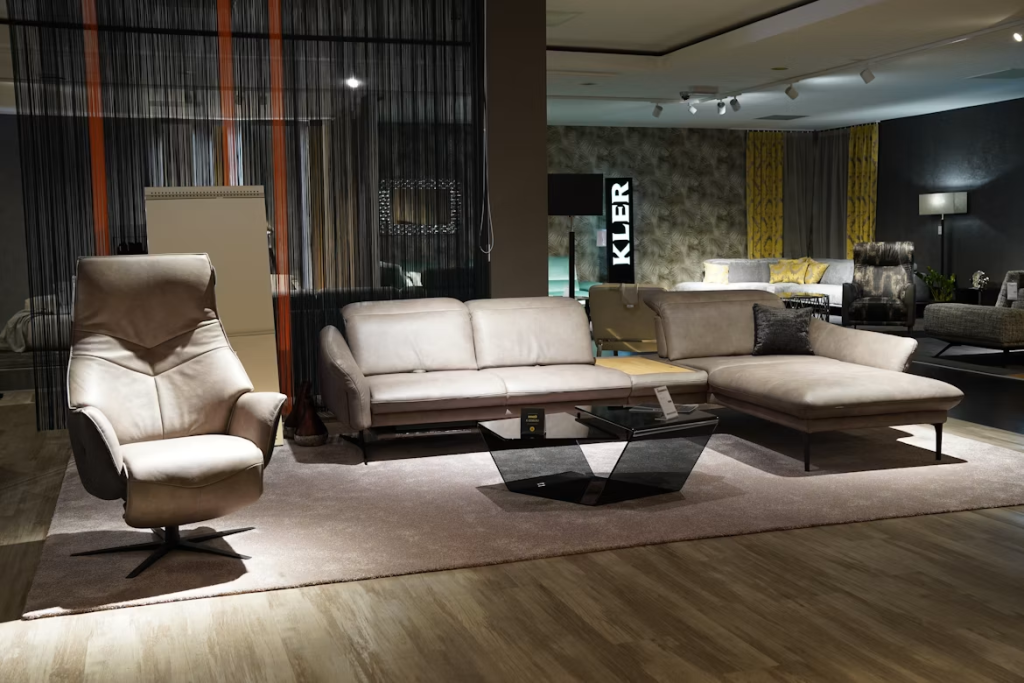
For sofas over 84″ or any L-shaped sectional, matching coffee + end table sets create the visual rhythm that one-off pieces can’t. The reasoning:
- A large sofa pulls visual weight toward one side of the room. Identical end tables at each arm balance it
- An L-sectional has two seating zones — coffee table for the long side, matching end table at the short side’s outer arm gives the second zone its own surface without breaking style
- Per NKBA’s residential planning guidelines, the sofa-to-coffee-table gap should sit between 14–18 inches — close enough to set down a drink, far enough that knees clear. Matching sets are sized to hit this gap automatically when the coffee table length runs ½–⅔ of the sofa
Do Smaller Living Rooms Need Matching Tables for Visual Order?
Under 250 sq ft, matching tables earn their cost by quieting visual noise. A small room can absorb one statement piece — not three. When the coffee table, end table, and console all share one wood tone and one hardware finish, the eye reads “calm.” When each piece argues a different style, the room reads “cramped” even when it isn’t.
The override condition: if your sofa is already a statement piece (bold color, distinctive shape), pick quieter matching tables. Two statement pieces fighting in a small room is a regret waiting to happen.
Coffee Table and End Table Set vs Mixed Pieces: Which Should You Buy?
Choose a coordinated coffee table and end table set when starting from zero or replacing 2+ pieces at once. Mix pieces when you already own one table you’d keep.
| Configuration | Best for | Trade-off |
| Coffee + end table set | New room, 2+ pieces to buy, finish-coherence priority | Less unique character |
| Mixed pieces | One piece already owned, intentional collected look | 4–6 weeks of finish-matching effort |
| Coffee only | Tight rooms, side tables not needed | Drinks may not reach every seat |
The mistake I see most: buyers think mixed pieces always look “designer,” and matching sets always look “catalog.” In 2026, that math has flipped. Today’s table sets ship with intentional differences in size, height, and proportion — same finish family, varied silhouettes — which reads as collected, not matchy. Old-fashioned “perfectly identical 3-piece” sets are what looks dated. Modern coordinated sets vary the shapes while holding the finish.
When Do You Only Need a Coffee Table?
Skip the matching end tables when your sofa sits centered on one wall with a clear walkway behind it, and a single coffee table reaches every seat from 14–18 inches. Scenarios where a coffee table alone is enough:
- Apartments under 250 sq ft where end tables would block walkways
- Single-sofa rooms where every seat is within reach of one shared surface
- Buyers who already have side tables, ottomans, or built-ins serving the end-table role
If you’re in this group, a single coffee table from a matching living room collection keeps your future options open — when you upsize to a sectional next year, the matching end tables and console can join the family without a finish mismatch.
Console Table, Storage, and Traffic Flow Trade-Offs
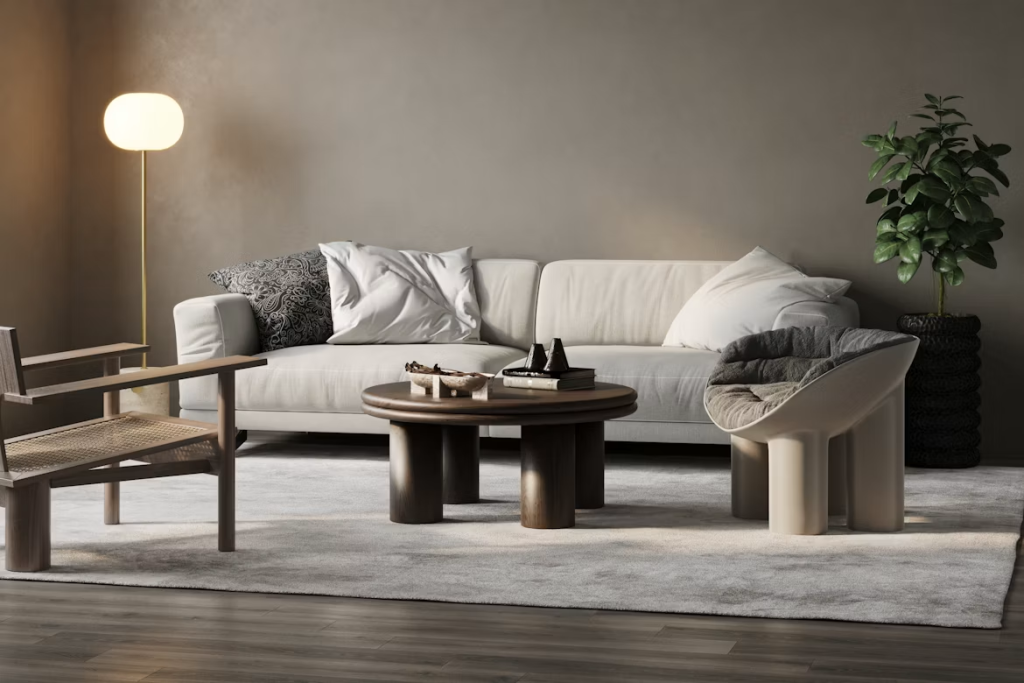
A console table set adds a vertical surface behind the sofa or against a wall — solving storage and lighting needs that coffee and end tables can’t reach. Standard console dimensions: 28–34 inches high, 30–72 inches long, 10–18 inches deep.
What a console table set solves:
- Behind a floating sofa — closes the back of the sofa visually, holds lamps, charges phones, drops keys
- Blank wall behind the seating zone — anchors the wall without consuming floor space (10–18″ depth is half a normal table)
- Entry-to-living transition — separates zones in open-plan rooms without adding a wall
For households with kids or pets, console tables with closed storage (drawers or cabinet doors) hide the daily clutter — chargers, remotes, mail — that coffee tables can’t conceal. On materials: any composite-wood console should carry CARB Phase 2 or TSCA Title VI compliance. Per the EPA’s formaldehyde emission standards, since June 2018 all composite wood sold in the U.S. must meet these emission limits. The label “California 93120 Compliant” confirms the spec.
How Much Space Between Sofa, Coffee Table, and Walkways?
Three clearances decide whether the room flows: 14–18 inches between sofa front and coffee table, 24–30 inches behind the coffee table for the main walkway, and 36 inches of continuous clear width for the primary path through the room.
The 36-inch walkway target tracks the ADA accessible-route standard from the U.S. Access Board — 36″ continuous clear width. A federal accessibility minimum makes a solid baseline for “can two people pass without turning sideways.”
Tape-out test: paint-tape the coffee table footprint and the end table footprints on the floor before ordering. Walk every daily path — sofa to kitchen, sofa to bathroom, front door to TV. If any path narrows below 30 inches, the set is too big.
What to Check Before Buying a Living Room Table Set Online?
Five checks before clicking order: surface material spec, assembly status, packaging dimensions vs doorway clearance, fully-assembled vs flat-pack, and the brand’s damage/return policy.
- Surface material spec. Solid wood lasts 15–20 years; sintered stone resists heat and scratches; tempered glass is 4× stronger than regular glass. Engineered wood with veneer fails inside 5 years under daily laptop and drink use
- Assembly status. Pre-assembled tables ship ready to place — roughly 3 minutes to set down vs 45 minutes of leg-bolt hunt for flat-pack
- Packaging dimensions vs doorways. Console tables especially — a 72-inch console in a flat box won’t navigate a 32-inch hallway turn
- Damage inspection window. Most retailers allow 24–72 hours from delivery to file damage claims with photos
- Return policy specifics. Restocking fees, return shipping cost, and “doesn’t fit” provisions vary widely — please refer to the brand’s most current published documentation, since these terms shift
FAQ
How much space should I leave between my sofa and coffee table for walking?
Leave 14–18 inches between the sofa front and the coffee table for comfortable leg room and easy drink reach, and 24–30 inches behind the coffee table for the main walking path. This aligns with industry residential planning guidelines and keeps the room flowing without forcing anyone to sidestep furniture.
Do matching coffee table and end table sets usually look cheap or outdated?
Matching coffee table and end table sets do not look cheap or outdated when the design varies silhouette, size, or height while holding one finish family. The dated look comes from identical-shape sets where every piece is a literal duplicate. Modern 2026 sets ship coordinated finishes with varied proportions, which reads as collected rather than catalog.
What if I only want a coffee table but do not need the matching end tables?
You can buy a single coffee table from a matching collection without committing to the end tables. The advantage: when your room changes — upsized sofa, new sectional, added accent chairs — the matching end tables and console remain available in the same finish family, avoiding a future mismatch.
Are living room table sets sturdy enough for everyday use with drinks and laptops?
Living room table sets built with solid hardwood frames, sintered stone or tempered glass tops, and reinforced corner joinery handle daily laptop use, drink condensation, and household traffic without damage. The durability indicator is the materials spec on the product page — solid wood frames, named stone or glass grades, and joinery descriptions predict lifespan more reliably than the price tag.
What is the most common issue people run into with online table set purchases?
The most common issue with online table set purchases is finish color reading differently in person than on the product page screen — natural light, room lighting, and monitor calibration all shift the perceived tone. Order a fabric or finish swatch when the brand offers one. For damage handling, restocking fees, and return window specifics, refer to the brand’s most current published documentation, since these policies update periodically.
Conclusion
A living room table set is a finishing layer, not a foundation. The sofa decides how the room sits — the tables decide whether it functions on a Tuesday and looks intentional on a Saturday. Two checks separate success from regret: confirm the 14–18″ sofa-to-coffee-table gap before ordering, and pick a finish family you’ll still want when next year’s accent chair joins the room.
The best table set is the one that’s already on the floor when guests arrive — not the one still in a flat-pack box waiting for next weekend’s hex-key marathon.
Related Reading:


