 By Stephanie
A mattress topper that slides toward the edge of your bed can leave you fixing your bedding every morning. If you’re wondering how to keep mattress topper from sliding, the first step is figuring out what’s actually moving. Sometimes the topper slips against the mattress. Other times, a loose fitted sheet pulls everything out of place, or the mattress itself shifts on its base. This guide covers six practical fixes, how to match each one to the problem, and what to do when ordinary bedding solutions aren’t enough.
Table of Contents
Why Does Your Mattress Topper Keep Sliding?
A mattress topper usually shifts because of slippery contact surfaces, loose bedding, or an improper fit. Before choosing a fix, check whether the topper is moving on its own, the fitted sheet is pulling loose, or the mattress itself is shifting. Each problem calls for a different solution.
Remove the fitted sheet and check whether the topper lies flat and matches the mattress edges. Then inspect the sheet’s elastic corners and gently push the mattress sideways to see whether it moves on its base. If nothing looks wrong, straighten the bedding before sleep and compare its position the next morning.
| What You Notice | Likely Cause | Best First Step |
| Topper slides while the mattress stays still | Low friction between the topper and mattress | Add a compatible non-slip grip pad |
| Fitted-sheet corners keep popping off | Sheet pockets are too shallow for the combined thickness | Check pocket depth and use a properly sized fitted sheet |
| Sheet fits but gradually loosens | Elastic or corner tension is insufficient | Try sheet suspenders |
| Topper bunches inside a loose cover | Cover does not fit the topper securely | Use a properly fitted topper cover |
| Topper hangs over the mattress or its edges curl | Size mismatch or material deformation | Check dimensions and the topper’s condition |
| Mattress and topper shift together | Mattress moves on the bed base | Check the bed frame and mattress support |
Start with the fix that matches what you observed. A temporary flat-sheet wrap can help with occasional guest bedding, while compatible hook-and-loop fasteners may be an option when removable solutions aren’t enough. Neither should replace checking the actual cause first.
How to Keep Mattress Topper From Sliding: 6 Practical Fixes
Once you’ve identified the likely cause, use the corresponding fix below. Start with removable options, such as grip pads, fitted sheets, or straps, before considering stronger fasteners. Each method explains how to apply it and when it makes sense, so you can address the problem without adding unnecessary layers or risking damage to your bedding.
1. Add a Non-Slip Grip Pad
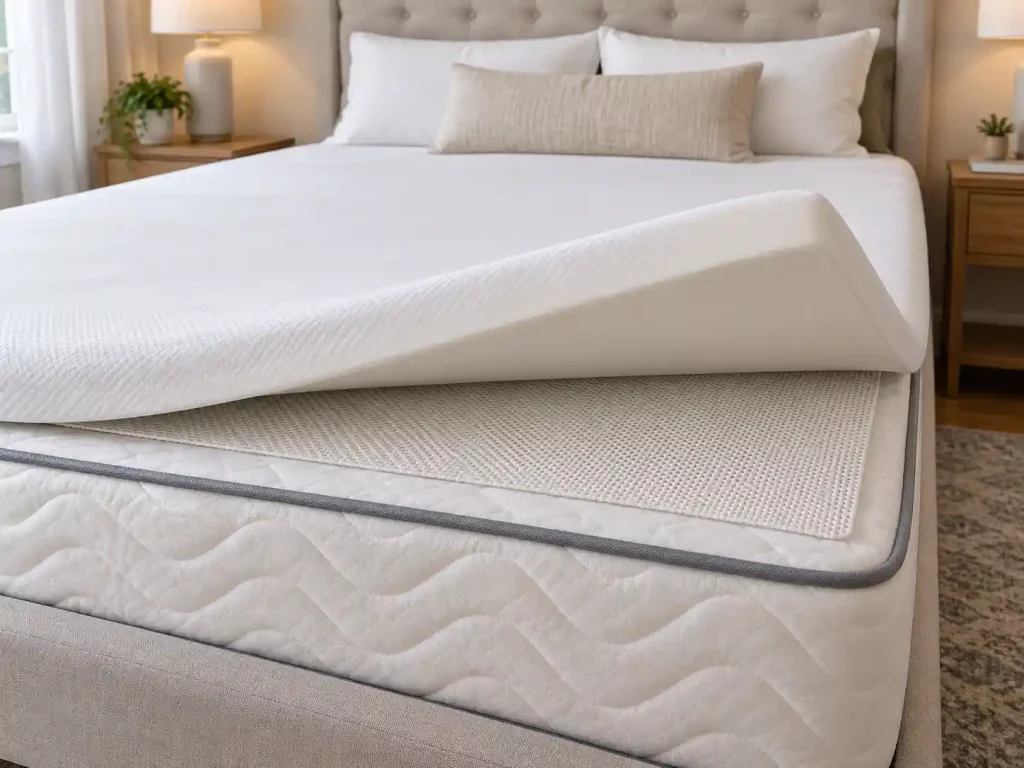
A non-slip grip pad creates friction between two smooth surfaces, helping prevent the topper from shifting when you turn over or get out of bed.
Remove the topper and clean the mattress surface according to its care instructions. Lay a thin, mattress-compatible grip pad flat on the mattress, then center the topper over it. Smooth out wrinkles and make sure the pad does not protrude beyond the mattress edges.
Choose a product specifically approved for contact with your mattress cover. Some rubberized materials may leave marks or interact with certain finishes, so avoid using an ordinary rug pad without checking compatibility.
This method is particularly useful for memory foam toppers with smooth undersides.
2. Use a Deep-Pocket Fitted Sheet
A fitted sheet can help hold the mattress and topper together, provided it is deep enough to cover both layers.
Place the topper directly on the mattress, pull the fitted sheet over the combined surface, and secure all four corners beneath the mattress. The elastic should sit below the mattress edges rather than resting against the sides of the topper.
If the sheet keeps popping off at night, check the pocket depth before pulling it tighter. A sheet that is too shallow can gradually lift the topper as its corners loosen.
3. Secure the Bedding With Straps
Sheet straps, also called sheet suspenders, can provide additional tension when a fitted sheet fits the mattress but repeatedly slips off.
Lift one corner of the mattress and attach the clips to the sheet edges underneath, following the strap manufacturer’s instructions. Repeat at the remaining corners, adjusting the tension until the sheet lies flat without pulling unevenly.
Some mattress toppers also have built-in corner straps that loop around the mattress itself. These hold the topper directly, while sheet suspenders primarily secure the fitted sheet.
Avoid overtightening the straps, which can stretch fabric or damage delicate elastic.
4. Try a Fitted Topper Cover or Mattress Encasement
A snug cover can help when the topper shifts inside loose bedding rather than sliding freely across the mattress.
Choose a fitted topper cover designed for your topper’s actual dimensions, or an encasement specifically rated to hold the mattress and topper together. Make sure the cover fits without compressing the foam or pulling the topper’s corners upward.
Not every mattress protector or zippered cover is designed to secure multiple layers. Check the manufacturer’s stated depth range and installation instructions before purchasing.
This approach is most practical for beds that remain fully made throughout the week.
5. Use a Tucked Flat Sheet for a Temporary Fix
When you need a quick solution without purchasing accessories, a spare flat sheet may help reduce movement.
Spread the sheet smoothly over the mattress, center the topper on top, and fold the excess fabric around the topper’s edges. Tuck the remaining fabric securely beneath the mattress where the bed’s design allows it.
This temporary wrap may work for an occasional guest bed, but it can loosen with repeated movement, especially on smooth mattress covers.

6. Consider Hook-and-Loop Fasteners
Hook-and-loop fasteners can hold two layers together more firmly, but they require greater care than removable grip pads.
Some topper covers are designed with compatible fastening points. If yours has them, follow the manufacturer’s instructions for attaching the matching fasteners.
Avoid applying adhesive-backed strips directly to memory foam, delicate mattress ticking, or removable covers unless the manufacturer explicitly permits it. Adhesives may leave residue, damage fabric, or affect warranty coverage.
For most households, this should be a last resort rather than the first fix.
What Sheet Depth and Topper Fit Do You Need?
Before buying a grip pad or new bedding, measure your mattress and topper separately. Check their width and length, then add their heights to determine the fitted-sheet pocket depth you need.
For example, a 12-inch mattress with a 3-inch topper has a combined height of about 15 inches. Choose a fitted sheet that accommodates this depth and can tuck securely beneath the mattress. The topper should also match the sleeping surface without excessive overhang, which can curl or shift when someone sits on the edge.
If you’re researching how to keep memory foam mattress topper from sliding, check its fit and underside material rather than assuming thicker foam will prevent movement. For a sofa bed, measure the fully opened sleeping surface before choosing a memory foam mattress topper for sofa bed use.
How Do You Secure a Topper on a Sofa Bed?
A topper can soften a sleeper sofa or cover minor surface seams, but folding sections create extra clearance and storage concerns.
Before securing it, fully open the sofa bed and check three things:
- Fit: The topper lies flat within the sleeping surface without overhanging gaps or hardware.
- Clearance: Grip pads and straps stay away from hinges, tracks, motors, and folding joints.
- Storage: Remove loose bedding and fasteners before closing the sofa unless the manufacturer explicitly permits leaving them in place.
Use a compatible, removable grip pad only on a stable, supported surface. Never attach fasteners directly to the upholstery or leave straps near moving parts. If gaps or uneven support keep shifting the topper, stronger fasteners may not solve the underlying problem.
When Is a New Power Sofa Bed a Better Option?
If your mattress topper keeps shifting because your current sofa bed has persistent gaps or an uneven sleeping surface, adding more straps or grip pads may not solve the underlying problem. After checking the topper’s fit and trying compatible, removable fixes, consider replacing the sofa bed if its sleeping surface remains uneven or difficult to use.
For a living room that serves mainly as everyday seating, the Aurora Modern Power Sofa Bed offers flexibility throughout the day. Its powered seat adjusts continuously from 27 to 45.5 inches deep, so you can move from upright sitting to stretched-out lounging without rearranging separate cushions. It’s suited to households that want more lounging flexibility without keeping a guest bed permanently set up.

Aurora Modern Power Sofa Bed
Its soft cream upholstery and rounded silhouette bring a relaxed, refined look to the living room without feeling overly formal.
When overnight guests need a larger resting surface, the Mila Electric Sofa Bed takes a more sleep-focused approach. Its seat extends from 32 to 59 inches, and the backrest reclines to 180 degrees, creating a broad, near-king-size rest surface. This can eliminate the need to bring out a separate temporary guest mattress for each visit.
Replacing an old sofa bed won’t solve topper slippage on a separate bedroom mattress. However, if your current sofa bed has an uneven resting surface and requires constant bedding adjustments, a model better suited to your seating and lounging needs may reduce the need for extra layers.

Mila Electric Sofa Bed
With its spacious sleeping surface, Mila makes overnight stays more comfortable for guests without requiring a separate guest bed.
How Can You Tell If the Fix Works?
A mattress topper may look secure immediately after installation but still move during normal sleep. Test your adjustment under the same conditions that originally caused the problem.
Before bed, straighten the topper, check the fitted-sheet corners, and note the alignment along both sides. Sleep normally, then inspect the layers in the morning.
Look for three signs of improvement:
- The topper remains approximately aligned with the mattress edges.
- The fitted sheet stays secured beneath all four corners.
- The grip pad or fastening material has not bunched, curled, or shifted.
Repeat the check over several nights. Change only one part of your setup at a time so you can identify what actually helps.
Conclusion
The practical answer to how to keep mattress topper from sliding begins with identifying which bedding layer is moving. A compatible grip pad, properly sized fitted sheet, or adjustable fastening system can often solve the problem without replacing the topper. If movement continues, inspect the mattress fit, the condition of the foam, and the stability of the bed beneath it. For convertible guest furniture, make sure every accessory works safely with the opening mechanism. The goal is a stable sleeping surface that stays comfortable without constant readjustment.

A More Flexible Way to Rest
Explore power sofa beds for adjustable comfort without the hassle of shifting toppers.
FAQ
Should a Mattress Protector Go Over or Under the Topper?
A protector designed for the combined thickness can cover both the mattress and topper, beneath the fitted sheet. A mattress-only protector belongs below the topper. If the protector creates a slippery surface, use a compatible grip pad between it and the topper.
Will Topper Straps Work on Adjustable Beds?
Only if the straps are designed or approved for adjustable-bed use. Ordinary elastic straps may pull unevenly when the bed bends or interfere with moving parts. Check the manufacturer’s instructions and test approved fasteners through the bed’s full adjustment range before sleeping on the setup.
How Thick Should a Mattress Topper Be for a Sofa Bed?
Choose a thickness that adds cushioning without making the topper too bulky to lie flat across the opened sleeping surface. A thicker topper won’t necessarily hide pronounced gaps or uneven support. Check the sofa bed’s dimensions and manufacturer instructions before choosing a topper.
Can You Use a Mattress Topper on a Sofa Bed Every Night?
Yes, if the sofa bed is suitable for regular sleeping and the topper fits its fully opened surface. However, a topper adds cushioning rather than repairing worn support. If the mattress sags or feels uneven, address the underlying problem before relying on a topper for nightly comfort.
When Should You Replace a Sofa Bed Mattress Instead of Adding a Topper?
Consider repair or replacement if the mattress has persistent sagging, deep indentations, or uneven support even when the topper is removed. A topper may soften minor surface irregularities, but it cannot restore damaged support. Check whether the mattress or underlying mechanism needs servicing before buying additional bedding.


