 By Stephanie
Sectional sofas may need to come apart for moving, deep cleaning, flooring work, or a layout change. Learning how to take apart a sectional sofa starts with finding the connection points between modules rather than pulling at the frame. Most detachable sectionals use metal hooks, clips, pins, brackets, or bolts, while power models may also have wiring between sections. Identify the connector first, then separate only the parts designed to come apart.
Table of Contents
Can Every Sectional Couch Be Taken Apart?
Not every sectional is designed to come apart. Modular sectionals typically use removable connectors between individual seating units, while some traditional sectionals use a fixed or partially fixed frame. Before pulling at a seam, inspect the back and underside for hooks, brackets, bolts, or other clear connection points.
Use this chart to determine what can usually be separated safely.
| Sofa Type | Can It Usually Be Separated? | Best Approach |
| Modular sectional | Yes | Release the original connectors between modules. |
| Fixed L-shaped sectional | Sometimes | Separate only clearly joined sections. |
| Power reclining sectional | Sometimes | Unplug first and disconnect labeled wires. |
| Sleeper sectional | Usually limited | Remove only manufacturer-approved parts. |
| One-piece corner sofa | Often no | Leave the frame intact and work around its full size. |
A modular sofa is built from separate seating units that connect to one another. If you are unsure which construction you have, see our guide to how modular sofas differ from fixed sectionals.
Stop if the upholstery pulls tight, a bracket starts to bend, two sections lift together, a wire remains taut, or you cannot find a clear release point. A detachable sectional should not require brute force. If the joint does not release, lower the module and check the product manual before continuing.
Identify the Metal Connector Before You Start
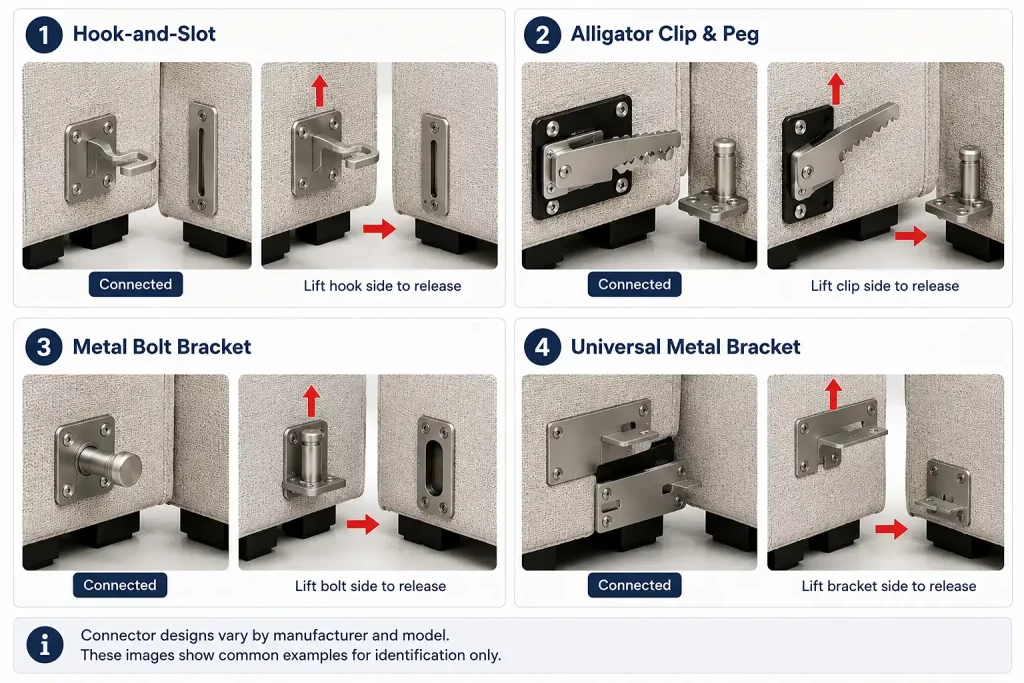
Use a flashlight to inspect the seam, back edge, and underside where two modules meet. Look for a hook, clip, fork-shaped bracket, metal plate, or bolts joining the sections. Before lifting or pulling anything, identify both the connector type and the side that needs to move.
On a power sectional, also check for wiring or quick-connect plugs between modules. Disconnect the electrical connection before releasing the mechanical connector.
| Connector Type | What It Looks Like | How to Release It |
| Hook-and-slot | A metal hook resting in a receiving slot or plate | Lift the side with the hook, then slide the sections apart. |
| Alligator clip | A hooked metal clip fitted into a channel or plate | Lift the clipped side slightly, then slide it free. |
| Fork-and-pin | A fork-shaped bracket locked over a metal pin | Raise the forked side straight up, then pull it away. |
| Bolted bracket | Bolts or joining plates fastened beneath the frame | Remove every bolt first before separating the sections. |
For bolted connections, use a helper and tilt the section only enough to reach the fastener. Never rest the full weight of the sofa on an armrest, cushion, reclining control, or exposed bracket. Only remove hardware that clearly joins two separate modules.
How to Take Apart a Sectional Sofa in 5 Steps
Once you know the sectional is designed to separate and have identified the connector type, you can begin taking it apart. Work from the outside inward, release one connection at a time, and move each freed section out of the way before starting on the next one.
Step 1: Clear the Cushions and Pull the Couch Forward
Remove loose cushions, pillows, blankets, and nearby furniture so you can see the seams between modules. If the sectional is against a wall, pull it forward carefully with a helper or furniture sliders. Start with an outside section, such as a chaise, armless seat, or end module.
Keep a flashlight, labeled zip bags, moving blankets, and any tool required by the connector nearby. If you are moving the sofa, check the tightest doorway or stair turn before separating more sections than necessary.
Step 2: Confirm Which Side Releases
Use the connector guide above to confirm which module needs to lift, slide, or unbolt. Position yourself where you can support that section from the lower frame before applying force. If the release side is still unclear, inspect the joint from the opposite side before continuing.
Step 3: Release the Connector the Right Way
If the connector feels under tension, gently pushing the two modules together may make it easier to disengage before lifting or separating them.
Then:
1.Support both sections by the lower frame.
2.Lift the hooked, clipped, or forked side as required by the connector.
3.Remove all fasteners first if the sections are bolted together.
4.Slide the released module straight away from the adjoining section.
Do not twist or yank the sections sideways. If the joint resists controlled movement, stop and check the connector again before applying more force.
Step 4: Separate the Modules and Protect the Edges
Once the connector is fully disengaged, slide the section straight away and set it down on a moving blanket or furniture sliders. Do not let an exposed bracket scrape the floor or press into the upholstery of another module.
Before carrying the section, protect any exposed metal connectors, upholstered corners, removable legs, or reclining controls that could be damaged in transit.
Step 5: Label Hardware and Move Each Section
Place bolts, washers, removable legs, and other loose hardware in a labeled zip bag as soon as they come off. Keep the bag with the module it belongs to so you can reconnect the sectional in the same order later.
Move each separated section out of the work area before disconnecting the next one. This creates more room to work and reduces the chance of another module hitting an exposed connector.

Disconnecting and Reconnecting Power or Reclining Sectionals
Power and reclining sectionals need more care because a simple-looking seat may contain wires, motors, control switches, or removable backrests. Treat the electrical system as a separate task. Disconnect it first, protect it during the move, and test it before pushing the sofa back against the wall.
Disconnect Power Components Safely
Unplug any powered sectional sofa from the wall outlet before moving a seat section. Make sure the power cord is free and not caught between sections.
Then follow this order:
- Find each quick-connect plug between modules.
- Place matching labels on both sides of the plug.
- Hold the plastic plug body when disconnecting it.
- Never pull the cord itself.
- Tape loose wires to the underside of the seat base.
- Keep cords away from brackets and floor sliders.
Reconnect the Sofa in the Right Order
Place the corner section first when your layout has one. If there is no corner piece, start with the heaviest or least movable module and rebuild outward from there. Reconnect each adjacent module only after the previous connection sits flush and feels stable.
After each connection:
- Push the sections together until the seam sits flush.
- Check that the modules do not rock or separate when you sit down.
- Reinstall legs before adding cushions.
- Reconnect labeled power cords.
- Test every reclining seat through its full range of motion.
If the room layout is changing along with the move, you do not have to rebuild every sectional in exactly the same arrangement. The POVISON Ergopals Power Reclining Loveseat uses fully independent power-seat modules that can be moved and rearranged, giving you more freedom to fit a new wall, seating plan, or traffic path without being locked into the original layout.

POVISON Ergopals Power Reclining Loveseat
A practical option for rooms where powered seating may need to shift, reconnect, or adapt as the layout changes.
Conclusion
Taking apart a sectional becomes much easier once you know how its modules are connected. Keep the sections and hardware organized as you work, and follow the same connection points when putting the sofa back together. If the hardware does not match the connector types shown above, check the manufacturer’s instructions before continuing.
FAQs About Taking Apart a Sectional Sofa
Can One Person Take Apart a Sectional Sofa?
One person may be able to inspect or release a light connector, but two people are safer for most sectionals. A helper keeps both modules level, prevents fingers from getting caught, and reduces the chance of bending a bracket. Heavy chaises, sleeper sections, and power bases should never be carried alone.
Should You Remove the Legs Before Moving a Sectional?
Remove legs only if the product manual identifies them as removable. Taking off approved legs can reduce height and help a module clear a doorway. Store each set in a labeled bag. Do not twist, pry, or force a leg that feels fixed because its mounting block may be part of the frame.
Can You Turn a Sectional Into Two Separate Sofas?
Sometimes, but only if both pieces have finished outer sides, stable bases, and enough support to stand independently. Armless center modules often look unfinished and may not be stable alone. Check exposed connectors before using separated pieces as standalone seating.
What Should You Do if a Connector Is Bent?
Do not try to hammer or bend the connector back into shape while it is attached to the sofa. Photograph the damaged hardware, protect the surrounding upholstery, and check with the manufacturer or a furniture repair professional before attempting another connection. A distorted bracket may no longer align safely with the adjoining module.


