 By Stephanie
Table of Contents
Why Do Sliding Doors Change the Storage Decision?
A TV stand often sits where a coffee table, ottoman, walkway, or play area limits the space in front of the cabinet. Sliding doors can preserve that circulation space, but the cabinet still has to work once it holds connected equipment, cables, and accessories. This guide compares six TV stands with sliding doors by door path, cabinet access, connected-device fit, setup, and room placement—not just style or total storage capacity.
What Makes a Sliding-Door TV Stand Easier to Use?
A useful TV stand with sliding doors should do more than eliminate the swing space required by hinged doors. Its panels should open far enough to keep frequently used equipment accessible, without leaving another essential cabinet bay permanently blocked. The interior also needs enough usable depth for connected devices, practical cable exits, suitable ventilation, and adequate support for the television.
Editorial ratings consider five areas: the door mechanism and clear opening, usable cabinet access, equipment fit, room compatibility, and value relative to construction and setup. Door movement and cabinet access receive the most consideration because they are the features most specific to a sliding-door media console. Ratings are editorial assessments, not customer-review averages or laboratory test scores.
Quick Summary: Best TV Stands With Sliding Doors
These picks cover retracting tambour fronts, accordion-style doors, rigid bypass panels, shallow storage, and electronics-focused layouts.
| Product | Best For | Door Type | Cabinet Access | Price | Editorial Rating |
| POVISON Eos Tambour Door TV Stand | Best overall | Retracting tambour | Wide access without a parked rigid panel | $1,099 | 4.9/5 |
| Burrow Opera Media Console | Soundbars and game consoles | Accordion slatted | Doors fold toward the sides | $1,149 ($862 with code SUMMER25) | 4.7/5 |
| POVISON Curved Slatted Wood TV Stand | Frequent cabinet access | Wraparound tambour | Doors follow the curved cabinet ends | $1,499 | 4.6/5 |
| West Elm Slatted Shallow Media Console | Small TVs and wall-mounted screens | Rigid sliding | One section may remain covered | $799 | 4.4/5 |
| POVISON Mid-Century Modern Fluted TV Stand | Assembled accessory storage | Accordion shutter | Doors compress toward the sides | $1,199 | 4.3/5 |
| IKEA STOCKHOLM 2025 TV Unit | Lower-cost adjustable storage | Rigid bypass | A panel always covers part of the cabinet | $449.99 | 4.2/5 |
Prices were checked on August 6, 2026. Final prices may vary by configuration, delivery region, coupon, and promotion.
The 6 Best TV Stands With Sliding Doors
These six products address the same core need, so a unified ranking makes their tradeoffs easier to compare. A lower-ranked option may still be the better choice when a room requires a particular width, height, equipment depth, or door mechanism.
🥇1. POVISON Eos Tambour Door TV Stand

Price: $1,099
Editorial Rating: 4.9/5
Best For: Narrow living rooms with compact media equipment
Highlights
- Ash tambour doors retract along the curved cabinet ends
- Three enclosed storage compartments
- Two interior shelves for separating compact devices and accessories
- 250-pound top capacity
- Only the legs require installation
Limitations
- The 11.81-inch-deep side side cabinets are too shallow for many full-size AV receivers
- One rear cable opening may require careful routing for several devices
Why this rating: Eos works well in narrower living rooms because its shallow profile leaves more circulation space without making the console feel undersized beneath a large TV. Its open-door layout also keeps controllers, routers, and streaming devices easier to reach than they would be behind a rigid bypass panel. The cabinet is best suited to compact media equipment, while larger receivers require a careful depth check.
Buyer review: “It hides the receiver and components but lets remote and wireless signals pass right through.” — Alec
🥈2. Burrow Opera Media Console
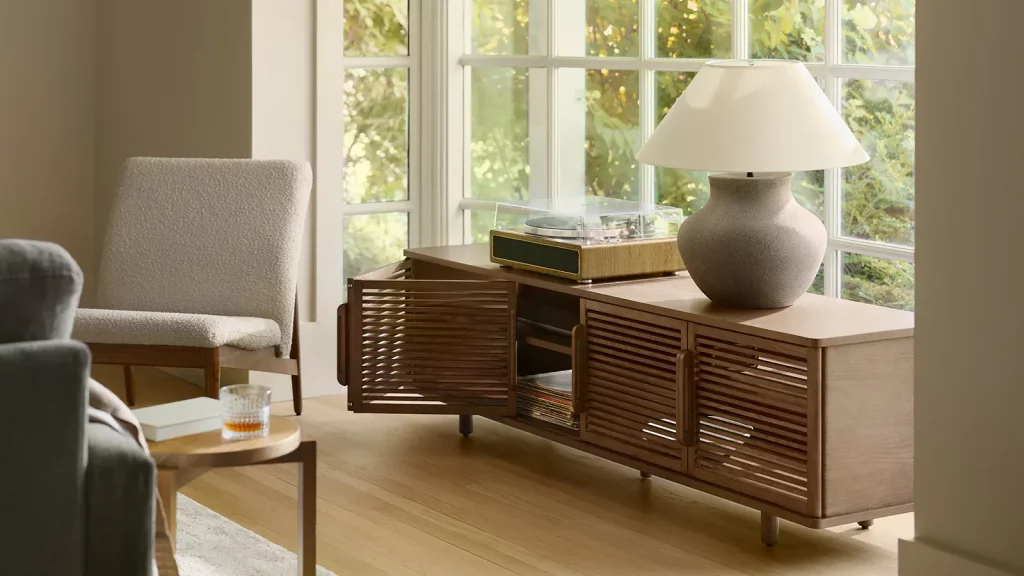
Price: $1,149 ($862 with code SUMMER25)
Editorial Rating: 4.7/5 Best For: Soundbars, game consoles, and frequently accessed electronics
Highlights
- Acoustically transparent slatted doors
- Open-back, ventilated equipment bays
- Built-in cable channels
- Full-width soundbar shelf
- 70″W × 17″D × 20″H
Limitations
- Requires assembly
- The 15-inch interior depth may not fit a deep receiver with rear connectors
Why this rating: Opera treats the cabinet as part of the media system rather than generic closed storage. Its folding front leaves a wider working opening than a rigid bypass panel, making controller and HDMI changes easier. The open back also suits equipment that runs for long periods. Its solid-ash, veneer, and MDF construction is practical, although deep components still require careful measurement.
🥉3. POVISON Curved Slatted Wood TV Stand
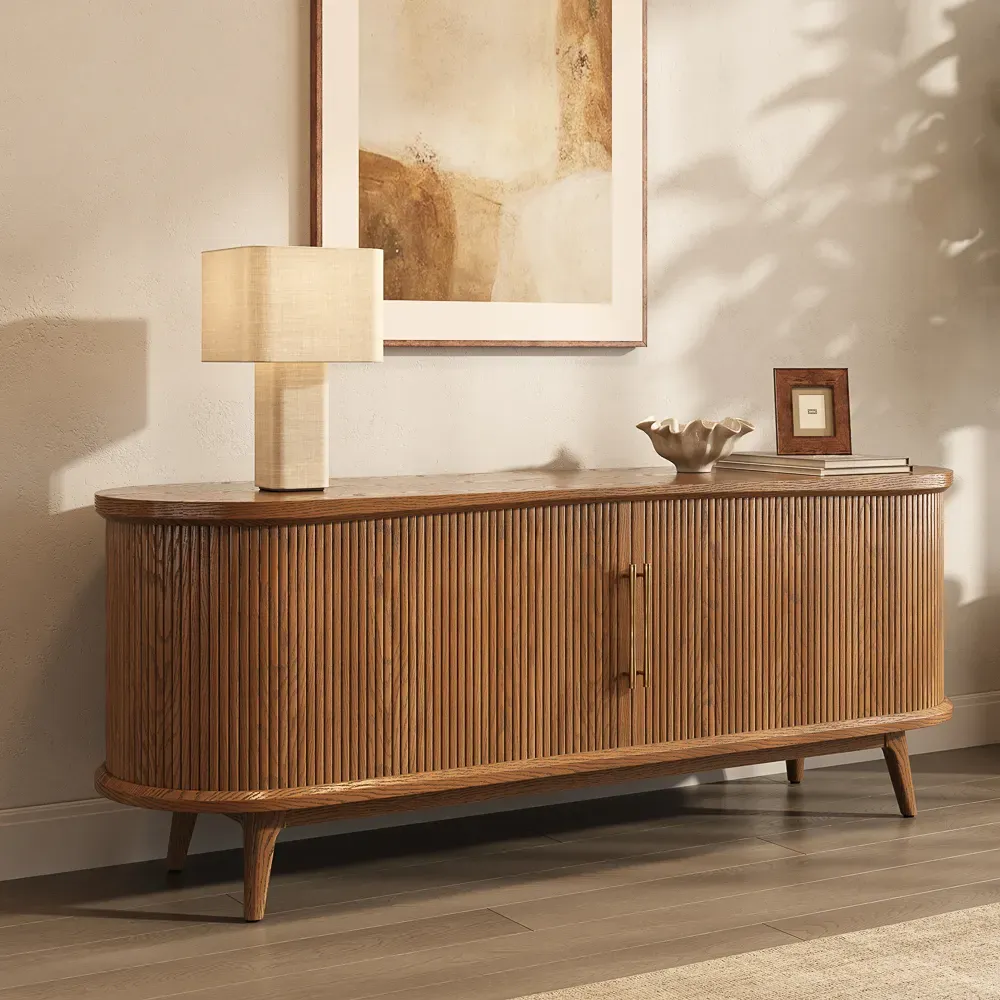
Price: $1,499
Editorial Rating: 4.6/5
Best For: Frequent cabinet access and adaptable media storage
Highlights
- Solid ash tambour doors
- Three removable interior shelves
- Five internal cable openings
- 250-pound top capacity
- Approximately five minutes of leg installation
Limitations
- No rear cable openings
- The 169.83-pound package requires two adults to move
Why this rating: At 26.8 inches high and 19.7 inches deep, this model has more storage presence than a low, shallow console. Its wraparound track keeps the doors traveling along the curved ends instead of entering the floor area. When a coffee table sits about two feet from the cabinet, the wraparound door path avoids the forward clearance a hinged door would require. Active electronics still need a planned cable exit.
Buyer review:“The slatted sliding doors—they glide seamlessly along the curved track without catching or feeling flimsy.” — Sarah
4. West Elm Slatted Shallow Media Console

Price: $799
Editorial Rating: 4.4/5
Best For: Small televisions or storage beneath a wall-mounted screen
Highlights
- 48″W × 12″D × 24″H
- Two sliding doors
- Two adjustable interior shelves
- Four rear cord cutouts
- Adjustable leg levelers
Limitations
- Officially accommodates televisions only up to 40 inches
- The nine-inch compartment depth is unsuitable for most AV receivers
Why this rating: This is a compact secondary-room console rather than a reduced-size base for a tabletop 65-inch TV. Its shallow body suits a bedroom, apartment, or narrow wall where a 70-inch cabinet would feel excessive. The adjustable interior works for routers, streaming boxes, remotes, and decorative storage, but equipment-heavy installations will quickly exceed its depth.
5. POVISON Mid-Century Modern Fluted TV Stand
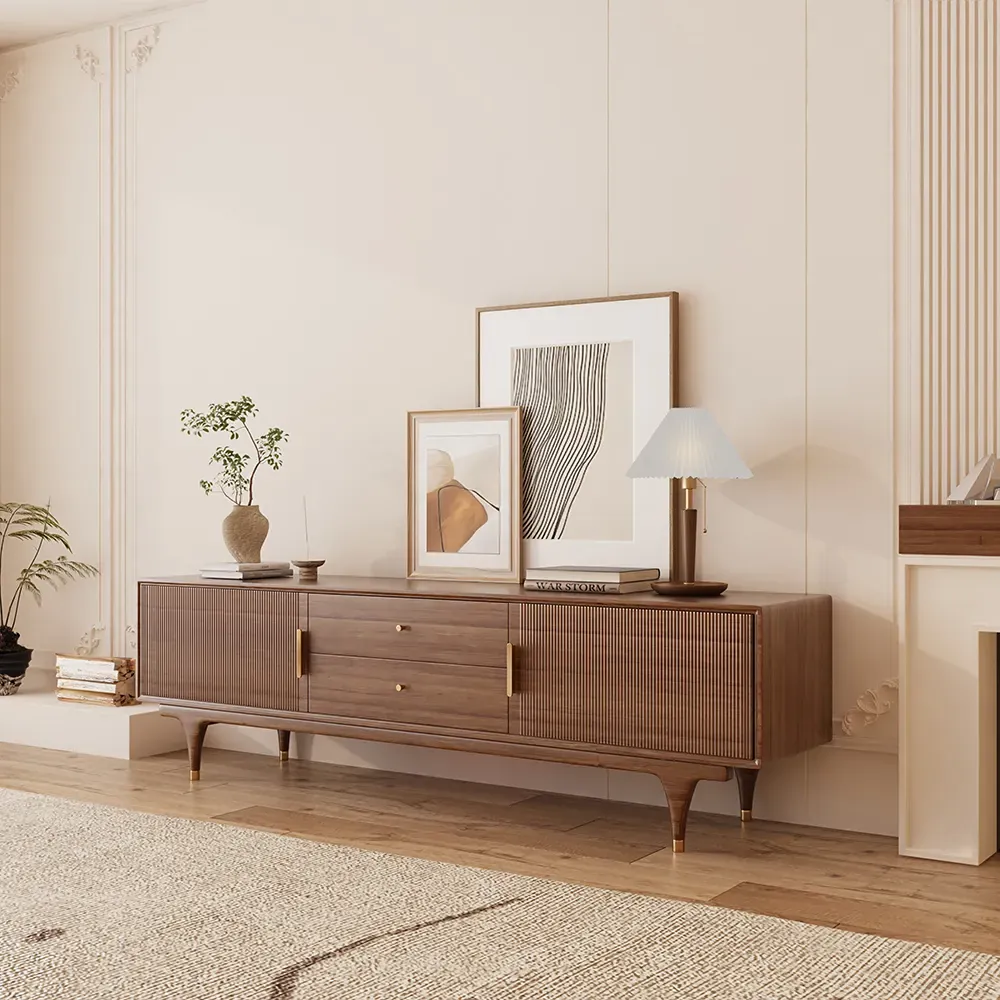
Price: $1,199
Editorial Rating: 4.3/5
Best For: Assembled storage for compact electronics and accessories
Highlights
- Two equipment cabinets and two drawers
- 16.06-inch cabinet depth
- 200-pound top capacity
- No furniture assembly required
Limitations
- The 6.3-inch cabinet height excludes taller components
- MDF construction may not suit buyers seeking solid wood
Why this rating: This layout keeps remotes, chargers, and spare cables out of the compartments used by active devices, so opening a cabinet does not expose every loose accessory. Its accordion-style fronts compress toward the cabinet sides instead of entering the walkway. The low internal bays make it a better match for compact media players and horizontal equipment than upright consoles or tall receivers.
Buyer review:“The shutter door switch is very smooth and special.” — Brittaney
6. IKEA STOCKHOLM 2025 TV Unit With Sliding Doors
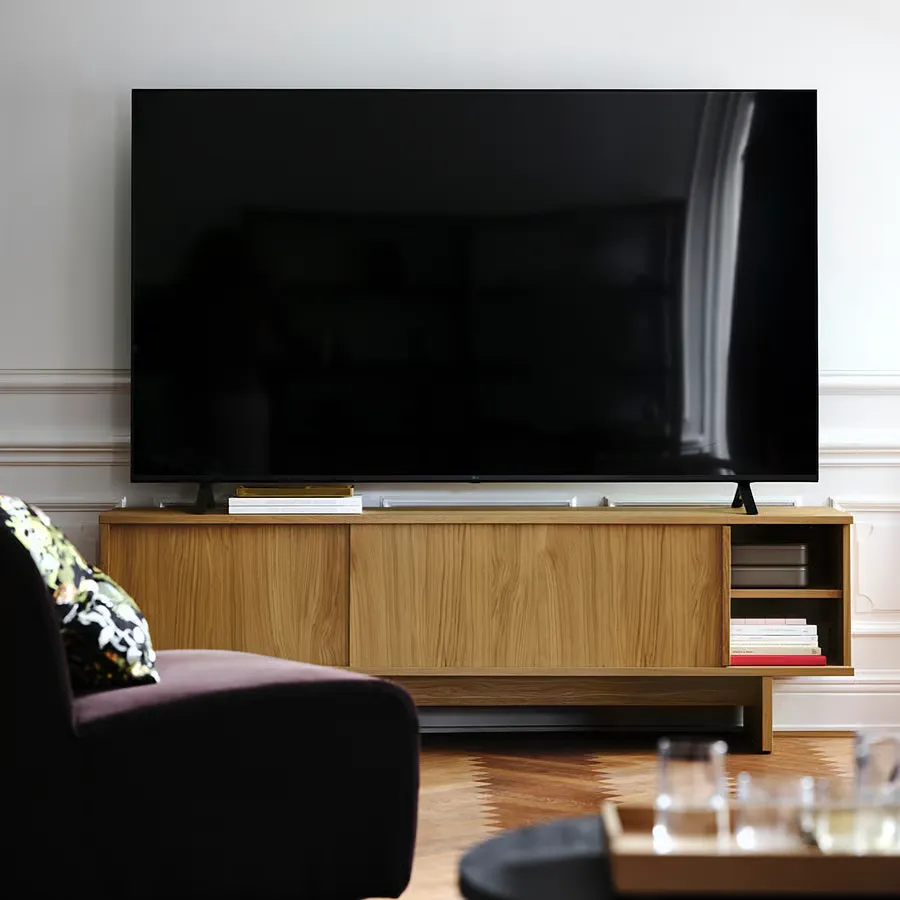
Price: $449.99
Editorial Rating: 4.2/5
Best For: Budget-conscious buyers wanting adjustable oak-veneer storage
Highlights
- 70⅜-inch width
- Movable interior shelves
- Adjustable feet for uneven floors
- Supports televisions weighing up to 88 pounds
- Suitable for TVs up to 70 inches
Limitations
- Requires full assembly
- A rigid door always covers part of the cabinet opening
Why this rating: STOCKHOLM offers a broad surface and adaptable shelving at the lowest price in the ranking. Its 16.5-inch overall depth provides more equipment room than the 12-inch West Elm pick, while adjustable feet help establish a level base before the doors are aligned. The tradeoff is more assembly and periodic wax care for the wood-on-wood sliding grooves.
How Much of the Cabinet Stays Accessible When the Doors Open?
A sliding door can eliminate outward swing while still covering the cabinet section used most often. Before buying, study the fully open product images and check which compartments, controls, ports, and shelves remain reachable in each door position. A tambour door and rigid sliding door comparison can explain how the mechanisms differ, but the actual clear opening matters more than the door name.
Use a simple three-position check:
| Door Position | What to Check |
| Doors moved left | Which right-side compartments, controls, and cable connections remain accessible |
| Doors near the center | Whether the panels narrow the central opening or cover parts of two compartments |
| Doors moved right | Which left-side power buttons, disc slots, docks, and ports remain accessible |
Tambour and accordion doors may retract farther than rigid panels, but handles, folded sections, and internal tracks can still reduce the opening. Place frequently handled equipment in the compartment that remains accessible in the greatest number of door positions. Games, manuals, and spare cables can go in areas that are occasionally covered.
Also confirm that removable shelves can pass through the clear opening. A shelf may be adjustable inside the cabinet but difficult to remove once the console is against the wall and filled with equipment.
What Should You Check After the TV Stand Arrives?
Level the cabinet before judging how smoothly the doors move. Test every fully open and closed position, then confirm that no panel rubs, catches, or shifts out of its intended track. Install the shelves before connecting devices, using the measurements collected earlier to preserve access to buttons, ports, and plugs.
Run heat-producing equipment for a typical session in the door position you expect to use. Slatted or openwork fronts do not automatically provide adequate ventilation, so follow the device manufacturer’s clearance requirements. A media console airflow and cable-management setup should include a clear intake, airflow path, exhaust route, and accessible cable exit.
Secure the cabinet and television as instructed. The U.S. Consumer Product Safety Commission estimated that emergency departments treated an annual average of 17,800 injuries involving furniture, television, and appliance tip-overs from 2020 through 2022 (U.S. Consumer Product Safety Commission). Keep heavier equipment low, route cords out of children’s reach, and use suitable wall fasteners for the surface.
Conclusion
A well-chosen TV stand with sliding doors should make daily access easier rather than simply hide more storage. Prioritize the door path that keeps the most-used cabinet bay available, then choose the size and interior layout that support the room. POVISON stands out for retracting wood fronts and minimal setup, offering a more finished alternative to many rigid flat-pack sliders. Choose the design that will remain practical after the cabinet is filled, not only the one that looks clean when empty.
Build a Better Entertainment Setup
Explore media consoles with the right width, door style, and interior layout for your TV and equipment.
FAQs
Can a soundbar sit behind sliding TV stand doors?
Only when the manufacturer identifies the doors as acoustically transparent or they can remain fully open during use. Solid panels and some decorative slats may muffle sound, especially from side- or up-firing drivers. Otherwise, place the soundbar on top or in an unobstructed front-facing shelf.
Do sliding TV stand doors block remote signals?
They can. Infrared remotes need a clear line of sight, while Bluetooth and radio-frequency controls usually do not. Do not assume that every slatted wood door is IR-friendly. Check the manufacturer’s specifications, leave the door open during use, or place the receiver in an exposed bay.
How do you move a TV stand with sliding doors safely?
Empty the cabinet, remove loose shelves, close the doors, and secure them according to the manufacturer’s instructions. Do not tape directly onto finished wood. Keep the cabinet upright where required, and never lift it by the doors, handles, slats, or sliding track.
How do you clean pet hair from sliding-door tracks?
Use a vacuum crevice tool or soft brush, then wipe the track with a dry cloth. Avoid soaking wood grooves or applying oil, which can attract more debris. Use wax or another lubricant only when the product’s care instructions specifically recommend it.


[…] belong to several different kinds of TV stands at once. A low-profile walnut console with slatted doors may still be a standard floor media console with closed storage. Choose the structural format first, then use finish and design labels […]