 By Kelvin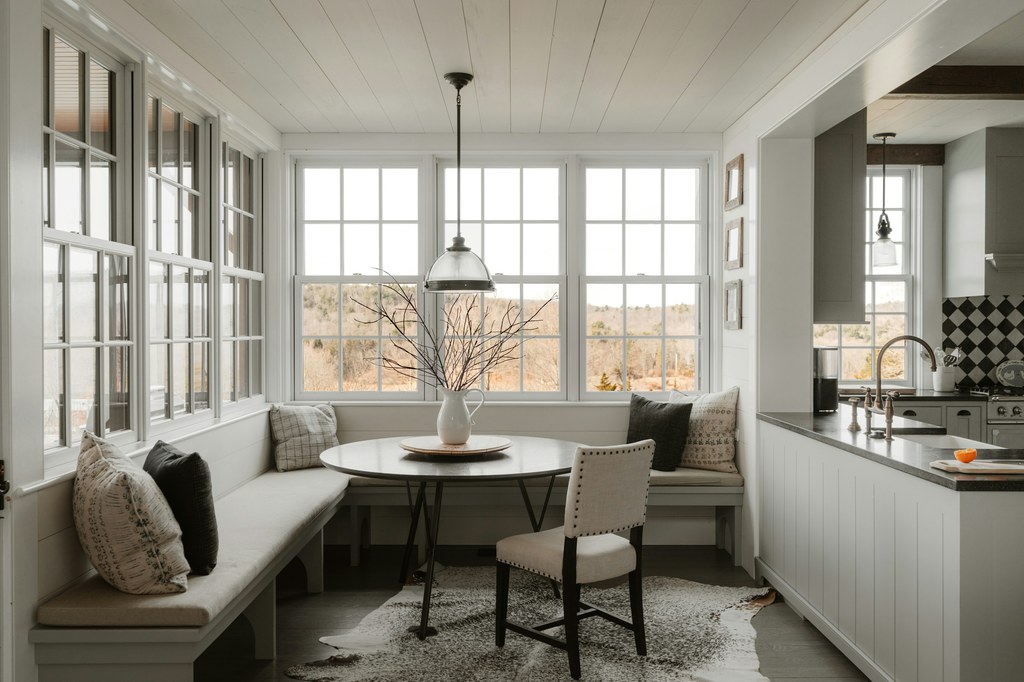
Introduction
Choosing a dining table for banquette seating means solving three connected problems: matching the table to a fixed bench, preserving comfortable legroom, and keeping the open side usable. A table that looks right can still block the entry, crowd the walkway, or leave diners awkwardly positioned. This guide explains which shapes suit different banquette layouts, why base placement matters, how to measure usable clearance, and when an extendable design makes sense. It also compares four tables suited to different room configurations, seating needs, and everyday routines.
Table of Contents
What Makes a Dining Table Work With Banquette Seating?
A dining table for banquette seating needs a compatible tabletop shape, accessible support structure, appropriate height, and enough surrounding clearance for everyday use.
Unlike movable dining chairs, a built-in bench cannot shift when a table leg lands in the wrong place. Diners must be able to sit down, slide into position, and leave without moving the entire table.
This becomes especially important in corner bench dining room layouts, where the innermost seat can become difficult to reach.
Start by identifying three conditions: your bench configuration, the direction people enter, and the space available on the open side. Those factors matter more than whether a table looks attractive in an empty room.
Which Table Shape Fits Your Banquette Layout?
Choose the table shape according to how the banquette meets the room, not whether round or rectangular designs are generally considered more space-efficient.
| Banquette layout | Recommended table shape | Why it works | What to check |
| Straight wall-side bench | Oval or narrow rectangular | Follows the bench while preserving open-side circulation | Table width, entry access, and support placement |
| L-shaped corner bench | Round or gently curved oval | Softens the corner and supports conversation across both sides | Room depth and access to the inside seat |
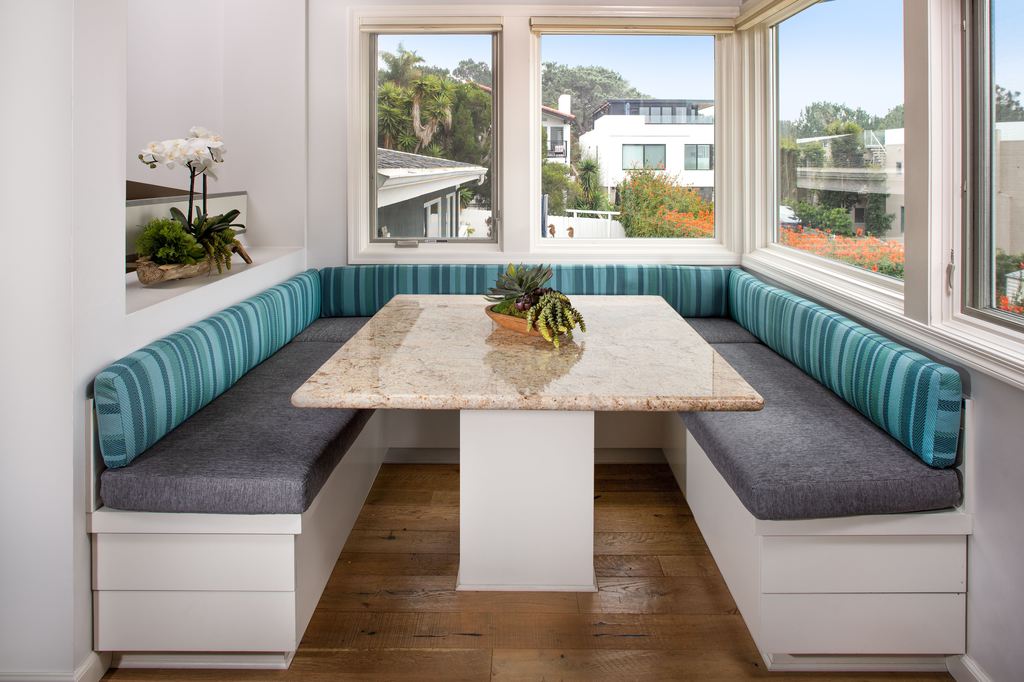
| U-shaped banquette | Round or appropriately sized oval | Creates a shared focal point within the surrounding seating | Opening width and whether diners can exit independently |
| Curved banquette | Round or oval with rounded ends | Echoes the bench shape without sharp corners | Whether the tabletop reaches each seating position comfortably |
When comparing round versus square dining table layouts, remember that a round tabletop still occupies its full diameter in both directions.
A 47-inch round table can require more room depth than a 35-inch-wide oval, even when the oval is substantially longer. That distinction matters when comparing dining tables for corner banquettes against options for a long, narrow wall-side bench.
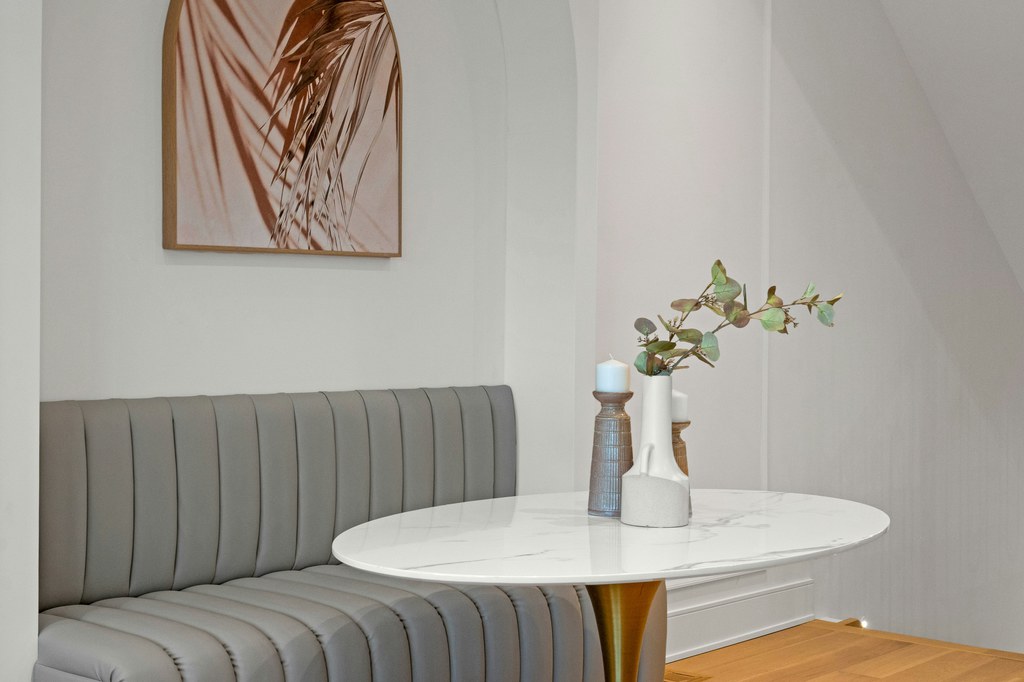
Why Does the Table Base Matter More Than You Think?
The base determines whether someone can actually slide along the bench after sitting down.
Traditional corner legs can interrupt the path between the bench and tabletop. A centrally positioned pedestal often improves access, but a wide pedestal, low crossbar, or outward-facing support can still interfere with knees and feet.
Check the base from the bench side and the entry side. A sculptural support may work well when its open side faces the bench but become restrictive when rotated toward the entry.
Also inspect the underside. A thick apron or extension mechanism can reduce usable thigh clearance even when the tabletop height looks appropriate.
For a family breakfast nook, this becomes obvious when one person slides toward the corner while another carries breakfast to the open-side chair.
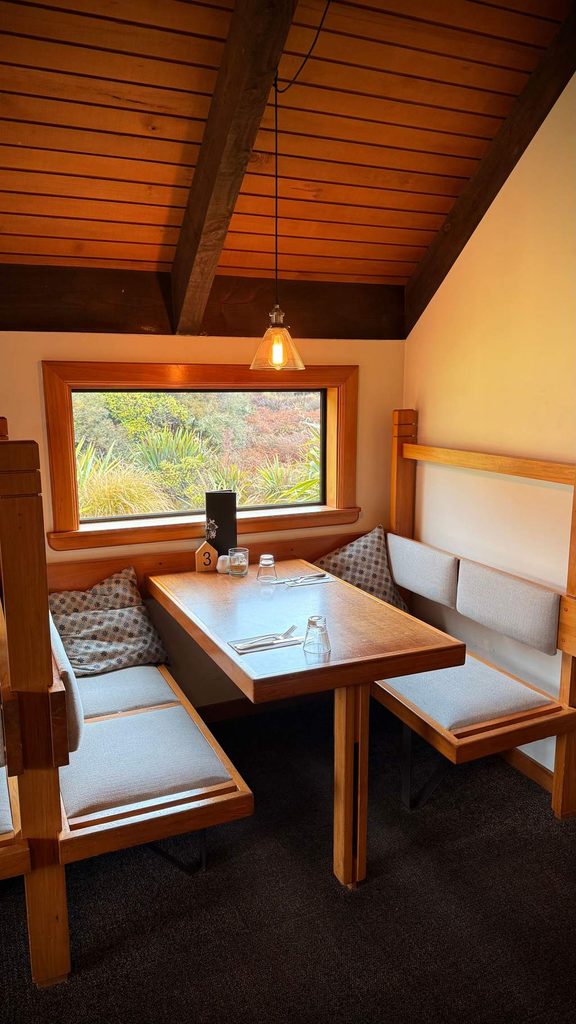
What Measurements Determine Whether the Table Actually Fits?
Begin with the finished bench height, including the cushion as it feels under a seated person. Many dining benches fall around 17–19 inches high, while standard dining tabletops are commonly around 28–30 inches high.
Next, measure the underside of the table, not just the tabletop. Aprons, extension tracks, and support braces can make an otherwise suitable table uncomfortable.
For open-side circulation, the National Kitchen & Bath Association’s kitchen planning guidelines recommend:
- 32 inches behind a seated diner when no traffic passes behind.
- 36 inches when someone needs to edge past.
- 44 inches when someone needs to walk past comfortably.
These measurements apply to the open seating side, not the fixed bench against the wall.
For a straight wall-side banquette, estimate the overall room depth using this formula:
Bench depth + tabletop width − tabletop overlap + open-side clearance
Assuming a 24-inch-deep bench, approximately 4.5 inches of tabletop overlap, and 36 inches of open-side clearance:
- A 35.43-inch-wide oval needs approximately 90.9 inches of room depth.
- A 47.24-inch round table needs approximately 102.7 inches.
- A 59.06-inch round table needs approximately 114.6 inches.
Treat these figures as planning examples, not universal requirements. Cushion thickness, wall trim, table position, and actual seating movement can change the result.
POVISON Picks: Dining Tables for Different Banquette Layouts
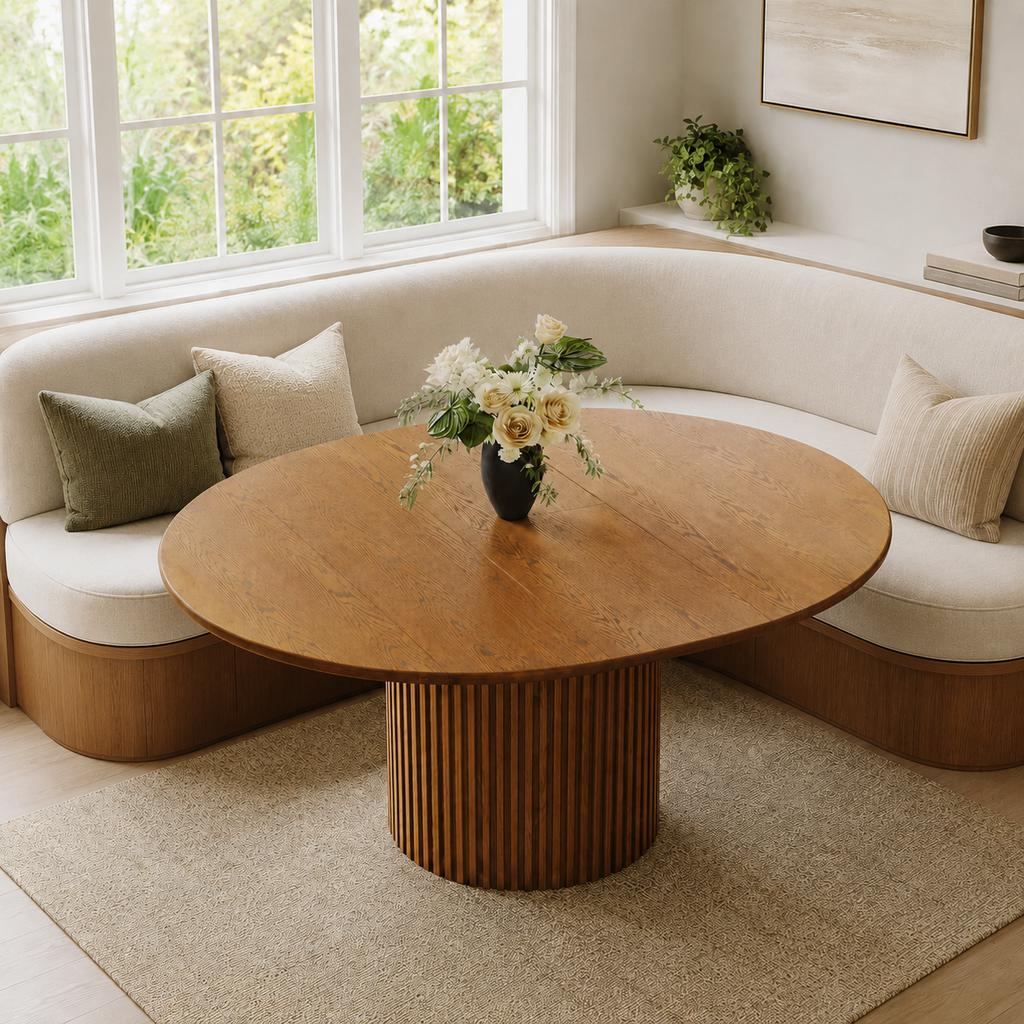
Best for Flexible Seating: Silva Round Extendable Dining Table
Silva Round Extendable Dining Table
An expandable wood table accommodates changing guest counts without permanent extra length.
👍 Best for: Banquettes with occasional extra guests
✨ Highlights
- Round-to-oval extending tabletop
- Self-storing butterfly extension leaf
- Warm ash-veneer wood finish
- Central solid-wood slat base
🎯 Features
A household that usually seats four but occasionally hosts six benefits from a table that changes length without requiring a second dining setup. Silva opens from a 47.2-inch circle into a 63-inch oval, while the extension leaf stores inside the table. The engineered-wood top with ash veneer adds warmth, and the central base helps reduce interference from corner legs. Confirm that the extended position still leaves the banquette entry accessible.
🗨️ Buyer Review
“The leaf adds a dual functionality feature” — Wittenberg
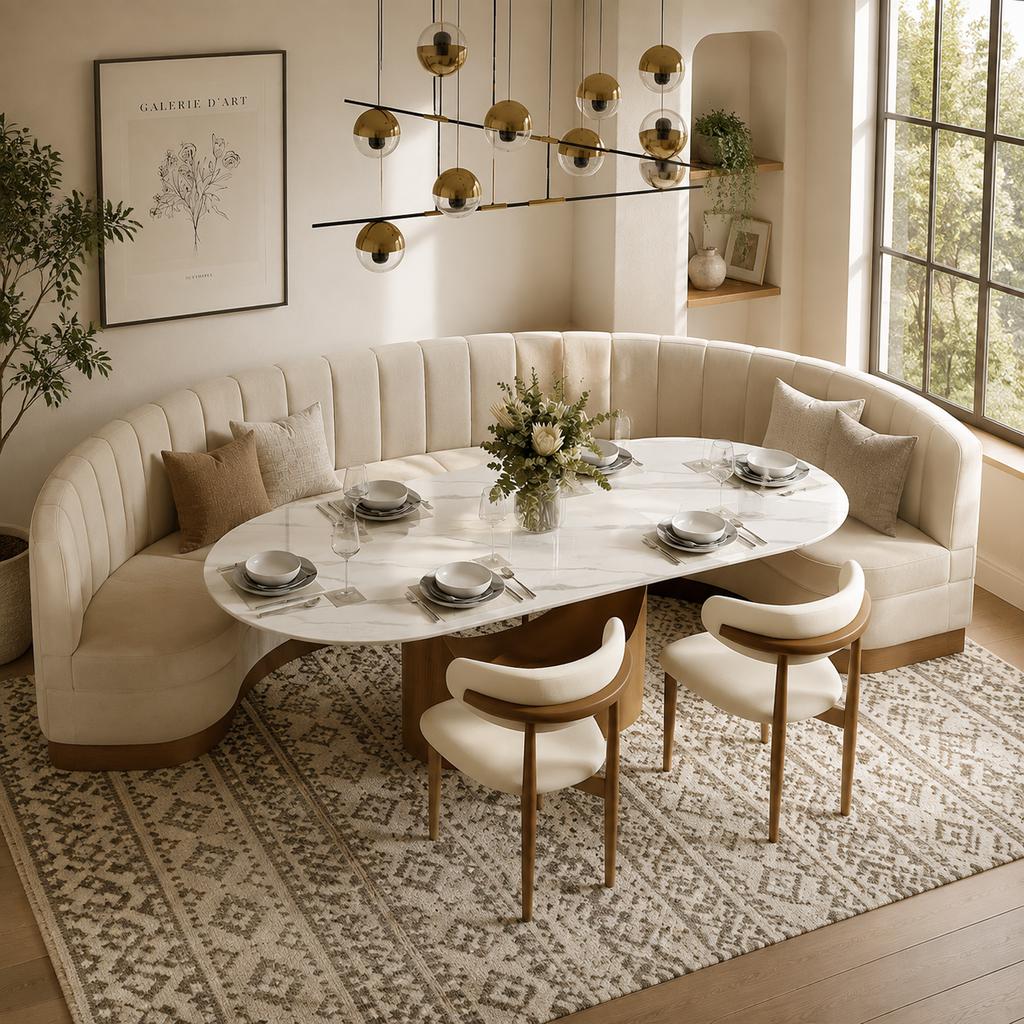
Best for Long Wall-Side Banquettes: Hobart Oval Glossy Sintered Stone Dining Table
Hobart Oval Glossy Sintered Stone Dining Table
A narrow oval stone table supports six seats beside longer wall-side benches.
👍 Best for: Long wall-side six-person banquettes
✨ Highlights
- Rounded oval edges
- Easy-clean glossy sintered stone
- Narrower profile for open-side circulation
- Bronze carbon-steel support
🎯 Features
Long wall-side banquettes often need seating capacity without sacrificing the walkway across from the bench. Hobart Oval addresses that trade-off with a 70.87-inch length and a comparatively narrow 35.43-inch width. Its rounded ends soften movement around the entry, while the glossy sintered-stone surface handles routine cleanup. The six-person configuration suits extended benches, provided the metal base does not obstruct the primary slide-in position.
🗨️ Buyer Review
“Looks great and fits well in my space! Great design, durable and easy to clean.” — Tomogon
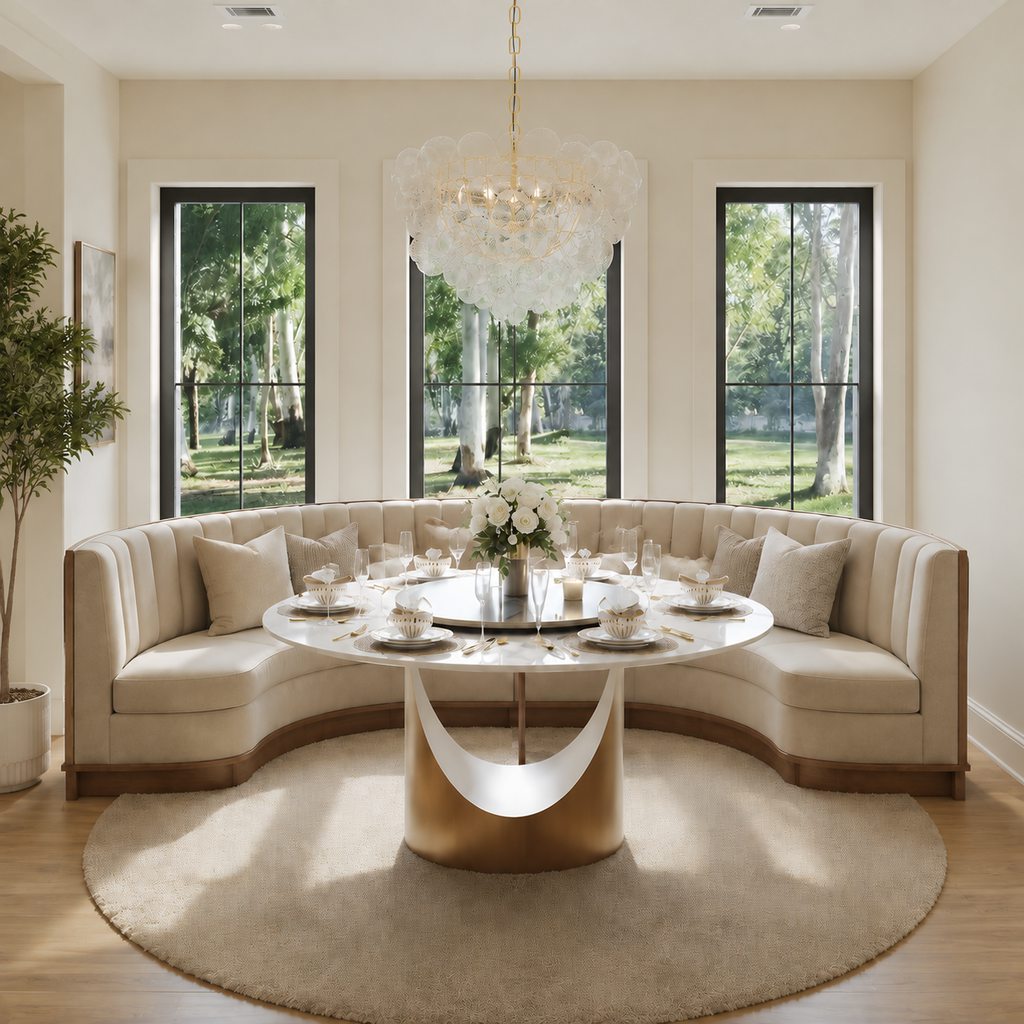
Best for Corner Banquettes: Hobart Round Glossy Sintered Stone Dining Table
Hobart Round Glossy Sintered Stone Dining Table
A fixed round stone table creates a balanced four-person corner-banquette setup.
👍 Best for: Four-person corner dining banquettes
✨ Highlights
- Fixed round tabletop
- Wipe-clean glossy sintered stone
- Sculptural bronze stainless-steel base
- Rounded perimeter without sharp corners
🎯 Features
An L-shaped banquette used primarily by four people may benefit more from a consistent footprint than an extendable tabletop. Hobart Round provides a 47.24-inch circular surface with glossy sintered stone that simplifies everyday cleanup. Its sculptural metal support avoids conventional corner legs, although the base orientation should still be checked against the bench entry. Choose it for predictable daily seating, not because it occupies less space than a similarly sized round extendable table.
🗨️ Buyer Review
“It feels incredibly stable and looks like a luxury designer piece built to last.” — Ilker
Best for Spacious Banquettes: Tulora Round Glossy Sintered Stone Dining Table
Tulora Round Glossy Sintered Stone Dining Table
A spacious pedestal table gives six diners clearer access around built-in seating.
👍 Best for: Spacious six-person corner banquettes
✨ Highlights
- Single central tulip pedestal
- Six-person circular dining surface
- Easy-clean glossy sintered stone
- Bronze stainless-steel base
🎯 Features
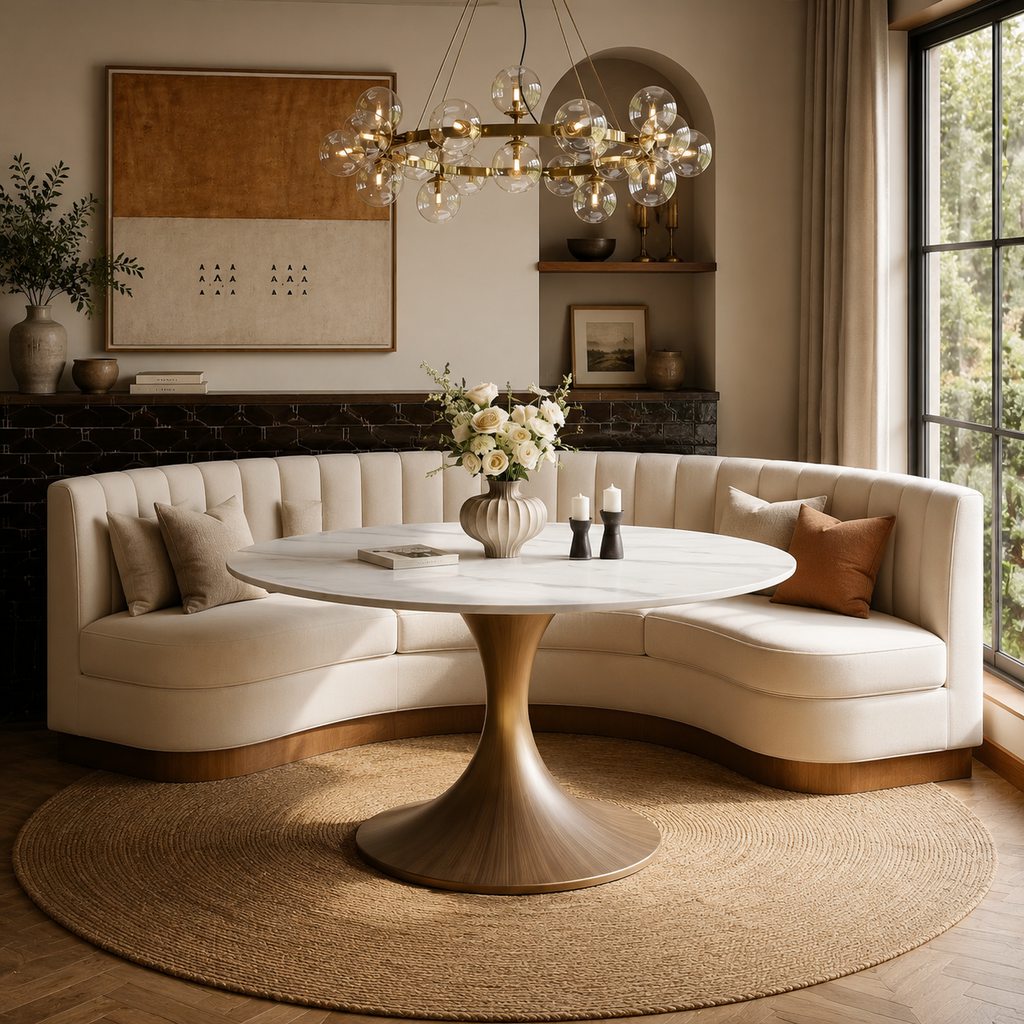
Larger L-shaped, U-shaped, or curved banquettes need a tabletop that reaches multiple seats without placing support legs in the sliding path. Tulora pairs a 59.06-inch round surface with a single central tulip pedestal, creating a more open perimeter for six diners. The glossy sintered-stone top simplifies cleanup after shared meals. However, the larger diameter requires substantially more room depth than a 47-inch round table.
🗨️ Buyer Review
“The legroom is amazing thanks to the pedestal design.” — Philip
Regular prices are shown; final prices may vary by location, available discounts, and promotions.
What Should You Check Before Buying a Banquette Table?
Before ordering a dining table for banquette seating, verify the conditions that product photographs rarely reveal:
- Confirm the bench configuration and identify the primary entry point.
- Measure the occupied seat height and the table’s underside.
- Check whether the base interrupts the slide-in path.
- Calculate clearance on the open side according to actual foot traffic.
- Compare tabletop width against available room depth.
- Check the closed and expanded footprints of round extendable dining tables.
- Confirm the specified variant, seating capacity, materials, and assembly requirements.
A quick floor outline made with painter’s tape can reveal problems before a heavy table arrives.
Conclusion
The right dining table for banquette seating should fit the bench you already have, preserve usable legroom, and leave enough space on the open side for real movement. Start with the layout, then compare tabletop shape, support placement, seat height, and overall room depth. An extendable wood table can accommodate changing guest counts, a narrower oval can work better beside a long bench, and a larger pedestal table can improve access in a spacious corner. Choose according to how people actually enter, sit, eat, and leave.
Find the Right Dining Table
Explore designs for different room sizes, layouts, and everyday needs.
FAQs
Should the bench extend past the table at the entry?
A short extension can help when it provides enough exposed bench space to sit before sliding behind the tabletop. However, it should not interfere with a doorway, cabinet, or walking path. Check the entry while someone is seated to confirm that knees and feet can move into position comfortably.
Which extension mechanism works beside a fixed banquette?
A center-split tabletop may need clearance for both moving halves, while a one-sided extension can work better when expansion faces the open end. Before buying, check where the leaf deploys, whether the table must be repositioned, and whether the expanded surface blocks the bench entry.
Will a dining table block storage-bench lids?
It can if the tabletop overlaps the lid or prevents it from opening through its full arc. Measure the lid’s hinge location and lifting clearance before choosing a table. Front-access drawers or removable seat cushions are more practical when a heavy dining table cannot be moved easily.
Who should sit on the open side of a banquette?
Give the open-side chairs to people who need to leave frequently, carry food, or require easier access because of limited mobility. Reserve the deepest bench positions for diners who usually remain seated. This arrangement reduces interruptions and avoids asking several people to move when one person stands up.
Can a rug make a banquette table harder to use?
Yes. A thick rug can resist chair movement, create an uneven surface under a pedestal, or curl near the bench entry. Choose a low-pile rug large enough to support the entire table base and open-side chairs. Avoid placing rug edges directly across the main slide-in path.


