 By Stephanie
Bouclé furniture can make a room feel softer and more finished, but texture alone does not make a piece suitable for daily life. The right choice depends on where the furniture will sit, how often it will be used, who shares the home, and how much maintenance the household can realistically handle. This guide explains how to choose boucle furniture for your home by matching the fabric, furniture type, room layout, and construction to real routines at home—not simply to a styled product photo or a short-lived decorating trend.
Table of Contents
Decide Whether Bouclé Fits Your Household
Start with how the furniture will be used, not with its color or shape. A bouclé chair in a quiet reading corner experiences far less wear than a family-room sofa used for snacks, naps, pets, and movie nights. Classify the intended location as low, moderate, or high use, then match the fabric performance to that routine.
| Household or Room Condition | Recommended Choice | Avoid |
| Bedroom, guest room, or occasional seating | Standard bouclé can work if the care instructions suit the household | Paying extra for performance features the room does not need |
| Adult living room with regular use | Short-pile, tightly woven polyester bouclé | Loose loops or fabric without clear cleaning instructions |
| Dining area or home with young children | Performance bouclé with a stated spill- or stain-resistant treatment | Assuming all polyester bouclé resists spills |
| Home with pets that scratch furniture | Use bouclé only in a lower-risk room or choose smoother upholstery | Open-loop bouclé on the main sofa |
At this stage, make a simple go-or-stop decision. Bouclé may not be suitable for the main seating area when spills are frequently left untreated, pets regularly claw upholstery, or the household cannot vacuum textured fabric. In those cases, either choose a documented performance bouclé or move the texture to a bedroom chair, bench, or another lower-use piece.
Choose the Bouclé Piece That Solves the Room’s Main Problem
Do not begin with the piece that makes the strongest visual statement. Identify the room’s unresolved problem first: insufficient everyday seating, a chair that cannot face multiple zones, an uncomfortable dining setup, or an empty bedroom corner. The best bouclé purchase is the one that improves a repeated activity without creating a larger layout or maintenance problem.
Replace the Main Sofa Only When Seating Is the Problem
A bouclé sofa makes sense when the current seating lacks capacity, comfort, or an appropriate focal point. It is a poor upgrade when the room already functions well and the only goal is to introduce texture. Because many bouclé sofas have generous cushions and rounded profiles, compare their usable seating with the floor area they occupy.
Before replacing the sofa, confirm that the new piece improves three things:
- Seating capacity for regular users
- Comfort for the household’s usual sitting posture
- Support for the room’s main activities, such as conversation, reading, or watching television
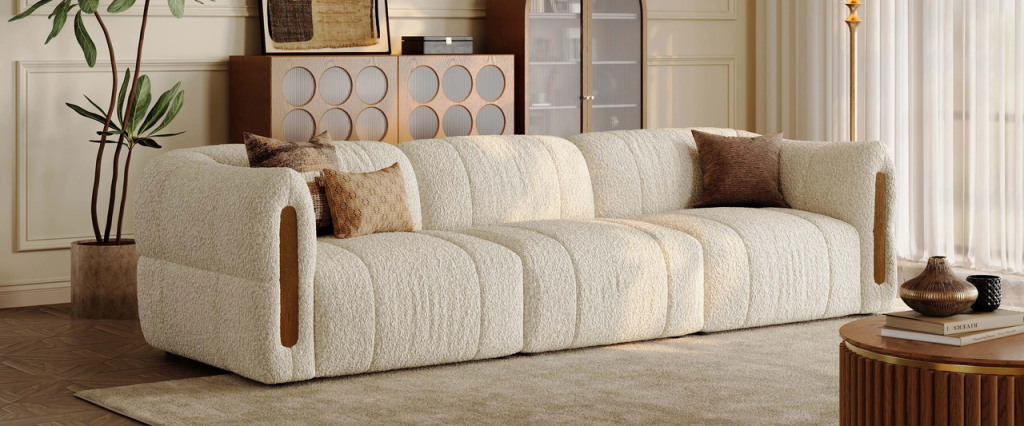
A living room used mainly for movie nights, naps, and relaxed lounging needs deeper seating rather than a compact conversation sofa. The Modern Bouclé Sofa with Solid Wood Details provides a 26.2-inch seat depth for stretching out, while solid-wood armrest inlays add contrast to the textured upholstery. Its beige short-pile bouclé creates a light, comfortable focal point without making the sofa look visually heavy.
Add a Swivel Chair When One Seat Must Serve Several Zones
Choose an accent chair because the room needs another useful seat, not simply because a smaller piece feels less risky. A fixed chair works in a dedicated reading corner, while a swivel chair earns its footprint in an open-plan room where the user regularly turns between the television, sofa, fireplace, kitchen, or window.
Map the directions the chair must face during a normal day. A chair positioned only for the best product-photo angle may force the user to drag it across the floor whenever the activity changes. Place it where the rotation replaces furniture movement rather than adding another obstacle.
A darker, flecked, or warm-toned bouclé chair can also connect a light sofa with wood furniture more naturally than another cream-colored piece. This creates texture contrast without making every upholstered surface look like part of the same matching set.
Use Dining and Bedroom Pieces for Specific Comfort Gaps
Bouclé dining chairs are worthwhile when the current chairs feel hard during longer meals or when a wood or stone dining area needs visual softness. They should not be added only to repeat the living-room upholstery. At the table, upright support and cleaning access matter more than a thick, lounge-like cushion.
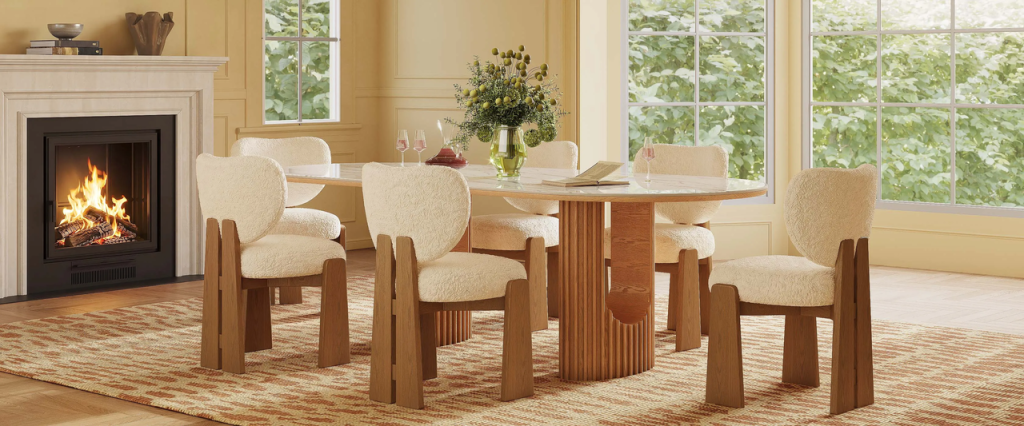
For a dining area that needs more comfort without a bulky lounge-chair profile, upholstered seating should still provide upright support and easy cleanup. The Organic Modern Upholstered Wood Dining Chairs use short-pile polyester bouclé with a C0 spill-resistant barrier, while the solid ash frames arrive fully assembled. The visible wood also balances a stone or wood tabletop.
A bouclé bed, bench, or bedroom chair solves a different problem. These pieces add softness where food exposure and constant traffic are lower. Choose them when the bedroom needs a supported reading seat, a place to put on shoes, or an upholstered surface that balances hard case goods. Avoid adding a bench when it only fills visual space but narrows the route around the bed.
Map Clearance and Exposure Around Bouclé Furniture
Outer dimensions show whether a piece fits, but not whether it will remain practical during daily use. Before choosing its final position, map three layers:
- The furniture’s fixed footprint
- The clearance needed for sitting, turning, or pulling out a chair
- The areas exposed to spills, direct sun, and repeated contact
Together, these checks reveal whether the furniture fits both the room and the household routine.
Test the Sofa, Table, and Walkway as One System
Do not evaluate a living-room sofa by wall fit alone. Mark the sofa footprint, then place temporary markers for the coffee table, side table, and main route through the room. Sit where each household member normally sits and check whether drinks, remotes, chargers, and lighting can be reached without leaning across the upholstery.
When choosing boucle furniture for a living room, test the narrowest passage while someone is seated or reclining. A route that appears sufficient in an empty room may become uncomfortable once knees, an open laptop, or a pulled-out ottoman extend into the passage.
In one apartment layout, a deep sofa fit neatly against the wall but forced people to turn sideways between the coffee table and media console. Shifting the table six inches and adding a narrow side table restored the route while giving both end seats a practical surface.
Measure Dining Chairs in Three Positions
Dining-chair dimensions should be checked in three states:
- Tucked fully under the table
- Pulled out for a person to sit
- Moved back far enough for that person to stand
Confirm that curved backs and arms clear the table apron and legs. Then check whether another person can walk behind an occupied chair without asking the seated guest to move. The same measurements used to choose modern dining chairs for your table and room become especially important with upholstered chairs, which are often deeper than slim wood frames.
At a six-seat breakfast table, treated upholstery made a tipped drink easier to blot, but the useful advantage came from having enough clearance to pull the affected chair away from the table. Closely packed chairs would have restricted access to the spill regardless of the fabric finish.
Protect Bedroom Routes and Everyday Reach
Measure an upholstered bed by the outside edges of its headboard, side rails, and footboard rather than by mattress size. Confirm that nightstand drawers open fully and that the route from the bed to the closet or bathroom remains usable when another person is standing nearby.
Mark the bench’s full depth and the standing area in front of it, then confirm that someone can sit, stand, and pass through the room while nearby closet or dresser drawers are open. For a reading chair, test access to the lamp, outlet, and side table before deciding where it looks most balanced.
Keep pale bouclé away from repeated contact with curtains, heating vents, luggage, or a wall that receives strong direct sunlight. The goal is not to protect the piece from all use, but to place it where normal use does not create avoidable wear.
Check Fabric, Support, and Delivery Access Before Buying
The bouclé label alone does not tell you how a piece will perform. Before ordering, review the upholstery, the furniture underneath it, and the route it must travel to reach the room. Two similar-looking pieces may differ significantly in snag resistance, seat support, cleaning requirements, and setup difficulty.
Start with the product specifications. Understanding what bouclé fabric is made from and how the weave affects daily use helps distinguish useful details from vague texture claims. Check:
- Fiber percentages and care instructions
- Close-up images of the loops, seams, and edges
- A clearly stated spill- or stain-resistant treatment
- Frame material, cushion fill, and weight capacity
- Seat height, seat depth, and back support
- Assembly and package dimensions
Request a swatch when the texture, color, or risk of snagging could affect the purchase. Press the surface and lightly pass a clean fingernail across it to see whether the loops pull or remain flattened. Abrasion ratings can be useful, but they do not predict durability on their own; pilling, seams, cleaning methods, and actual use also affect service life (Association for Contract Textiles). Follow the product’s care label rather than assuming that removable covers are machine washable.
Finally, measure the narrowest doorway, hallway turn, stair landing, and elevator opening. Compare these limits with the packaged dimensions rather than the assembled footprint alone. Confirm which parts detach, where assembly will take place, and whether there is enough room to open and remove the cartons without blocking the hallway.
Keep Bouclé Practical and Current
Use bouclé as one material layer rather than a complete room formula. One large sofa or a set of dining chairs usually provides enough texture; repeating cream bouclé across every upholstered piece removes contrast and gives the entire room the same maintenance demand. Pair it with visible wood grain, leather, stone, glass, or a flatter woven fabric. This balance is central to organic modern interior design for a warm, usable home.
Color can also make bouclé feel more personal and less trend-dependent. Dark gray, brown, olive, and flecked neutrals often integrate more naturally with existing furniture than several nearly matching cream tones. When repeating bouclé in the same room, vary the color, furniture scale, or surrounding material so the pieces look intentionally coordinated rather than approximately matched.
Conclusion
Choose the furniture function before choosing the texture. First identify the room’s missing seat or surface, then match the fabric to daily use, spill risk, pets, and cleaning habits. Measure the piece in use, inspect the fiber and loop structure, verify the frame and support, and confirm the delivery route. A large bouclé sofa should solve a real seating need; otherwise, a chair, dining set, bed, or bench offers a more controlled way to add softness. The right purchase should improve the routine as clearly as it improves the room.
FAQs About Bouclé Furniture
Can Bouclé Furniture Work in a Humid Climate?
Yes, provided the room is ventilated and the upholstery can dry quickly after cleaning. Avoid placing bouclé against a damp exterior wall or in a room with persistent condensation. In humid homes, use minimal cleaning moisture, run ventilation or air conditioning, and let the fabric dry fully before sitting on it.
Is Bouclé Suitable for People with Dust Allergies?
Its textured surface can hold more dust than smooth leather or tightly finished microfiber. Choose short-pile bouclé, vacuum it with an upholstery attachment, and avoid placing it beside an open window that collects pollen. For severe sensitivities, smoother seating with washable covers may be the lower-maintenance choice.
Will a Robot Vacuum Fit Under Bouclé Furniture?
Check leg clearance against the robot’s total height before buying. Low-profile sofas may leave visual space underneath but not enough room for sensor housing. Also confirm that throws or low-hanging fabric cannot enter the brush. Manual cleaning will still be needed along upholstered edges.
Does Bouclé Furniture Pill Over Time?
Bouclé can pill in areas exposed to repeated friction, especially seat fronts, armrests, and cushion edges. Pilling depends on the fiber, yarn structure, cleaning method, and frequency of use. Before buying, inspect close-up product photos and reviews, and check whether removable cushions can be rotated to distribute wear.


