 By Stephanie

Inflating an air mattress should be straightforward once you know which valve and pump to use. Whether you’re preparing a temporary bed for overnight guests, setting up a spare sleeping space in your living room, or getting ready for a camping trip, the right method depends on your mattress’s inflation system.
This guide explains how to inflate an air mattress with built-in, external, and manual pumps, what to do when you have no pump or electricity, and how to tell when the mattress is ready for a comfortable night’s sleep.
Table of Contents
How to Inflate an Air Mattress With a Pump
Before choosing a pump, look at where air enters the mattress. Common inflation setups differ in how they connect to the pump, so identifying the valve first can help you avoid using an incompatible nozzle. These are common arrangements, not universal designs; always check your mattress manual before connecting another inflator.
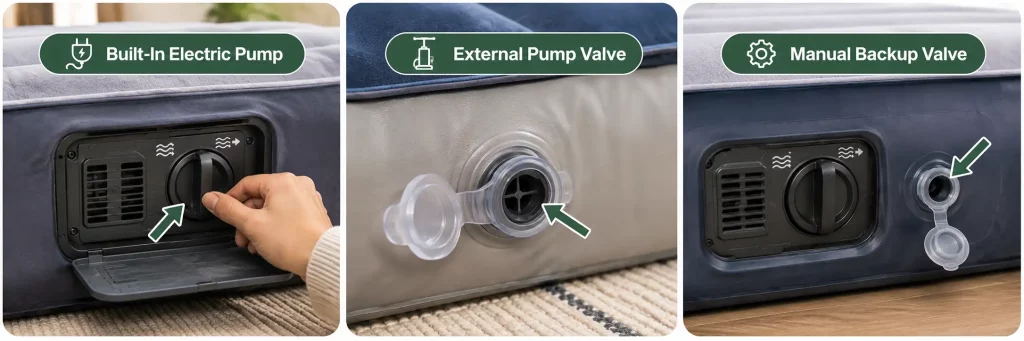
Using a Built-In Electric Pump
If your air mattress has a built-in pump, you won’t need a separate inflator. Most models have a control dial or switch near the pump housing.
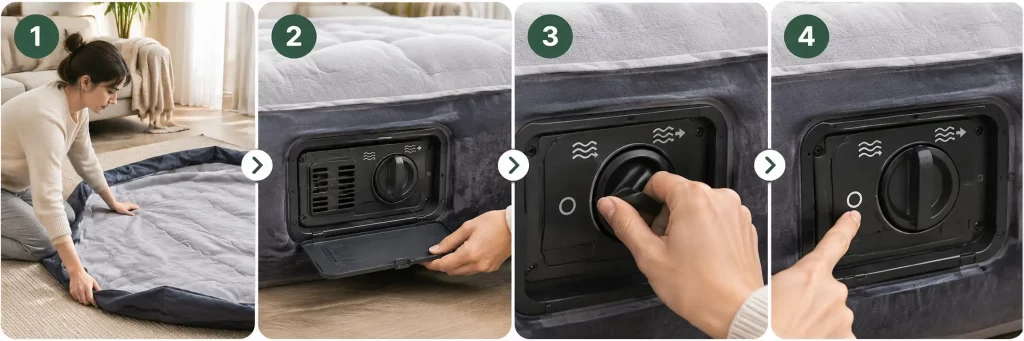
- Unfold the mattress: Place it flat in the intended sleeping area. Smooth out large folds so the material can expand evenly.
- Locate the pump controls: Find the built-in pump and open its protective cover or access panel if necessary.
- Check the power source: Connect the pump to the outlet or power supply specified in the manufacturer’s instructions.
- Select Inflate: Turn the dial or switch to the inflation setting. Some models use separate Inflate, Off, and Deflate positions.
- Monitor the mattress: Let the pump run while checking that the mattress expands evenly.
- Turn off and secure: Stop the pump, return the control to Off, unplug it if required, and close any protective compartment.
Keep the mattress unloaded while it inflates. Sitting or lying on it during this process can interfere with expansion and may damage some models.
If the pump still won’t start or produces no airflow after the basic setup checks, stop and follow these air mattress pump troubleshooting steps rather than forcing the connection or repeatedly restarting it.
Using an External Electric or Battery-Powered Pump
An external pump is useful when your mattress has a separate inflation valve. It can also provide an alternative for certain built-in-pump models that have a compatible secondary valve.
- Open the inflation valve and check its shape.
- Choose the nozzle adapter that fits the opening without leaving large gaps.
- Insert the nozzle securely, making sure air will not escape around the connection.
- Turn on the pump while keeping the nozzle connection steady.
- When inflation is complete, switch off the pump, remove the nozzle, and close the valve promptly.
Battery-powered pumps follow a similar process. Check the battery level before starting, especially if you’re preparing a guest bed away from a convenient outlet.

Using a Manual Hand or Foot Pump
A manual pump is useful when there is no electrical outlet nearby. It is also a practical backup for camping or temporary guest setups.
First, connect the pump hose to the correct inflation valve using a compatible adapter. Secure the connection before pumping. With a hand pump, use steady strokes rather than rushing. With a foot pump, apply consistent pressure to the pedal and allow it to return fully between strokes.
If the hose slips out, stop pumping and reseat the adapter before continuing. Otherwise, air may escape instead of entering the mattress.
| What You See | Likely Setup | What to Do |
| A control dial or switch built into the mattress | Built-in electric pump | Use the marked Inflate setting and the designated controls. |
| A separate capped opening | External or manual pump valve | Choose a compatible nozzle adapter and secure the connection. |
| A secondary valve beside the built-in pump | Possible manual backup valve | Use a hand or foot pump only if the manual identifies it as an inflation port. |
Alternative Ways to Inflate an Air Mattress
The right alternative depends on what you still have access to. If you have an outlet but no compatible inflator, a trash-bag method may work on some valve designs as a slow emergency option. If no wall outlet is available, a manual pump or a charged battery-powered inflator is more practical. Check the valve before trying either approach.
When You Have Power but No Compatible Pump
If you cannot find the original pump, start by checking whether you can borrow or obtain a compatible low-pressure inflator. This is more reliable than experimenting with household appliances.
A trash bag can also serve as an emergency workaround on certain mattresses with a suitable valve:
- Open a large, clean trash bag and trap air inside.
- Twist or gather the opening to hold the air.
- Position the bag opening against the mattress valve.
- Compress the bag to push air into the mattress.
- Repeat the process until the mattress begins to take shape.
This method transfers relatively little air with each attempt, so it can take considerable time. It also depends on the valve accepting air from the bag. It is not suitable for every mattress.
Avoid assuming that a hair dryer, leaf blower, or vacuum cleaner will work. Heat, excessive pressure, or an unsuitable airflow setting can damage the mattress. Only use an alternative appliance if the manufacturer specifically permits it.
When No Wall Outlet Is Available
When electricity is unavailable, first check whether your mattress has a separate manual inflation valve. Some built-in pump models include a backup port, but others rely entirely on their electric system.
If the mattress has a compatible manual valve, use the hand- or foot-pump method described above. A charged battery-powered inflator is another option if its nozzle fits the valve.
If the mattress has no independent manual valve and you don’t have a compatible battery pump, there is no reliable universal household workaround. Don’t dismantle the built-in pump or force air through its housing.
How Do You Know When to Stop Inflating an Air Mattress?
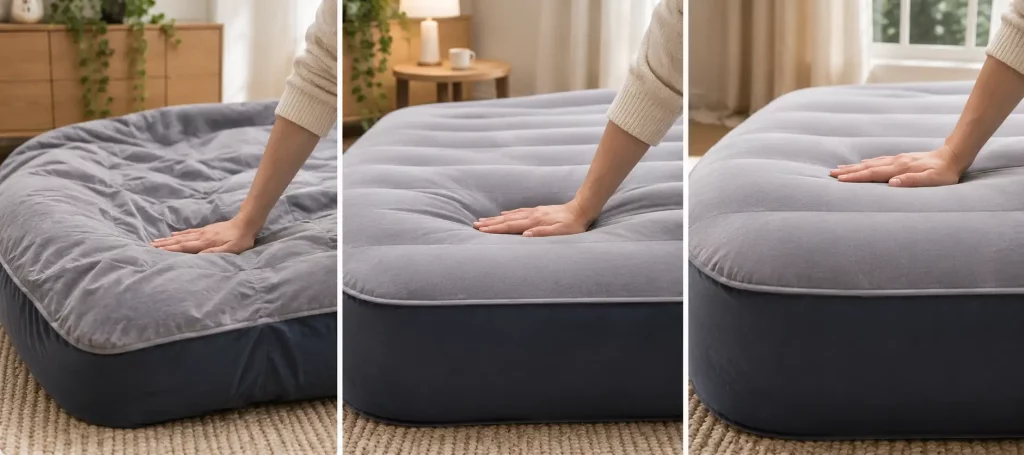
Inflation limits vary by model, so follow the manufacturer’s instructions rather than aiming for a universal percentage. Before disconnecting the pump, press the center lightly with your palm and check the mattress’s shape, surface, and seams.
Use these three indicators together to determine whether the mattress is ready for use.
| What to Check | Ready to Stop When | Warning Sign |
| Mattress shape | Expanded evenly | Visible bulges or uneven stretching |
| Surface feel | Slight give under light pressure | Rigid with almost no give |
| Seams and edges | Sit flat without pulling | Look unusually tight or stretched |
Don’t use a universal 90% inflation target. Mattress designs and pressure limits differ. Intex, for example, advises using a low-pressure inflator and avoiding overinflation. Follow your model’s instructions rather than treating one percentage as universal.
Final Setup Checks Before Sleeping on an Air Mattress
Once inflation is complete, focus on the room layout and the mattress footprint. Before adding bedding, check the following:
- Clear the floor: Remove toys, loose cables, sharp objects, and anything that could puncture the mattress.
- Check furniture clearance: In a living room, move the coffee table or ottoman outside the mattress footprint so the expanded bed doesn’t press against furniture edges.
- Keep access clear: Leave enough room to walk around the mattress and reach the door, closet, or bathroom without stepping over bedding or other items.
If the mattress loses noticeable firmness after setup, don’t keep adding air automatically. Follow these steps for an air mattress that keeps deflating to determine whether the problem is related to air retention.
A Power Sofa Bed Alternative to Repeated Air Mattress Setup
For households hosting overnight guests without a guest room, an air mattress means finding a pump, clearing floor space, and waiting for the bed to inflate. A power sofa bed stays in place as everyday seating, then extends electronically to create a deeper surface for lounging or sleeping.
The POVISON Aurora Smart Sofa Bed uses remote-controlled adjustment to extend its seat depth from 27 to 45.5 inches. You can keep it at a shallower depth for everyday seating, then extend it when someone stays overnight. There’s no separate mattress to inflate, and the adjustable depth lets you switch between daily use and a more spacious sleeping setup without rearranging the room.

Aurora Smart Sofa Bed | $2,699
Worth considering for households that host overnight guests regularly, rather than once or twice a year.
Conclusion
Inflating an air mattress starts with identifying the right valve and choosing a compatible pump. Follow the manufacturer’s inflation limits, and don’t force an adapter or household appliance if the connection isn’t suitable. Whether you’re preparing a temporary bed for family, friends, or overnight guests, understanding your mattress’s inflation system makes setup easier and helps avoid unnecessary trial and error.

Skip the Air Mattress Setup
Make overnight stays easier with a power sofa bed that extends for guests and returns to everyday seating.
Q&A
How Long Does It Take to Inflate a Queen Air Mattress?
There isn’t one standard inflation time for every queen air mattress. The total depends on the mattress’s air capacity, pump output, valve fit, and power source. Check the manufacturer’s estimate for your model; a low-output manual pump will generally take longer than a compatible electric inflator.
Does a Larger Air Mattress Need a Different Pump?
Not necessarily. Pump compatibility depends on the valve, adapter, and inflator’s intended pressure and airflow—not just whether the mattress is Twin, Queen, or King. A larger mattress may take longer to fill, but it does not automatically require a higher-pressure pump. Follow both manuals.
Can You Use a Bicycle Pump to Inflate an Air Mattress?
A bicycle pump may work only if its nozzle connects securely through a compatible adapter and the pump suits the mattress’s airflow and pressure requirements. Many bicycle pumps move air too slowly for a full-size bed. Never force the nozzle or exceed the mattress manufacturer’s limits.
Can You Blow Up an Air Mattress by Mouth?
Some small inflatables have valves designed for mouth inflation, but most full-size air mattresses require far more air than is practical to blow in manually. Mouth inflation also introduces moisture into the chamber. Use a compatible hand or foot pump instead.
What Should You Do If Your Air Mattress Valve Cap Is Missing?
First check whether the valve is self-sealing or depends on a removable cap to hold air. If the cap provides the seal, contact the manufacturer for a compatible replacement before using the mattress overnight. Don’t rely on tape or an improvised plug.


