 By Charles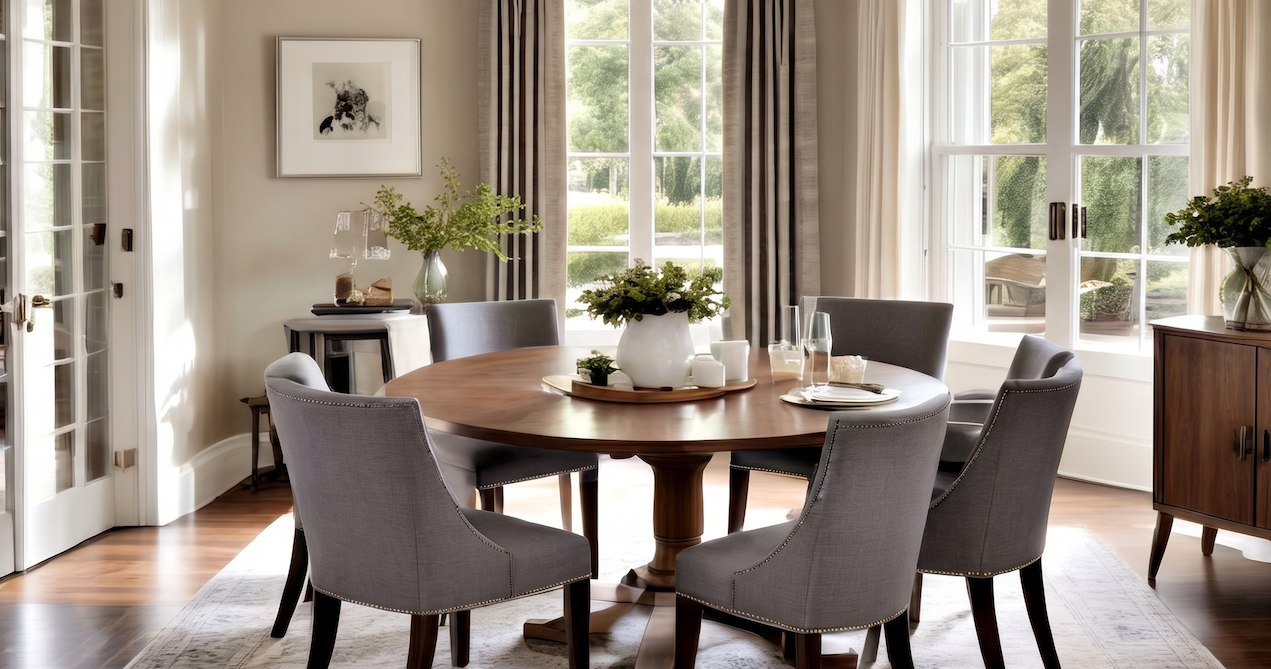
Last spring I helped my sister pick a dining table for her new 2-bedroom apartment. She wanted a rectangular one. Six feet long. Seated eight. Looked stunning in the Pinterest photos.
Her dining nook is 10 feet by 9 feet.
Guys, it did not fit. Well — it fit. You just couldn’t pull the chairs out without hitting the wall. Someone always had to eat standing up or crawl in from the side like it was a submarine hatch.
That’s when we started looking at round tables. And honestly? It changed the whole room. So this is the guide I wish we’d had three weeks earlier — when a round dining table actually works, when it doesn’t, and how to figure out which size fits your space before you click “buy.”
Why Round Tables Change the Feel of a Room
A round table doesn’t just look different. It behaves differently.
No corners means no dead zones. Everyone sits the same distance from everyone else, which sounds trivial until you’ve hosted a dinner where one person at the far end of a rectangle spent 90 minutes talking to nobody. Round tables keep conversation collective.
They also walk differently. According to published dining room clearance standards from Dimensions, round tables are more space-efficient than square or rectangular tables specifically because their lack of corners results in a smaller effective footprint. You can circle around them without zigzagging.
There’s one more thing I noticed after switching: rooms with round tables feel calmer. Less geometric. The softer edge blends into an open-plan living area instead of chopping it up. If your dining table sometimes doubles as a WFH desk, that visual softness matters more than you’d think.
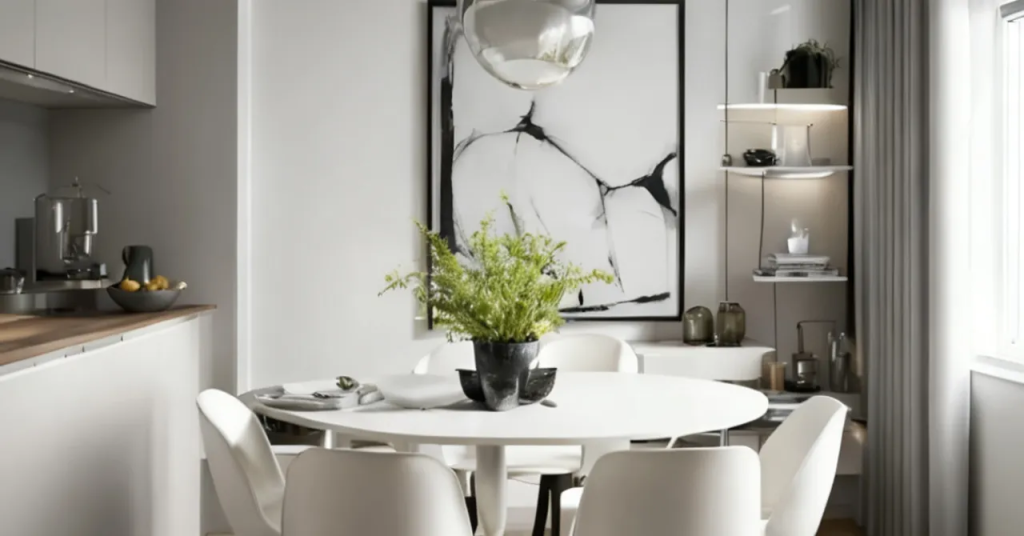
But — here’s the part most articles skip — round tables have real limits. They struggle in long, narrow rooms. They don’t scale up gracefully. A 72-inch round seats eight but feels enormous in most dining rooms, because the diameter sits in the middle of the floor no matter which way you turn it. If your space is shaped like a hallway, a round table is going to waste most of it.
Best Room Sizes for a Round Dining Table
Quick math before we get into details.
| Table Size | Diameter | Seats | Minimum Room | Ideal Room |
| Small round | 36″–42″ | 2–4 | 9′ × 9′ | 10′ × 10′ |
| Standard round | 47″–48″ | 4 | 10′ × 10′ | 11′ × 11′ |
| Larger round | 54″–60″ | 6 | 11′ × 11′ | 12′ × 12′ |
| Oversized round | 66″–72″ | 6–8 | 12′ × 12′ | 13′ × 13′ |
The rule behind this table: leave at least 36 inches of clearance between the table edge and any wall or furniture. Interior design standards consistently recommend 36 inches as the minimum — that’s the distance needed to pull a chair out, sit down, and let someone walk behind you without doing the hip-shuffle. This threshold is also codified in the NKBA’s official kitchen and dining planning guidelines, the industry benchmark used by professional residential designers across the U.S.
42 to 48 inches is better if you can swing it. Less than 36, and you’ll regret every meal.
When a 4-Seat Round Table Works Best
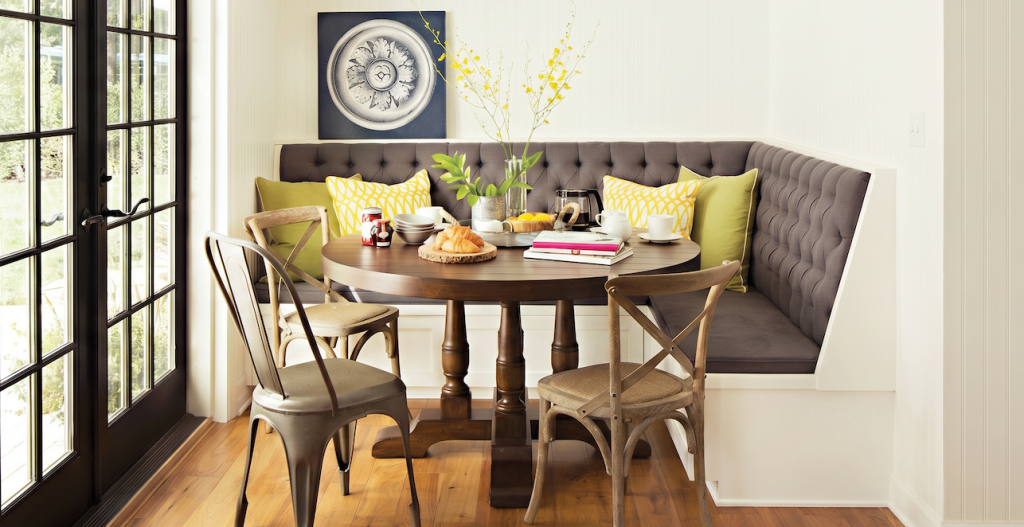
A 47-inch round table is the sweet spot for apartments, condos, breakfast nooks, and open-plan living areas where the dining zone is carved out of a larger room.
Across friends’ homes and Reddit threads, 47 inches keeps winning for one reason: it seats four adults comfortably (24 inches of table edge per person is the benchmark), but its footprint is small enough to leave real walking space in a 10-by-10 or 11-by-11 room.
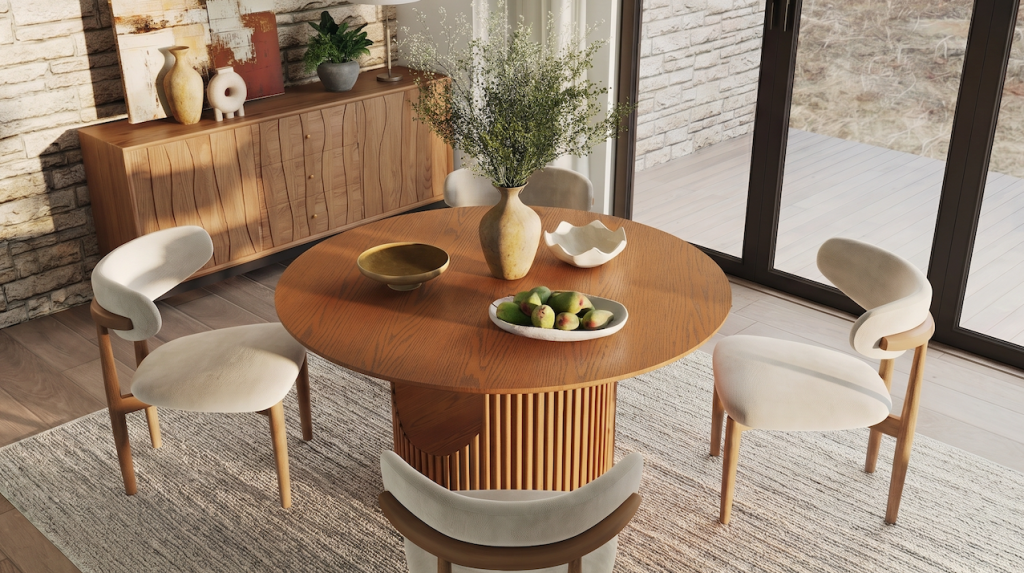
It’s also the size that pairs best with a pedestal base. POVISON’s 47″ walnut fluted pedestal round dining table, for example, ships fully assembled with a solid plywood top and walnut fluted column base — fits a breakfast nook without feeling like a boulder landed in the middle of the room. No tools. No 45-minute instruction video.
If you want the whole package — table plus chairs — a coordinated dining set for 4 takes the styling guesswork off the table.
Skip the 4-seater if: You regularly host six or more, or you want real holiday overflow room.
When a 6-Seat Round Table Makes Sense
6-seat rounds are trickier than they look.
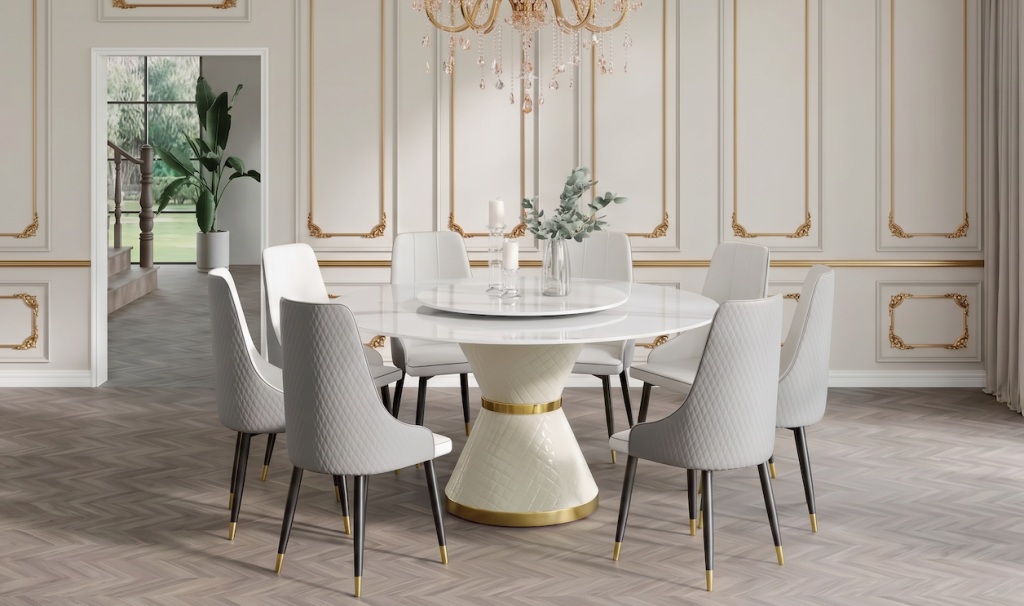
A 54-inch round technically seats six (each person gets about 28 inches of edge — fine for 6, tight for 6.5). A 60-inch round is more comfortable at 31 inches per person, which is formal-dining comfortable. Both need a room that’s at least 11 by 11 feet, and honestly 12 by 12 is where they start to breathe.
Where they shine: square-ish rooms, open-concept layouts, and households that regularly host four-to-six people. Round tables at this size create what designers call an “egalitarian” setup — everyone’s equidistant, which genuinely matters when hosting people who don’t all know each other.
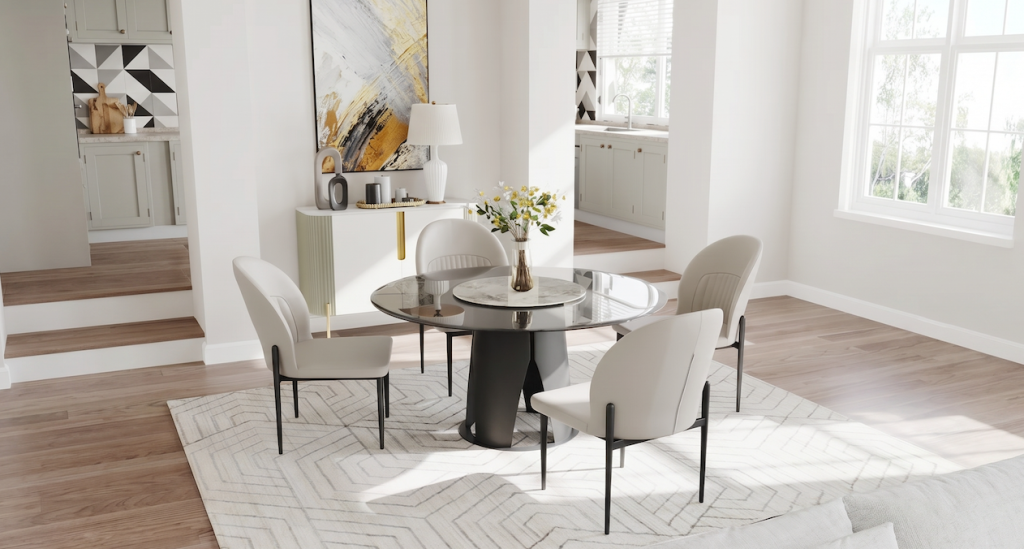
POVISON’s 53″ round pedestal table with sintered stone Lazy Susan is a good example of what to look for at this size. The rotating center solves the biggest problem of 53-inch rounds: reaching dishes across the middle gets awkward fast. The Lazy Susan turns that from a stretch-and-apologize moment into a casual spin.
Skip the 6-seater if: Your dining space is shaped like a bowling alley. A 60-inch circle in a 9-by-14 room wastes huge amounts of floor space on either end.
Apartment vs House Dining Setups
These are not the same problem.
Apartment dining (9’×9′ to 11’×11′): A round table almost always wins. Corners take floor area your apartment doesn’t have, and rectangular tables force one-side-against-the-wall setups that only seat three comfortably. Stick to 42″–48″ diameter with a pedestal base.
House dining, formal room (12’×14′ or larger): This is where I’d push back on a round table for most buyers. Formal dining rooms are usually rectangular, and a rectangular table matches the geometry better. A 72-inch round in a 14-foot-long room actually feels smaller than a 72-inch rectangular table would, because the rectangular one uses the length. If you entertain eight-plus regularly, an oval dining table is usually the smarter compromise — rectangular room-fit with rounded edges and better conversation flow.
House dining, eat-in kitchen or open-plan: Round table, all day. Visual softness matters more when the dining zone touches the kitchen or living room. Sharp corners chop up open floor plans.
Common Trade-Offs Buyers Overlook
Three things people miss, over and over:
- The pedestal stability question. Pedestal bases give you dramatically better legroom — no leg dodging, and you can squeeze in an extra chair at holidays without anyone straddling a table leg. But not all pedestals are equal. A well-built pedestal with a weighted base (sintered stone or solid wood columns) is rock-solid. A hollow or lightweight pedestal can feel tippy when someone leans on the edge. Check the product spec for base weight and material, not just the photo.
- The “just barely fits” trap. If your room technically accommodates a 60-inch round with 30 inches of clearance, don’t buy the 60-inch. You will hate it within two weeks. Go one size down. Extra clearance is worth more than an extra inch of table per person.
- Chairs take up more space than the table. Pulling a chair out to sit down needs 18–24 inches of pull-back room. That’s on top of the table footprint. Obvious, but people measure the table and forget the chairs exist.
What to Check Before Buying Online
Before you hit checkout:
- Tape the floor. Put painter’s tape in the table’s actual dimensions. Live with it for three days. Walk around it. You’ll know.
- Confirm the base type. Pedestal for tight spaces or armchairs; four-leg for larger, traditional setups.
- Check the tabletop material honestly. Sintered stone and tempered glass are heat- and scratch-resistant and wipe clean in seconds — matters if you have kids or cook often. Solid wood looks warmer and ages better but needs actual care. No hot pans directly on the surface.
- Verify delivery logistics. A 60-inch round weighs 120–180 pounds depending on material. Walk-up apartment? Ask about white-glove service. Narrow doorways? Check packed dimensions before ordering, not after.
- Read the return policy. POVISON ships fully assembled with a 30-day return window, which removes the single biggest return risk — “it arrived and I couldn’t figure out the instructions.”
If you’re still narrowing sizes, the POVISON round dining table collection filters by seating capacity, base type, and room fit — saves more time than scrolling a hundred product pages.
FAQ
Is a round table better for small spaces?
Yes, in most cases. Round tables eliminate corners, which saves floor area in apartments and small dining nooks. A 47-inch round fits comfortably in a 10-by-10 room while seating four adults — a rectangular table of equivalent seating capacity typically needs 11 by 13 feet minimum. Pedestal bases further improve the fit by letting chairs tuck closer.
Can a round table seat 6 comfortably?
A round table can seat six comfortably starting at 54 inches in diameter, though 60 inches is more generous. Each person needs about 24–28 inches of table edge for casual dining and 28–30 inches for formal comfort. Below 54 inches, six people start feeling squeezed — elbows bump, and passing dishes across the middle gets awkward without a Lazy Susan.
Does a pedestal base help with legroom?
Yes, significantly. A pedestal replaces four corner legs with one central support, which means chairs tuck closer and no legs block diners’ knees. Especially useful at smaller tables (42″–48″) where four-leg designs restrict chair placement. The trade-off is stability — cheaper pedestals can feel less firm than four-leg equivalents, so check base construction and weight.
What delivery concerns matter for larger tables?
For any round dining table 54 inches or larger, three issues matter. First, weight: stone and solid wood tables often exceed 150 pounds and need two people to carry. Second, packed dimensions — confirm the crate fits through your doorways and up any stairwells. Third, assembly: tables that ship fully assembled eliminate setup time but can’t be disassembled for tight turns. White-glove delivery is worth the extra cost for oversized rounds or walk-up apartments.

Conclusion
Round dining tables aren’t universally “better” — they’re better for specific situations. Apartments, condos, open-plan homes, square-ish rooms where corners would chop up the floor — a 47″ or 53″ round is almost always the right answer. Long, formal dining rooms for eight-plus? You’ll be happier with an oval or rectangular table that uses the length properly.
The biggest mistake I see buyers make is falling in love with a table that’s one size too big. Don’t. Measure your room, subtract 72 inches total (36 inches of clearance on two sides), and buy the table that actually fits that number. You’ll enjoy every meal more for the next ten years.
Ready to find the right size for your space? Start with the POVISON round dining table collection — filterable by seating, base type, and material, so you can narrow by room fit. If you want a specific apartment-friendly starting point, the 47″ walnut pedestal round table for 4 arrives 100% pre-assembled — zero tools, zero hex keys, zero Saturday afternoons lost to instructions. That’s the Ready To Live In promise, made real.
Life’s too short for the wrong table.
Related Reading:


