 By Jenny Smith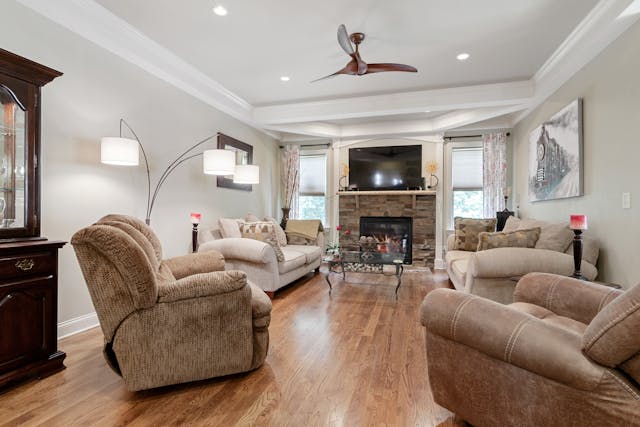
Most reclining sofas look similar in a showroom, yet they feel very different once they’re in your living room. The biggest split is between a manual recliner and a power reclining sofa: one relies on your strength and a few set angles, the other uses motors and buttons for smooth, fine-tuned comfort. This guide walks you through the real-life differences so you can decide which type actually fits how you relax, host, and live.
Table of Contents
Manual vs Power Reclining Sofas at a Glance
Key Differences in 10 Seconds
A manual reclining sofa uses a lever, pull handle, or your body weight to kick up the footrest and lean back. A power reclining sofa or power recliner sofa uses one or more electric motors, activated by buttons or a touch panel, to move slowly and smoothly. Manual models usually stop at a few fixed positions, while power lets you settle into almost any angle, often with extras like USB, power headrests, or even heat and massage.
Quick Pros & Cons Table
A quick side-by-side view helps frame the rest of this guide:
| Aspect | Manual Reclining Sofa | Power Reclining Sofa |
| Ease of use | Requires pull/lean effort | Button-press, minimal effort |
| Comfort & adjustability | Few fixed positions | Near-infinite micro-adjustments |
| Features | Basic footrest/back | USB, power headrest, lumbar, heat & massage |
| Price range | Lower upfront | Higher upfront, more long-term comfort |
| Best for | Tight budgets, occasional use | Daily relaxing, families, aging in place |
Manual Reclining Sofas: Simple, Affordable, but With Limits
How a Manual Recliner Works & Feels
Manual recliners use a mechanical linkage connected to a lever or handle. You pull or lean back to release the footrest and push with your legs to close it. The feeling is quite “on/off”: upright, TV position, and full recline, with little in-between. Because you need leg and core strength to move the seat, closing it at the end of the night can feel clunky, with the occasional “click” or jolt as the mechanism locks.
Pros, Cons & Who It’s Really Best For
The biggest upside is price: a manual reclining sofa usually costs less and doesn’t need an outlet, so it works even in rooms with limited power access. The trade-off is effort and precision. Older adults, pregnant people, or anyone with knee or back issues may find the push-back motion tiring over time. It’s a good fit if you’re on a strict budget, recline only once in a while, and mainly care that the sofa can lean back at all rather than delivering spa-level fine-tuning.
Power Reclining Sofas: Comfort & Convenience Upgrade
What Makes a Power Recliner Sofa Different
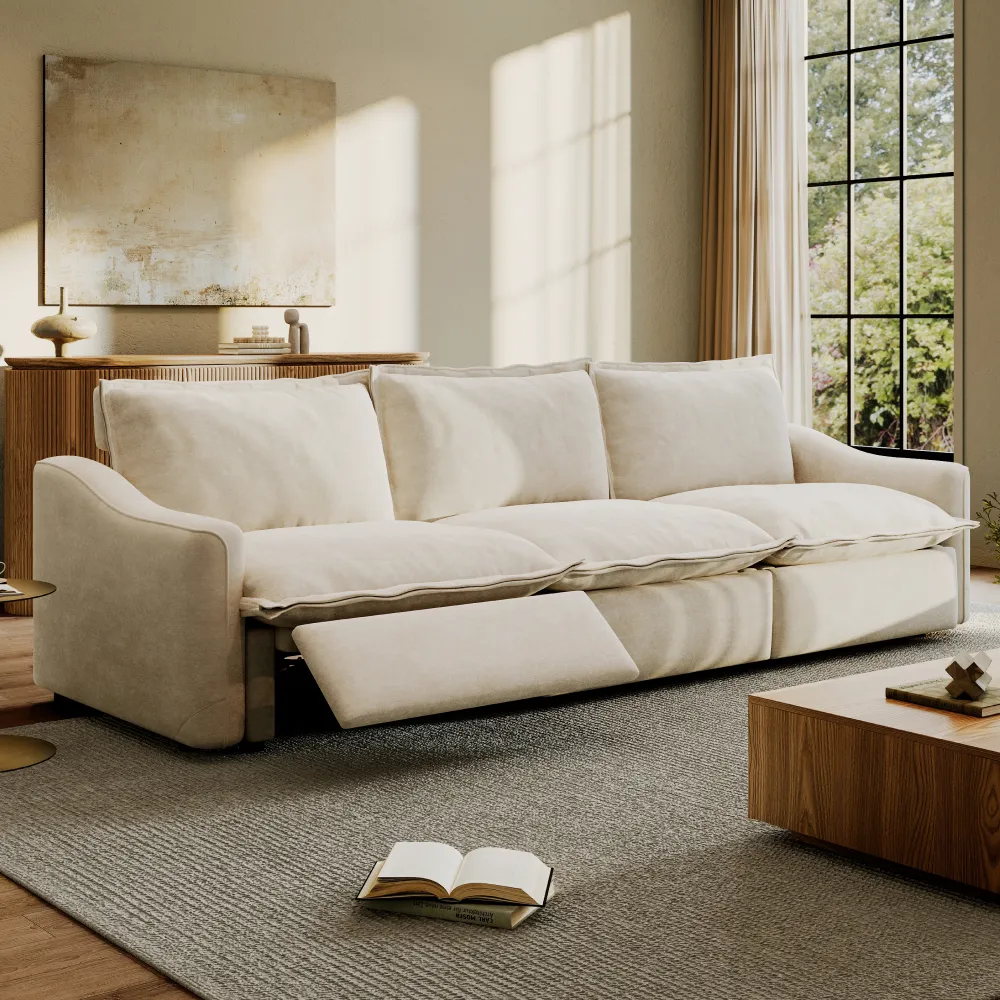
A power reclining sofa (or power recliner sofa) uses electric motors to move the footrest, back, and sometimes headrest. You tap buttons to glide into position instead of fighting with a lever. The recliner sofa market was valued at about $4.66 billion in 2024 and is projected to grow to $6.78 billion by 2032, driven partly by demand for powered motion and tech features (Maximize Market Research, 2024).Today you can choose dual power reclining sofas, triple power reclining sofas, leather power reclining sofas, and cozy fabric power reclining sofas to match your style.
Everyday Benefits You Actually Feel
In real life, the benefit shows up at 9:30 p.m. when you drop onto the sofa and only have energy to press one button. The seat eases back, the power headrest tilts to the perfect angle for your neck, and you can stop anywhere—not just “halfway” or “all the way.” Adults already spend around 7.7 hours per day in sedentary behaviors (American Journal of Epidemiology, 2008), so making that time more ergonomic matters. When I tested a dual power reclining leather sofa in a small apartment, the ability to nudge the angle a few degrees made the difference between “slouching” and genuinely supported lounging.
Common Concerns: Price, Power Outages & Durability
Yes, a power reclining sofa costs more than a comparable manual. But spread over years of daily use, the “per-night” cost of extra ease and support is small—especially if multiple family members use it. With power outages, a plug-in power reclining sofa usually stays in its current position until electricity returns. POVISON power sofa products are mainly designed for wall-outlet use, which helps provide a steady power supply for daily reclining and adjustment. Power source, reset method, and included accessories can vary by model, so always check the product detail page before ordering. Motor mechanisms are designed for thousands of cycles and often backed by multi-year warranties; check that parts can be serviced individually. As the 65+ population in the U.S. has grown 34% in a decade, from 43 to 58 million (Harvard Joint Center for Housing Studies, 2023), investing in accessible, low-effort seating is becoming a practical aging-in-place choice, not a luxury.
Manual vs Power: How to Choose the Right Reclining Sofa for You
3 Quick Questions to Guide Your Decision
Use this mini checklist to get out of “scrolling forever” mode:
- How often will you recline each week—once in a while, or most evenings?
- Does anyone at home (kids, older adults, pregnant, mobility-limited) struggle with leg strength or balance?
- Do you care more about the lowest upfront price, or about all-day comfort and easy lounging over the next 5–10 years?
If you recline often, have family members who tire easily, or want your living room to feel like a true recovery zone, a power reclining sofa usually wins.
Clear Recommendations for Typical Scenarios
For a small-space couple who loves TV nights and sometimes works on the sofa, a compact power recliner sofa with USB ports is ideal—pair it with this best power recliner sofa guide to compare specific models. Families living with parents or grandparents often find that power recliners make it easier for older adults to shift and stand independently. If you’re furnishing a rental on a tight budget and won’t recline much, a manual reclining sofa still makes sense; just go in knowing you’re choosing simplicity over long-term ease. For more model ideas, check the best reclining sofas for 2026.
Buying Checklist for a Power Recliner Sofa- Size, Layout & Features
First, measure everything: the room, doorways, corridors, and the clearance needed when the sofa is fully reclined. Note where outlets sit because most POVISON power sofas are designed for plug-in use. Keep cords away from walkways, avoid stretching the power cable across the room, and check the product detail page for the exact power source, cord placement, and included accessories before buying.
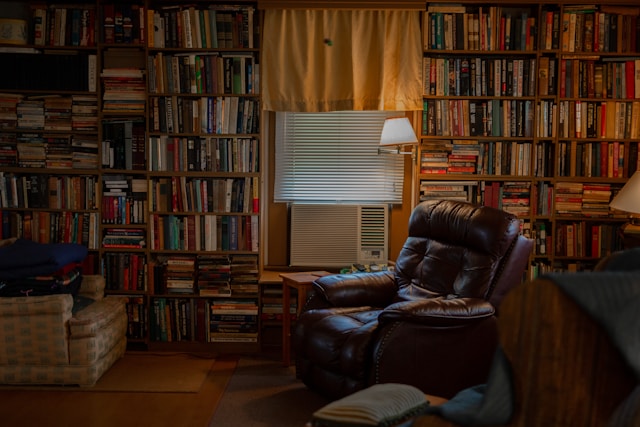
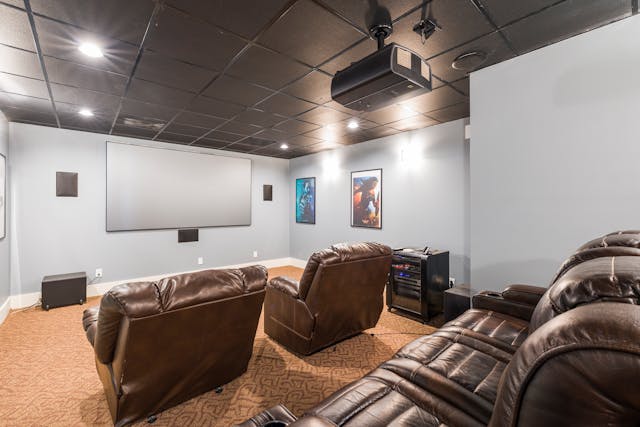
Prioritize a smooth motor, independent footrest and back, and at least one powered seat. Then think about add-ons: a power reclining sofa with power headrest is great for reading, a dual power reclining sofa works well for couples, while triple power or a power reclining sofa with heat and massage turns a media room into a full-on recovery zone. For more layout inspiration, see Povison’s guide to living room furniture layouts.
Easy-Care Materials & Simple Maintenance
Despite the tech, caring for a power reclining leather sofa or fabric power reclining sofa is much like caring for any quality couch. Performance fabric resists stains and is ideal for kids and pets; leather and faux leather usually wipe clean with a damp cloth.
Daily life tip: in one busy family home I visited, a microfiber power recliner sofa survived weekly movie-night spills thanks to quick blotting and a no-shoes rule on the cushions. Every few months, vacuum crevices and quickly check cables aren’t pinched or tripped over. For deeper leather care, you can follow Povison’s detailed guide on cleaning a leather sofa. Maintenance mostly comes down to light cleaning and basic cord habits—not a complicated chore list.
Conclusion
Manual and power recliners share one goal—helping you put your feet up—but they get there differently. Manual models trade lower cost for more physical effort and fewer positions. A power reclining sofa, especially one with adjustable headrest or lumbar, gives you near-infinite fine-tuning, modern features, and easier use for every age. If you want your living room to be the place where your body truly lets go at the end of the day, a thoughtfully chosen power recliner sofa is usually the smarter long-term investment. Use the questions and checklist above, then narrow down specific designs with Povison’s expert buying content so your next sofa actually matches how you live.
FAQs about Power Reclining Sofas
Do power reclining sofas use a lot of electricity?
Not really. Plug-in power reclining sofas only draw power while the motor is moving, and each recline cycle usually takes a short time. In normal home use, the energy use is low because the motor is not running continuously. For long trips, you can unplug the sofa if recommended by the product instructions. Always check the product detail page for the exact power configuration.
What happens to a power recliner sofa during a power outage?
If the power cuts out mid-recline, a plug-in power recliner sofa will usually stay in its current position until electricity returns. POVISON power sofa products are mainly designed for standard wall-outlet use, which provides stable power for daily reclining.
Are power reclining sofas safe for kids and older adults?
Yes, when you choose a quality model and use it as directed. Smooth, slow motors reduce sudden jolts, and most power recliners stop the moment you release the button. Make sure cords are tucked away, teach kids not to play with the controls, and look for designs with enclosed mechanisms so small fingers can’t reach moving parts.
How long do power recliner sofa motors typically last?
With normal home use, many motors are rated for thousands of cycles, which often translates to years of daily reclining. Frames and cushions usually outlast the motor, so check whether your sofa allows the motor or control panel to be replaced. Good brands back motion components with a dedicated multi-year warranty separate from the frame.
Is a power reclining sofa worth the higher price compared with a manual recliner?
If you recline often, share the sofa with family, or plan to age in place at home, the answer is usually yes. The ability to adjust angle precisely, move with a button instead of force, and enjoy features like USB ports or power headrests adds up over years of use. For rare, occasional reclining, a well-built manual can still be enough.


