 By Charles
Two years ago my sister moved into a Brooklyn railroad apartment where the “dining room” was the hallway between the kitchen and the living room. Three feet of usable width on one side of the table. I gave her the wrong answer first — a 36-inch-wide rectangle that looked great in photos and turned every dinner into a chair-shuffle Olympics. We swapped it a month later for something narrower with the right chair geometry, and the room finally worked.
A narrow dining table sounds like a simple fix for a small room. It isn’t. The table is half the equation — the other half is whether you can pull a chair out and walk past someone without saying “excuse me” four times per meal.
When a Narrow Dining Table Makes Sense
A narrow dining table earns its keep in three room types. First, railroad apartments and brownstone dining rooms where the room is long but one dimension is choked — usually 7 to 9 feet of width. Second, eat-in kitchens where the table lives between a counter run and a wall, and any extra inch of width steals from your walkway. Third, open-plan condos where the dining zone runs parallel to a sofa or island, and a wider table would break the visual corridor.
What unites these rooms isn’t square footage — it’s direction. You have length to work with and almost no width. A 30-inch-deep tabletop instead of a standard 36–40 inch one buys you 6–10 inches of walking space on one side. That’s the difference between a chair tucking under cleanly and a chair sticking out into the path to the kitchen.
A sanity check before you shop: tape out the table. Painter’s tape on the floor, mark the table footprint plus the chair pull-back zone, then walk the room holding a tray. If the tape says no, the real table will say no louder.
Measure Walkways Before Choosing a Table
This is the part I wish someone had drilled into me the first time. Table width is the wrong starting point. Walkway width is. Pick the table that protects the walkway, not the other way around.
The numbers below come straight from the NKBA Kitchen Planning Guidelines, which most U.S. kitchen designers treat as the working baseline.
Kitchen Walkways
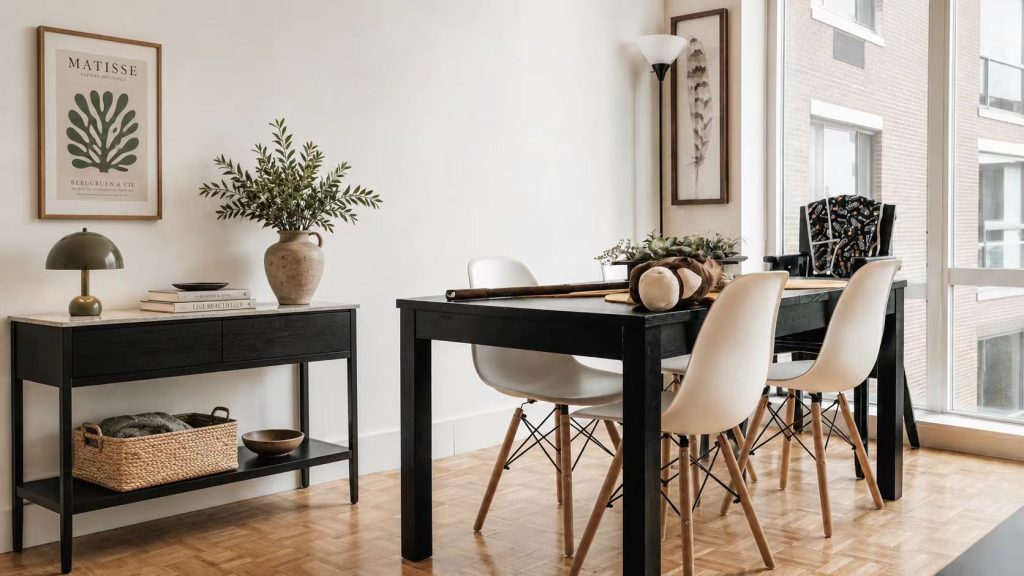
In any kitchen, the NKBA recommends a minimum 36-inch walkway for general circulation and 42 inches when two walkways meet perpendicularly. If you’re a single cook working the prep area, that bumps to 42 inches, and to 48 inches for two cooks sharing the space.
Here’s where the table comes in: the chair pull-back zone is part of the walkway. If you push your table edge to within 36 inches of the opposite cabinet run, you’ve technically met the walkway minimum — but only when nobody is sitting down. The moment someone slides a chair out 20 inches to sit, your walkway shrinks to 16. A narrow table (28–32 inches deep) gives you the margin you need to keep the path usable during meals.
A simple test: measure from the back of a pulled-out chair to the opposite wall. That number is your real walkway. If it drops below 36 inches, you need a narrower table, not a smaller chair.
Apartment Dining Corners
Apartment corners follow a different rule because traffic patterns are different. The NKBA standard for behind-chair clearance is 32 inches when no one walks behind diners and 36 inches if people pass by occasionally. If your corner is a real thoroughfare to a bedroom or balcony, you want 44 inches — the comfortable walk-past number.
The relief most apartment dwellers miss: you can run one long side of the table within 12 inches of a wall as long as that side stays as a bench seat or remains unused. All your real clearance budget goes to the chair side. This is the geometry that makes a 60-inch rectangular table fit a 7-foot-wide room that “shouldn’t” hold one.
One logistical note: getting a real solid-wood or sintered-stone table through a narrow stairwell or freight elevator is its own problem. POVISON’s dining tables ship fully assembled, which sounds like a nice-to-have until you’re trying to wrestle flat-pack hardware in a 4-foot-wide kitchen. Pre-assembled cuts setup from a typical 2–3 hours to about 7 minutes of placement.
Best Shapes for Narrow Dining Areas
Three shapes work in narrow rooms. The rest don’t, and marketing photos suggesting otherwise are lying with wide-angle lenses.
Slim rectangular (28–34 inches deep, 55–72 inches long): The default. Follows the long axis, pushes against the wall cleanly, scales from 4 seats to 6 if you add the ends. This is what I put my sister into — a 32-inch-wide, 63-inch-long rectangle.
Narrow oval (28–32 inches at the widest point): Same length advantages as rectangular, but rounded ends are forgiving in corners and easier to squeeze past. The curve eliminates the hip-bashing corner.
Small round (36–44 inches diameter): Works in square narrow corners, not long ones. If your nook is roughly 7 × 7 feet, a 40-inch round seats 4 with chairs that pull out in any direction.
What to avoid: square tables over 36 inches per side (eat too much width) and farmhouse rectangles 40+ inches deep (defeats the purpose). To compare narrow-footprint options side by side, POVISON’s dining tables collection filters down to rectangular and oval shapes built for tight rooms — most run 30–34 inches deep, the sweet spot for the walkway math above.
Pedestal vs. four-leg matters more in narrow rooms than wide ones. A pedestal base lets chairs slide along the table’s length without colliding with legs — exactly what you want when seating is squeezed against a wall on one side. A four-leg table dictates exactly where each chair sits.
Seating, Chair Clearance, and Trade-Offs
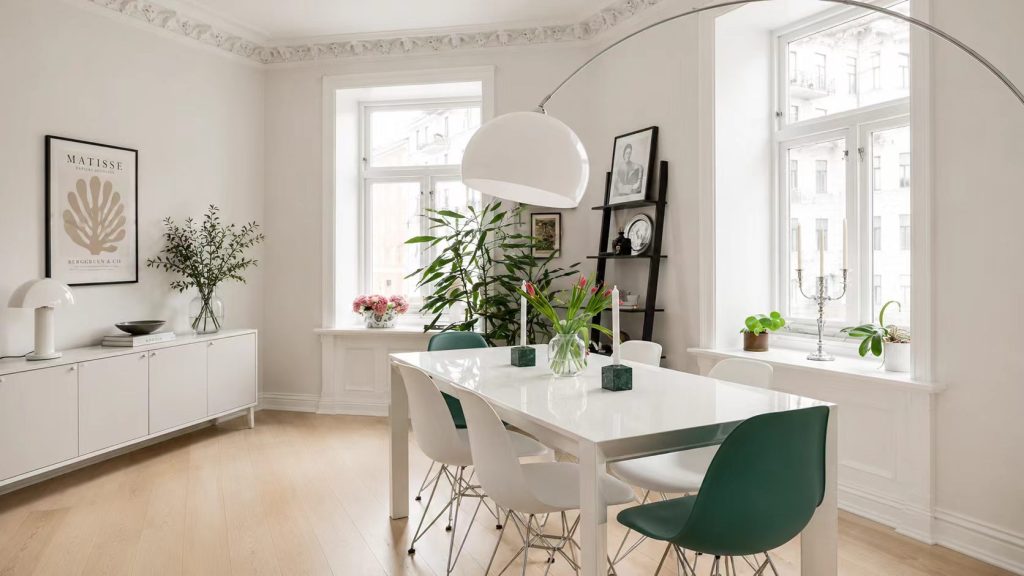
The single most common mistake in narrow dining rooms isn’t the table — it’s the chairs. People buy bulky upholstered armchairs because they’re comfortable in the showroom, then discover those chairs need 30 inches of pull-back space instead of the 24 inches a standard armless chair needs. In a narrow room, that 6-inch difference is the entire difference between workable and unworkable.
The standard chair pull-back numbers, cross-checked against Dimensions.com’s dining room clearance data: a sitting zone needs 18–24 inches, the circulation zone behind needs another 18–36 inches. Total: roughly 36–60 inches from table edge to whatever is behind. In a narrow room you live at the lower end.
Chair choices that work:
- Armless dining chairs, 16–18 inches deep: The workhorse. Tuck fully under the table edge, pull out cleanly, minimal visual mass.
- Backless stools or low-back chairs: Slide all the way under the apron. Best for the long wall side.
- A bench along the wall side: Frees the open side for chairs that need pull-back room. This is a separate decision worth its own thinking — I won’t dive into bench trade-offs here.
Chair choices to avoid: Upholstered armchairs over 22 inches wide, chairs with splayed back legs, anything with arms in a room under 8 feet wide.
One thing narrow rooms penalize hard: visual mismatch. When a dining area is compact, the eye reads everything at once. A coordinated table-and-chair finish family — same wood tone, same metal hardware — does more for the room’s calm than any single design move. Mismatched finishes in 200 square feet don’t read as “eclectic”; they read as cluttered. If you’re sourcing table and chairs separately, at minimum align the leg color and metal finish.
For structural stability — especially with narrow rectangular tables that rely on slim aprons — look for products that reference ANSI/BIFMA X5.5 compliance. That’s the U.S. desk and table structural standard, and a real test reference is more meaningful than “extra sturdy” copy.
FAQ
What size narrow dining table is best for a small or tight room?
For most narrow rooms, a 30–34-inch-wide rectangular or oval table with a length of 55–72 inches is the best fit. This depth gives you 4 comfortable seats — two on the long sides, optionally one at each end — while leaving 36+ inches of walkway on the chair side when the table runs along a wall. Under 28 inches deep gets cramped for plates and serving dishes. Over 36 inches and you’ve lost the narrow advantage.
How much walkway space do I need around a narrow dining table?
You need a minimum 36-inch walkway measured from the table edge to the opposite wall when no traffic passes, and 44 inches when people regularly walk behind seated diners, per NKBA guidelines. Critical detail: measure from the back of a pulled-out chair, not from the table edge. Chairs typically pull back 18–24 inches, so a 36-inch raw clearance shrinks to 12–18 inches of real walkway during meals.
Can a narrow dining table comfortably seat 4 people?
Yes — a narrow dining table can comfortably seat 4 if it’s at least 55 inches long, since each diner needs about 24 inches of elbow width. A 60 × 32 inch rectangle is the most reliable 4-seat narrow geometry: two diners on each long side, with the table either run lengthwise against a wall or floating in the center with chairs on both long sides. Stretching to 6 seats on a narrow table usually requires 72+ inches of length and pulling chairs to the ends.
Is a bench better than chairs for a narrow dining space?
A bench is better than chairs on the wall side of a narrow dining space because it doesn’t require pull-back clearance — you slide in laterally instead of pulling a chair away from the table. This frees the room’s clearance budget for the open chair side. A bench is not better as a full replacement for chairs in narrow rooms, though — climbing past someone in the middle of a bench in a tight space is harder than asking them to scoot a chair. The strongest narrow-room layout pairs a wall-side bench with chairs on the open side.
Conclusion
A narrow dining table only works if the chair geometry behind it works. Start with the walkway, then size the table to protect it. Tape out the room before you buy anything. Pick chairs that match your real pull-back budget. If the math doesn’t work for a fixed narrow table, look at extendable, pedestal, or drop-leaf shapes that solve the same problem with different geometry.
The goal isn’t to fit furniture into a small room. It’s to make a small room feel like a real dining space. Done right, a 7-foot-wide alcove hosts four people for a real dinner without anyone apologizing for the layout.
Related Reading:


