 By Charles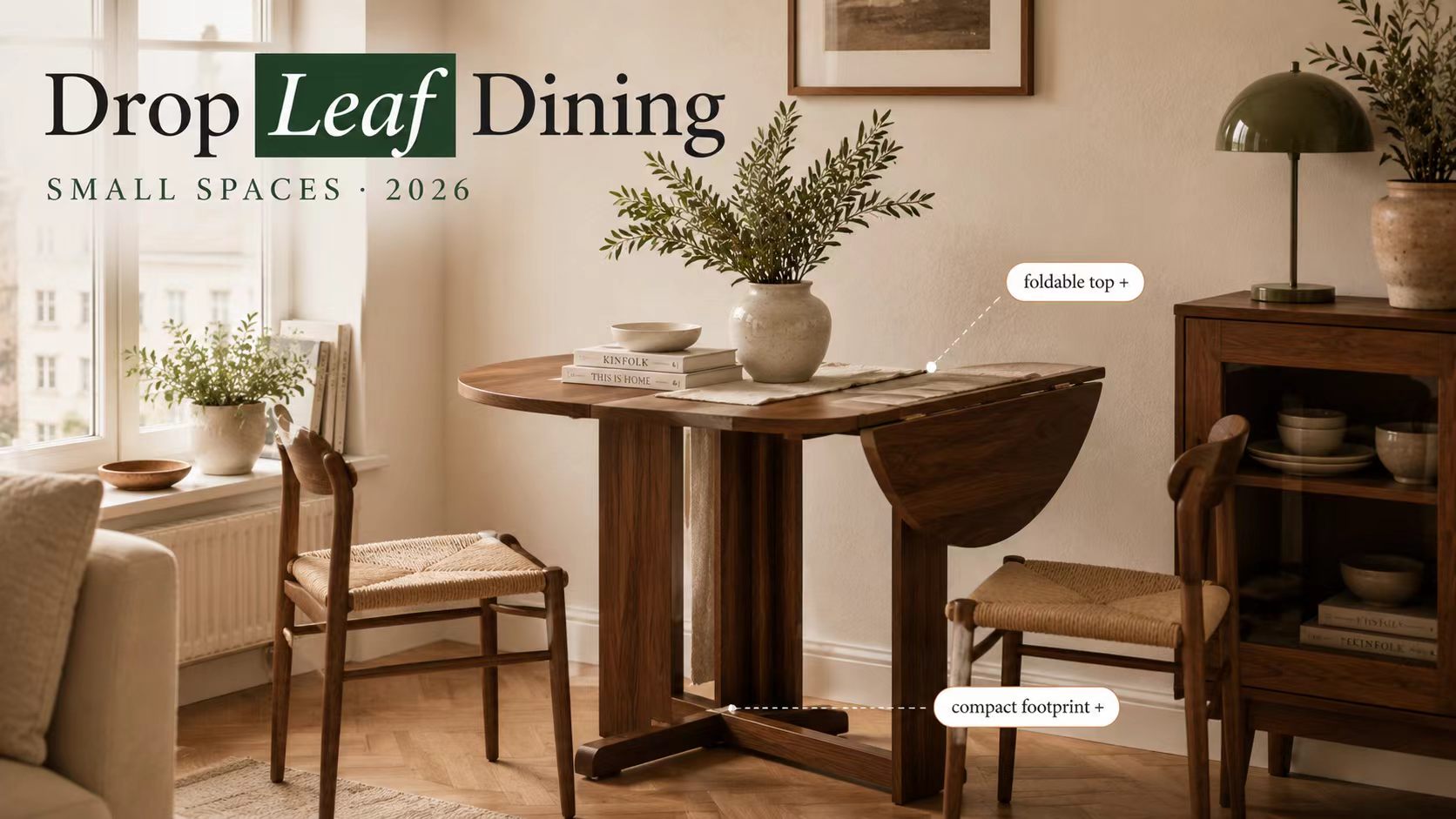
Last spring my younger brother moved into a 480-square-foot studio in Brooklyn. She called me in a mild panic. “Where am I supposed to eat? The ‘kitchen’ is a wall. The ‘dining area’ is a rug.” I told her what I tell everyone in that situation: stop looking at fixed dining tables and start looking at a drop leaf dining table for small spaces. Three weeks and one tape-outline experiment later, she has a real place to eat, a real surface to work from, and somehow still enough floor to do yoga without flattening a chair.
That’s the whole pitch of this furniture category — and also where most blog posts stop being useful. They tell you drop leaf tables “save space.” They don’t tell you the folded depth, the hinge type, or whether the thing actually stays still while you cut a steak. I want to fix that here.
When a Drop Leaf Dining Table Makes Sense
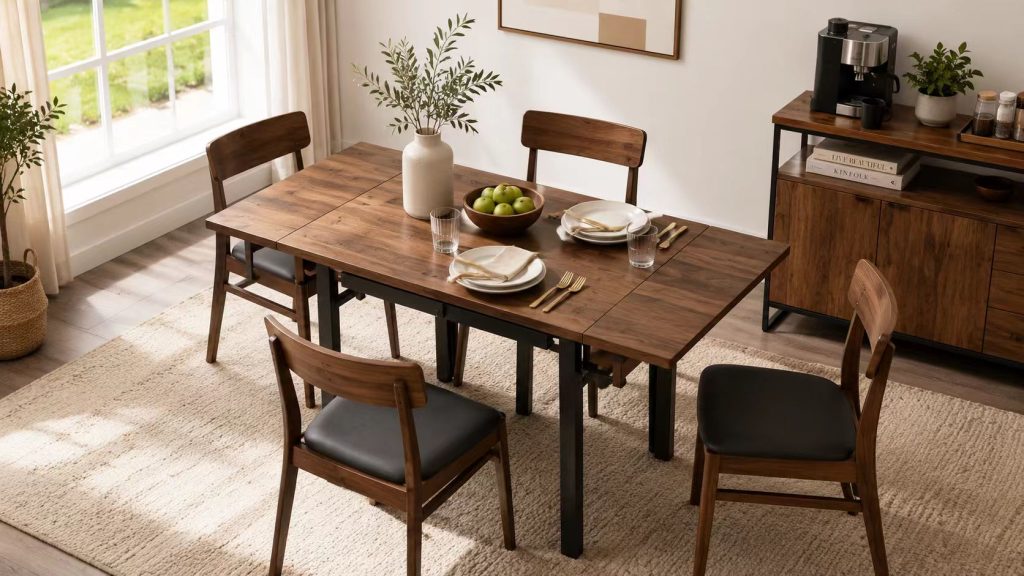
A drop leaf table is one with one or two hinged side panels that fold straight down against the frame when you don’t need them. Lift them up, slide a swing-arm or gateleg support underneath, and you get a full dining surface back. The math is simple: 70–80% of the time you live with the small footprint, and the other 20–30% you eat or host on the big one.
That’s the right shape for a few specific situations. Studios where the table doubles as a desk and only becomes a “dining table” at 7pm. Eat-in kitchens where the wall between counter and seating is under 60 inches. Galley-shaped condos where a fixed 60″ rectangle would block the only walkway to the bedroom. If your kitchen sits right next to your bed or your sofa, material matters more than it would in a separate dining room — your breathing zone is two feet from the tabletop. I won’t buy anything in this category without seeing FSC certification on the wood and a CARB Phase 2 rating on the finish. That’s the baseline, not the bonus.
Who should skip a drop leaf entirely: families who eat dinner together every single night with both leaves up. At that point you’re operating it as a fixed table anyway, and a regular extendable model gives you more stability per dollar.
Best Small-Space Layouts
Studio Apartments
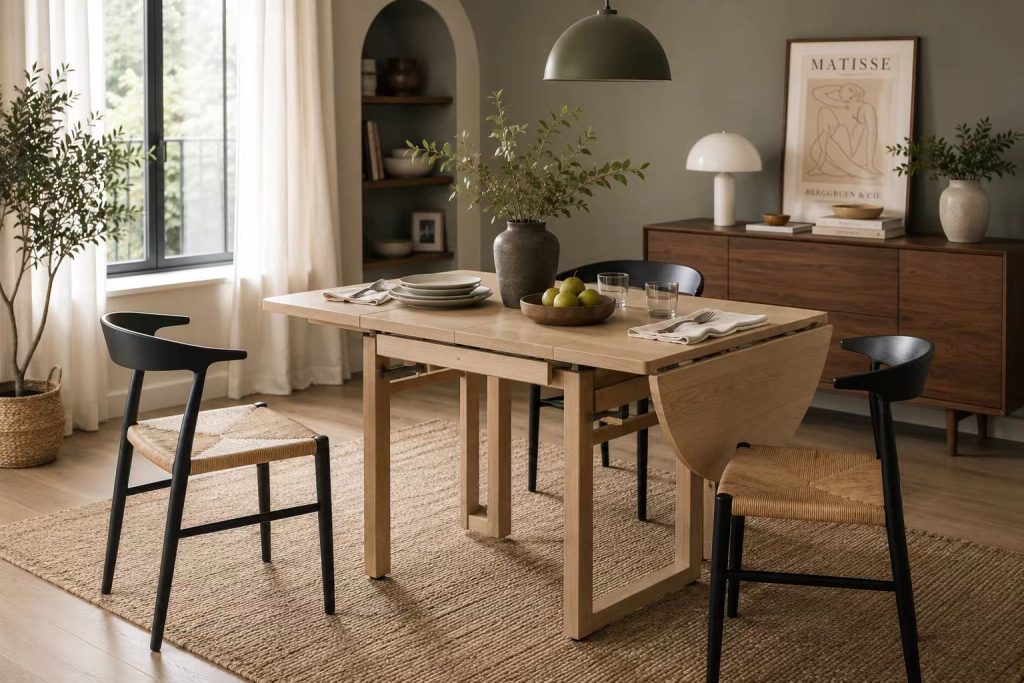
In a true studio, your table is never just a table. It’s your laptop desk by day, your dinner spot by night, and your “where do I put the pizza box” surface at midnight. Push the folded table flush against a wall — most drop leaf designs collapse to between 14 and 22 inches deep, which is roughly the footprint of a console table. That leaves the room readable as a living space, not a perpetual dining setup.
For a one-person or couple studio, I’d shortlist a small round drop leaf (when one leaf is up, you get a half-circle against the wall; when both are up, a full circle for four). Round geometry forgives placement mistakes. You can pull the table six inches off the wall for two people, or slide it into the room’s center for four, and it never looks orphaned. POVISON’s dining tables collection carries small-footprint round and oval shapes that ship fully assembled, which matters more than people realize — drop leaf hardware is the part most prone to going wrong when an end user tightens hinges themselves.
Eat-In Kitchens
Eat-in kitchens have their own rule: you need a real walkway behind the seated diner. The NKBA recommends a minimum 36-inch walkway clearance and 32 inches of clearance behind a chair if no traffic passes, 36 inches if it does. Run those numbers against your actual room before you fall in love with a 48″ round.
Practical setup: park the folded drop leaf against the long wall opposite your counter, with both chairs tucked in. When dinner happens, lift one leaf, pull the table eight inches into the room, and you’ve got a workable two- or three-seat spot without violating the walkway rule.
How to Measure Folded and Expanded Space
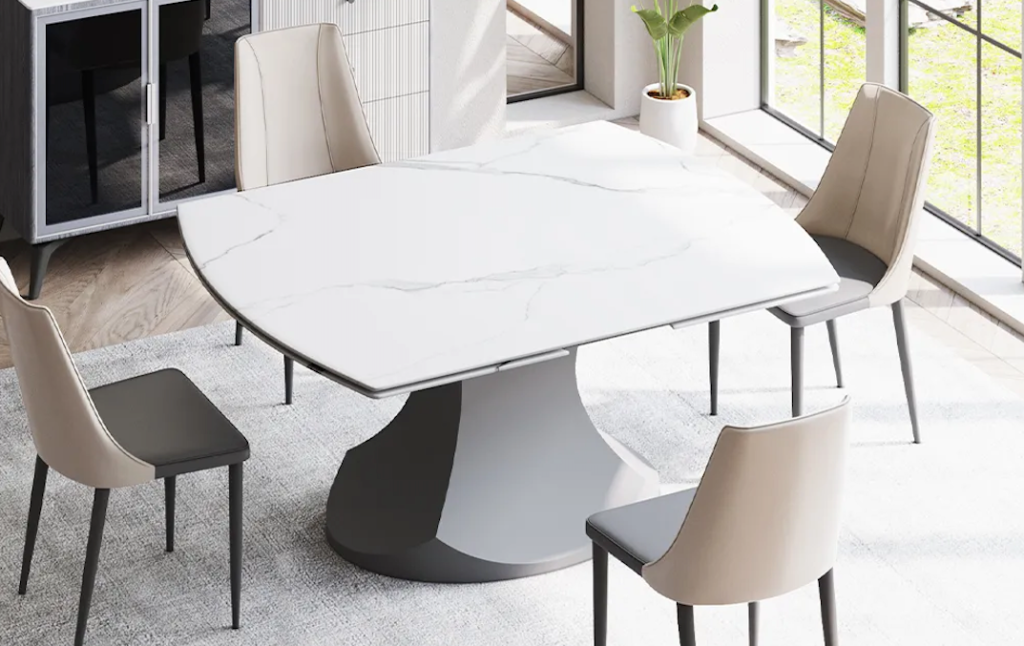
This is the step everyone skips, and it’s the step that decides whether your table works on day one. Charles’s standing rule: tape it out before you click buy.
Grab painter’s tape. On your actual floor, mark out three rectangles:
- Folded footprint — for most drop leaf tables, this is roughly 14″ to 22″ deep × 36″ to 48″ wide. The depth is what determines whether you can walk past it.
- One leaf up — depth roughly doubles, but on the room’s narrow axis you’ve still cleared the walkway. Useful for two diners on a weeknight.
- Both leaves up (full) — typically 36″ to 48″ deep × 48″ to 60″ wide. Add 30 inches of chair clearance on every side where someone sits.
Stand in each configuration. Walk the path you actually walk — fridge to sink, bedroom door to bathroom — and confirm you’re not threading a needle. I’ve watched people buy a beautiful 54″ round drop leaf and discover their kitchen door no longer opens past it. The tape catches that in five minutes.
One more measurement nobody talks about: leaf swing radius. When the leaf is flipping up or down, it sweeps through an arc. If you store the folded table six inches from a wall, that wall is going to take scuff marks every time you raise the leaf. Park it eight to ten inches off any wall during operation.
Drop Leaf vs Folding vs Extendable Tables
The vocabulary in this category is genuinely confusing. Here’s the honest comparison.
| Feature | Drop Leaf | Folding | Extendable |
| Folded depth | 14–22″ (leaves hang vertically) | 2–6″ (entire table collapses) | Full table depth always |
| Setup time | 5–15 seconds per leaf | 1–3 minutes (legs unfold) | 30–90 seconds (pull + insert leaf) |
| Stability when open | High — fixed legs, hinged top | Moderate — depends on locking legs | Highest — engineered for seated use |
| Best for everyday use | Yes, if leaves stay up | No, intended for occasional use | Yes |
| Storage when not in use | Stays in room as console | Folds flat to a closet | Stays in room at compact size |
| Typical price range | $250–$900 | $80–$300 | $400–$2,000+ |
Drop leaf is a hybrid: it lives in the room full-time (no closet storage required) but shrinks meaningfully. Folding tables are for people whose “dining room” is a hallway closet. Extendable tables assume you have a dining footprint that’s already adequate and you just need to upsize for guests. They are not interchangeable categories, and most “best small space dining table” lists pretend they are.
Stability and Daily Meal Trade-Offs
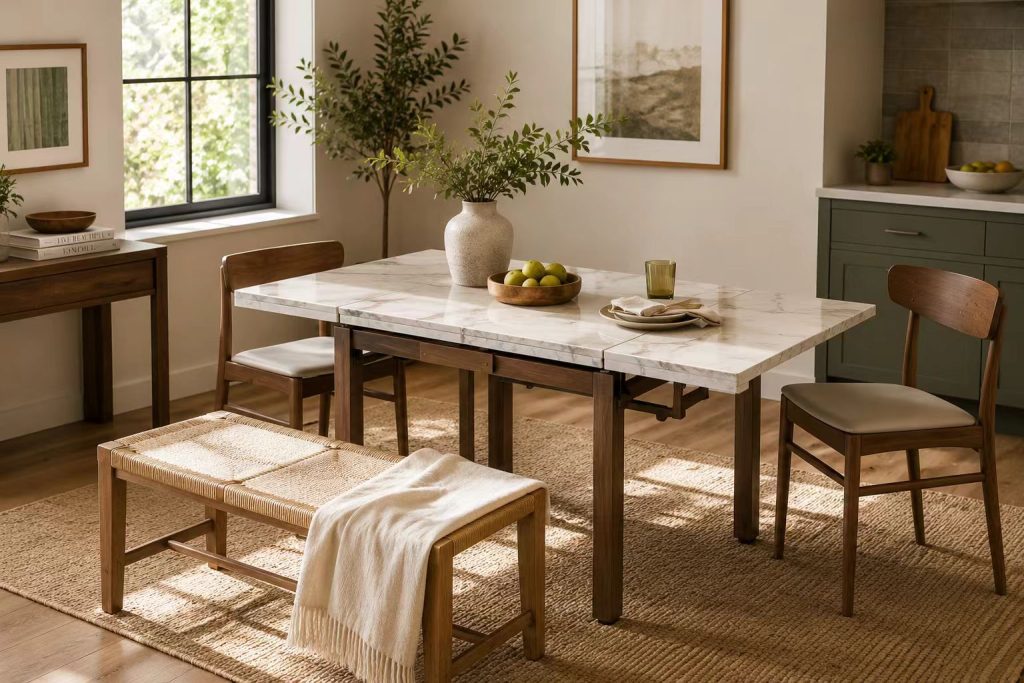
Here’s the part of drop leaf shopping where the cheap ones fall apart. The leaf isn’t just a flap — it has to lock into the main top so tight there’s no visible seam and no wobble. Three hinge systems dominate the market:
- Rule joint hinge — the leaf and main top are cut so they nest like puzzle pieces, with the hinge concealed underneath. This is the heritage design, mechanically the strongest, and what you want on a table you’ll eat at five nights a week.
- Butterfly hinge (drop leaf hinge) — a flat metal plate on the underside. Common on mid-range tables. Functional, but the leaf can flex more under pressure (think: leaning on the edge while you reach for the salt).
- Plain butt hinge — visible from underneath, weakest in the category. Fine for occasional use, not great as a daily eating surface.
The support under the lifted leaf matters equally. Gateleg designs swing a whole leg out to support the leaf — most stable, but the leg takes floor space when deployed. Swing-arm brackets (a flat wooden bracket that pivots from the apron) save floor space but rely entirely on the hinge holding tight over time. Fixed pedestal with cantilevered leaf looks the cleanest but only works on smaller leaf spans — physics catches up with anything wider than about 10 inches of unsupported overhang.
For structural performance, ANSI/BIFMA X5.5 is the U.S. standard for desk and table products and covers stability, leg strength, and top retention testing. If a manufacturer’s product page lists adherence to this standard, that’s a real signal. If it says “extra sturdy” with no test reference, that’s marketing.
One more piece I always check: assembly state. Drop leaf hardware is the most common warranty complaint in this entire category, and almost every issue traces back to user-installed hinges that were under- or over-tightened during flat-pack assembly. Tables that ship fully assembled (legs attached, hinges calibrated, supports tested at the factory) skip that whole failure mode. Worth the premium, in my honest experience.
FAQ
Is a drop leaf dining table a good solution for a studio apartment or very small kitchen?
Yes, especially if your space is under 500 sq ft and the table needs to serve multiple roles — desk by day, dining surface by evening. Drop leaf tables collapse to a slim 14–22 inch depth, functioning like a console most of the time while expanding when needed. They work best for 1–2 people daily who occasionally want to seat 3–4. Skip them if you eat with the leaves up every single night, as a standard table or extendable option may offer better everyday stability.
How do I choose between a drop leaf, folding, or extendable table for my small space?
Drop leaf tables are ideal when you want the table to stay in the room full-time but shrink significantly. Folding tables collapse almost flat for closet storage but take longer to set up and feel less stable for regular meals. Extendable tables suit slightly larger footprints where you mainly need occasional extra seating. Consider your daily habits: if the table lives in the room 70–80% of the time folded, a drop leaf usually wins for convenience and aesthetics.
How do I keep a drop leaf table stable and wobble-free over time?
Focus on careful daily use — always engage the support leg or bracket fully when raising a leaf, and avoid leaning heavily on the edges. Periodically check and gently tighten hinges and brackets. For best longevity, choose models with rule joint hinges and gateleg supports, and clean the mechanism occasionally to prevent dust buildup. Many owners find that proper support usage keeps the table solid even after several years of regular operation.
What should I do if the leaves on my drop leaf table start sagging or the hinges loosen?
First, inspect the hinges and supports for proper alignment and tighten any screws as needed. Minor sagging can often be fixed by adjusting the swing-arm brackets or adding felt pads. For persistent issues, contact the manufacturer — quality tables usually include a 1–2 year warranty covering hardware. Preventing problems is easier: always lift leaves with support underneath and avoid overloading one side.
How much space should I plan for when using a drop leaf table in different configurations?
Carefully measure for all three states: fully folded (console depth), one leaf up, and both leaves extended. Follow NKBA guidelines of 36 inches clearance for walkways and test everything with painter’s tape on your floor for a couple of days. Leave 8–10 inches from walls when raising/lowering leaves to avoid scuffs. This planning ensures the table feels seamless in your daily routine while providing enough surface when you need it.
Conclusion
A drop leaf dining table earns its place in a small space when you respect what it is: a piece of furniture that lives in two modes, not one. Measure both modes before you buy. Read the hinge spec, not the marketing copy. And in a tight room where the table sits a few feet from where you sleep, breathe, and work, don’t compromise on the certifications behind the materials.
If you’re working through this decision and want to see what fully assembled options actually look like at small-space dimensions, browse POVISON’s dining tables collection — every piece ships pre-assembled with factory-calibrated hardware, so the hinge system you spec is the hinge system you get. That single detail removes most of the failure modes I see in this category.
Related Reading:


