 By Kelvin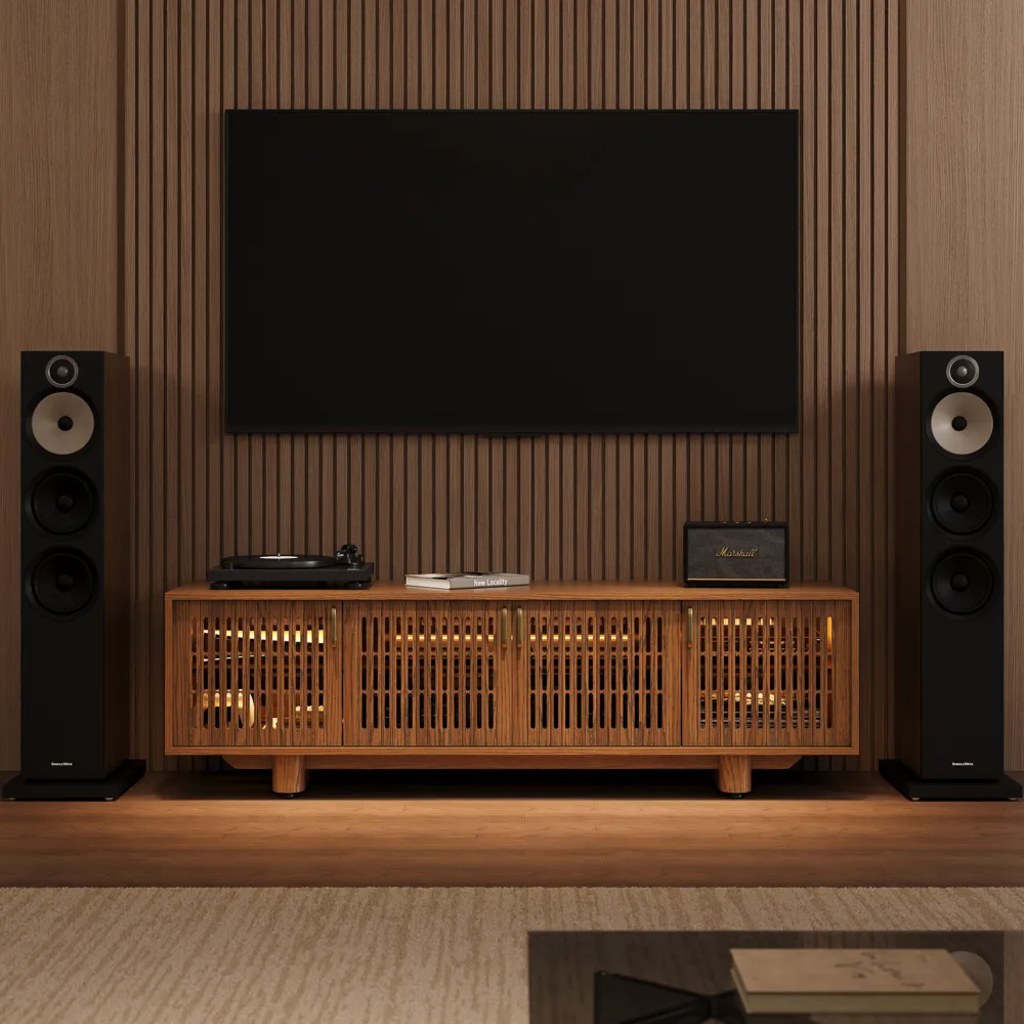
Introduction
A minimalist TV stand should make your entertainment area easier to live with, not simply look sparse in a product photo. The right design balances clean proportions with enough storage for cables, remotes, streaming devices, and other equipment. This guide explains how to evaluate size, storage, materials, installation type, and everyday function before buying. It also compares five stands for different room setups, from wall-mounted TVs in compact apartments to equipment-heavy media rooms that need deeper, better-ventilated cabinets.
Table of Contents
What Makes a TV Stand Truly Minimalist?
The right minimalist TV stand reduces visible clutter without removing the functions your household actually uses. White paint, handle-free doors, or a floating installation can support the look, but none of those details makes a poorly planned cabinet practical.
The most useful minimalist design principles focus on visual control:
- A simple horizontal silhouette with limited projections
- Few visible handles, hinges, seams, or decorative breaks
- A controlled mix of colors and materials
- Storage that gives remotes and accessories a fixed place
- Cable openings positioned behind actual equipment
- Proportions that balance the TV without filling the entire wall
The best shapes and materials depend on the room. A low rectangle usually creates a calmer horizontal line than a tall cabinet. Walnut and light oak can feel as restrained as white or matte black when the grain, hardware, and door pattern remain consistent.
Avoid choosing a unit only because its listing describes it as “minimal.” A narrow open shelf may appear light in an empty room, yet quickly look busy once it holds a router, game cases, controllers, and loose cords. A slightly larger cabinet with well-planned closed storage can produce a cleaner final result.
How Do You Choose the Right Size and Proportion?
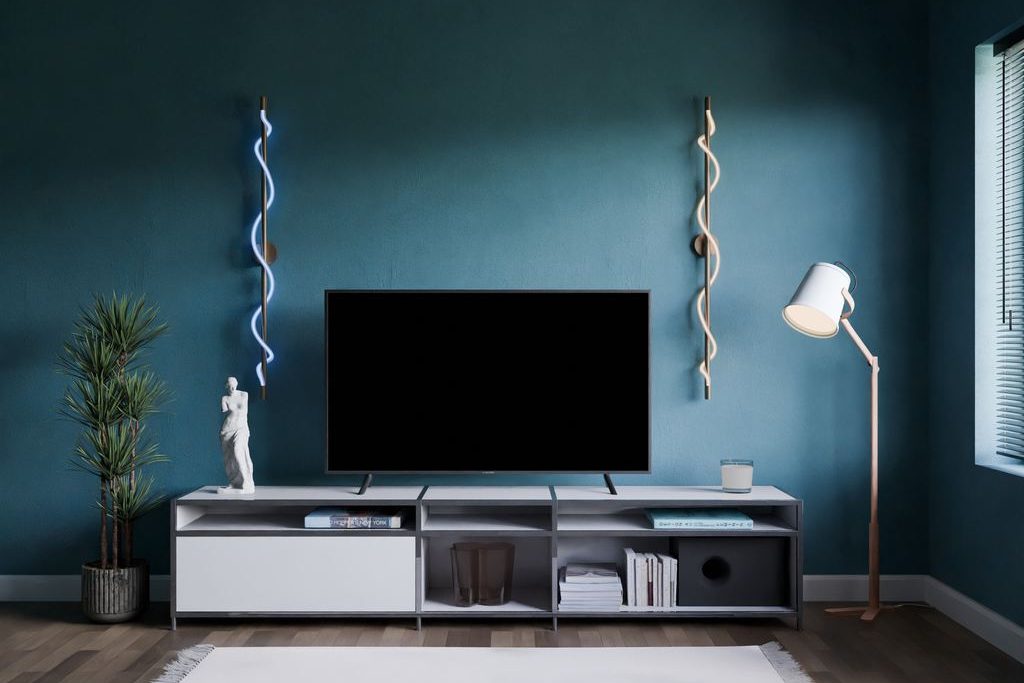
Start with the television’s actual edge-to-edge width. Screen size is measured diagonally, so a “65-inch TV” is not 65 inches wide. For a floor-standing setup, the console should generally extend beyond the screen on both sides. This creates a more stable visual base and leaves usable space around the TV feet.
Measure these five areas before shopping:
- TV width: Measure the complete screen and frame.
- Base footprint: Check the distance between the TV feet and their front-to-back depth.
- Available wall: Leave room for doors, vents, walkways, and nearby furniture.
- Seated eye level: The screen center should feel comfortable from the sofa, not just from a standing position.
- Equipment depth: Include plugs and the space cables need to bend behind each device.
A TV stand size guide for 55- to 85-inch TVs is useful once you know the television’s real measurements. It should support your room-specific calculation rather than replace it. A wide console can still be unsuitable if the top is too shallow for the TV feet or the screen sits too high above a deep sectional.
Wall-mounted televisions need the same proportional planning. The cabinet no longer supports the screen, but it still anchors the wall visually. A short console directly under a wide television can appear disconnected, while an oversized cabinet may leave no breathing room beside bookshelves, doorways, or floor lamps.
Which Storage Keeps the TV Area Clutter-Free?
Before comparing doors and finishes, list everything that will live around the television. Include the soundbar, router, streaming box, game console, controllers, remotes, power strip, spare cables, and any items that currently collect on the coffee table.
Open storage works well for equipment that needs frequent access or unrestricted airflow. Its drawback is that every device, indicator light, and cord remains visible. Fully closed cabinets create a quieter front but require more careful checks for ventilation, remote signals, and rear access.
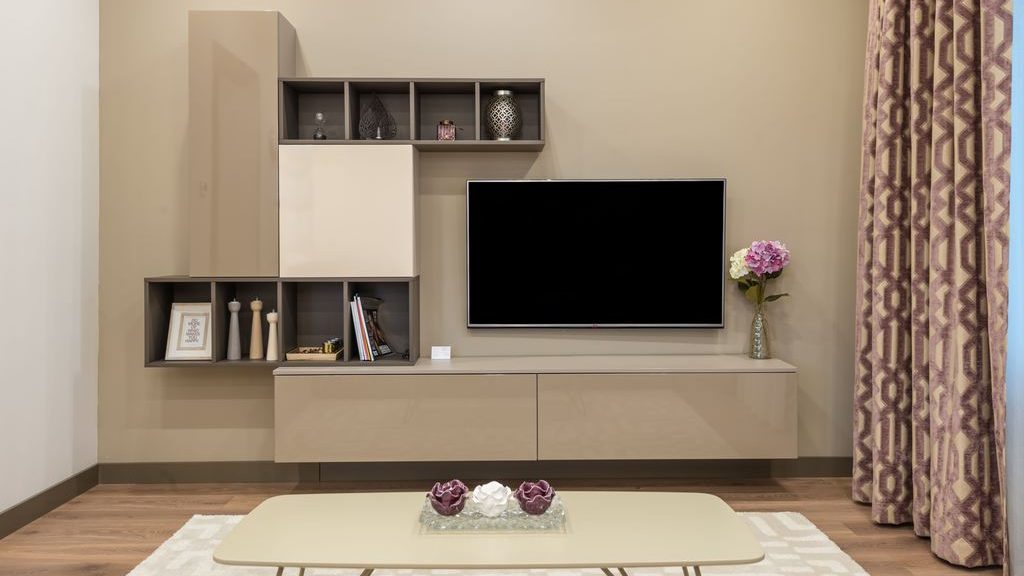
Mixed storage is often the most practical compromise. An open bay can hold a soundbar or frequently used game console, while doors hide controllers, manuals, and less attractive equipment.
Do not rely only on the cabinet’s exterior depth. Check:
- Interior width, height, and usable depth
- Space lost to hinges, door tracks, and fixed dividers
- Adjustable or removable shelves
- Rear ventilation openings
- Cable holes in each equipment compartment
- Clearance for power plugs and HDMI connectors
- Access to the wall outlet after installation
A plan for TV stand cable management with hidden wires should route cords directly through the cabinet back rather than around its sides. If you change game systems or streaming equipment regularly, removable panels and reachable cable openings matter more than an uninterrupted back panel.
One realistic test is to photograph your current setup before shopping. If the photo shows six devices and a large power strip, an ultra-shallow cabinet with two small compartments is unlikely to remain clean, regardless of how simple it looks online.
Best Minimalist TV Stands for Different Setups
No single design works equally well for small apartments, wall-mounted screens, soundbars, and deep AV receivers. The following five products represent different types rather than five versions of the same cabinet. Compare the use case first, then evaluate the finish and proportions.
| Product | Best For | Type | Main Strength | Check Before Buying |
| POVISON Arboren-71” TV Stand | AV receivers and home theaters | Deep floor console | Flexible, ventilated equipment storage | Requires more floor depth |
| POVISON Merrin-63″ Black Floating TV Stand | Wall-mounted TVs and small rooms | Floating console | Clears visible floor space | Wall installation is required |
| POVISON Ravenna-71” Minimalist Slatted Media Console | Warm interiors and soundbars | Raised-leg slatted console | Combines closed storage with signal flow | Not an ultra-low design |
| Article Lenia 63″ Low Media Unit | Light everyday media setups | Low-profile wood console | Quiet proportions and compact depth | Limited space for deep equipment |
| IKEA BESTÅ TV Units | Changing storage requirements | Modular TV unit | Configurable layout and installation | Components may be sold separately |
A floating vs. floor TV stand comparison can help narrow the installation type before comparing individual products. Floating cabinets reduce floor-level visual weight, while floor consoles are easier to relocate and can offer deeper storage.
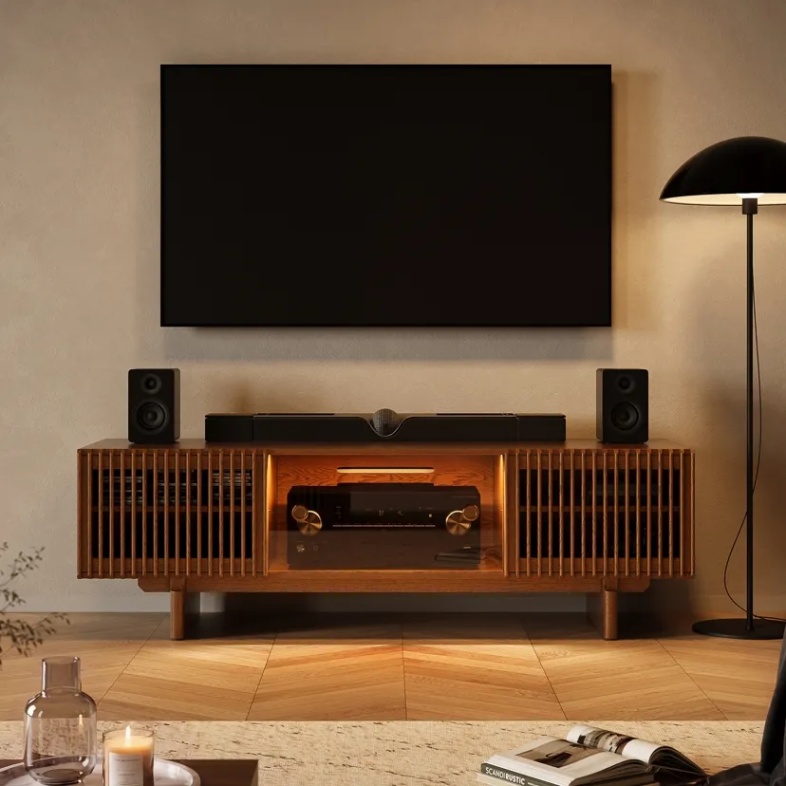
Best for AV Equipment: POVISON Arboren-71” TV Stand
A living room with an AV receiver, game system, and several source devices needs more than an attractive shallow cabinet. Arboren provides an 18.3-inch internal depth, adjustable or removable shelves, rear ventilation, and a clear tempered-glass center door that allows infrared remote signals through while the cabinet stays closed.
Its 22-inch overall depth requires more floor space than a slim console. Measure the walkway in front of it and include the receiver’s rear plugs when checking whether the interior is deep enough.
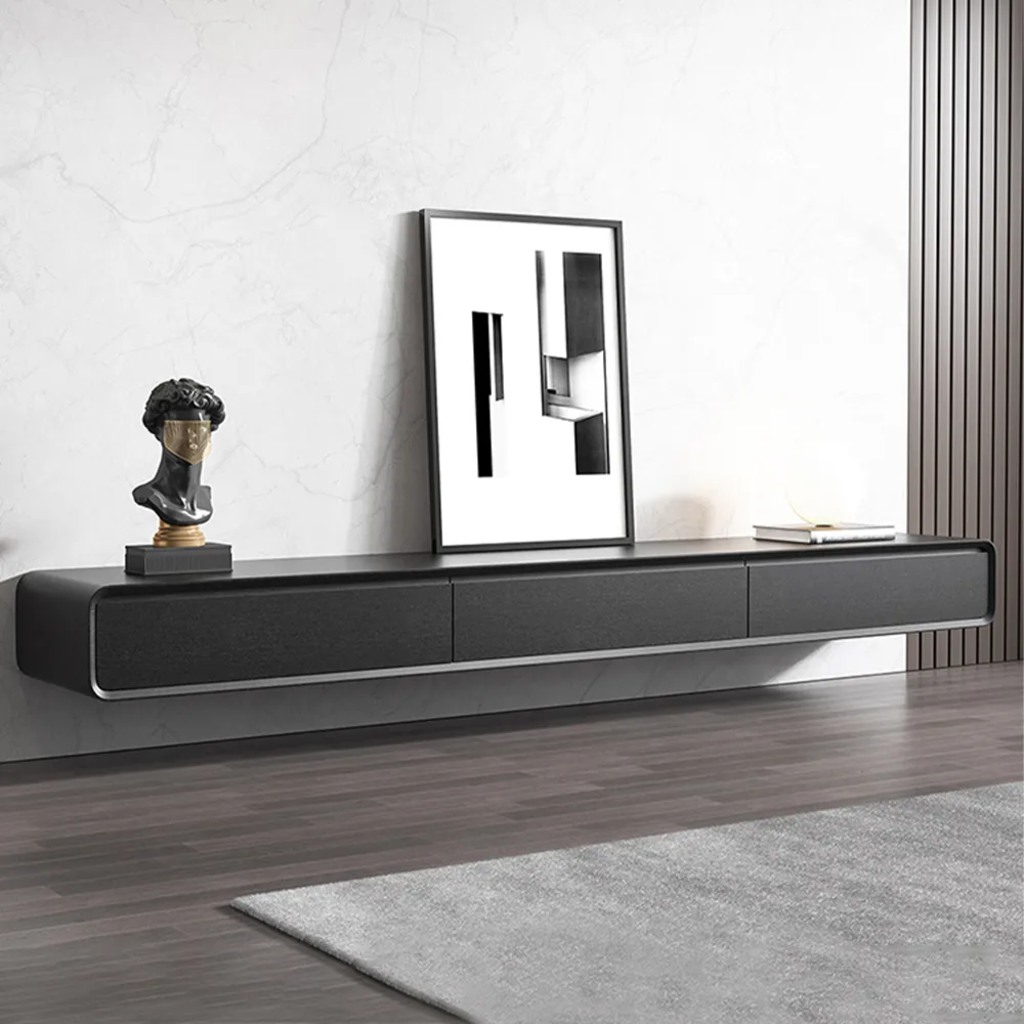
Best Floating Design: POVISON Merrin-63″ Black Floating TV Stand
Merrin suits a wall-mounted television in a compact living room where visible floor area helps the layout feel less crowded. Its shallow floating body contains three closed cabinets for controllers, remotes, and small accessories, while the mounting height can be adjusted to the television and seating position.
The cabinet arrives assembled, but it still requires secure wall installation. Confirm the wall structure, fastener requirements, outlet location, and total loaded weight before deciding where to mount it.
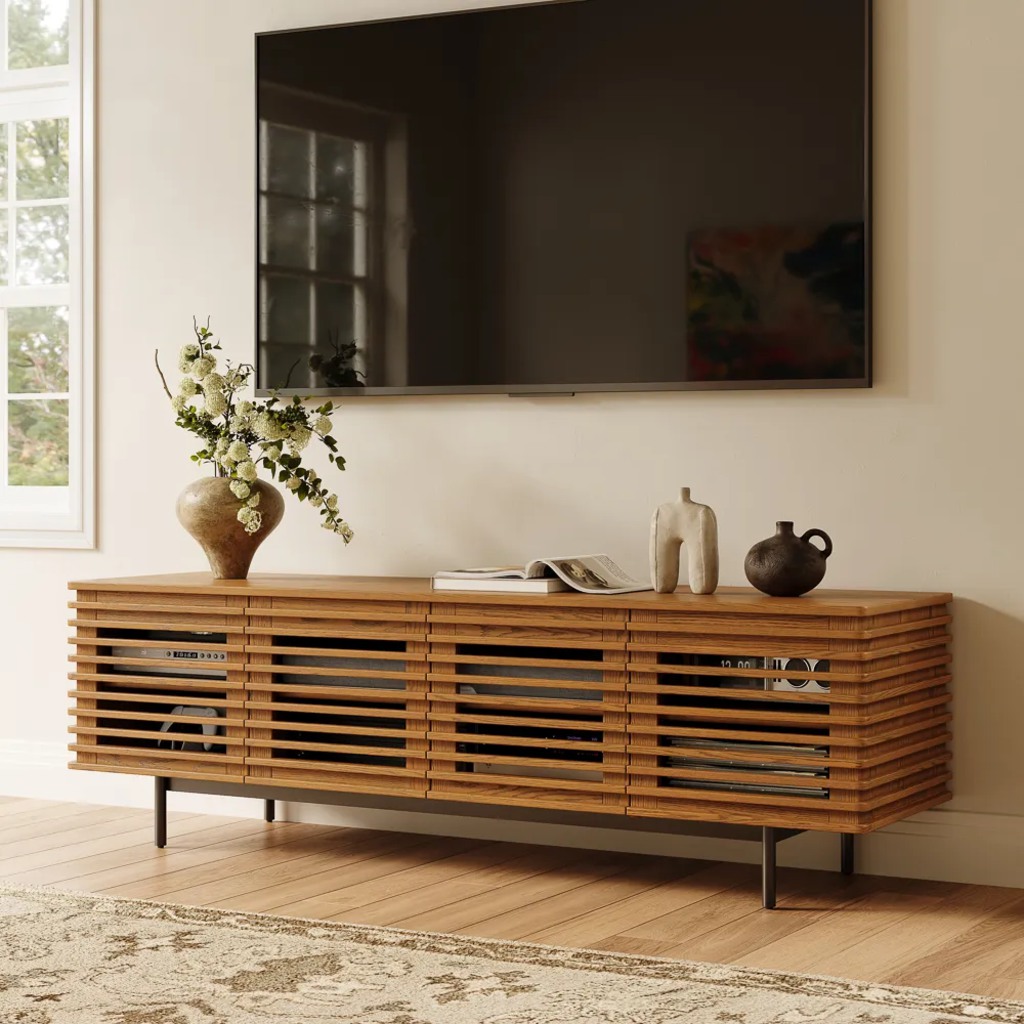
Best Warm Minimalist Design: POVISON Ravenna-71” Minimalist Slatted Media Console
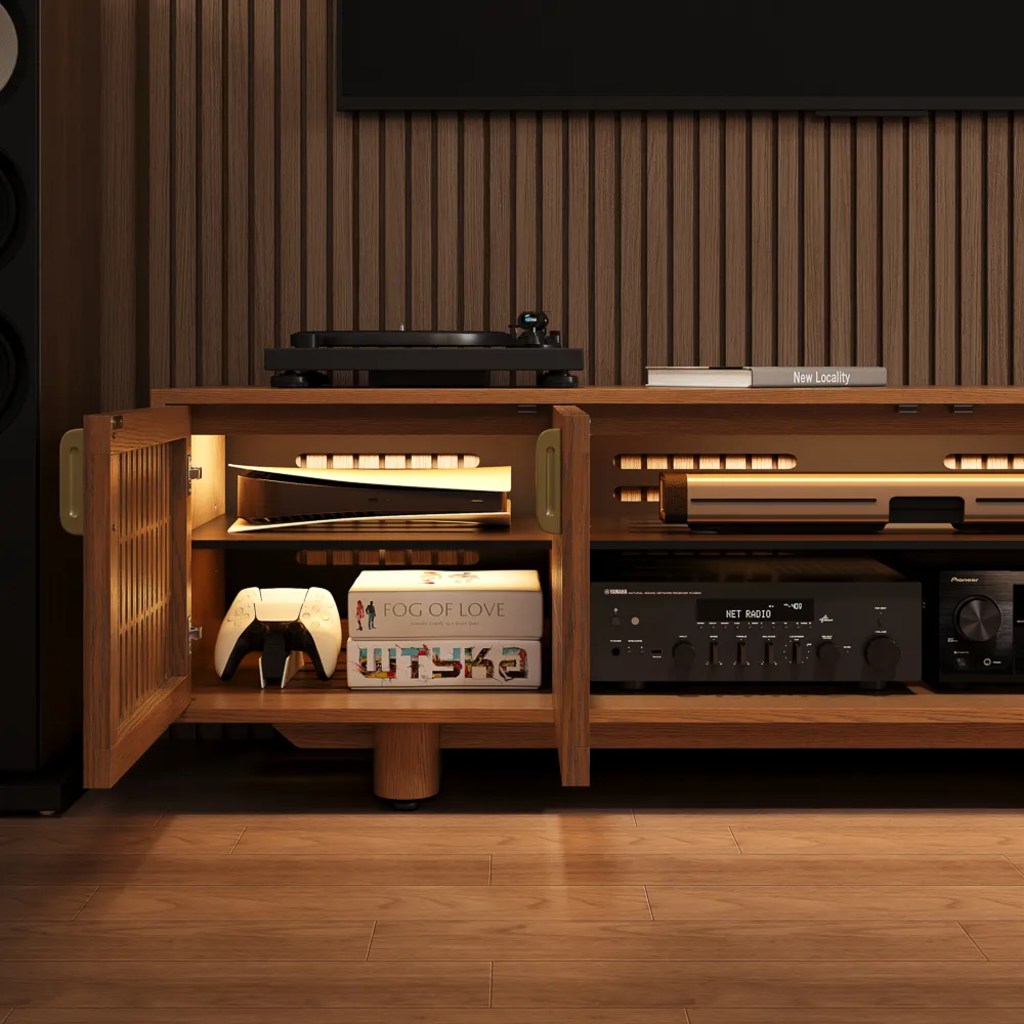
Ravenna fits rooms that need visual warmth without exposed electronics. Its walnut-colored ash veneer, raised metal legs, and continuous slatted doors keep the front orderly while allowing sound and infrared signals to pass. Removable shelves and multiple internal and rear cable holes support soundbars and everyday media equipment.
At about 22 inches high, it creates a more furniture-like presence than an ultra-low console. Check the resulting screen height when placing a TV directly on top.
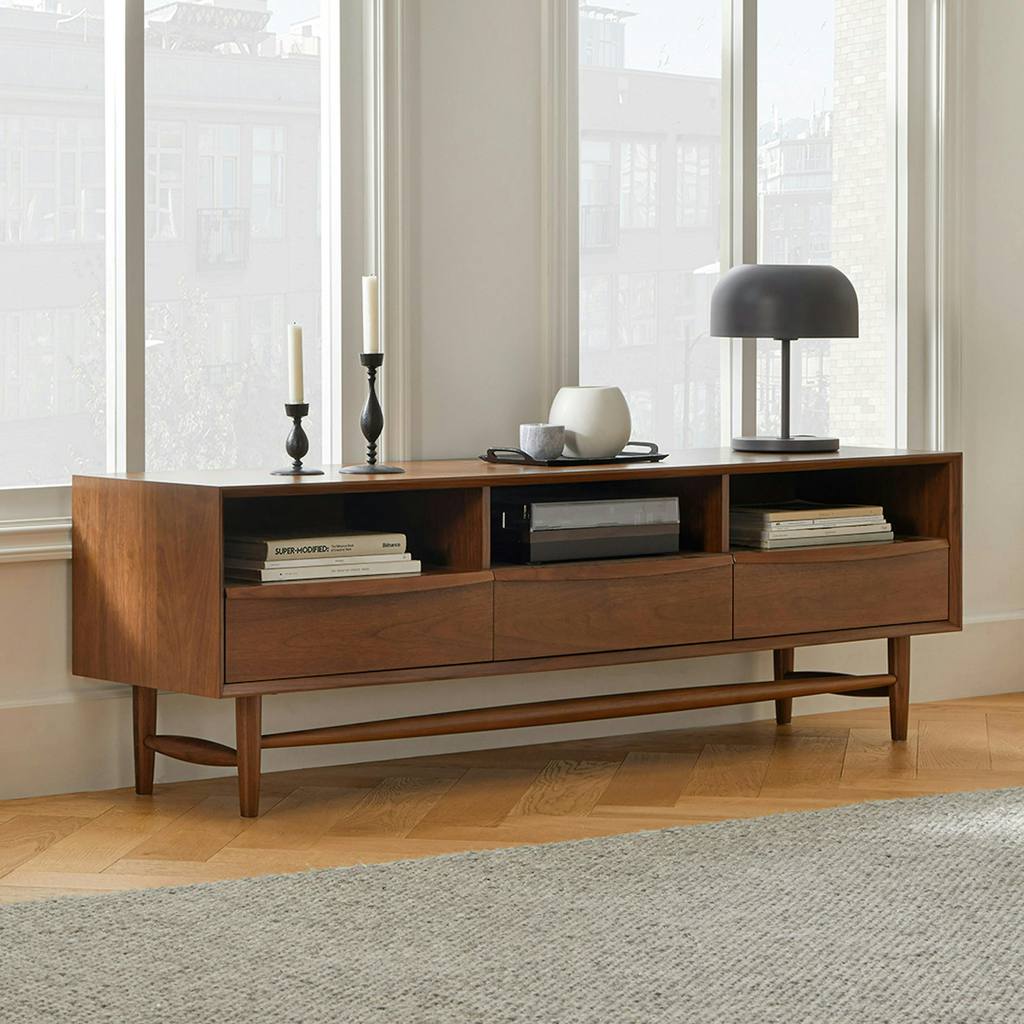
Best Low-Profile Wood Console: Article Lenia 63″ Low Media Unit
Article’s Lenia works for a smaller living room with a streaming box, a few accessories, and no large receiver. Its 63-inch width, 20-inch height, and 16-inch depth create a restrained wood profile without taking the wall-mounted look of a floating cabinet.
The compact depth is part of its appeal, but it also limits equipment capacity. Measure consoles and plugs carefully before assuming the exterior width guarantees enough usable room.
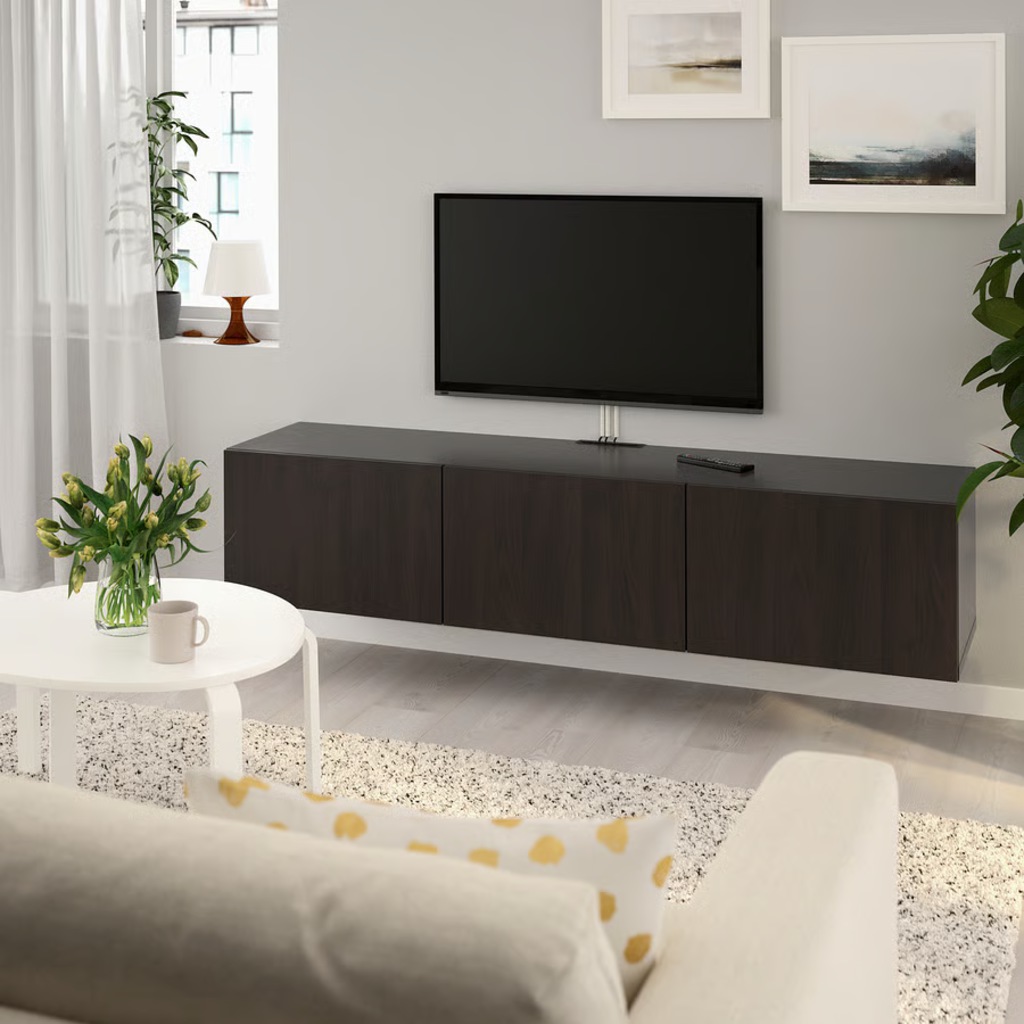
Best Modular Storage: IKEA BESTÅ TV Units
BESTÅ suits renters, first homes, and households whose storage needs may change. The 70⅞-inch TV unit can stand on the floor or mount on the wall, and its cable outlet routes wires into the frame. Doors, hinges, interiors, and some supports are selected separately, allowing greater control over the final layout. (IKEA)
That flexibility requires planning. Review every included component before ordering, especially when adding doors, legs, interior shelves, or a wall-mounted configuration.
What Should You Check Before Buying?
Use this final checklist after narrowing the design. It catches practical problems that are difficult to fix once a heavy console has been delivered.
- Confirm the TV’s actual width, weight, and base footprint.
- Measure the wall, floor depth, and nearby walking path.
- Check the cabinet’s interior dimensions, not only its exterior.
- Add the depth of plugs and curved cables to each device.
- Confirm that shelves can accommodate tall or wide equipment.
- Locate the cable holes in relation to each planned device.
- Check airflow around game systems and AV receivers.
- Confirm whether remote signals work through closed doors.
- Review wall requirements for floating units.
- Check what assembly, lifting, and anchoring are required.
- Leave enough clearance for baseboards and wall outlets.
- Make sure a robot vacuum can pass under raised legs if that matters.
Treat product photography as inspiration, not proof of capacity. A cabinet shown with one streaming box may be used very differently in a family room with two consoles, a router, a soundbar, and charging cables.
When Is a Minimalist TV Stand the Wrong Choice?
The style itself is rarely the problem. The key mistakes to avoid come from prioritizing a thin silhouette over the room’s real equipment and storage needs.
An extremely shallow unit may be wrong when you own a large receiver or need frequent rear-cable access. A fully closed cabinet may be unsuitable when it lacks ventilation. A floating design becomes impractical when you cannot drill into the wall or when the installation surface cannot support it.
Minimal storage can also work against a clean interior when the living room has no bookcase, sideboard, or other closed cabinet. In that situation, a slightly deeper media console may create less visible clutter than a narrow unit that forces everyday items onto its top.
Conclusion
Choosing a minimalist TV stand is less about finding the sparsest cabinet and more about giving every device, cord, and everyday item a controlled place. Start with the television’s true dimensions, then compare internal storage, ventilation, cable access, and installation requirements. A floating unit can lighten a small wall, while a deeper floor console may create a cleaner result in an equipment-heavy room. When the proportions and functions match how the room is actually used, the simple exterior is much easier to maintain.
Frequently Asked Questions
Can a sideboard be used as a minimalist TV stand?
Yes, when its height, weight capacity, and top depth fit the television. Also check for rear cable openings and ventilation. Many sideboards are taller than media consoles and were not designed for electronics, so confirm the resulting screen height and equipment access before using one.
Should the console match the wall or the television?
Matching the wall color makes the cabinet visually recede, while black or dark wood can connect it to a large black screen. Neither approach is automatically more minimal. Choose based on whether you want to reduce the visual presence of the cabinet or soften the contrast created by the television.
How much decor should go on the console?
Keep enough open surface to frame the screen and access equipment. One low group of objects or one substantial vase is often more controlled than several small accessories spread across the top. Do not block the screen, soundbar, ventilation openings, or infrared receiver with decorative pieces.
Is a low TV console suitable for a bedroom?
It depends on the viewing position. A person watching from bed usually has a higher eye level than someone seated on a sofa. Measure from your normal supported position and place the screen center near that sightline. An extremely low unit may be comfortable in a living room but awkward opposite a tall bed.
Can a soundbar sit inside a closed TV cabinet?
A soundbar should not sit behind a solid cabinet door because the door can muffle dialogue and alter how sound spreads through the room. An open shelf or acoustically transparent slatted or fabric front is more suitable. Keep the speaker close to the front edge and avoid placing objects directly in front of it.


