 By Jenny Smith
A high quality dining table is more than a surface for plates; it’s the daily hub for meals, homework, laptop time, and late-night talks. When the top stains easily, the base wobbles, or the finish chips, you feel it every single day. Upgrading to a high quality dining room table means better stability, a warmer look, and a piece that can grow with your family.
Why a High Quality Dining Room Table Is Worth the Investment
A good dining table is one of the few pieces you’ll use every day for a decade or more, so cost per use quickly beats cheaper options. U.S. households already spend around $2,500 a year on household furnishings and equipment, so it makes sense to direct part of that toward a durable table instead of frequent replacements (U.S. Bureau of Labor Statistics). When I finally replaced my shaky budget table with a solid wood option, the difference in silence, comfort, and confidence hosting friends was instant.
Key Materials That Define a High Quality Dining Table
Solid Wood vs Veneer vs Engineered Wood – What Really Matters
Hardwoods such as oak, walnut, maple, and ash offer weight and warmth and can be sanded to remove scratches. Wood veneer can also be great, but only when it has a real-wood layer over a stable core like plywood, MDF, or a similar material. Problems usually come with low-grade particle board and cheap composites that can easily chip and swell with moisture. Always check the underside and small chips to see what lies under the finish.
| Material | Durability | Look & Feel | Repairability | Typical Lifespan* |
| Solid hardwood | Very high | Natural grain, substantial feel | Can be sanded and refinished | 15–20+ years |
| Quality wood veneer | Medium to high | Real-wood look, lighter weight | Limited refinishing possible | 10–15 years |
| Low-end composite/board | Low | Often “printed” wood look | Hard to repair if damaged | 3–5 years (or less) |
*Approximate ranges with normal home use and basic care.
Finishes, Coatings & Edge Details That Signal Quality
Finish serves as the first barrier defending against spills, steam, and hot dishes. A quality dining table should have a smooth and even finish without imperfections such as rough spots, drips, cloudy patches, or sharp edges. Run your hand along the apron and legs; everything should feel smooth, and not splintery. A table should not have inconsistent color and grain; look for the repeated printed patterns that scream “fake wood.” If you have a sensitivity to chemicals, it is worth asking about low-VOC finishes and certifications such as CARB compliance or FSC-certified wood, especially for kid-filled households.
Craftsmanship Details – How to Spot a Well-Built Table in Minutes
Joints, Frame & Stability – The “Shake Test”
Do a quick 5-second “shake test” before you fall in love with the color:
- Rock the table diagonally; it should barely wobble.
- Press down on each corner; no creaks or pops.
- Try twisting each leg; it shouldn’t move independently.
- Peek underneath for reinforcement rails, not just thin brackets.
- Check that screws and bolts are snug, not biting into soft wood.
Good tables often use mortise-and-tenon joints or sturdy dowels instead of relying only on visible metal plates.
Surface Quality, Leaves & Moving Parts
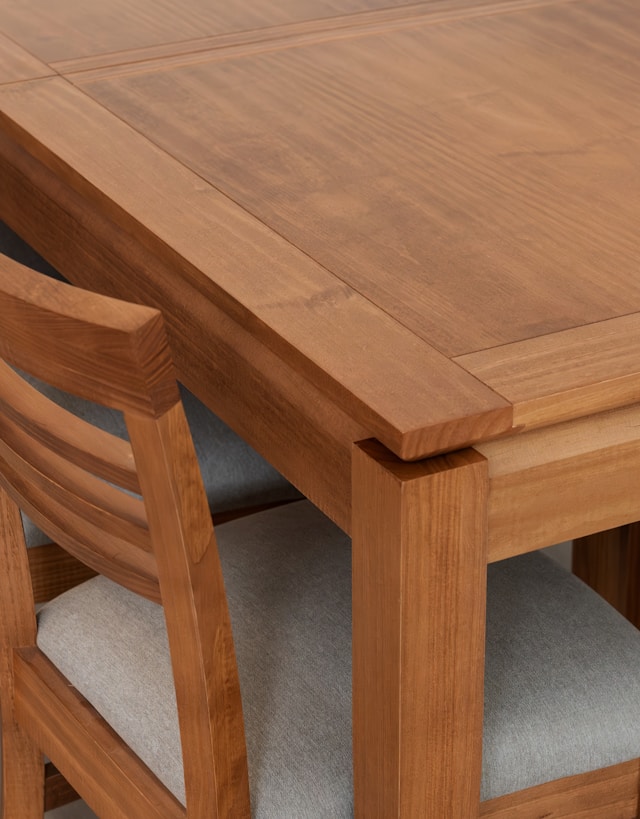
High-quality dining tables on extensions have leaves that fit flush with the main top, glide smoothly, and lock into position. To prevent spills and crumbs from gathering in large spaces, seams where boards join should be tight. When someone leans on the edge of a pedestal or single-base design, it should feel tip-resistant. Selecting a sturdy extension table in my tiny dining room allowed me to remove the leaves without making that grinding, metal-on-metal sound. Choose rounded corners and finishes that can withstand little scratches from toy cars and zooming claws if you have children or pets.
Size, Shape & Comfort – Matching the Table to Your Dining Room
How to Choose the Right Size for Your Space (Without Overcrowding)
Start by measuring your room and subtracting at least 36″ (about 90 cm) from each wall so people can pull out chairs and walk behind them. A typical four-seat table starts around 40–48″, six seats around 60–72″, and eight seats around 78–96″, depending on shape. Tape those dimensions on the floor and “walk” the route from kitchen to table with an imaginary tray. For more exact layouts, this dining table set for 6 size guide has helpful information.
Shape, Seating Comfort & Daily Use
Rectangular tables suit long rooms and larger families, especially when you mix chairs and benches. Round and oval tables are great for small spaces and better eye contact, since no one sits at a “far end.” Square tables feel modern but work best in squarer rooms. Comfort-wise, check that there’s enough legroom between the seat and the underside apron and that table legs or pedestal bases don’t block knees. Leave elbow space between chairs, especially if your table doubles as a home-office or kids’ craft zone. For more layout ideas, compare shapes in this round vs. rectangular dining table layout guide.
Where to Buy a High Quality Dining Table (Online vs In-Store)
Buying Online – How to Avoid Disappointment
When you buy a high quality dining table online, the product page is your showroom. Look for clear material details (solid wood vs veneer vs “wood-look”) plus close-up photos of grain, edges, underside, and extension mechanisms. Dimensions and weight should be specific; heavier often means more solid construction. Furniture e-commerce already accounts for roughly 25–30% of global furniture revenue in 2024, so choice has exploded (ECDB).A 2025 report projects the online furniture market to expand by about $282.1 billion between 2024 and 2029 at a 23.4% CAGR, so digital shopping will only get busier (Technavio). Prioritize solid warranties, clear damage-handling, delivery options such as Front Door Delivery, Room of Choice, or Assembly Delivery Service, and pre-assembled or minimal-assembly designs—exactly what fully assembled furniture brands like Povison aim to provide.
Buying In-Store – Questions to Ask Before You Swipe Your Card
In person, your job is to get behind the showroom gloss. Ask, “Is this solid wood or veneer, and what’s the core material?” and “How is the table joined—mainly wood joinery or metal brackets?” Get clarity on warranty coverage for the frame, finish, and moving parts. Then sit at the table, pull chairs in and out, and repeat your shake test. Don’t be shy about flipping a corner of the table to inspect the underside. Take photos, measurements, and notes; comparing three or four options later at home is much easier than trusting your memory. If you’re still choosing between flexible setups and classic pieces, this modular dining set vs fixed dining table guide offers a handy decision framework.
Conclusion – Confidently Choosing a Dining Table That Lasts
A truly high quality dining table isn’t just “pretty” in photos. It combines the right materials, a protective finish, solid craftsmanship, and sizing that fits your room and lifestyle. When you understand how to read product pages, spot flimsy joinery, and test stability, you can choose a high quality dining table and chairs set that feels great today and still looks intentional years from now. Whether you shop online or in-store, you’ll walk away knowing exactly what you’re paying for.
FAQs About High Quality Dining Tables
Is a solid wood dining table always better than veneer?
Not always. A solid wood dining table is usually heavier, warmer to the touch, and easier to refinish many times, which is ideal if you want a long-term piece. But a high quality wood veneer over a stable core can be more affordable, lighter to move, and less prone to seasonal movement. Poorly made veneer or low-end composites are what you really want to avoid.
What is a “normal” lifespan for a quality dining table?
With decent materials and care, a good table should easily last 10–15 years; higher-end solid wood pieces can go 20 years or more before needing major refinishing. In practice, most people replace their dining table for style or size reasons long before it structurally fails. If you choose solid wood, avoid standing water and give the finish basic maintenance to stretch its life.
How can I tell if a finish is kid- and pet-friendly?
Look for mentions of scratch resistance, heat resistance, and stain protection, and avoid ultra-soft or glossy finishes that show every mark. Ask whether the finish is low-VOC and water-based if you’re concerned about indoor air quality. In the store, lightly drag a fingernail across an inconspicuous spot—on a quality finish, you shouldn’t see a clear mark.
Can I buy a high quality dining table online without seeing it in person?
Yes, if you slow down and read like a pro. Make sure the listing clearly states solid wood, quality veneer, or engineered core, and study close-up photos of grain, edges, and the underside. Check real customer reviews for comments about sturdiness and finish quality, and confirm the return and damage-handling policies. When those boxes are ticked, buying a high quality dining table online can be just as safe as in-store.


