 By Charles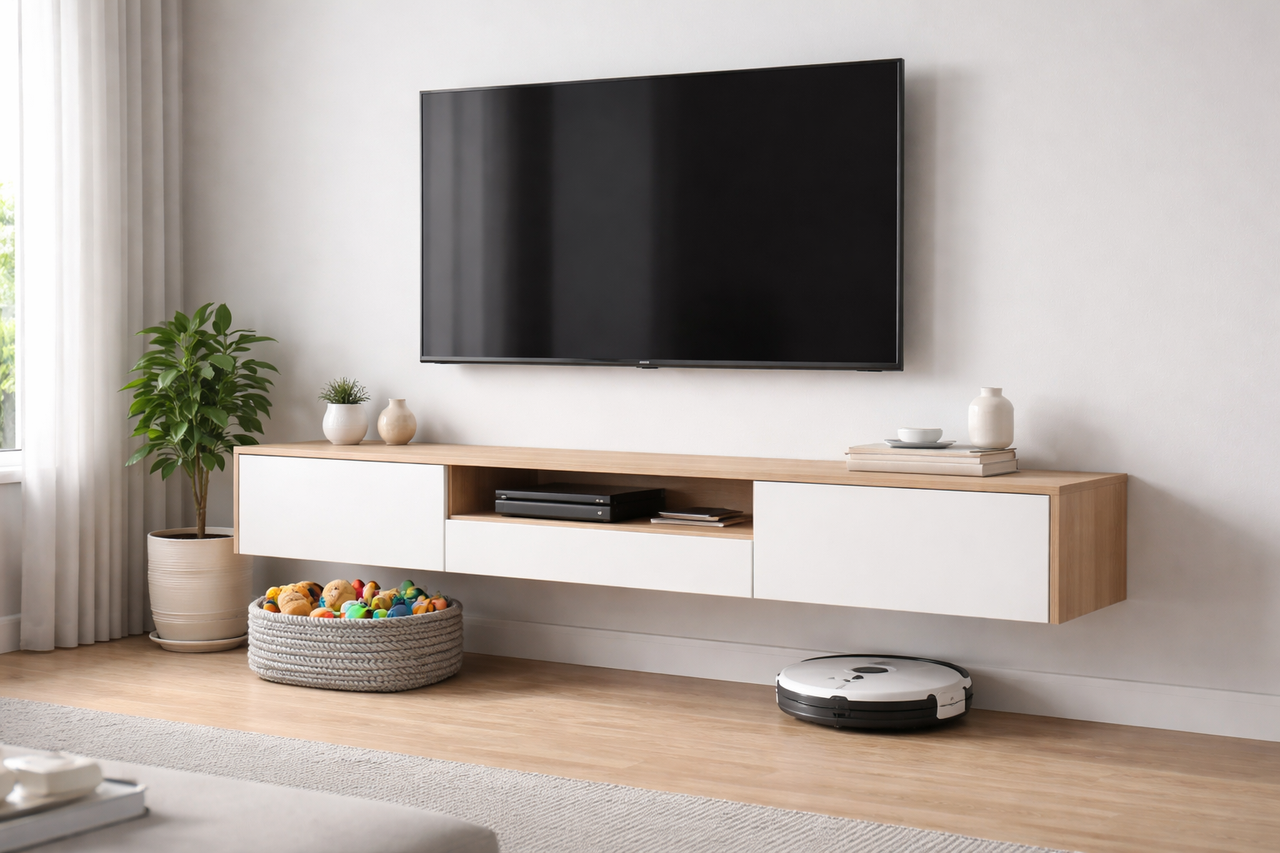
You’ve probably Googled “floating TV stand vs floor TV stand” while staring at a tangle of cables and toys on the living room floor. You want your space to look pulled together, but you don’t have a free Saturday to wrestle with flat-pack instructions or worry about your kids pulling the TV down.
This breakdown helps you choose the style that fits your real life, not just what looks good in a staged photo. You’ll see how each option handles space, safety, setup time, and long-term costs so you can pick once and be done.
What Defines a Floating TV Stand?
A floating TV stand is a wall-mounted media console that doesn’t touch the floor. It’s anchored directly into your wall studs and usually pairs with a wall-mounted TV, creating a clean, “hovering” look and freeing up space underneath.
How Does Wall Mounting Save 25% More Floor Space?
Wall mounting saves floor space because your storage shifts vertically. Instead of a full-depth cabinet sitting on the ground, a floating stand uses the wall area that’s usually dead space.
In a typical 12′ x 16′ living room, a floating stand that’s 12–14 inches deep leaves more visible floor than a chunky 18–20 inch deep floor unit. That can feel like reclaiming roughly 20–25% of the visual floor area along that wall, enough for a playmat, dog bed, or just easier walking space.
If you’re trying to keep a small room from feeling cramped, pairing a floating stand with a slim profile TV can make the whole wall look lighter. Explore Povison’s ‘Space-Saver’ Floating Collection, which features compact, wall-mounted units specifically designed to open up tight floor plans.
Why Pick Floating Stands for Homes with Pets?
You pick a floating TV stand with pets for one key reason: there are fewer things for them to bump, knock, or chew. No legs for puppies to gnaw, fewer edges for a wagging tail to slam into, and nothing for a cat to use as a springboard to your TV.
With the stand off the floor, you can:
- Run a robot vacuum under it without moving anything.
- Keep water bowls, dog beds, or litter boxes under the unit.
- Reduce dust build-up around cables.
For example, Povison’s pet-friendly floating consoles leave 6–10 inches of clearance, finally giving your Roomba and dog toys a clear path. While mounting takes a bit of initial effort, it’s a ‘one-and-done’ job that buys you years of hassle-free cleaning.
What Makes a Floor TV Stand Ideal for Quick Setup?
A floor TV stand sits directly on the ground, usually with legs or a plinth base, and often doesn’t require drilling into walls. It’s the faster, lower-commitment option if you rent or aren’t sure where the TV will live long-term.
How Simple Is Assembly in Under 15 Minutes?
Assembly for a solid floor TV stand can be as little as 10–15 minutes if you choose a pre-assembled or mostly assembled piece. Many higher-end units ship with the body built and only require you to:
- Screw on the legs or base.
- Adjust the shelves.
- Place your TV and plug in devices.
Povison’s fully assembled solid wood TV stands arrive as one main unit—no bag of 60 screws, no confusing manuals. You might pay a little more upfront, but you’re effectively buying back your Saturday afternoon to relax instead of building furniture.
Which Safety Features Guard Against Kids and Pets?
Floor TV stands support safety in a few ways:
- Low center of gravity: A long, solid-wood base makes it harder to tip.
- Anti-tip straps: Many include straps to secure the stand or TV to the wall.
- Rounded corners: Less chance of forehead-level accidents with toddlers.
For families, look for heavy-duty consoles with anti-tip kits included, aiming for weight ratings like 150+ lbs. While we have a full safety guide, starting with a naturally stable, low-center-of-gravity cabinet is your first line of defense against climbing kids.
Floating vs Floor TV Stand: Pros & Cons for Busy Parents
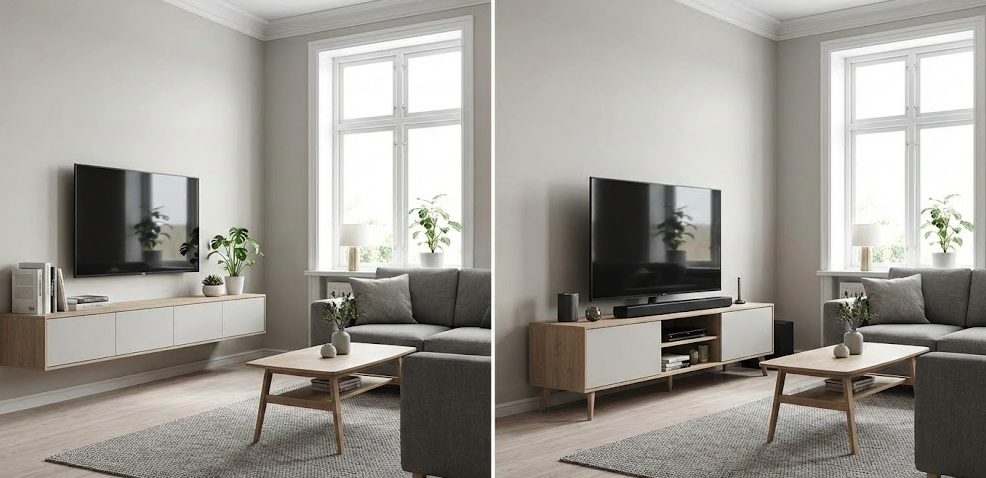
When you compare a floating TV stand vs floor TV stand, you’re really choosing between long-term clean lines and immediate plug-and-play convenience. Both can work for a busy household: the best pick depends on your walls, your kids, and your future plans.
What Are 3 Top Advantages of Floating TV Stands?
Floating TV stands give you three standout wins:
- Floor space: Freeing the area underneath makes a small room feel bigger and easier to clean.
- Cable control: You can route wires through the wall or a hidden channel so they’re out of reach of kids and pets.
- Modern look: The “floating” effect instantly upgrades the room and pairs well with minimal or mid-century décor.
If you’re building a more permanent setup and don’t move often, the installation effort pays off every single day in visual calm and easier cleaning.
Why Do Floor Stands Save You $50 on Average?
Floor stands often cost $30–$50 less on average than similar-quality floating units because they don’t need the extra hardware or reinforced structure for wall mounting. You also skip hiring a handyman, which can run $75–$150 per visit.
Over five years, choosing a solid floor stand once is usually cheaper than buying a flimsy fast-furniture unit every 18–24 months. If a $180 floor stand lasts 5–7 years, that’s roughly $25–$35 per year, compared to replacing a $120 particle-board stand twice in the same window. For more detailed breakdowns, check resources like Architectural Digest’s TV stand picks alongside Povison’s higher-durability options.
What Installation Requirements Apply to Each Type?
Installation is where your decision often makes itself. Floating stands demand strong walls and tools: floor stands ask for a bit of muscle and a screwdriver.
Wall Mounting Guide: How to Securely Install Floating Stands (DIY)
To install a floating TV stand safely on your own, you need to:
- Find studs with a stud finder (usually 16 inches apart).
- Mark height, typically 18–24 inches from floor to bottom of stand.
- Pre-drill pilot holes into studs.
- Attach bracket or back panel using lag screws rated for your stand’s weight.
- Hang and level the unit, then load devices.
If your stand plus gear weighs 80–120 lbs, make sure all main fasteners go into studs, not just drywall anchors. Povison’s product pages usually list exact weight capacities and hardware requirements, so double-check specs before you drill.
When Should You Hire Help for Heavy Units?
You should bring in help when:
- The unit weighs more than 70–80 lbs.
- Your walls are plaster, brick, or concrete and you’re not used to drilling into them.
- You want the TV mounted at the same time.
Professional installation for both the TV and stand typically takes 60–90 minutes and can save you patching holes later. For renters, that cost may not be worth it, another point in favor of a solid, freestanding console that only needs basic setup.
Which TV Stand Suits Busy Parents and Pet Owners?
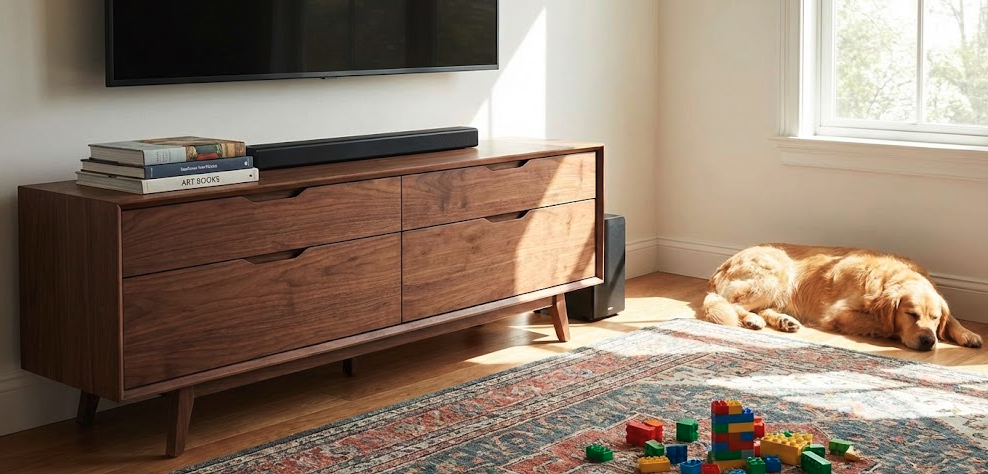
Choosing between a floating TV stand vs floor TV stand comes down to your walls, your lease, and how much chaos your living room sees on a daily basis.
Who Should Skip Floating Stands Due to Wall Issues?
You should skip floating stands (for now) if:
- Your walls are thin drywall with metal studs and low weight ratings.
- You rent and your landlord limits drilling or large holes.
- You rearrange furniture often or plan to move within a year.
In those cases, a heavy, low floor console with anti-tip straps to the wall still gives you safety and storage without risking structural issues.
How I Compared 4 Key Metrics Like Durability and Cost?
When you’re deciding, use four simple metrics to compare options:
- Durability: Solid wood or high-quality veneer over plywood will outlast particle board. Look for 10+ year expected lifespans.
- Setup time: Floating = more up front, less later. Floor = fastest today.
- Safety: Check weight capacity and anti-tip features regardless of style.
- Cost over time: Divide price by years you realistically plan to use it.
If you want to see how these look in real living rooms, check out the Povison ‘Real Homes’ Gallery. Seeing how other homeowners mix-and-match these floating and floor styles can help you picture exactly what works for your space.
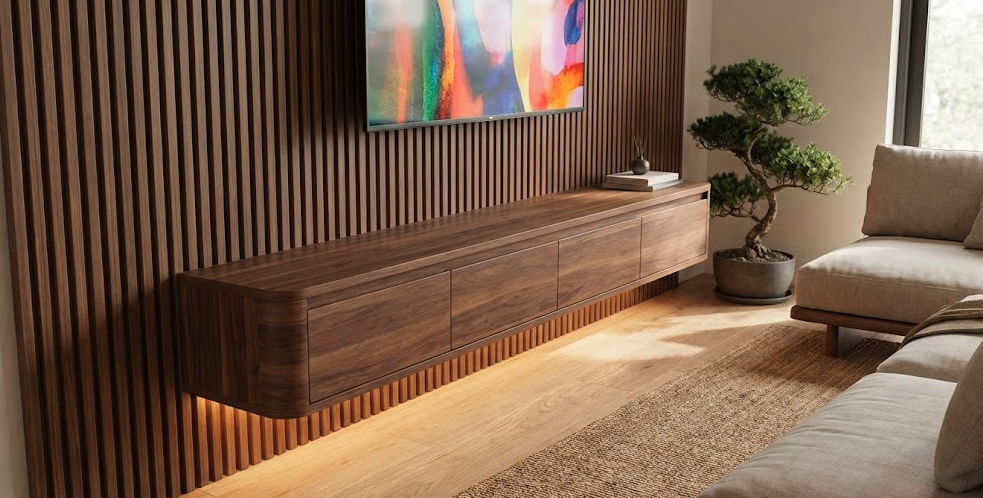
In short: choose a floating TV stand if you’re staying put, craving clean walls, and have solid studs. Go for a floor TV stand if you want quick setup, flexible layouts, and less drilling drama.
Floating TV Stand vs Floor TV Stand: Frequently Asked Questions
What is the main difference between a floating TV stand vs floor TV stand?
A floating TV stand mounts to the wall and doesn’t touch the floor, freeing space underneath and creating a clean, modern look. A floor TV stand sits directly on the ground, usually needs no drilling, and is easier to move or replace—ideal if you rent or frequently change layouts.
Which is better for small living rooms: a floating TV stand or a floor TV stand?
For tight spaces, a floating TV stand usually wins. By shifting storage up onto the wall and using a shallower depth, it can reclaim roughly 20–25% more visible floor along that wall, making the room feel more open and easier to clean, especially with kids’ toys or pet gear.
Are floating TV stands safer than floor TV stands for homes with kids and pets?
Both can be safe if installed correctly. Floating stands keep cables and surfaces higher, away from curious hands and paws, but require solid stud mounting. Floor TV stands offer a low center of gravity and anti-tip straps. In all cases, anchoring the TV and using proper hardware is essential.
When should I choose a floor TV stand instead of a floating TV stand?
Choose a floor TV stand if you rent, have weak or metal-stud walls, plan to move soon, or want the fastest setup with no drilling. A solid, low console with anti-tip straps gives good safety and storage while avoiding wall damage and professional installation costs.
What is the best height to mount a floating TV stand and TV together?
A practical guideline is to place the bottom of the floating TV stand about 18–24 inches from the floor, then mount the TV so its center is roughly at seated eye level—around 42–48 inches from the floor. Adjust slightly for your sofa height and viewing distance for comfort.
Past Review:


I really like how you framed this as a choice based on real-life habits rather than just aesthetics. One thing I’ve noticed is that floating stands work best when people are willing to hide or manage cables proactively—otherwise the ‘clean’ look disappears fast. On the flip side, floor stands can be a lifesaver in rentals where drilling into studs isn’t an option, so it’s nice to see both sides laid out clearly.