 By Charles
My cousin Maya bought a one-bedroom condo in Queens last year and immediately ran into the dining-room math problem most apartment buyers run into: daily seating for two, occasional capacity for six at Easter, and she wants a sintered stone top because she’s seen what red wine does to wood. She found an extendable sintered stone table at a good price and asked me whether the combination was real engineering or just marketing.
Fair question. Extending mechanisms and heavy stone slabs are not natural friends. The slab wants to sit on a fixed, supported plane; the mechanism wants the slab to move. Most extendable tables sold today are designed for wood or veneer tops, and the ones properly engineered for sintered stone are a smaller subset. This guide walks you through what’s real, what to verify on a spec sheet, and the trade-offs you can’t avoid.
What an Extendable Sintered Stone Table Solves
Sintered stone is everything you want in a dining surface — stain-resistant, near-zero porosity, modern aesthetic, large-format slabs without seams — but in small homes it’s heavy and permanent. A 78-inch fixed sintered table looks beautiful in a magazine and absurd in a 9′ × 11′ dining nook 360 days a year.
An extendable sintered stone table solves exactly that gap. The everyday footprint stays apartment-friendly — often 47″ to 63″ closed — while a leaf or two extends the surface to 70-90″ when needed. You get the material benefits in the dimensions you can actually live with. The catch: you’re now asking a stone surface to behave like a mechanical product. That’s where the engineering gets interesting, and where most of the marketing exaggeration lives.
Best Homes for This Table Type
Not every “extends sometimes” household actually benefits from this category. The math only works in two specific situations.
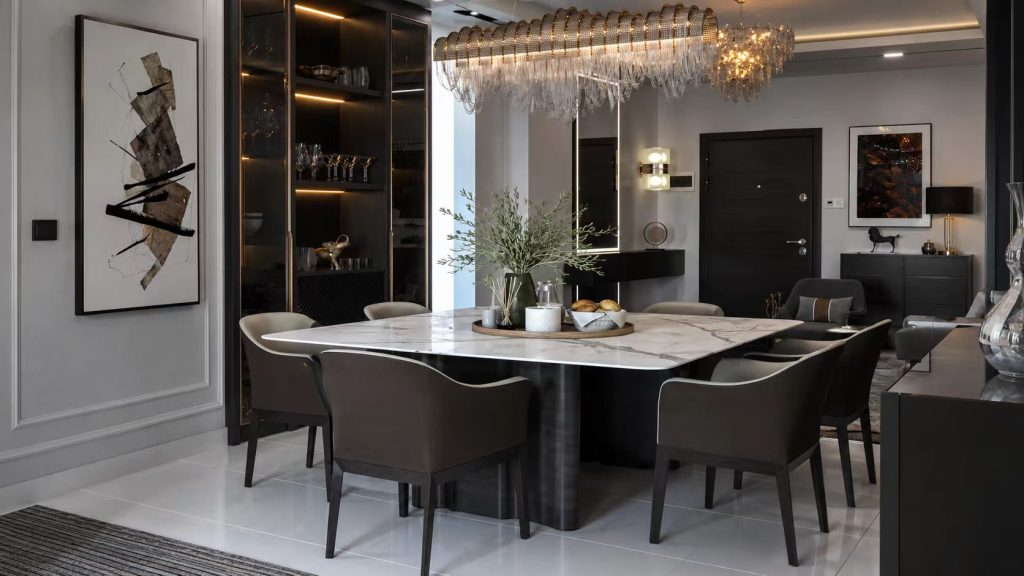
Families That Host Occasionally
The right user profile is something like Maya — daily seating of 2-4 people, surge demand of 6-8 about 5-15 times a year for holidays, birthdays, monthly dinner club. If you extend the table once a quarter, the mechanism stays factory-tight for years. If you extend it twice a week for work-from-home setups, you’re treating a precision assembly like a daily-use drawer — and stone-topped mechanisms aren’t tested for that.
Per Dimensions’ dining clearance data, each diner needs 24-30 inches of linear edge space for comfortable elbow room. So a closed 55″ table comfortably seats 4, extends to 79″ for 6, and pushes to 90″ for 8 at a tight holiday meal.
Dining Rooms With Changing Seating Needs
The second fit is open-plan dining rooms where the closed configuration needs to look intentional. Modern sintered stone extendables hide the seam well — a polished 12mm slab joined at a butterfly leaf shows a fine line under close inspection but reads as a clean surface from across the room.
Per the NKBA Kitchen & Bath Planning Guidelines, allow 36 inches of clearance between the table edge and any wall, or 44 inches if traffic passes behind seated diners. Run that math against the extended footprint, not the closed one. This is the single biggest planning mistake I see — people measure for the everyday size, then can’t move around the table when it’s extended for the dinner they bought it for.
Extension Mechanism and Stone Surface Trade-Offs
Here’s where most listings get vague. Three common mechanism types are sold for extendable dining tables, and they do not behave equally under stone.
Butterfly leaf (self-stored). The leaf folds underneath the closed table and unfolds upward as the two halves slide apart. Mechanically elegant, but the leaf has to be lighter than the main top — usually meaning the integrated leaf is thinner stone (8-10mm) bonded to a substrate, while the fixed top is 12-20mm solid sintered. The seam shows the thickness difference at the edge. Best for moderate-weight stone, occasional use.
Removable leaf (manual insert). The halves slide apart and you physically insert a separate leaf. Mechanically simplest and handles the heaviest stone leaves because there’s no folding hardware bearing the weight. Downside: you need somewhere to store a 20-40 lb stone leaf — under a bed, behind a couch, somewhere flat where it won’t tip and crack.
Pop-up/swivel mechanism. A sub-leaf rotates or rises from inside the apron. These are usually rated for wood or laminate; very few are engineered for stone weight, and the ones that are tend to use 8-10mm slab tops bonded to lighter cores. If a listing shows a pop-up extension with a “solid sintered stone” claim and no thickness disclosure, that’s a flag.
Why slab thickness matters more on extendable than fixed. A 12mm sintered slab on a fixed table sits on a continuous support frame. On an extendable, the slabs cantilever further at the join when extended. Breaking strength here is governed by the ISO 10545-4 standard for modulus of rupture in ceramic tiles; 20mm slabs roughly double the resistance to flex failure compared to 12mm at the same span. Translation: 12mm works if support spacing is tight; 20mm is genuinely better for extendable.
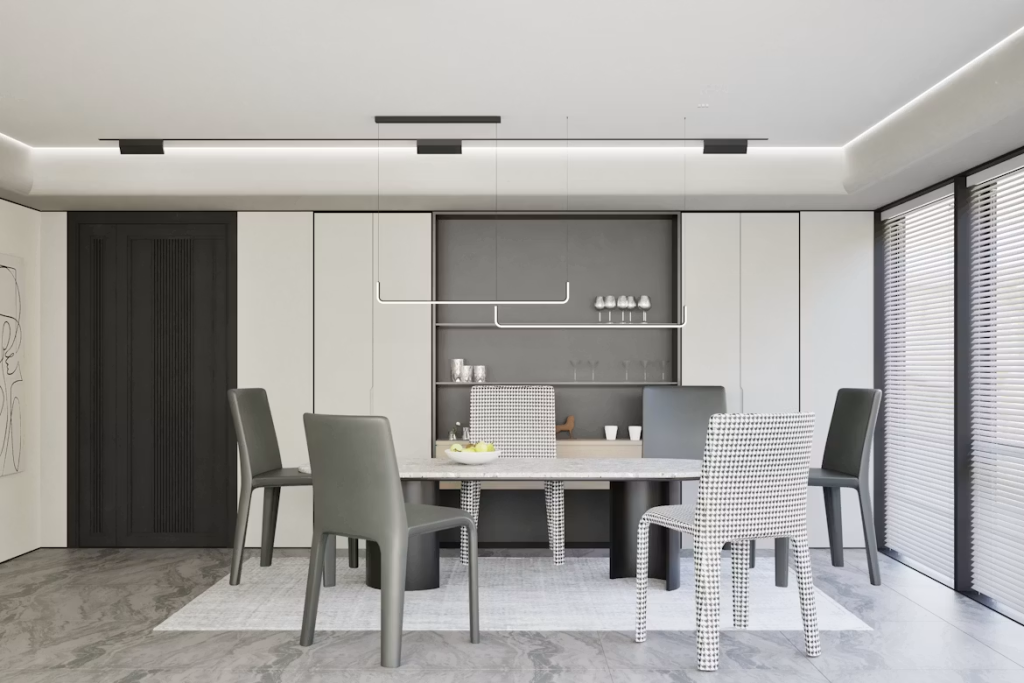
Here’s how the three mechanisms compare across the factors that matter for stone:
| Mechanism | Slab Weight Capacity | Seam Visibility | Storage Required | Best Use Frequency |
| Butterfly leaf | Moderate (8-12mm slab leaf) | Low (integrated edge) | None (self-stored) | Monthly to quarterly |
| Removable leaf | High (12-20mm solid stone) | Medium (separate piece) | Yes (flat storage for 20-40 lb leaf) | Quarterly to occasional |
| Pop-up/swivel | Low (8-10mm bonded only) | High (different surface) | None | Rare — flag for stone use |
On the hardware side, slides and pivots should be specified to ANSI/BHMA A156.9 Grade 1 or 2 — Grade 1 is institutional, Grade 2 is heavy residential, Grade 3 is light residential and not appropriate for stone weight. And because the mechanism is precision-aligned at the factory, a fully assembled, pre-calibrated table from a reputable seller will track better over time than one a homeowner installs at the kitchen table with the screwdriver from a kitchen drawer. If a product page doesn’t disclose hardware grade or assembly status, ask. The mechanism is the part most likely to fail before the stone does.
Weight, Stability, and Delivery Checks
A 60-inch extendable sintered stone table typically weighs 180-260 lbs assembled — about 30-50% more than a fixed equivalent at the same surface area, because of the mechanical hardware and reinforced frame. Extended with the leaf deployed, add another 25-40 lbs.
Three stability checks worth running before purchase:
- Center deflection. When extended, how much does the center flex under light pressure (someone leaning to pass a dish)? Under 2mm at midpoint is well-engineered; above 5mm and the leaf alignment will loosen over time.
- Lateral wobble. Push horizontally on one end of the extended table. Movement should be barely perceptible. Visible swaying means the base isn’t engineered for the extended moment arm.
- Leaf seam alignment. After several extensions, the slab halves should stay flush within 0.5mm. Above 1mm catches glassware and signals a loose locking mechanism.
A useful benchmark for stability claims is ANSI/BIFMA X5.5, the North American standard for desk and table structural performance. Most consumer brands don’t certify, but those who do — ask for the test report.
Delivery is where this category breaks down. A 240-lb extendable sintered stone table is not something a threshold-delivery driver leaves at your door and walks away from. Damage rates on stone tops shipped this way are meaningful, and the mechanism can warp during transit if the crate isn’t braced properly. POVISON ships these pre-assembled with the mechanism factory-calibrated, palletized with foam edge protectors, and routed through white-glove appointment delivery — two people place it in your room and confirm it works before they leave. Browsing POVISON’s dining tables collection gives you side-by-side specs on closed and extended dimensions, slab thickness, weight, and what’s included in shipping.
One more thing on weight: extended sintered stone tables are not casually movable. The Natural Stone Institute’s guidance on stone weight and handling is worth a glance — slabs in this weight class are a structural choice, not a mobile one. My tape-out variation for extendable: tape both the closed and extended footprints on the floor, live with both for two days, and walk both configurations through the doorway you’d use to bring it in. If the extended size doesn’t fit your hosting reality or the closed size feels cramped, the table is the wrong size before the truck arrives.
FAQ
Is an extendable sintered stone dining table worth it for flexible seating?
An extendable sintered stone dining table is worth it for flexible seating if you live in a 700-1,200 sq ft home, host 5-15 times a year, and want sintered stone’s stain and acid resistance without committing the daily floor space of a full-size hosting table. It’s not worth it if you extend the table weekly, rearrange furniture often, or need the lightest possible movable surface. The premium over a fixed sintered table is roughly 20-35%, which pays back over a 10-year horizon if you actually use the extension capability.
Are extendable sintered stone tables too heavy to move easily?
Extendable sintered stone tables are too heavy to move easily by one person. A typical 60″ extendable weighs 180-260 lbs assembled — about 30-50% heavier than a fixed sintered table the same size because of the added mechanism and reinforced frame. Two-person handling is required for any repositioning. If you anticipate moving the table even quarterly, choose a lighter wood or aluminum-base alternative; if it lives in one place for years, the weight is a feature.
Do extendable sintered stone dining tables stay stable when extended?
Extendable sintered stone dining tables stay stable when extended if the mechanism is properly engineered and slab thickness is appropriate for the span. Three failure points to check: center deflection under 2mm at midpoint under light pressure, lateral wobble barely perceptible when pushed sideways at the end, and leaf seam height alignment under 0.5mm between halves. Tables built to ANSI/BIFMA X5.5 with Grade 1 or 2 hardware stay stable for 10+ years; cheaper mechanisms with Grade 3 hardware loosen within 2-3 years.
What should I check before buying an extendable sintered stone table online?
Before buying an extendable sintered stone table online, verify six things: closed and extended dimensions in inches, slab thickness (12mm minimum, 20mm preferred for spans over 70″), mechanism type (butterfly, removable leaf, or pop-up), hardware grade (BHMA A156.9 Grade 1 or 2), total shipping weight with packaging, and delivery method (white-glove for anything over 150 lbs). A serious seller can email a spec sheet covering all six within a day. If they can’t, the product is most likely a wood-table mechanism with a stone top bolted on rather than an integrated engineered piece.
Conclusion
Extendable sintered stone dining tables solve a genuinely useful problem for small apartments with occasional hosting needs — but they live or die on engineering details most product pages skip. The combination of heavy stone and mechanical motion forces real trade-offs around slab thickness, hardware grade, and how often you can extend the table before the mechanism loosens. If you want one, ask for the spec sheet, verify the hardware grade and slab thickness, and plan delivery as if you were receiving a small piece of architecture, not a piece of furniture. Done right, this category gives you 25 years of flexible dining in a footprint that respects your daily life. Done wrong, you’ve bought a beautiful slab attached to a mechanism that wasn’t designed for it.
Related Reading:


