 By Charles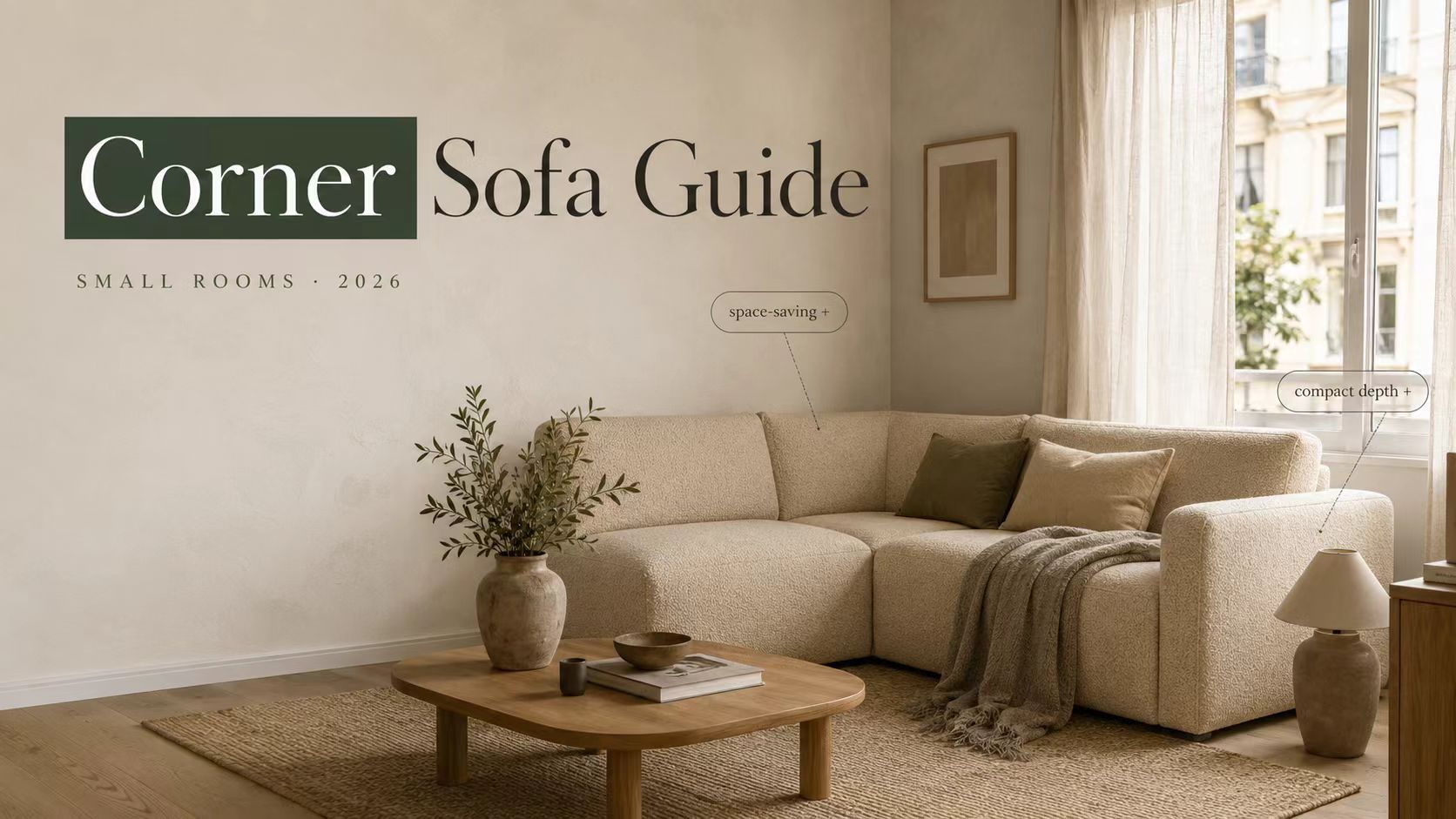
The most wasted real estate in a small apartment isn’t the closet. It’s the corner of the living room. Nine square feet of floor that holds a sad plant, a charging cable, and nothing else. A corner sofa for small rooms is supposed to fix that — but only if you make four decisions correctly before you order, not after the truck shows up.
I learned this the annoying way. My first apartment corner sofa technically “fit.” It also turned the path from my front door to my kitchen into a sidestep-and-suck-in maneuver every single time. The sofa wasn’t the problem. The decision was.
This is a buyer’s guide, not a mood board. We’re going to talk about what most people skip: left versus right, doorway width, walkway flow, and whether a corner sofa is actually more space-efficient than a sectional or just looks like it should be. Let’s get into it.
What Is a Corner Sofa Best For?
A corner sofa is best for compact living rooms where a corner is currently dead space and the room has to do more than one job — TV, hosting, working from the couch. By folding two seating footprints into one L that hugs a wall junction, it returns the center of the room to you instead of scattering a sofa, a loveseat, and a chair across the floor.
That’s the honest version of the pitch. Here’s where it actually shines:
- Studio and one-bedroom layouts, where the back of the L doubles as an invisible wall, splitting “sleep zone” from “living zone” without building anything.
- Work-from-home setups, where you need a defined lounge area that doesn’t eat the whole 12-foot wall you also want a desk against.
- Rooms with one good corner and one bad wall — the kind with a radiator, a low window, or a door swing chewing up the obvious sofa spot.
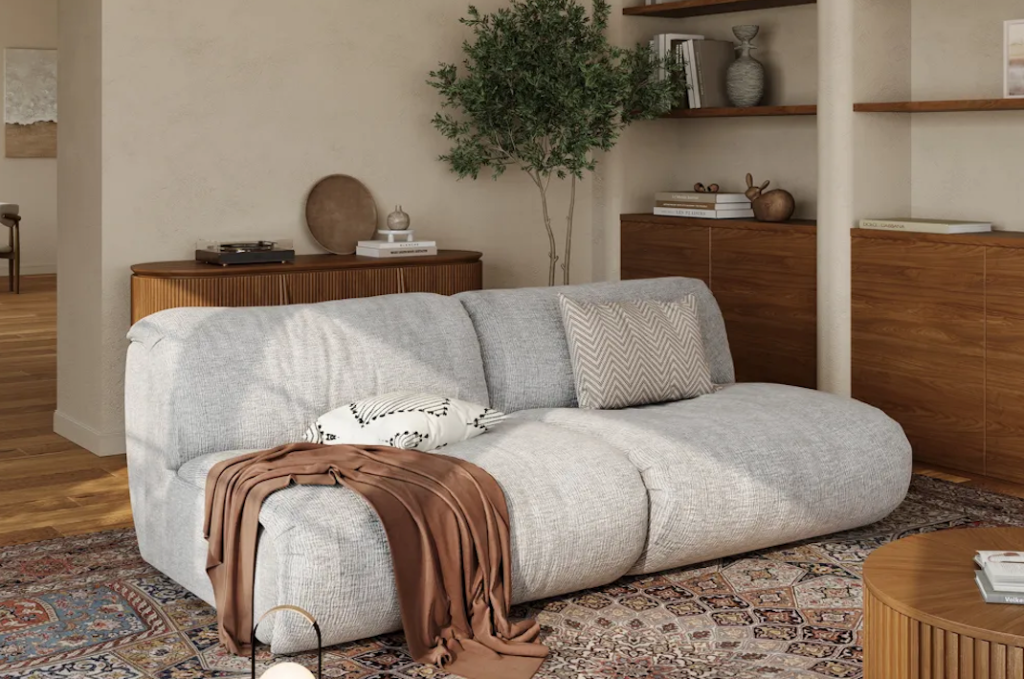
And here’s where I’ll push back on the internet: a corner sofa is not best for a room under 10 feet on its short wall, or for anyone who rearranges furniture every few months. One big L is one big commitment. If “I move this couch three times a year” is your life, a corner sofa fights you. That’s not a flaw — it’s just not your piece. I’d rather you skip it than resent it.
Corner Sofa vs Sectional Sofa: What’s the Real Difference?
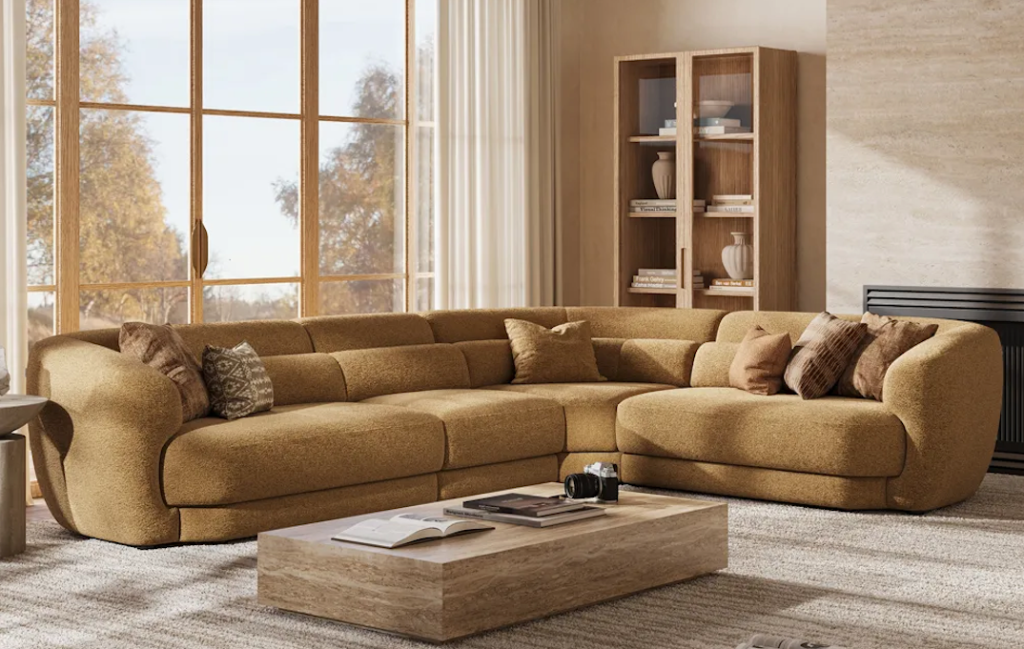
A corner sofa is technically a type of sectional — specifically a true 90-degree L where two arms meet at a corner. “Sectional” is the umbrella term covering L-shapes, U-shapes, chaise-ended designs, and modular systems. Furniture-dimension references like the sectional sofa dimensions database confirm the same thing: the 90-degree corner or L-shape is the most common configuration, and there’s no single “standard” size because the format is built to be customized. For a small room, the practical difference isn’t the name. It’s the footprint shape and whether the pieces can move.
People agonize over the terminology and miss the decision that matters. Here’s the comparison I’d actually use when shopping:
| Factor | Corner Sofa (true L) | Chaise Sectional | Modular Sectional |
| Footprint in a small room | Tightest in a corner; both arms hug walls | One arm floats; needs more open side | Flexible; can shrink or shift |
| Best room size | 10×12 ft and up | 12×14 ft and up | Works in odd/tight layouts |
| Commitment to layout | High — fixed shape | Medium | Low — reconfigure anytime |
| Moves with you | Hard through tight doorways | Hard | Section-by-section, easier |
| Best for | Permanent small-room corner | Lounging-forward rooms | Renters, frequent movers |
The takeaway: if your corner is permanent and you want maximum seating in minimum floor, a true corner sofa wins. If you’re renting and your next place is a mystery, a modular sectional you can carry in pieces is the smarter buy — it sidesteps the doorway problem entirely. POVISON’s modern sectionals collection splits these out by L-shaped, small-space, and modular so you can filter by which of those three you actually are, instead of guessing from a photo.
Choosing Left vs Right Orientation
This is the decision that catches almost everyone — including me, the first two times. Get it wrong and the sofa arrives mirror-image to your room, the chaise points at a doorway, and there’s no fixing it short of a return.
The rule is dead simple and never changes: stand in front of the sofa as if you’re about to sit down. If the long arm or chaise extends to your left, it’s a left-facing (LAF) corner sofa. To your right, it’s right-facing (RAF). Not from the seated perspective. Not from the doorway. Standing, facing it, about to sit.
One catch worth its own sentence: left-facing and right-facing are not standardized across retailers. Some flip the terminology. Before you confirm any order, read the brand’s own diagram and, if you can, get it in writing which side the long arm lands on as you face the piece. I’ve seen too many forum threads about this exact mix-up to trust the label alone.
Doorways and Walkways
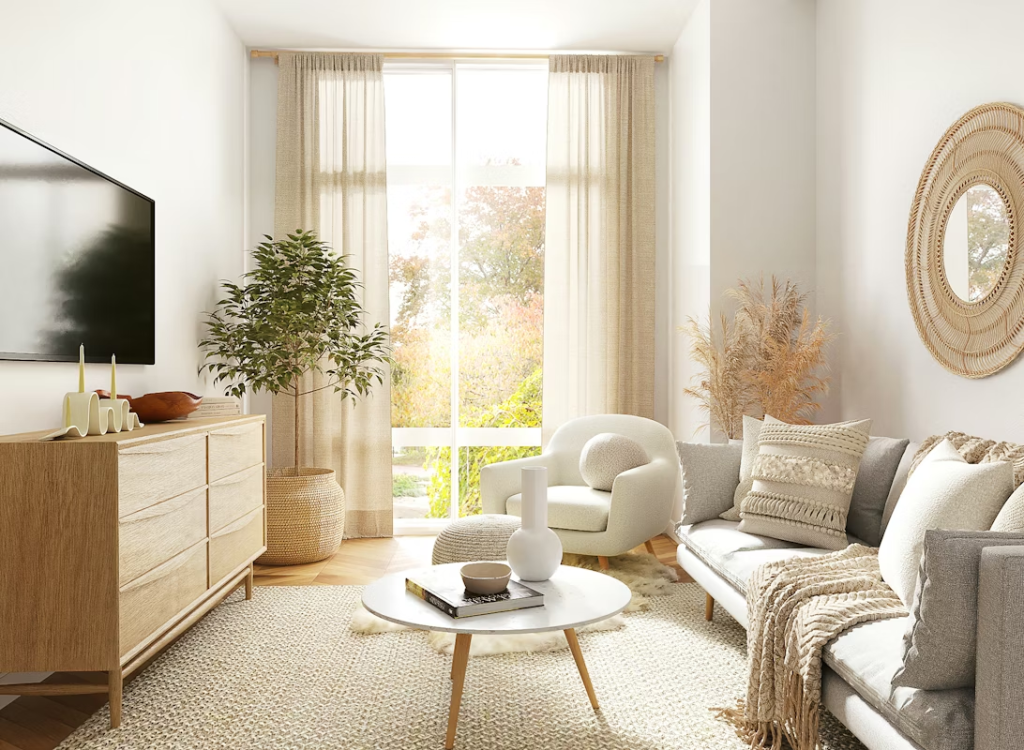
Your corner sofa’s long arm should extend away from your main traffic path, never across it. Stand at the room’s main entrance. Trace how you actually walk in and move toward the kitchen, the hallway, the balcony. The open side of the L should invite you into the seating zone — not body-check you on the way past.
Here’s the standard worth anchoring to: the National Kitchen & Bath Association recommends a minimum 36-inch walkway width for comfortable passage through a space. That number isn’t kitchen-only folklore — it’s the floor for not feeling cramped anywhere people walk. In a compact room, if placing the chaise on the wrong side drops your main path below 36 inches, that orientation is wrong. Full stop. Pick the side that keeps the path clear, then choose the sofa to match.
There’s a second clearance most people forget: the doorway itself. A POVISON corner sofa ships fully assembled — no flat-pack box, no hex keys, no Saturday lost to a 40-step manual. The trade-off of pre-assembled is honest and worth saying out loud: the whole piece has to clear your doorway in one go, because there’s nothing to disassemble. Most fixed L-sections need roughly 30–34 inches of doorway clearance angled through. Measure your narrowest doorway, your entry path, and any stairwell turn before you fall in love with a listing. If that clearance is tight, a modular design carried in section-by-section makes the problem disappear — that’s a real reason to choose modular over a one-piece L, not a sales line.
TV Wall and Window Placement
The long arm of the L points toward your focal point — the TV, the window with the view, the fireplace. Not toward a wall, not toward a door. In a small room you usually have exactly one good focal wall, which means the corner sofa’s orientation is decided for you once you’ve located it.
Quick real-world check: if your TV is on the wall to the left as you enter, and your hallway continues on the right, you almost always want a right-facing corner sofa so the long arm runs along the focal wall and leaves the right-side path open. Reverse the room, reverse the sofa. Don’t fight the room’s geometry — read it.
Mistakes That Make a Compact Room Feel Smaller
A corner sofa can make a small room feel calmer and more open. The same piece, chosen badly, makes it feel like a furniture showroom packed into a shoebox. Here are the mistakes I see most, and what to do instead — because “choose carefully” is useless advice and you deserve specifics.
- Buying for seat count instead of floor count. A six-seat L in a 10×11 room seats nobody comfortably because you can’t walk to the seats. Size to the room’s open floor, not the number of friends you wish you hosted.
- Pushing the corner into the doorway side. This is the one that got me. The corner of the L is the visual heavy point. Aim it at a wall junction, not at the path people use to enter.
- Ignoring frame quality because it’s hidden. You can’t see a frame, so it’s easy to skip — until the corner sags in year two. Look for makers whose frames meet recognized durability benchmarks; the BIFMA furniture performance standards define the structural and weight-capacity testing that separates a frame built to last from one that loosens at the joints.
- Ignoring back height. In a small room, a high-back corner sofa walls off the space. A lower back (think 30–33 inches total height) lets the eye travel across the room, which reads as “bigger.”
- Forgetting the move-in logistics. That 90-pound assembled L has to physically get inside. This is exactly where POVISON’s white-glove delivery earns its keep — it includes in-room placement and packaging removal, so a heavy one-piece sofa doesn’t become a two-person stairwell wrestling match or a damaged corner you discover after the box is gone. For a large pre-assembled piece in a tight building, that service is the difference between a good day and a bad one.
- Skipping the tape test. Which brings us to the only step that actually prevents all of the above.
What to Measure Before Buying
Before you order anything, you measure. Not eyeball. Measure. This is the single habit that has saved me from every furniture mistake I didn’t make.
Here’s my exact process, the one I run every time:
- Measure the room’s usable width and length — wall to wall, then subtract anything fixed (radiator, baseboard heater, door swings).
- Tape out the sofa’s full footprint on the floor with painter’s tape. Both the long arm and the short arm, real dimensions from the product page. This costs five minutes and a roll of tape and replaces every “I think it’ll fit” with an answer.
- Walk it for 24 hours. Live with the tape lines. If you find yourself stepping over them or turning sideways to pass, that’s exactly how the real sofa will feel — except the real one doesn’t peel off the floor.
- Confirm 36 inches of clear walkway on your main path with the tape down, per the NKBA standard above. If you can’t keep 36 inches, the sofa is too big or the orientation is wrong.
- Measure every doorway, hallway turn, and stairwell the piece must pass. Compare against the product’s packed dimensions, remembering a fully assembled sofa won’t shrink for the trip.
I will say this in every guide I write because it’s the cheapest insurance in furniture: tape it out before you buy it. A roll of painter’s tape has prevented more expensive returns than any review ever has.
FAQ
Is a corner sofa actually good for a small living room?
Yes — a corner sofa is good for a small living room when it’s scaled to the room and the corner is currently dead space. By consolidating a sofa-plus-chair into one L that hugs a wall junction, it can return roughly 30–40% of floor footprint to the open center. It stops working below about 10 feet of room width.
What is the real difference between a corner sofa and a sectional?
A corner sofa is one type of sectional — a true 90-degree L where two equal arms meet at a corner. “Sectional” is the broader category covering L-shapes, U-shapes, chaise designs, and modular systems. For a small room the meaningful difference isn’t the name; it’s footprint shape and whether the pieces are fixed or reconfigurable.
How do I know which side, left or right corner sofa, I need?
Stand in front of the sofa as if you’re about to sit down. If the long arm or chaise extends to your left, it’s left-facing; to your right, it’s right-facing. Then point that long arm toward your focal point and away from your main walkway. Always confirm the brand’s own diagram, since the terms aren’t standardized.
Can a corner sofa block walkways or doorways in a compact space?
Yes — a corner sofa can block walkways or doorways if the long arm extends across your main traffic path or the corner is aimed at the entry side. Keep at least a 36-inch clear walkway per NKBA guidance, and measure every doorway against the sofa’s packed size, since a fully assembled piece can’t be taken apart to fit through.
Conclusion
A corner sofa for small rooms isn’t a style decision dressed up as a furniture purchase. It’s four buyer’s decisions: is the corner actually dead space, left or right, does it clear my doorway, and have I taped it out. Get those right and the room opens up. Get one wrong and you’re living with a daily reminder.
If you’ve done the tape test and the corner is genuinely yours to reclaim, a fully assembled piece means the only thing left to do is decide where to sit — not spend a weekend building it. Browse POVISON’s sectionals collection filtered by small-space and L-shaped, measure twice, and let white-glove delivery handle the heavy part.
Related Reading:


[…] and total open depth rather than assuming that a wall-saving mechanism automatically suits a small room. Compare the manufacturer’s specifications with the room’s power recliner sofa wall clearance […]