 By Charles
Last spring my sister called me from her Brooklyn brownstone, mid-panic. She had a 55-inch TV, a wall that was maybe nine feet wide, and a floor-standing cabinet that ate so much of the room you had to turn sideways to reach the window. “Just tell me what to buy,” she said. I didn’t. I told her to grab painter’s tape first, because a floating TV console in a small room lives or dies on three numbers most people never measure: sofa-to-TV distance, mount height, and what’s actually behind the drywall. Get those right and the wall feels twice as big. Get them wrong and you’ve drilled four holes for a console that gives you a stiff neck every night.
This is the how-to I walked her through. No fluff about “modern aesthetics” — just the tape, the math, and the wall check.
When a Floating TV Console Works in a Small Room
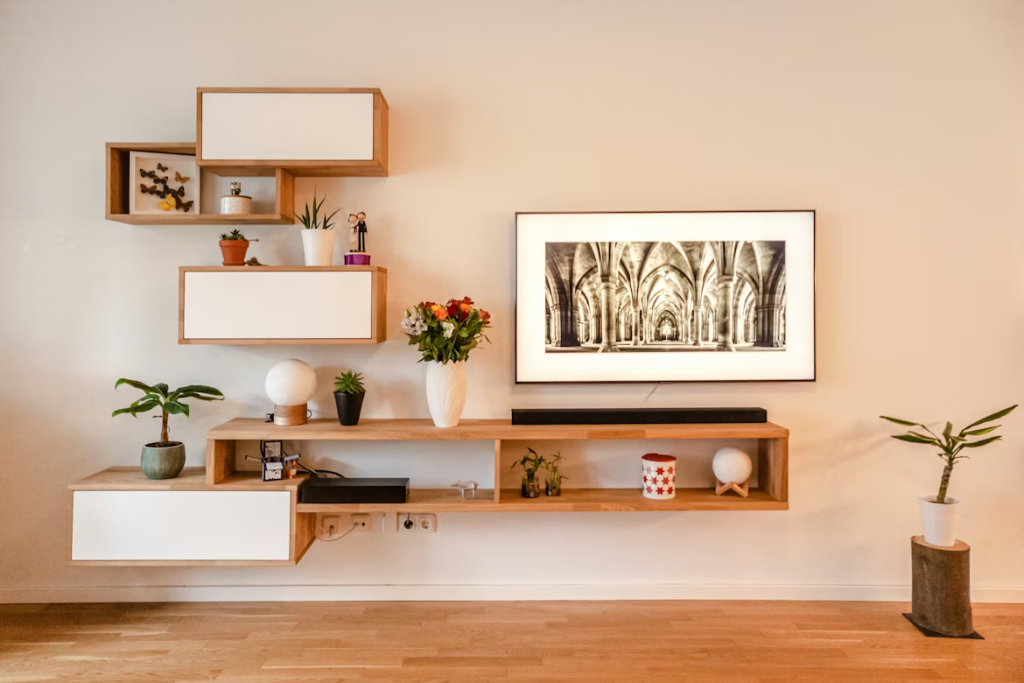
A floating TV console works in a small room because it gives you the floor back. The footprint never touches the ground, so the eye reads the visible floor as extra square footage. In my sister’s case, swapping a 19-inch-deep floor cabinet for a wall-mounted unit at 15-inch depth made a roughly 240-square-foot room feel noticeably less boxed-in — and a robot vacuum could finally run the full length of the wall without getting trapped.
But it’s not automatic. A floating console is the right call when you own the place (or can drill), your wall is structurally sound, and you want hidden storage without adding another tall cabinet elsewhere. Skip it if you rent and can’t patch holes, or if your wall is the wrong type — more on that below, because that’s the part people get wrong and find out the hard way.
For tight rooms, depth is the number that matters most. Aim for 14–16 inches deep. Anything past 18 inches and a small room starts to feel like the wall is leaning in on you. Width should run about 2–4 inches wider than the TV for visual balance — for a 55-inch screen, a 59–63-inch console hits the proportions without swallowing a narrow wall.
Measure Sofa-to-TV Distance First
Before height, before product, before anything: measure how far your sofa sits from the wall. This single number decides whether the whole setup feels right.
Here’s the standard worth knowing. The Society of Motion Picture and Television Engineers recommends the screen fill at least a 30-degree slice of your field of view, while THX targets closer to 40 degrees for a cinematic feel. In plain terms, a 30-degree angle works out to roughly 1.6× the screen’s diagonal in viewing distance, and a 40-degree angle to about 1.2×.
So run your own number. A 55-inch TV at the relaxed SMPTE 30-degree comfort level wants a sofa sitting around 7 to 9 feet back. My sister’s couch was 8 feet out — right in the pocket. If your only seat is closer than about 6 feet from a 55-inch screen, the floating console isn’t your problem; the TV is too big for the room, and no mount height will fix that.
Tape it out before you commit. I had her run a strip of painter’s tape on the floor at her actual sofa-front, then a second strip at the wall marking the console’s planned width. Standing in that taped box for five minutes tells you more than any spec sheet. If it feels cramped on the floor, it’ll feel cramped on movie night.
How High to Mount a Floating TV Console
This is where most small-room setups go sideways. People mount the console to look symmetrical on the wall, then spend three years tilting their chin up. The wall doesn’t watch TV. You do.
Comfortable Viewing Height
The rule is boring and it works: the center of the screen should land at your seated eye level. For most adults on a standard sofa, that puts the screen center around 40–48 inches from the floor. As the long-running reference on optimum HDTV viewing distance and angle lays out, the goal is keeping the screen within your natural line of sight so your neck stays neutral — not craned up at the wall like it owes you money.
Don’t trust the average — measure yours. Sit on your sofa the way you actually sit on a Tuesday night (the real slouch, not the posture you fake for guests). Have someone mark where your eyes hit the wall. That mark is your screen center. On a deep sectional or a recliner you’ll land lower, often closer to 36–40 inches, because you sit back and down.
Clearance Below the Console
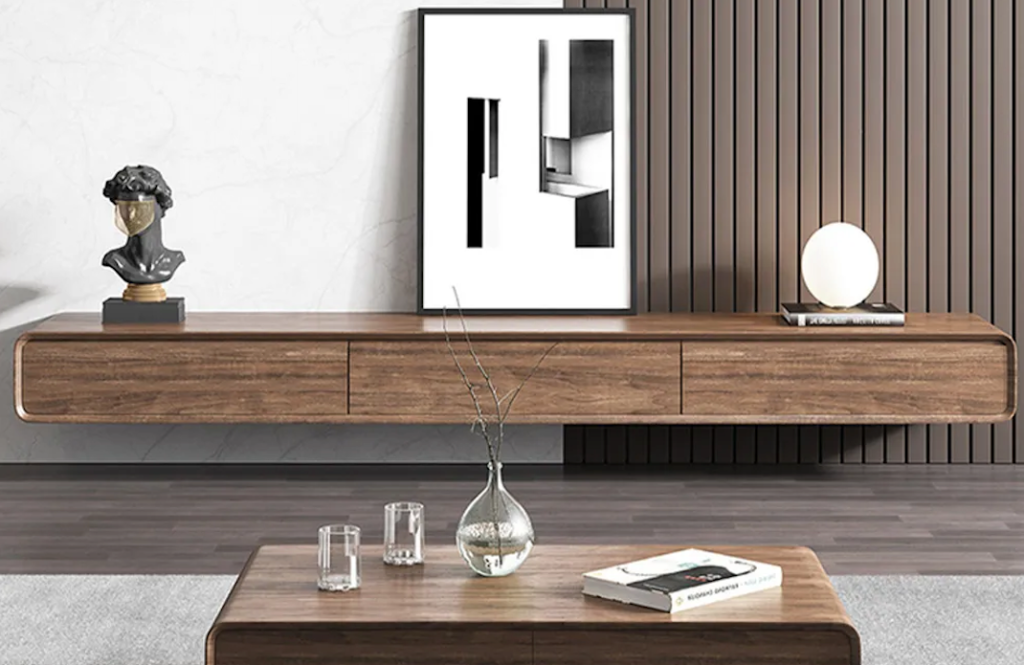
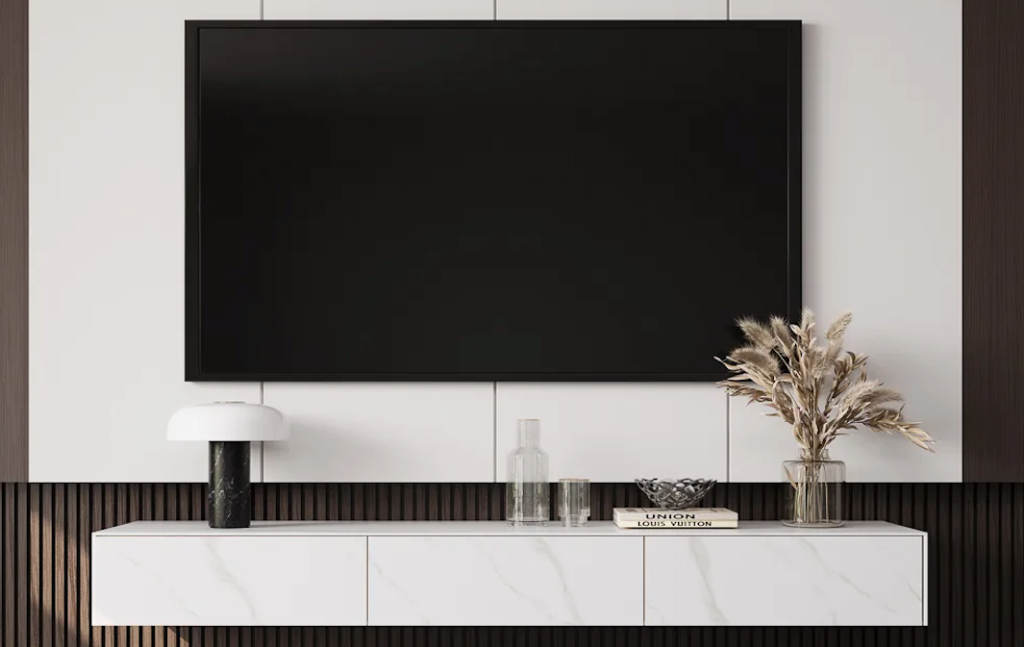
Now work backward to the console itself. You’re not mounting the console at eye level — you’re mounting it so the TV sitting above it, or the wall-mounted TV near it, lands the screen center on your mark. Practically, that puts the top surface of a floating console around 18–22 inches from the floor in most small rooms.
Leave a deliberate gap between the console top and the bottom of the screen — roughly 6–12 inches. That gap is not wasted space. It fits a soundbar without crowding the picture, it keeps the console reading as its own clean horizontal line, and it leaves room for the visible floor effect that makes the room feel open in the first place.
Once you know the mounting height that works for your seat, the next question is whether the console itself stays shallow enough for the room. In a tight layout, that makes depth more useful than simply choosing the widest cabinet that fits the wall.
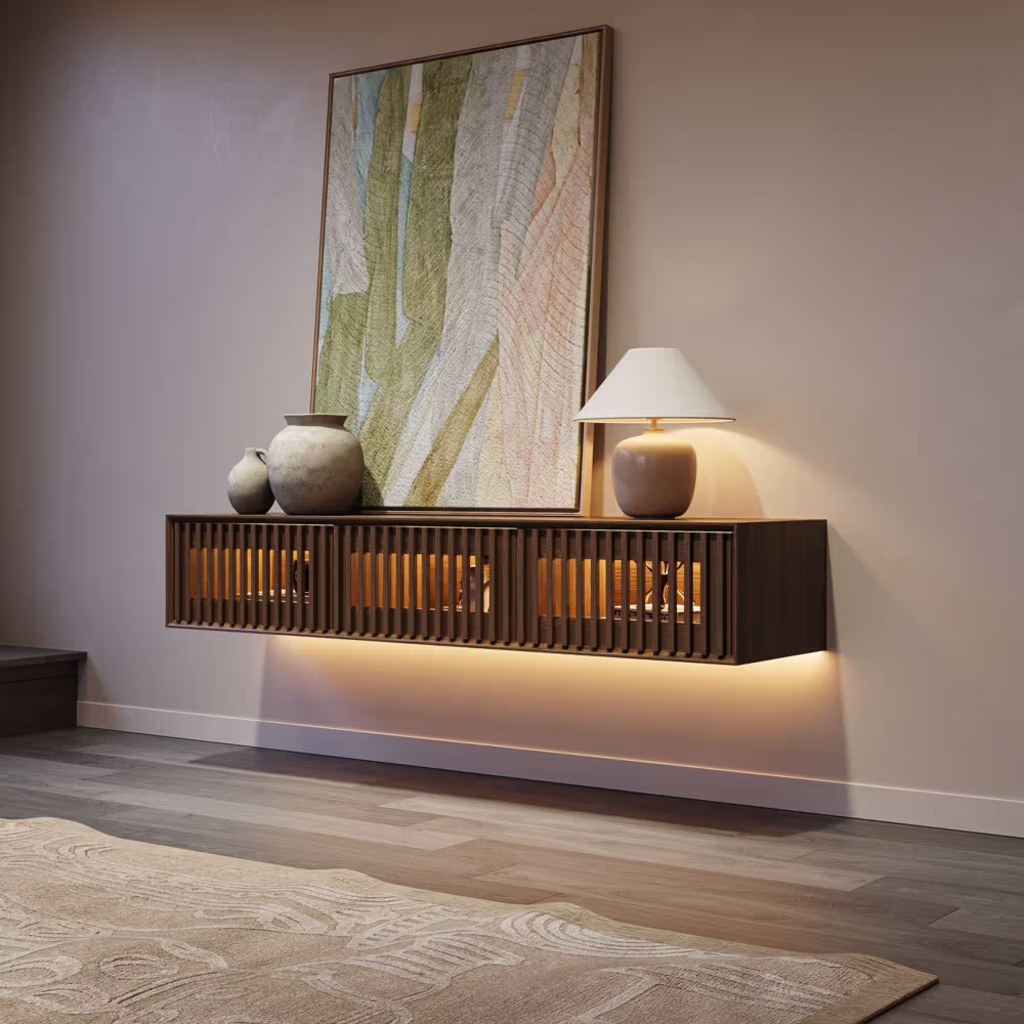
The Merrin Black Floating TV Stand is 14.57 inches deep, keeping it within the compact range discussed above. Its wall-mounted design lets you position the cabinet around your actual TV height, while three closed storage sections keep everyday media accessories out of sight without adding a floor-standing footprint.
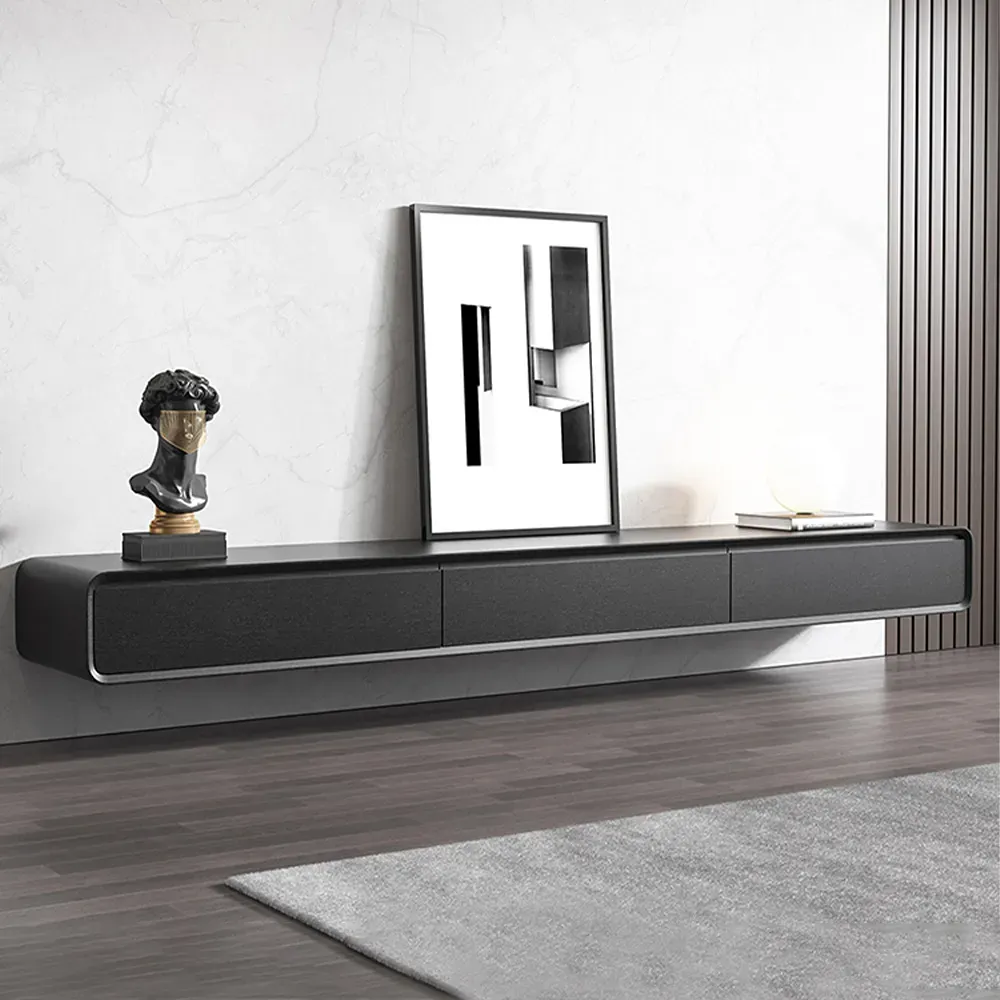
Merrin Black Floating TV Stand
Shallow wall-mounted storage keeps compact media walls open and uncluttered.
👍 Best for: Small rooms needing shallow depth
✨ 14.57-inch compact depth
✨ Three closed storage cabinets
✨ Flexible wall-mounting height
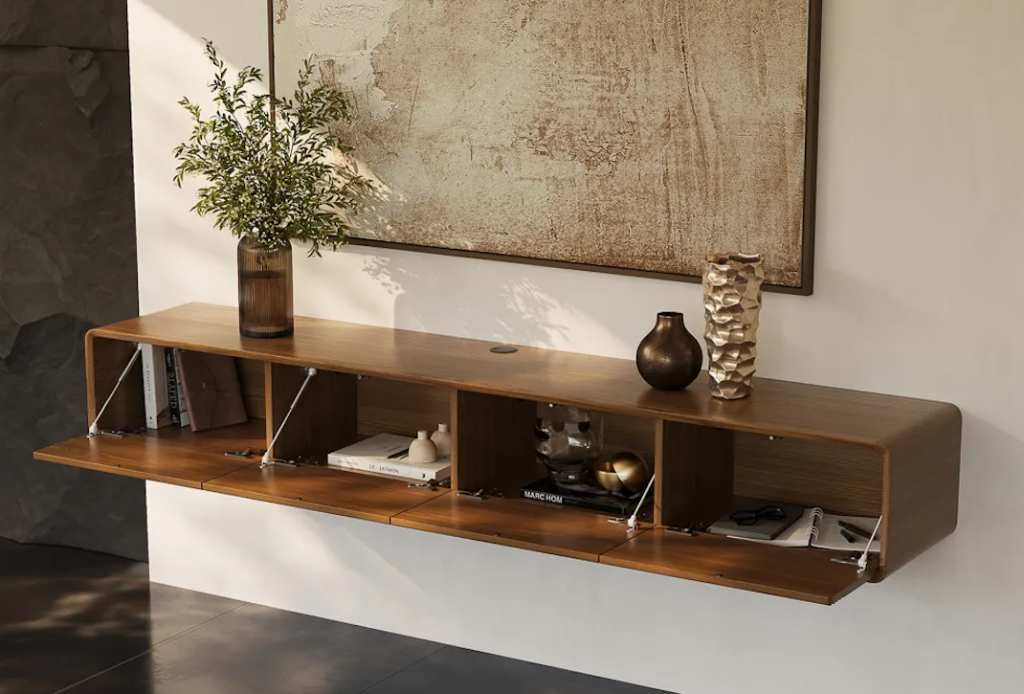
Cable and Device Storage Checklist
A floating console only looks clean if the cables don’t betray it. In a small room, every dangling cord is visible from every seat, so plan storage before you buy.
Walk through this list with a tape measure against the gear you actually own:
- Measure your tallest device. A cable box or game console is usually 2–3 inches tall; an AV receiver can be 6+ inches. Your console’s interior shelf clearance has to clear the biggest one with airflow to spare — components cook in sealed boxes.
- Count your devices and your ports. Cable box, streaming stick, game console, router, soundbar feed — that’s easily five power bricks and a tangle of HDMI. A center compartment around 18 inches wide by 12 inches deep comfortably holds a cable box, router, and three controllers; check the spec, don’t eyeball it.
- Demand a cable cutout. A real wire-management grommet at the back panel is non-negotiable. Without one, every cable has to route around the cabinet edge and you’ve lost the floating look.
- Plan the wall run. Cables traveling from a wall-mounted TV down to the console either run inside an in-wall conduit or behind a paintable cord channel. Decide which before you drill, not after.
- Check the material under the load. Devices and a soundbar add real weight on top. This is where build quality stops being cosmetic — solid wood or FSC-certified panels with a CARB Phase 2-compliant finish hold a screwed cleg and a loaded shelf without the slow sag you get from thin veneer over particle board. “Eco-friendly” on a tag means nothing; a named certification means the material was tested.
If your priority is more enclosed storage rather than the shallowest possible profile, staying near the upper end of the 14–16-inch depth range gives you another option.
The FLOAT Mid-Century Floating TV Stand stays relatively shallow at 14.96 inches deep while adding built-in cable access and top ventilation for connected equipment. Adjustable LED lighting adds ambient light without another floor fixture, making it a stronger fit for a wider media wall that still needs to preserve floor space.
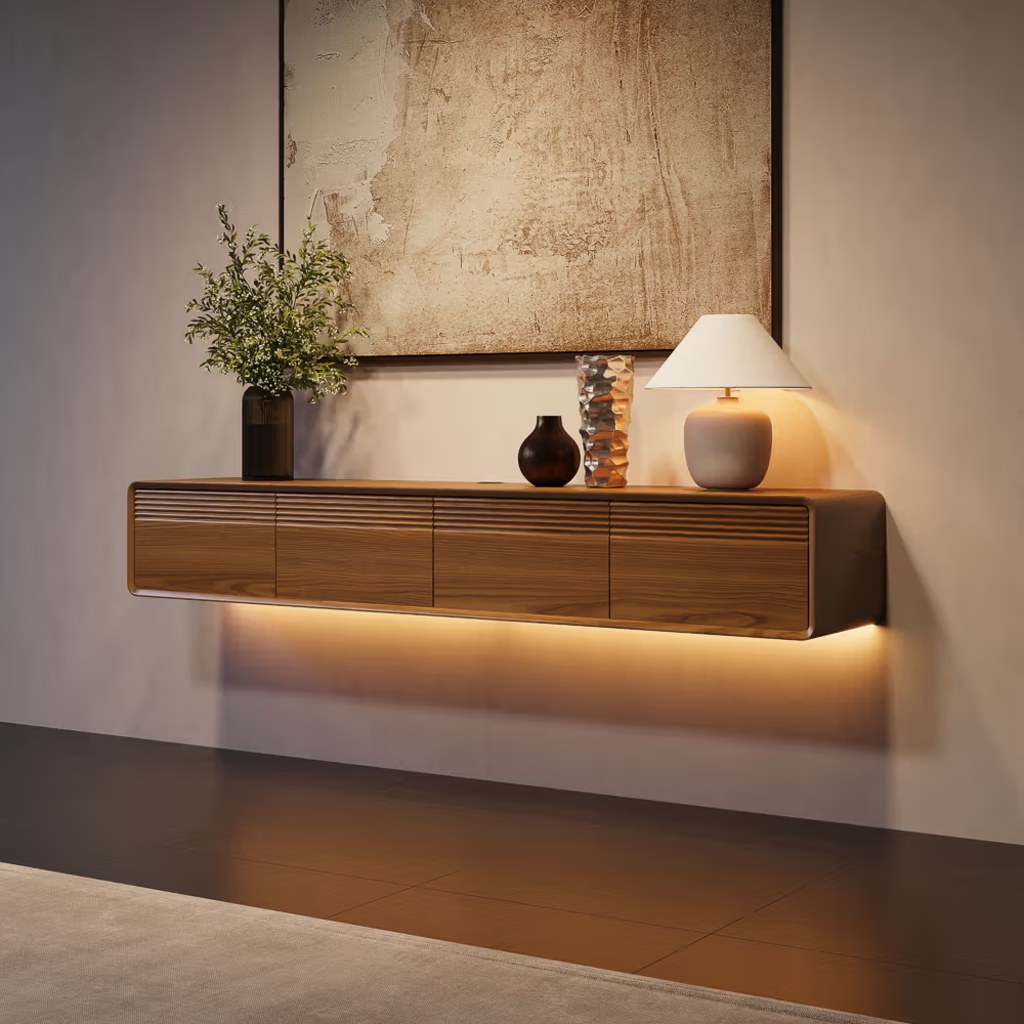
FLOAT Mid-Century Floating TV Stand
Shallow media storage keeps connected equipment organized without adding floor-level bulk.
👍 Best for: Connected compact media walls
✨ 14.96-inch compact depth
✨ Built-in cable access
✨ Top ventilation for equipment
Wall Type and Installation Checks
Here’s the part that scared my sister, and the part that should make you pause before you buy: a floating console is only as safe as the wall behind it. This is also where I’ll be straight with you about what to verify yourself.
Find your studs. In standard residential framing, wall studs sit 16 inches on center (sometimes 24). A floating console must anchor into at least two studs — drywall alone will not hold it. As the U.S. Consumer Product Safety Commission’s Anchor It! safety campaign emphasizes, furniture-and-TV tip-over is a documented household hazard, and proper wall anchoring is the single most effective fix. A standard screw driven into a wood stud holds dramatically more than the 5–10 pounds drywall manages on its own — that gap is the whole reason this matters.
Match the anchor to the wall. If a stud doesn’t line up where you need it, the engineering reference on drywall anchor load capacity and toggle bolts shows why a strap-style toggle bolt — not a plastic plug — is the only acceptable backup, and even then a console should still catch at least one stud. Crucial caveat from the product side: many floating consoles are rated for brick, cement, or solid-wood walls and explicitly notfor hollow gypsum-board partitions. Read the manufacturer’s wall-compatibility note and confirm the unit’s stated weight rating against your loaded gear before you drill. I’m flagging this hard because it’s the one spec people skip and then post angry reviews about.
The part that actually makes this easy. Everything above is about the mount — and that’s the only work you should have to do. POVISON ships these consoles fully assembled, so you skip the 2–3 hour flat-pack build entirely and never touch a hex key; the cabinet arrives as one solid, machine-tightened piece, and the only task left is anchoring it level into your studs. For a large or heavier unit, that’s still genuinely a two-person job and worth saying out loud — but POVISON’s white-glove delivery brings it into the room and handles the carry, and damage-in-transit is covered, so a stairwell and a 9-foot Brooklyn hallway don’t become your problem. If you want to browse units actually sized for tight walls, the fully assembled TV console collection filters by width so you’re not guessing.
Honest line: if you’re not comfortable locating studs and drilling a level mount, hire the install. A $200-ish wall job is cheaper than a console — and the gear inside it — on the floor.
FAQ
How high should I mount a floating TV console for comfortable viewing?
Mount it so the TV’s screen center lands at your seated eye level — for most adults on a standard sofa, that’s a screen center of 40–48 inches from the floor, which usually puts the console’s top surface around 18–22 inches up. Measure from your real seat in your real slouch, not a guessed average. Deep sectionals and recliners sit lower, so drop the whole setup a few inches.
Is a floating TV console a good choice for small living rooms?
Yes — it’s one of the strongest choices for small rooms because the visible floor underneath makes the space read larger, and a robot vacuum or storage bins can slide right under it. Keep depth to 14–16 inches so it doesn’t crowd a narrow room, and confirm you can drill into a sound wall. It’s not the pick if you rent and can’t patch holes.
Can a floating TV console hold media players, soundbars, and routers?
Yes, if you size the interior to your gear before buying. A center compartment near 18 inches wide by 12 inches deep holds a cable box, router, and several controllers, while the top surface carries a soundbar. Confirm the console’s stated weight rating covers your total load, and insist on a rear cable grommet so the wires stay hidden.
Do floating TV consoles require professional installation?
Not always — the cabinet itself arrives fully assembled, so there’s no flat-pack build. The only work is mounting it level into at least two wall studs. If you can locate studs, use a level, and you’ve confirmed your wall type matches the unit’s requirement, a confident DIYer can manage a smaller unit. For large or heavy consoles, or any wall you’re unsure about, professional installation is the smart, safe call.
Conclusion
A floating TV console is the right move for a small room — but only after you’ve done three things in this order: measured your sofa-to-TV distance against the SMPTE/THX angle, set the mount height to your seated eye level instead of the wall’s center, and confirmed what’s behind the drywall. Skip any one of those and you’ve got an expensive shelf that gives you neck strain.
Tape it out first. Always. Five minutes of painter’s tape on the floor and the wall has saved me more bad furniture decisions than any review ever has.
And once the measuring is done, the build doesn’t have to be the hard part. The whole reason I keep pointing people toward fully assembled pieces is that the only job worth your Saturday is getting the mount level — not deciphering a 40-step manual on the living room floor. A console that arrives ready to live in, delivered into the room, with the carry handled, means the only thing left between you and a clean TV wall is one well-placed drill.
If you’ve measured your wall and you’re tired of cabinets that eat your floor, POVISON’s fully assembled floating consoles arrive built and ready to mount — no hex keys, no weekend lost.
Ready to compare options?
Browse floating TV stands by width, storage, and finish.
Related Reading:


