 By Kelvin
Introduction
A bar stool weight capacity tells you the maximum load a manufacturer rates a stool to support, but the number alone does not tell you whether that stool is right for your household. If you are comparing 250-, 300-, or 400-lb models, the useful question is not simply how much weight can a bar stool hold. You also need to know who will use it, how often, and what construction supports that rating. This guide explains how to read the number, compare stools fairly, and verify the specification before buying.
Table of Contents
What Does Bar Stool Weight Capacity Actually Mean?
A bar stool weight capacity is the maximum user load published for a specific stool. Treat it as a product-specific limit, not as a universal rating for stools made from the same material or designed at the same height.
That distinction matters because a bar stool weight limit does not automatically describe comfort, resistance to wobble, or how well the stool will hold up after years of repeated use. A stool can be rated for a certain load and still have a seat that feels too narrow, a base that does not suit your floor, or moving parts that require more maintenance.
There is also no single capacity that applies to every residential stool. Wayfair, for example, uses 250 lb as a typical reference point in its weight-capacity guide while also sorting stools into under-200, 200–300, 300–400, and over-400-lb ranges. That variation is a good reason to check the individual product rather than rely on an assumed industry average.

How Much Weight Capacity Do You Need?
The most useful way to think about the average bar stool weight capacity is as a market reference, not a target you must choose. Start with the heaviest person who is reasonably expected to use the stool, then compare that weight with the manufacturer’s published maximum.
A kitchen island used by several adults needs a different purchasing decision from a stool used primarily by one person. For example, if relatives regularly gather at the island during weekend meals, choosing based only on the lightest or average household member can leave some seats unsuitable for guests.
Use the ranges below as shopping filters rather than universal safety classifications:
| Published Capacity | How to Interpret It Before Buying |
| Under 250 lb | Check carefully against every expected adult user; do not assume it suits general guest seating. |
| Around 250 lb | A commonly cited residential range, but still verify the individual user’s weight and product rating. |
| Around 300 lb | Provides more usable range for households with adults of different sizes. |
| 400 lb+ | Worth considering when higher-capacity seating is specifically needed; the number alone does not prove commercial certification. |
| No rating shown | Do not estimate from frame thickness or appearance. Ask the manufacturer for the current specification. |
A 300 lb weight capacity bar stool, for example, should be evaluated as a stool rated to that stated maximum—not automatically as “heavy duty.” Likewise, a 400-lb rating is not inherently better for someone who needs a lower capacity but places more importance on seat comfort, height, or floor clearance.
Avoid inventing your own universal safety-margin formula. Instead, choose a published capacity above the heaviest expected user’s weight and follow the manufacturer’s usage instructions. If the intended user’s weight is extremely close to the stated maximum, comparing a higher-rated model is the more practical purchasing approach.

Why Can Two 300-lb Bar Stools Be Different?
Two stools can publish the same load rating while using very different frame layouts, joints, bases, and moving components. That is why capacity should be read alongside construction rather than used as the only durability score.
Frame material is only the starting point. Metal stools may use welded or mechanically fastened joints, while wooden stools depend on the quality and reinforcement of their joinery. A four-leg frame, sled base, and pedestal also transfer load through different structures.
When comparing metal bar stools for modern kitchens, look beyond the word “metal” and check how the frame is actually joined and supported.
Moving parts add another comparison point. Swivel plates, height-adjustment mechanisms, and central columns introduce components that fixed stools do not have. This does not mean a swivel or adjustable stool is necessarily weaker; it means its published rating should apply to the complete stool, including those mechanisms.
A useful comparison is therefore:
- Same capacity, different construction: compare joints, cross-supports, base geometry, and moving components.
- Same material, different capacity: follow each manufacturer’s published rating rather than assuming the material determines the limit.
- Higher capacity, less comfortable fit: do not sacrifice seat width, height, back support, or normal usability simply to obtain the largest number.
The result is a more useful purchasing question: not “Which stool looks strongest?” but “What construction supports the rating I am being given?”
How Can You Verify Weight Capacity Before Buying?
Knowing how to verify bar stool weight capacity is especially useful when a marketplace listing, retailer page, or specification sheet provides incomplete information. Instead of estimating from appearance, use a short verification process before ordering.
- Find the stated maximum user weight. Look in the specifications rather than relying only on marketing terms such as “sturdy” or “heavy duty.”
- Confirm whether the rating applies to each stool. A listing for a set of two or four should clearly identify the capacity of an individual seat.
- Resolve conflicting specifications. If the retailer listing and manufacturer information disagree, verify the current manufacturer specification or contact the seller rather than selecting whichever number is higher.
- Look for a named testing standard when one is claimed. “Tested” is less useful than a statement identifying what standard was used.
- Check the construction around the rating. Review the frame, joints, base, footrest connection, and swivel or adjustment mechanism where applicable.
The fourth step deserves special attention. BIFMA does not have one generic “bar stool capacity” label. ANSI/BIFMA X5.1 covers general-purpose office and institutional seating including stools, while X5.4 covers public and lounge seating used in settings including restaurants, dining areas, and cafeterias. BIFMA X5.41 addresses large-occupant public and lounge seating using separate 400- and 600-lb test bases.
That means a seller simply stating “300 lb capacity” does not by itself establish BIFMA compliance. If testing is part of your buying decision, check which standard the manufacturer actually names and whether it fits the type of seating being sold.
Mechanisms deserve the same specificity. If you are considering adjustable bar stools for flexible seating, verify the rating for the complete adjustable stool rather than assuming the gas lift or pedestal works like a fixed four-leg frame.

Does Higher Weight Capacity Mean a Better Stool?
No. A higher maximum load can be useful when your household needs it, but it does not make a stool better in every other respect.
Keep four separate questions in mind:
Capacity: Can the stool support the intended user within its published limit?
Stability: Does the stool sit securely on the actual floor and remain steady during normal use?
Comfort: Do the seat dimensions, back, footrest, and padding suit how long people normally sit?
Durability: Are the frame, joints, upholstery, and moving components appropriate for the expected frequency of use?
This distinction becomes important at a kitchen island. A 400-lb stool that is too tall for the counter can be a worse purchase than a correctly sized 300-lb model that comfortably meets the household’s load requirements.
Once capacity is confirmed, decisions such as seat height, back style, and everyday comfort can be compared separately when choosing kitchen bar stools for daily use.

3 Best POVISON Bar Stools for Different Household Needs
Once you know the capacity you need, compare the published rating with the stool’s construction, assembly, and everyday-use features. These three POVISON picks range from 285 to 300 lbs and show why a clear weight rating is more useful than assuming similar-looking stools offer the same support.
Prices may vary by region, selected configuration, promotions, and discounts, so check the current product page for the latest pricing.
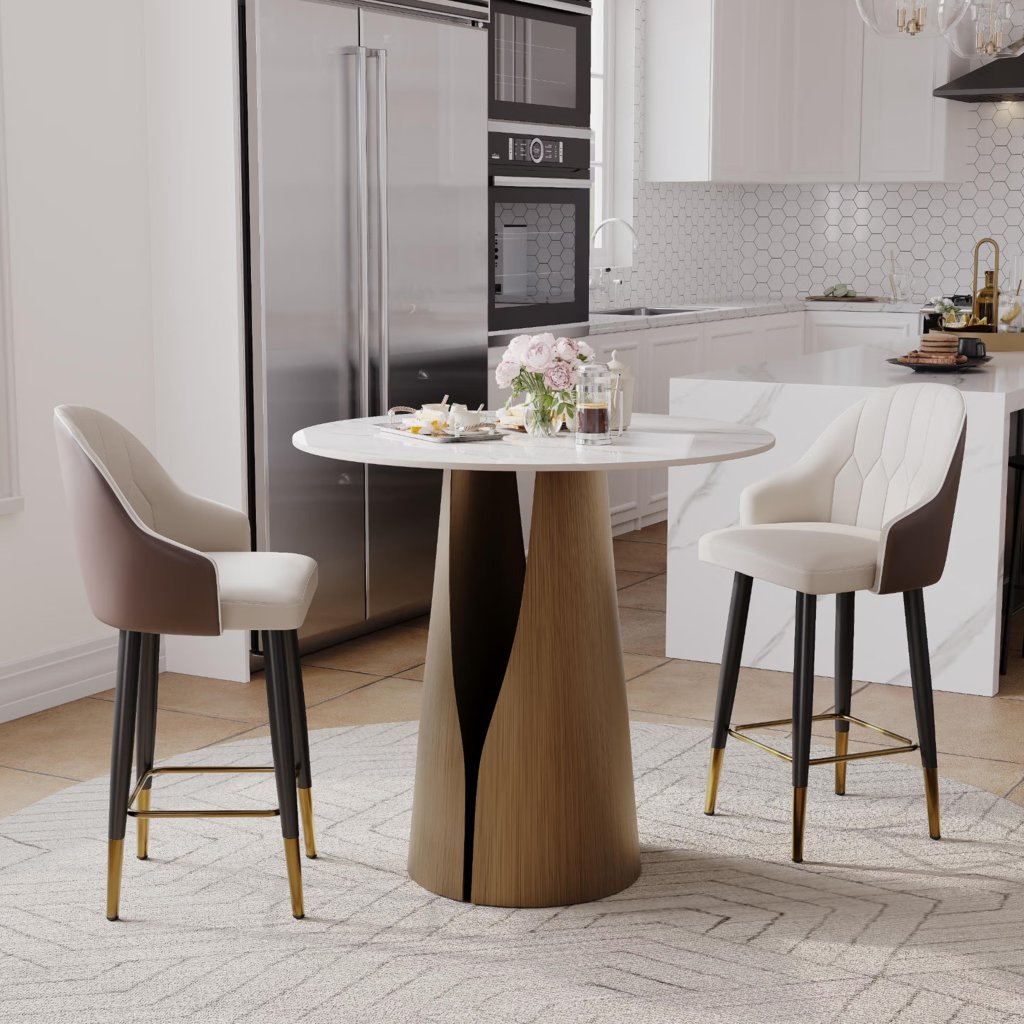
24″ Modern Counter Stools Set of 2
POVISON Modern Counter Stools
A cushioned 285-lb counter stool with metal legs and easy-care PU leather for everyday kitchen seating.
👍 Best for: Households needing a specific 285-lb rating
✨ Highlights
- Published 285-lb weight capacity
- PU leather upholstery with metal legs
- Curved padded seat and back for everyday support
- Adjustable floor levelers for slightly uneven surfaces
🎯 Features
The 285-lb rating makes this stool useful for buyers who want to compare an exact manufacturer specification rather than rely on broad 250- or 300-lb categories. Its metal-leg structure supports a softly upholstered seat and back, while floor levelers help keep the stool steady on slightly uneven kitchen floors. The wipe-clean PU surface also suits counters used regularly for breakfast, drinks, or casual meals.
🗨️ Buyer Review
“Very comfortable for a bar stool. The seat is wider than I expected and the back actually supports you.” — Amanda
Lawson-24″ Mid-Century Modern Wood Counter Height Bar Stools Set of 2

POVISON Lawson Mid-Century Modern Bar Stools
A fully assembled 300-lb counter stool combining solid wood support with easy-clean upholstery for ready-to-use kitchen seating.
👍 Best for: Buyers wanting fully assembled 300-lb counter seating
✨ Highlights
- Published 300-lb weight capacity
- Solid wood construction with PU leather upholstery
- Arrives fully assembled
- Smooth faux leather surface designed for simple cleaning
🎯 Features
Lawson separates two specifications buyers sometimes confuse: assembly status and weight capacity. It arrives fully assembled, while its published load rating remains a separate 300 lbs. Tapered solid wood legs create a different supporting structure from the metal-based options in this list, and the faux leather seating is easy to wipe down after daily meals. It fits buyers who want both a documented rating and no furniture assembly after delivery.
🗨️ Buyer Review
“Everything is of the highest quality and fits perfectly in our space. I couldn’t be happier.” — Ali
24″ Modern Counter Height Bar Stools Set of 2
POVISON Modern Counter Height Bar Stools
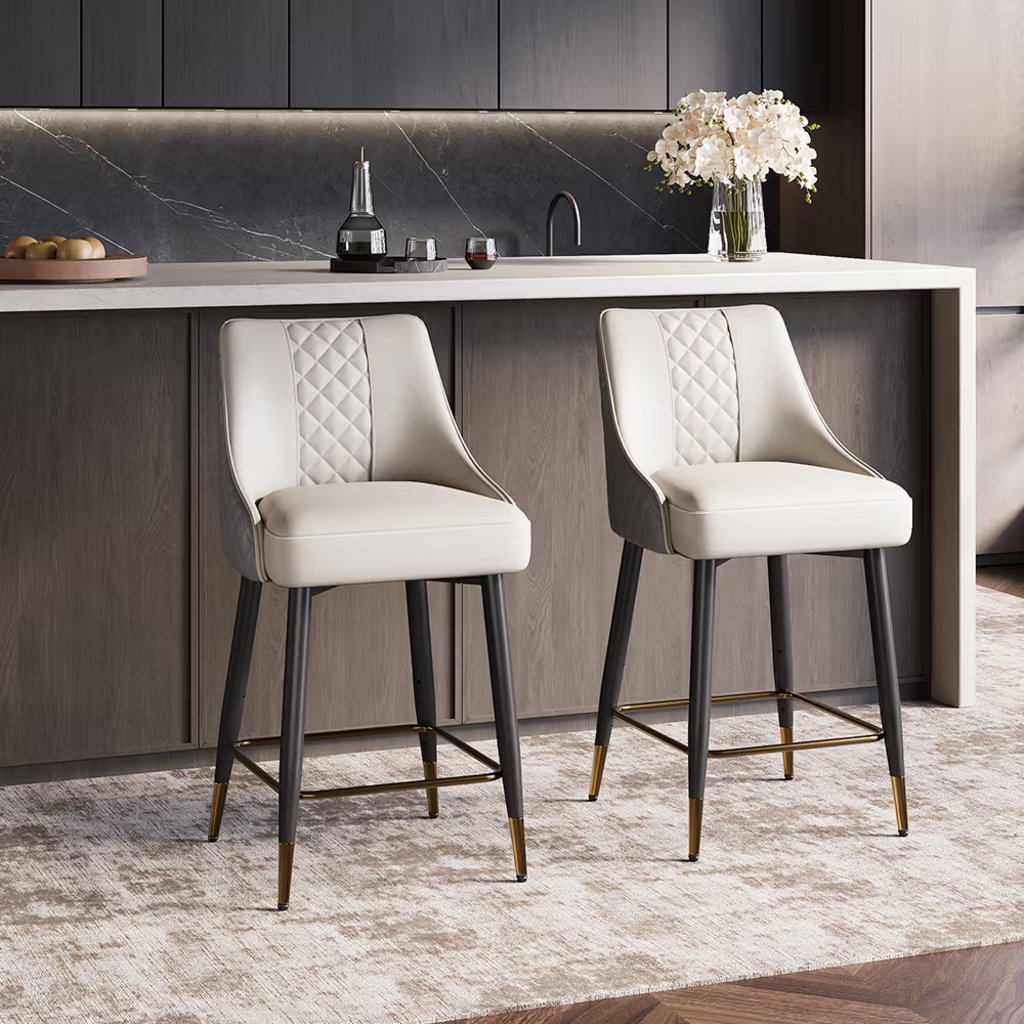
A 300-lb counter-height stool with easy-clean faux leather and supportive seating for frequently used kitchen islands.
👍 Best for: Everyday kitchen islands needing a 300-lb rating
✨ Highlights
- Published 300-lb weight capacity
- Scratch-resistant, easy-clean PU leather
- Non-slip contact points support everyday floor stability
- Partial assembly keeps the product structure distinct from Lawson
🎯 Features
This model is especially useful for comparing two stools with the same 300-lb rating. Unlike the fully assembled solid-wood Lawson, it requires partial assembly and uses a different seating and base design. Its wipeable faux leather suits frequently used kitchen counters, while the product’s floor-contact features help with everyday stability. The comparison reinforces a key buying rule: identical weight ratings do not mean two stools are built or used in the same way.
🗨️ Buyer Review
“We use these every day for breakfast and they’ve held up great so far. No sagging in the seat at all.” — Audrey
Conclusion
Choosing the right bar stool weight capacity starts with the heaviest expected user, but it should not end with the number printed on a product page. Compare the published limit with the stool’s frame, joints, base, and moving components, and verify unclear or conflicting specifications before buying. Higher capacity is useful when your household needs it; it is not a substitute for stability, comfort, or correct counter height. Once the load requirement is clear, you can compare those remaining features without asking one specification to do every job.
Q&A
Can two people share one bar stool below its weight limit?
No. A single-seat bar stool should be used by one person unless the manufacturer specifically allows otherwise. Two people can place uneven force on the seat edges, frame, and footrest even when their combined weight stays below the stated limit. Follow the seating capacity, not just the total body weight.
Can a backrest increase a bar stool’s weight limit?
Not by itself. A large or thick backrest may improve seated support, but it does not prove that the stool carries more weight. When comparing stools, check the published load rating and how the back connects to the frame instead of using backrest size as an indicator of structural strength.
Can you rely on an older stool’s original weight rating?
Only while the stool remains structurally sound. Cracked wood, bent metal, damaged welds, loose joints, or worn swivel hardware can make the original rating less useful for judging current condition. Inspect frequently used stools periodically, especially before a heavier user relies on an older seat.
What should you do if a bar stool starts wobbling?
Check for loose fasteners, damaged joints, bent parts, worn glides, and uneven floor contact. If approved hardware tightening or leveling does not correct the movement, stop using the stool until the cause is identified. Staying below the published weight limit does not make persistent structural looseness safe to ignore.
Can an uneven floor make a properly rated stool unstable?
Yes. Weight capacity describes load support, not whether every foot meets the floor evenly. Test a rocking stool on a known level surface first. If the floor is responsible, use built-in levelers or manufacturer-approved glides rather than shortening, bending, or otherwise modifying the stool legs.


