 By Charles
I swapped out our kitchen’s old wooden stools for metal ones about a year ago — partly for the clean look, partly because we’d worn through the finish on the wooden seats with too many spilled coffees. The three things I learned in the first month weren’t what the product pages talked about. The seats felt cold in the morning. The stools made a louder sound when dragged than wood does. And the rubber feet shipped pre-installed weren’t actually right for our floor.
A year later, I’d buy metal stools again — they’ve held up beautifully — but I’d ask different questions before checking out. This guide is the version of that conversation I wish I’d had with myself. It’s not about industrial-style restaurant seating; it’s about whether metal bar stools work in a normal home kitchen, and what to verify before they show up in a box.
Are Metal Bar Stools Practical for Home Kitchens
Practical, yes — for the right kitchen and the right user. Metal bar stools have three real advantages over wood and upholstery: they shrug off spills and grease, they don’t dent from dropped utensils, and the visual footprint is lighter, which matters in open-plan rooms where stool legs are visible from the living area.
The trade-offs are real, and they’re the things product pages skip. Metal conducts heat about 100 times faster than wood — not marketing exaggeration, a property of the material. In practice: a metal seat at 65°F room temperature feels noticeably colder against bare skin than a wooden seat at the same temperature, because metal pulls heat from your body faster on contact. The seat warms up after a couple of minutes; the first 30 seconds are the part everyone notices. Anyone who’s sat on a metal park bench in November knows the feeling.
Foot positioning also matters more on metal than on softer seats. Per Dimensions’ stool dimensions data, a foot rest about 12 inches below the seat is the ergonomic standard. On a hard metal seat, getting that foot rest height wrong amplifies the discomfort — your weight has nowhere soft to redistribute, so it lands on the back of your thighs.
Who should skip metal stools: people who sit on the same stool for hours (working from the island, all-day homework supervision), households where the kitchen runs under 68°F most of the year, and anyone unusually sensitive to the sound of dragged metal.
Best Rooms for Metal Bar Stools
Metal works exceptionally well in two kitchen styles and feels out of place in others.
Modern Kitchens With Clean Lines
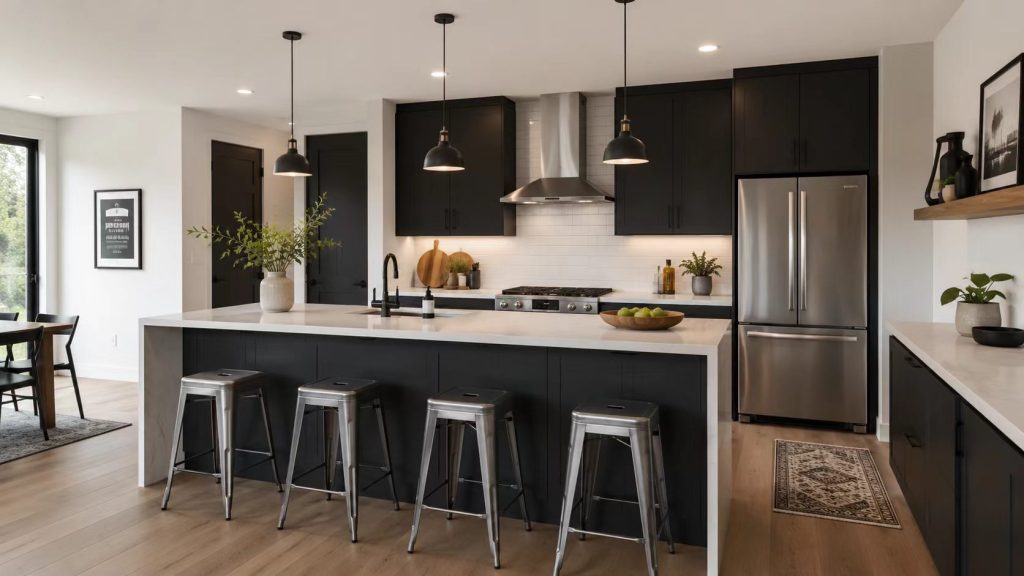
If your kitchen leans toward minimalism, matte finishes, and visible lines — quartz or sintered stone counters, slab-front cabinets, neutral palette — metal stools belong. The thin profile reads as architectural rather than decorative. Black powder-coated steel is the most flexible neutral; brushed brass and matte champagne work as warmer accents; chrome and high-polish stainless are harder to integrate without looking dated. The key visual principle: metal stools should match the kitchen’s smallest metal details (cabinet pulls, faucet finish, pendant lights). A row of black metal stools next to brass hardware reads as designed; the same stools with brushed nickel hardware reads as mismatched.
Industrial-Inspired Dining Corners
A note on style boundary: “industrial bar stools” — welded steel frames, exposed rivets, warehouse aesthetic — work in dedicated industrial-style rooms (exposed brick, Edison bulbs, raw concrete). They generally don’t translate to a modern kitchen with white walls and oak floors without looking forced. If your kitchen isn’t already industrial, choose a streamlined modern metal stool rather than a heavy industrial one. The industrial subcategory tends to be heavier (often 18-25 lbs vs 10-15 lbs for modern metal), louder when dragged, and harder to clean around exposed welds.
Metal Bar Stools With Backs vs Backless Metal Stools
The general backed-vs-backless question changes when the seat is metal. A wooden backless stool relies on your core for support; a metal backless stool does the same thing with a colder, harder seat under you. That combination tips the balance toward backed metal stools for anything longer than a quick coffee.
Metal stools with backs have one extra wrinkle wooden ones don’t: the back is also metal, so it has the same thermal-conductivity issue against your shoulder blades through a t-shirt. A back with a slight contour or a thin upholstered pad changes that completely; a flat metal back panel doesn’t. If a listing photo shows a perfectly flat metal back, ask for an angled side photo to confirm contour.
Backless metal works when the stool tucks fully under the counter, sessions stay under 20 minutes, and visual lightness matters in an open layout. Metal with a back works for longer meals, kids who lean back, anyone who runs cold (older household members especially), and dedicated dining setups where the stool stays put.
Comfort, Noise, Floor Protection, and Cleaning
This is where most metal-stool regret originates. Four issues to plan for, not one.
Cold-contact comfort. Three solutions exist. A removable seat cushion is the cheapest and most effective — a 2-inch foam pad in a wipeable cover eliminates the cold issue entirely. A factory-applied seat cover (faux leather, fabric, or rattan inlay over the metal frame) is the integrated approach. The third is acclimation — if the stool only gets sat on for short bursts after the kitchen has been warm a while, the temperature delta becomes manageable.
Noise. Metal stools generate noise from three sources: the foot tips against the floor when the stool is dragged, the joints in the frame if welds or bolts loosen, and resonance through the seat itself when struck. Per CDC NIOSH guidance on noise exposure, 85 dBA over an 8-hour day is the occupational threshold for hearing-loss prevention — household stool noise is nowhere near that level for hearing risk, but a metal stool repeatedly scraped across a tile floor can hit 70-75 dBA at the source, which is conversational-voice territory. Felt or silicone foot pads cut that noise floor by half. Tighter factory-welded frames don’t develop the bolt-rattle that loose ones do.
Floor protection. Here’s the part that bit me: a metal stool foot is a hard edge, not a soft contact like a wooden leg. If the foot pad fails or wears through, the metal hits the floor directly, and the damage profile is different from wood — a metal edge dragged across LVP can cut the wear layer, a metal edge on hardwood can dent rather than scratch. The three foot-pad types work differently on metal stools than on wooden ones:
| Foot Pad Type | Hardwood Floors | LVP / Vinyl | Tile / Concrete |
| Felt (adhesive) | Good (replace yearly) | Acceptable | Slides too easily |
| Rubber (cup) | Good if light-colored rubber | Excellent | Best option |
| Silicone (cup or sleeve) | Excellent | Excellent | Excellent |
| Bare metal | Avoid | Avoid | Avoid |
For light-colored hardwood, black rubber pads can leave gray streaks over time; ask for clear silicone or natural felt instead.
Cleaning. Powder-coated metal wipes clean with a damp microfiber cloth. Avoid abrasive sponges, which can dull the coating. Per EPA’s guidance on indoor VOCs and coatings, powder coating itself is one of the lower-VOC finish methods because most of it cures during factory baking rather than off-gassing into your home — that’s a real advantage over solvent-based paints. If a metal stool smells like fresh paint when it arrives, it should air out within 48 hours; longer means the finish wasn’t fully cured.
What to Check Before Buying Online
Six checks for metal bar stools specifically:
- Frame material. Steel is the default and the strongest; aluminum is lighter (often 30-40% lighter) but dents more easily; iron is heaviest and most prone to rust if the coating fails. Stainless steel resists rust without depending on a coating.
- Coating type and durability rating. Powder coating is the kitchen-friendly default — durable, low-VOC, available in many colors. Electroplating (chrome, nickel) looks polished but can chip. Look for ASTM B117 salt-spray test ratings on coatings; 500-1,000 hours of salt-spray resistance is solid for indoor kitchen use.
- Weld quality. Inspect product photos for the welds at frame joints. Continuous, smooth welds last; spot welds in tension points loosen over time. If the listing only shows aesthetic shots, ask for a close-up of a weld.
- Foot pads pre-installed. What ships in the box matters. Felt pads peel off; rubber cups stay on better; silicone is best. Ask whether replacements are available from the seller.
- Weight and weight capacity. Most home metal stools weigh 10-15 lbs and rate to 250-300 lbs capacity. Stools that don’t publish a capacity should be assumed under-rated. Cyclic-load testing per ANSI/BIFMA’s seating standards (X5.1 for chairs, X5.4 for lounge/public seating) separates well-engineered stools from decorative ones.
- Assembly status. Metal stools take their stress at the welds between the seat and the upright, and between the upright and the foot frame. DIY-bolted frames develop noise (the rattle that wasn’t there in the showroom) within months. Browsing POVISON’s fully assembled bar stool collection gets you stools that arrive with the structural welds factory-set and the foot pads pre-installed, which is the difference between a stool that’s still quiet in year three and one that announces every visitor.
One ergonomics note: for households where the stool gets daily extended use, the comfort/posture principles from NIOSH’s ergonomics guidance still apply — proper seat height and foot support matter as much on metal as on wood. The materials don’t change the body’s needs; they only change what happens when those needs aren’t met.
FAQ
Are metal bar stools comfortable for daily use?
Metal bar stools are comfortable for daily use in short sessions, and become uncomfortable for long sessions without a cushion or seat cover. The hard metal surface and faster heat-conduction mean a cold seat and direct pressure on the sit bones — fine for a quick coffee or a meal, harder for hours of work-from-island. A removable seat cushion or factory-applied seat cover eliminates both issues. The comfort verdict depends mainly on how long you sit and how cold your kitchen runs.
Do metal bar stools scratch floors or create noise?
Metal bar stools scratch floors or create noise based on what’s between the foot and the floor. Bare metal feet will damage almost any soft floor (hardwood, LVP, vinyl) and generate noise on hard floors (tile, concrete). Felt, rubber, or silicone foot pads — installed at the factory or aftermarket — eliminate most of the issue, but they wear and need periodic replacement. Silicone pads tend to last longest; felt pads pick up grit. The risk profile is real but solvable with the right foot pads.
Are metal bar stools with backs better for kitchens?
Metal bar stools with backs are generally better for kitchens used for more than quick coffees because the back transfers some support burden off your core. Backless metal works for tight kitchens, short sits, and visual lightness; metal with a back works for longer meals, kids who lean back, and anyone who runs cold. A metal back with a slight contour or thin upholstered pad is noticeably more comfortable than a flat metal back panel.
Do industrial bar stools work in modern homes?
Industrial bar stools work in homes already styled industrial — exposed brick, raw concrete, Edison-bulb lighting, warehouse-loft character. They generally feel out of place in modern kitchens with painted walls, oak floors, and refined finishes. A streamlined modern metal stool with clean lines reads better in most homes than a heavy industrial-style stool with exposed rivets and reclaimed-wood seats. If you want a metal-frame look without the industrial weight, choose a stool with welded thin-tube steel and a powder-coated finish rather than raw or distressed metal.
Conclusion
Metal bar stools work for most modern kitchens that want durability and clean lines, as long as you address the three issues product pages skip — cold seat, drag noise, and floor protection. Add a cushion or choose a seat with an integrated cover, specify silicone or rubber feet for the kitchen’s specific floor, and look for powder-coated welded steel rather than bolted assemblies. Done right, they outlast wooden stools by years. Done wrong, they’re the stool you’ll find on the curb in eighteen months.
Related Reading:


