 By Charles
Hey, Charles here. I used to think the oval dining table was a compromise shape. Like someone couldn’t commit to round, couldn’t commit to rectangular, so they shrugged and stretched a circle. That was my dumb take. It took helping my sister redo her narrow Brooklyn brownstone dining room — the one where a 54″ round table left her chairs visibly bumping the wainscoting — for me to actually get it.
Here’s the thing about oval tables: they’re not for everyone. A lot of articles will tell you they’re “elegant” or “softer” and then give you no actual decision criteria. That’s not useful when you’re staring at a checkout page with a $1,200 table in your cart. So this is the practical version. When does an oval dining table genuinely beat a round one? When does it not? And how do you tell which one your room is asking for?
If you’ve already ruled out a standard round table — too tight on seating, or just visually wrong for the space — but you’re not sure a rectangular table is right either, this is for you.
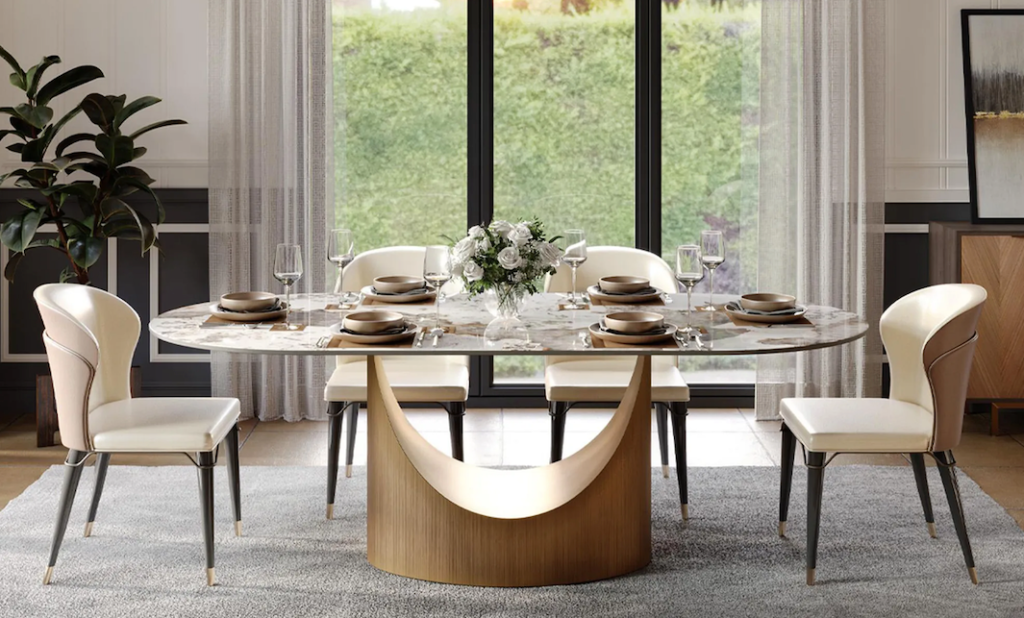
What Makes an Oval Dining Table Different
An oval table is essentially a rectangle that gave up its corners. Same length-to-width ratio as a rectangular table, similar seating capacity per linear foot, but the ends curve. That single change does three measurable things to how the table behaves in a room.
It saves about 6–10 inches of walkway clearance at the ends. A 72″ rectangular table needs the full 72″ length plus chair pull-out space at each end. A 72″ oval pulls back at the corners, so the actual footprint at chair height is closer to a 66″ rectangle. In tight rooms, this is the difference between brushing the wall and walking around comfortably.
It removes the four collision points where guests’ hips meet table corners. Anyone who’s hosted a dinner where guests get up between courses knows what I mean. Sharp corners at hip height are a small but real hazard, especially in narrow walkways. Oval tables eliminate this entirely.
It changes how conversation flows. A round table puts everyone equidistant. A rectangular table creates two “head” seats and a clear hierarchy. An oval splits the difference — the curved ends mean the people at the “head” can actually make eye contact with everyone else without leaning forward. According to Dimensions’ reference data on oval dining layouts, the curved contours allow flexible seating that accommodates extra chairs without the constraint of corners — which is why oval tables historically appear in formal dining rooms designed for actual conversation.
That last point is the one most buyers underestimate.
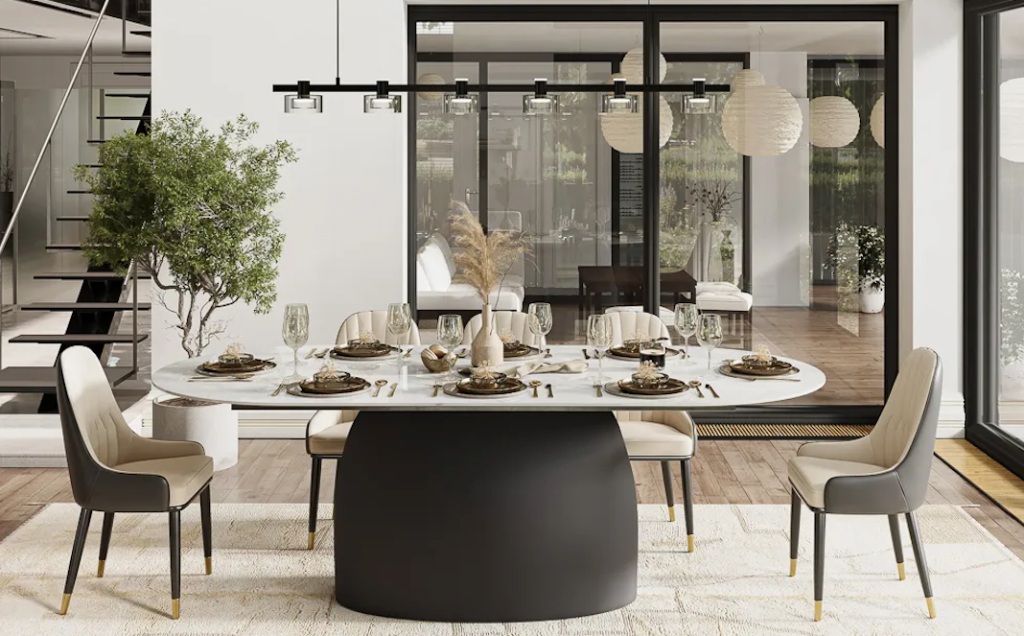
Oval vs Round vs Rectangular at a Glance
I made this comparison after measuring tape-outlines on the floor for three different rooms. The numbers below assume mid-range tables in each shape, seating 6 people comfortably.
| Factor | Round (54″) | Oval (71″ x 39″) | Rectangular (72″ x 36″) |
| Seats comfortably | 4–6 | 6 (8 at a squeeze) | 6 (8 at a squeeze) |
| Best room shape | Square or near-square | Long rectangle, narrow rooms | Long rectangle |
| Walkway around ends | Generous (curved) | Generous (curved) | Tighter (corners) |
| Conversation flow | Excellent (intimate) | Very good | Splits into two halves |
| Squeezing in an extra chair | Difficult | Easy | Easy |
| Hip-bump risk in walkways | None | None | Real |
| Visual weight in room | Compact | Medium | Heaviest |
| Works in open-plan zones | Yes | Excellent | Excellent |
If you want to see specific oval dimensions and base styles mapped to room sizes, POVISON’s oval dining table guide page catalogs the full range from 47″ extendables to 94″ pedestals.
The pattern that jumps out: oval tables behave like rectangular tables on the seat-count question and like round tables on the circulation question. That’s the actual reason to consider one — not aesthetics.
Best Rooms for Oval Dining Tables
Narrow Dining Rooms
This is the strongest case for an oval. If your dining room is longer than it is wide — say, 14′ x 10′ or narrower — a round table either seats too few people for the floor area, or the diameter you’d need to seat 6 (around 60″) leaves almost no walkway on the long sides.
Run the math with the published clearance standards. The NKBA’s kitchen and bathroom planning guidelines — the industry reference used by certified kitchen and bath designers in North America — call for a minimum of 36 inches of clearance from the table edge to any wall or obstruction when traffic passes behind seated diners, bumping up to 44 inches for regular walking paths. That standard is reinforced by the International Residential Code’s space requirements, which informs accessibility minimums in most U.S. jurisdictions.
In a 10-foot-wide room (120″), subtracting 36″ of clearance on each side leaves 48″ of usable table width. A 60″ round simply won’t fit. A 39″-wide oval wall, with a foot of breathing room on each side.
This is where my sister landed. Her room is 13′ long, 9’6″ wide. We tried a 54″ round (too small for her family of 5), a 60″ round (chairs bumped the wall), then a 71″ x 39″ oval. The oval seats six, leaves 35″ of walkway on each long side, and the curved ends let her squeeze a high chair in for her toddler without anyone re-arranging.
Open-Plan Spaces
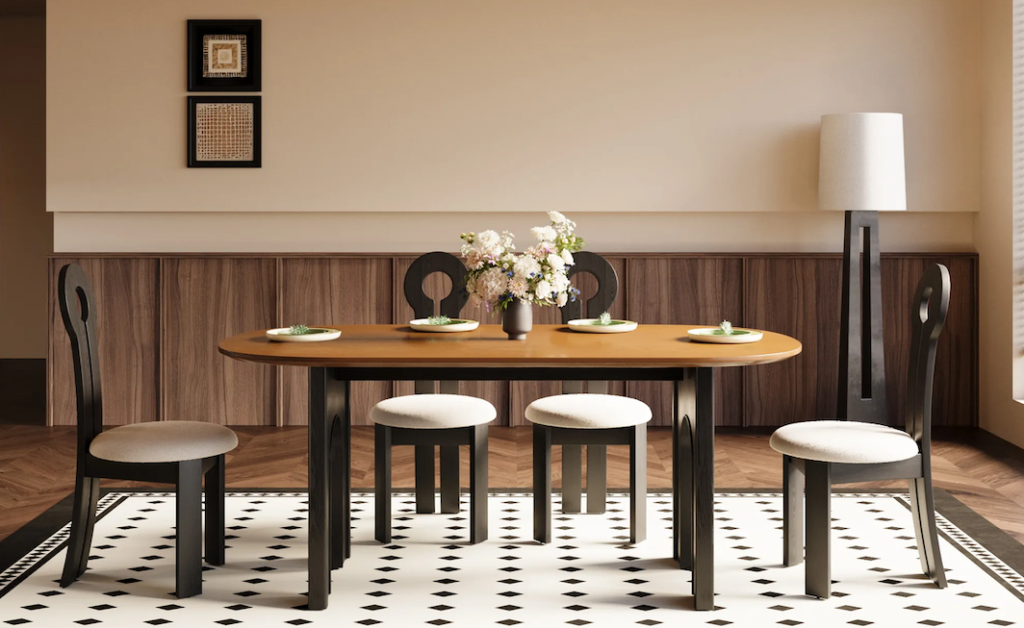
The second strong case is open-plan kitchens and living-dining hybrids. In rooms with no clear “dining wall,” the table itself defines the zone. Rectangular tables work here, but they create a hard linear axis that can fight with a curved sofa or a kitchen island with rounded ends. Round tables can feel undersized when the open-plan space is generous.
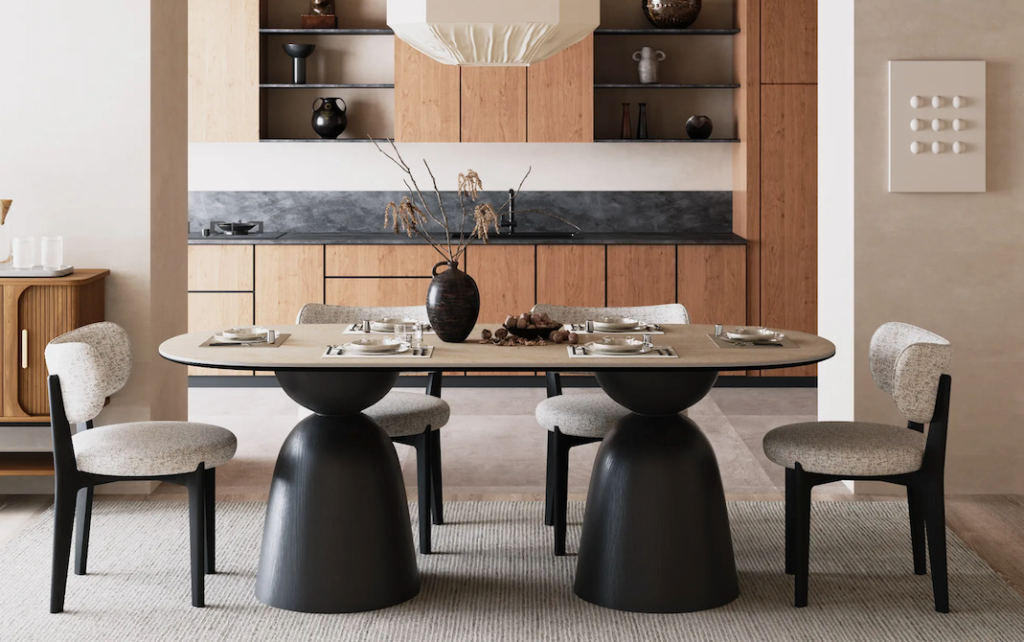
An oval splits the difference. It defines the dining zone with intent — the long axis tells you “this is where meals happen” — but the curved ends keep the silhouette softer, so it doesn’t visually slice the room into rigid compartments. In open-plan layouts, this is also where design cohesion starts to matter — the table sits in the same sightline as your sofa, sideboard, and kitchen island. POVISON builds its oval dining collection as coordinated sets — pedestal-base oval table, matching chairs, and complementary sideboard pieces in the same finish family — which solves the most common open-plan mistake of stitching together three different brands and ending up with a room that looks like a furniture clearance aisle.
If your space is part of the modern trend toward flexible multi-use rooms, the oval gives you something a round table can’t: real seating capacity without the visual weight of a long rectangle.
Who Should Skip an Oval Table
Look, I’m not going to pretend ovals are universally better. Here’s when I’d tell a friend to pass:
You have a square dining room under 11′ x 11′. A round table is almost always the right answer here. The geometry just works — equal clearance on all sides, no awkward “long axis” decision. An oval forced into a square room reads as if it’s pointing at something.
You host 8+ people regularly for sit-down meals. An oval can stretch to 8, but you start losing the conversational benefit. At that length, a rectangular extendable table gives you better daily flexibility (compact for 4–6, opens up for 10+). The extendable table mechanisms covered in POVISON’s flexible living guide handle this scaling more gracefully than fixed ovals.
You want a “head of the table” for formal dinners. Ovals technically have ends, but the curved geometry makes them feel egalitarian. If you host clients or run holiday meals where someone’s expected to sit at the head, a rectangular table delivers that signal more clearly.
Your chairs have wide arms. Curved table ends mean the chairs at the heads sit at slight angles relative to the table edge. Wide-armed chairs can interfere with this. Slim-back or armless chairs work much better with ovals — something to factor in if you’ve already bought your chairs.
Decision Factors Before Buying Online
I’ve returned enough furniture to know what actually matters before you click “buy.” Here’s the checklist I use now:
Tape out the actual footprint on your floor. Painter’s tape, 71″ x 39″ or whatever size you’re considering, on the actual floor. Walk around it. Pull a chair up to where it would sit. This single step kills 80% of returns.
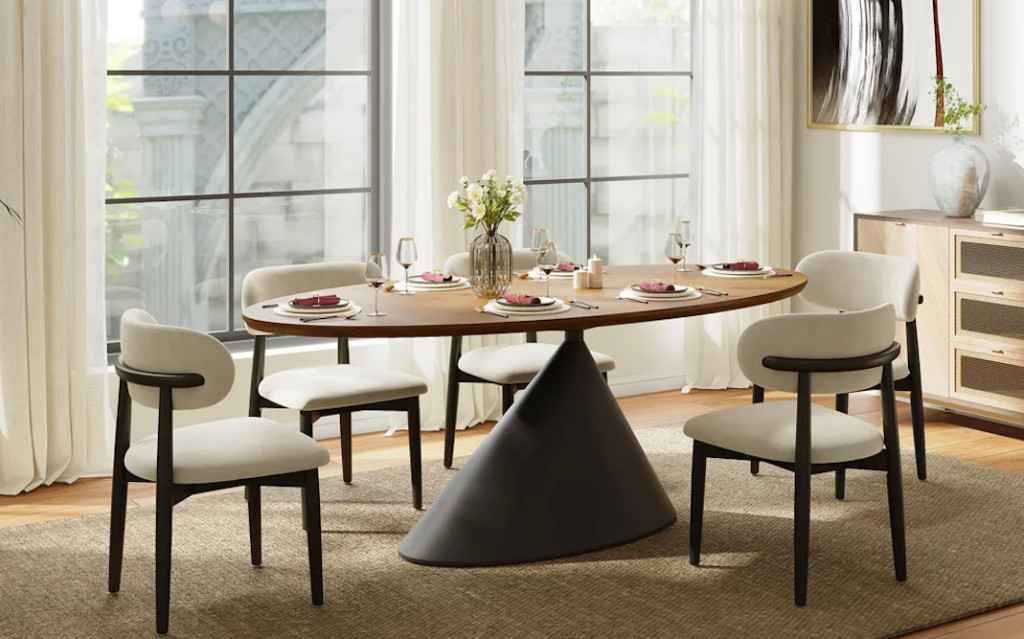
Check the base style honestly. Pedestal bases keep the floor visually open and give better legroom at the ends — but they can feel less stable for very long ovals (over 84″). Four-leg frames are stable but eat floor space and may force end-seat diners to angle their knees around the legs. Trestle bases (think two pedestal-style supports) split the difference but limit the position of end chairs. POVISON’s oval collection runs across all three styles, so you can match the base to your priorities.
Width matters more than you think. An oval narrower than 36″ makes family-style serving genuinely awkward — large platters squeeze the place settings to the edge. 39″–42″ wide is the sweet spot for daily use without losing the slimmer-than-rectangular feel. Anything over 44″ wide starts behaving like a rectangle.
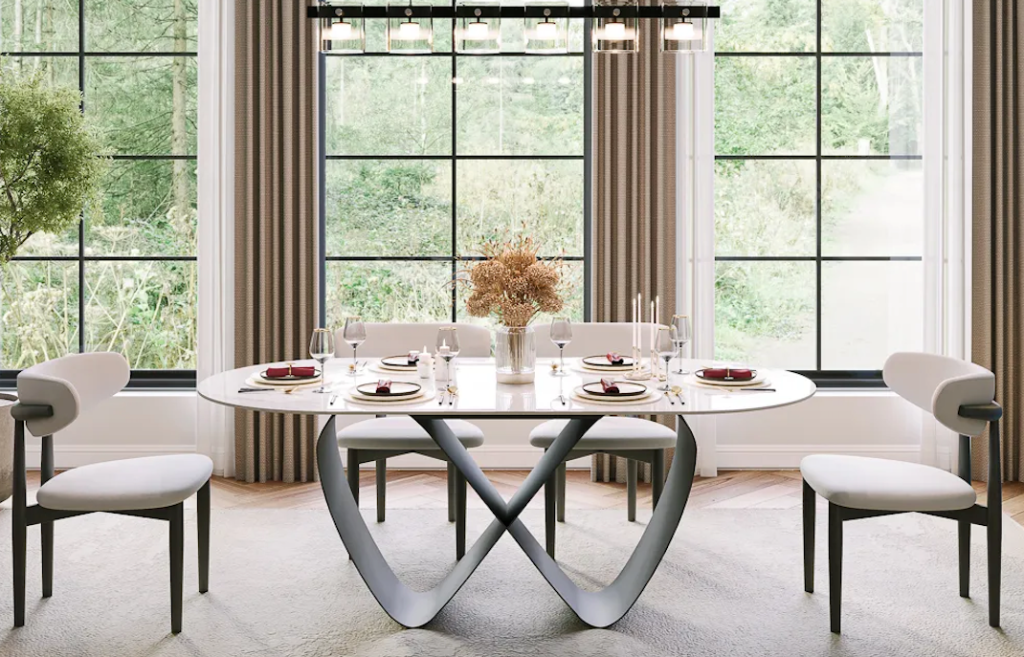
Verify what’s actually under the finish. This is where most online furniture descriptions get vague. Sintered stone, solid wood, MDF with veneer — the surface tells you durability, but the substrate tells you longevity and air quality. Look for explicit references to FSC-certified wood, CARB Phase 2 compliance for engineered cores, and non-toxic finishes. If a product page lists these by name (not just “premium materials”), that’s a real signal. POVISON publishes this on every dining table spec page — useful when comparing against listings that hide the substrate.
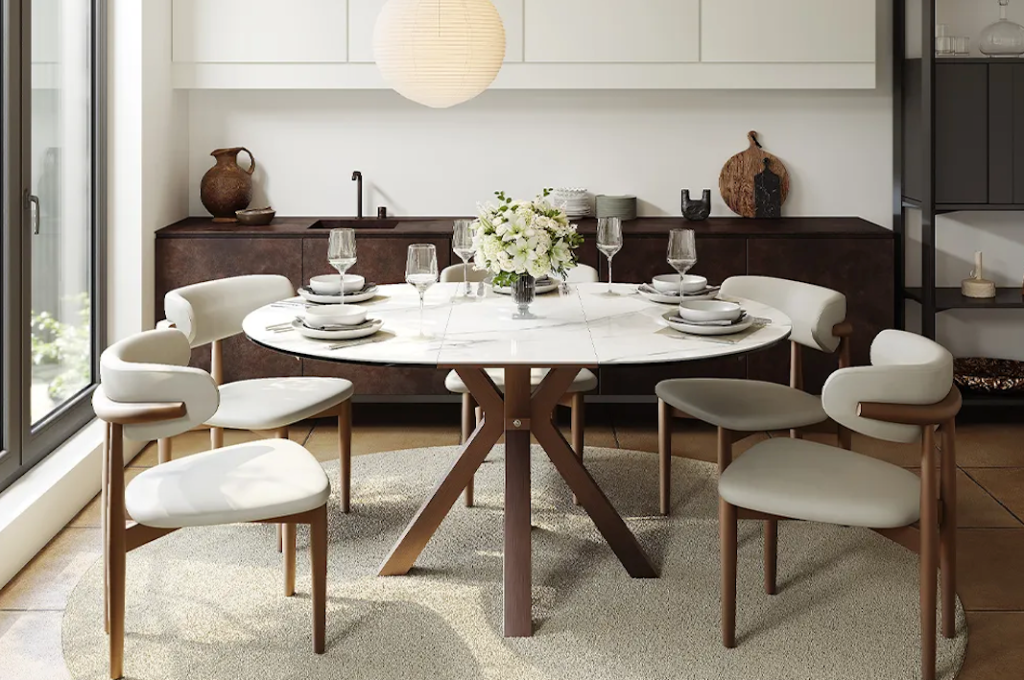
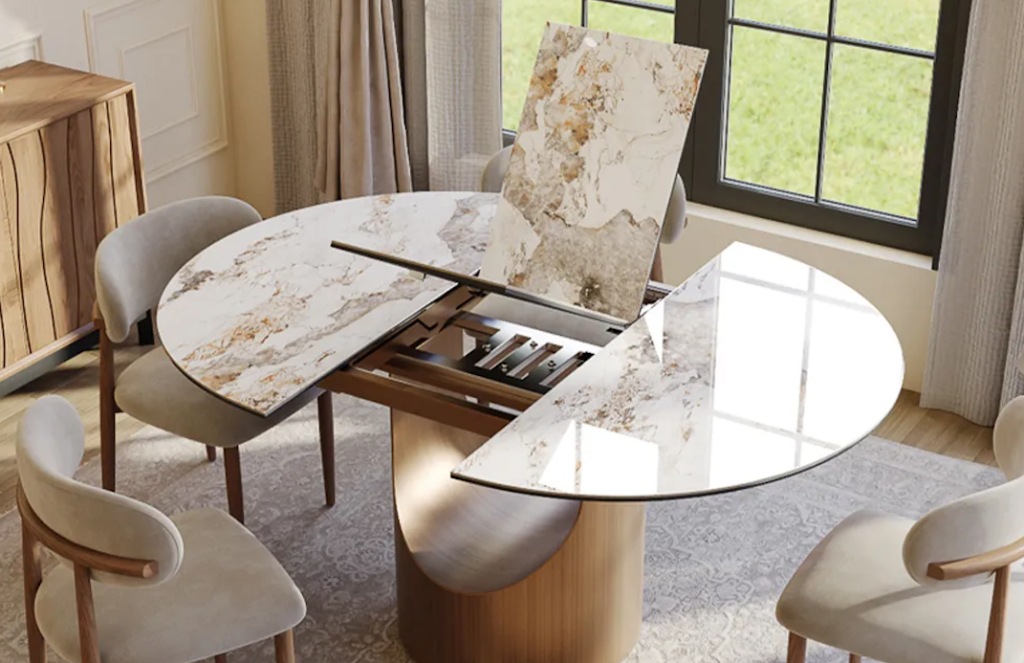
Extendable ovals exist, but read the spec carefully. True extendable ovals are rare. Most “extendable round” tables — including the round-to-oval extendable POVISON Hector model — start as a round and extend into an oval shape. This is genuinely useful if your daily seating is 4, but you occasionally host 6. What you usually don’t get is a fixed oval that extends into a longer oval; those mechanisms are mechanically harder.
Check assembly logistics before checkout. Oval tabletops are heavier and bulkier than round tops of similar seat capacity — a 71″ sintered stone oval can weigh 130–160 lbs. If you live above the second floor without an elevator, this isn’t trivial. Two things to verify: does the seller offer white-glove delivery (in-room placement, not just curbside drop-off), and is there a documented process for shipping damage? POVISON ships pre-assembled with white-glove options on most oval models, plus a documented damage-replacement workflow — which matters more than people think until they’ve tried to claim against a curbside-drop carrier on a $1,200 stone table.
Bottom line for the decision: If your dining room is rectangular, narrow, or part of an open-plan space — and you want to seat 6 without the sharp corners and visual weight of a true rectangle — an oval is probably the right shape. Browse POVISON’s full oval dining table collection to see specific dimensions, base styles, and finishes that match your room.
FAQ
Can an oval table seat 6 comfortably?
Yes — an oval roughly 71″ x 39″ seats 6 adults comfortably, with about 24″ of edge per person. That matches the per-person spacing recommended in most planning guides, including those used by NKBA-certified designers. The curved ends actually give end-seat diners slightly more room to angle their chairs than a rectangular table of the same length, which is why ovals can feel less crowded at full capacity.
Is oval better for tighter walkways?
Yes, in most cases. The curved ends pull back from the table’s full length, which means the actual footprint at hip height is smaller than a rectangle of the same nominal length. In a 10′ x 13′ dining room, this typically translates to 4–6 extra inches of clearance at the ends — enough to turn a tight squeeze into a comfortable walkway. It also eliminates corner-bump injuries entirely, which matters in homes with kids or in rooms where guests pass behind seated diners.
Are extendable oval tables practical?
Mostly when they’re round-to-oval designs. A round table that extends into an oval shape (typically 47″ round expanding to 63″ oval) is one of the more practical extendable mechanisms on the market — clean, single-pull operation, and you keep the round footprint for daily use. Pure oval-to-longer-oval extendables exist but the mechanisms tend to be more complex and the gap during extension is harder to hide. If you host occasionally and want flexibility, round-to-oval is the more reliable choice.
What base styles help with legroom?
Pedestal bases generally win for legroom on ovals up to about 84″ long. A single central pedestal means no leg-in-the-corner problems and lets you slide chairs in close at the ends. For longer ovals (over 84″), a double-pedestal or trestle base is more stable but limits where chairs can sit at the ends. Avoid four-corner-leg designs on ovals — they negate one of the shape’s main benefits by reintroducing the leg-clash issue at the corners.
Conclusion
An oval dining table isn’t the elegant compromise I used to think it was. It’s a specific solution to a specific problem: you need rectangular-table seating capacity in a room that’s punishing rectangular-table footprints. Narrow dining rooms. Open-plan layouts where a long rectangle would dominate. Households where guests pass behind seated diners and corner-bumps are a real cost.
Skip it if your room is square and small, if you host 8+ for formal dinners regularly, or if you specifically want the “head of the table” hierarchy. Choose it when the geometry of your space is fighting your seating capacity, and you’ve already ruled out round.
The shape is the decision. Material, base style, and finish come after. Tape out the footprint, walk around it, and check the legroom at the ends before you buy. That’s the whole framework.
If your weekend is too short for assembly drama, POVISON’s fully assembled ovals — like the pedestal-base sintered stone models — arrive ready to use, no tools, no instruction-manual archaeology. Ready To Live In, as the team says, and after losing one too many Saturdays to flat-pack furniture, I’ll take that promise every time.
Related Reading:


