 By Charles
A friend renovated her kitchen last spring and called me halfway through, mid-doubt, about a set of rattan counter stools she’d already ordered. “Am I going to regret this in six months when there’s olive oil in every weave?” Fair question. Rattan stools are having a long moment — warm, textured, photogenic in every kitchen-renovation feed — and they’re also the seat most likely to make you nervous about cooking near them. Whether they actually work in a real kitchen comes down to three things spec sheets never explain clearly: how the weave handles spills, how much weight the frame really holds, and whether the material reads as warm and intentional or as a craft-store afterthought next to your stainless appliances.
Are Rattan Bar Stools Practical for Kitchens
Practical, yes — with conditions. The honest version is that rattan stools work beautifully in kitchens that already lean warm (wood floors, neutral cabinets, soft lighting) and struggle in kitchens that are sleek, glossy, and high-splash. The material itself isn’t the problem. The mismatch between natural texture and a transactional cooking environment is.
Start with what rattan actually is on a stool. The frame is usually a hardwood (oak, rubberwood, or beech) and the woven element — the seat or back panel — is rattan core (the inner stem of the rattan palm, peeled and dried) or rattan peel (the outer skin used in tighter weaves). Both are flexible, fairly light, and structurally sound when properly tensioned. According to Dimensions’ stool height reference, counter stools sit at 23″–28″ seat height and bar stools at 29″–32″ — rattan models follow the same dimensional rules as any other stool, so the buying math doesn’t change.
What changes is the daily routine. A rattan seat catches crumbs, sauce splatter, and dust in a way a smooth surface doesn’t. If you’re a wipe-as-you-go household, that’s a two-minute weekly chore. If you’re not, the weave will look gritty within a month. The fully assembled question matters more here than with most stools: factory-tensioned weave is far less likely to loosen over time than a self-assembled one, where the tension applied during shipping and home setup is rarely consistent.
Best Rooms for Rattan and Woven Stools
Two contexts where rattan stops being a styling risk and starts pulling its weight.
Bright Kitchen Islands
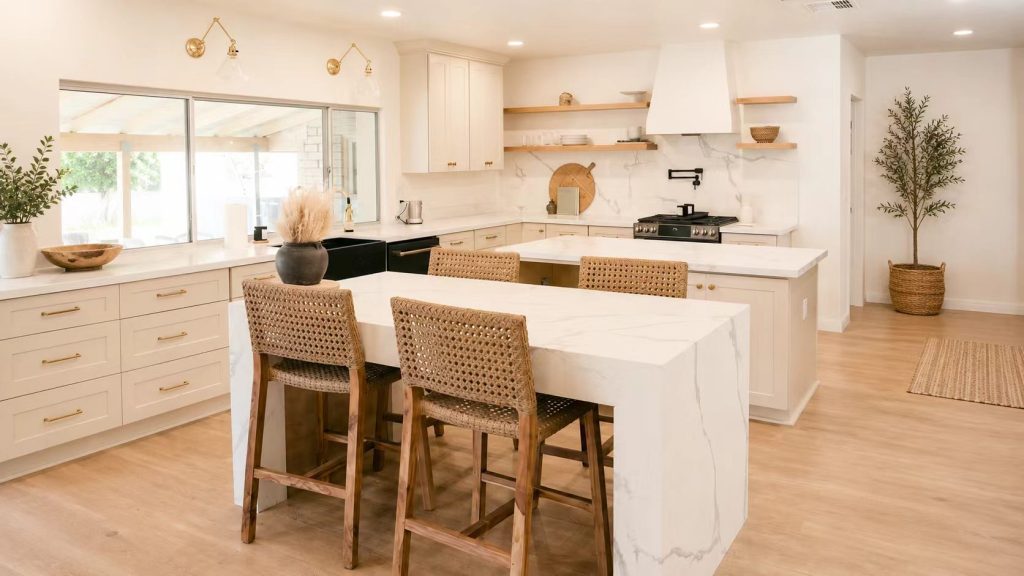
A south-facing kitchen island with white quartz and pale cabinets is exactly where rattan earns its keep. Light bounces off the smooth surfaces all day; without something textured to anchor the room, the kitchen reads as a showroom. Rattan stools at the island add the one warm element that makes the whole space feel lived-in. The trick is balance. Pair the woven seats with a hard counter material (marble, quartz, butcher block) — not another woven element nearby. If your pendant lights are also rattan, your runner is jute, and your fruit bowl is a basket, the kitchen reads as a boho diorama instead of a real room.
Skip rattan at the island if your cooktop sits on the same surface. Splatter from a stovetop reaches three to four feet on either side — directly into the seat zone, and weave plus oil is a hard combination to keep clean.
Warm Modern Dining Corners
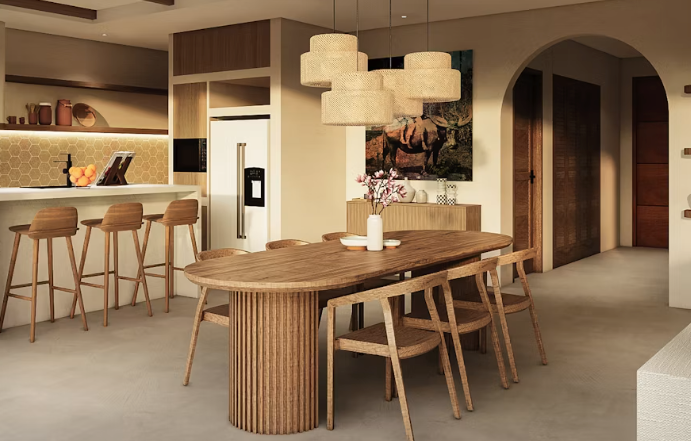
The second sweet spot is a counter or breakfast bar adjacent to a dining area in a warm-modern, Japandi, or coastal-modern home. Here, rattan stools function as a bridge between the kitchen’s hard materials and the softer textures of the living space — wool throws, oak floors, linen curtains. The woven texture only earns its keep when it picks up another natural element already in the room.
For visual coherence, the stool finish should echo something the dining chairs are already doing. A natural rattan stool next to dark walnut chairs reads as a deliberate contrast; the same stool next to white powder-coated chairs reads as an accident. POVISON’s bar and counter stool collection lists the frame material and finish on every product page, which is the spec to cross-reference against your existing dining chairs before you order. One coordinated set saves you the awkward “why doesn’t this room feel finished” question two months in.

Rattan vs Wicker vs Wood Stools
These three categories get confused constantly, and the confusion matters when you’re buying.
Rattan is a specific plant — a climbing palm from the Calamus, Daemonorops, and Korthalsia genera, grown primarily in Southeast Asia. According to the FAO’s non-wood forest products documentation, roughly 50 rattan species are used commercially, with Indonesia producing about 80% of the world’s supply. Rattan is the material — solid (unlike bamboo, which is hollow), naturally flexible, with tensile strength comparable to many hardwoods. Threatened rattan species like Calamus manan are listed under CITES Appendix II, which regulates international trade to prevent overharvesting — so “responsibly sourced rattan” on a listing has a real regulatory backbone behind it.
Wicker is not a material — it’s a weaving technique. You can wicker rattan, you can wicker willow, you can wicker synthetic resin. When a listing says “wicker stool,” check what the wicker is made of. Synthetic resin wicker (often called all-weather or polyethylene wicker) looks similar to natural rattan from three feet away, holds up to humidity and direct sun better, and typically lasts 10–15 years in daily use. Natural rattan wicker indoors lasts 5–8 years before fraying at high-friction points.
Wood stools with rattan accents — a small woven panel set into a solid wood frame — are the most durable option. The wood does the structural work; the rattan adds texture. Frame load capacity is typically 250–300 lbs (worth confirming on the spec sheet — anything under 250 for an adult stool is a flag), and the smaller woven section is easier to keep clean than an all-rattan seat.
If you live in a humid climate (Florida, Gulf Coast, Pacific Northwest in winter), natural rattan needs more upkeep — it can absorb ambient moisture and mildew if it never fully dries. Synthetic resin wicker or wood-and-rattan hybrids handle humidity without complaint.
A quick side-by-side:
| Material | Indoor lifespan | Humidity tolerance | Weight capacity | Best for |
| Natural rattan (all-rattan seat) | 5–8 years | Low — needs dry climate | 250–300 lbs | Warm kitchens, dry homes |
| Synthetic resin wicker | 10–15 years | High | 250–300 lbs | Humid climates, easy maintenance |
| Wood frame + rattan accent | 15+ years (frame) | Medium | 250–300+ lbs | Mixed modern interiors, families |
Cleaning, Comfort, and Durability Trade-Offs
Here’s the honest part, because most listings dodge it.
Cleaning the weave. The crevices catch crumbs and splatter, and a regular dishcloth can’t reach them. My routine — call it the brush-and-grit test — is a soft-bristle brush (an old soft toothbrush works for tight weaves) plus a handheld vacuum’s narrow attachment. Two minutes a week, working the brush over the weave and then vacuuming up what’s loosened, keeps a kitchen rattan stool looking new. Deeper cleans monthly: damp cloth wrung nearly dry (rattan does not love standing water), a drop of mild soap, then air dry completely. Standing water makes the strands swell and crack.
Comfort. Bare rattan seats are firm and textured. Sitting on one without a cushion for more than 20–25 minutes feels like sitting on a basket, because that’s essentially what you’re doing. Most people add a tie-on cushion or sheepskin throw, which solves the comfort issue and protects the weave from direct food contact. Budget for the cushion as part of the purchase.
Durability. Natural rattan in indoor daily use: 5–8 years before fraying at the front edge. Synthetic resin wicker: 10–15 years. Wood-frame stools with a rattan accent panel: 15+ years on the frame, with the rattan section possibly needing replacement at the 8-year mark. Frame weight capacity matters more than people realize — typical home stools handle 250–300 lbs, but cheap imports sometimes spec at 180 lbs, which is below average adult weight plus normal lean-and-shift movement. Read the number before you buy.
FAQ
Are rattan bar stools comfortable for daily kitchen use?
Rattan bar stools are comfortable for short to medium sits (under 25 minutes) without a cushion, and comfortable for longer meals with one. The woven seat is firm and textured, similar to sitting on a tight basket — fine for breakfast or a coffee, less ideal for an hour-long dinner. A tie-on cushion or sheepskin throw solves the comfort issue and also protects the weave from food contact. Budget for the cushion as part of the stool purchase, not an afterthought.
Are wicker or rattan bar stools hard to clean in a kitchen?
Wicker and rattan bar stools take more cleaning time than smooth-surface stools, but they’re not hard to clean — they just need a different tool. A soft-bristle brush (or old toothbrush for tight weaves) plus a handheld vacuum with a narrow attachment handles weekly maintenance in about two minutes. Monthly deeper cleans use a barely-damp cloth with mild soap. Avoid soaking the weave; standing water makes natural rattan swell and eventually crack.
Do rattan counter stools fit in modern kitchens?
Rattan counter stools fit in modern kitchens that already have at least one warm element — wood flooring, neutral cabinets, soft lighting, or natural stone counters. They struggle in all-white, glossy, high-contrast kitchens, where the woven texture reads as an outlier rather than a deliberate contrast. The rule of thumb: rattan stools earn their place when they’re echoing a natural material the room is already doing, not when they’re the only soft thing in a sleek space.
Are rattan bar stools durable enough for everyday family use?
Rattan bar stools are durable enough for everyday family use if you pick the right construction. Natural rattan seats last 5–8 years before fraying; synthetic resin wicker lasts 10–15 years and handles humidity better; wood-frame stools with rattan accent panels are the most durable and typically support 250–300 lbs. Skip rattan entirely if you have cats with a habit of clawing furniture — the weave is exactly the texture that invites claws. POVISON’s fully assembled bar and counter stool options list frame material, weight capacity, and finish on each product page, which are the three numbers that decide whether a stool fits a real household.
Conclusion
Rattan bar stools are practical for kitchens — under specific conditions. They reward households that already lean warm in their materials, that don’t mind a two-minute weekly brush-down, and that want one element of natural texture without committing to a full boho aesthetic. They’re a poor choice for sleek high-gloss kitchens, households that won’t keep up with the weave, or homes where a cooktop sits within splatter range of the seats. Pick the construction for the climate and the household. And do the brush-and-grit test before you commit — if the thought of a two-minute weekly clean feels like work, get a smooth seat instead.
Related Reading:


