 By Jenny Smith
A “standard couch size” sounds simple… until you try to fit one into a real living room with doors, rugs, and that one awkward corner. The good news: once you understand a few key measurements and how they relate to your room, your body, and your lifestyle, choosing the right couch becomes surprisingly straightforward. In this guide, we’ll break down standard couch sizes, show you how they play with real rooms, and give you practical steps so your next sofa actually fits and feels amazing.
What Is the Standard Size of a Couch? (Key Measurements Explained)
The typical standard couch size (length, depth, height)
Across independent buying guides and interior-design magazines, a “standard couch” usually means a three-seater sofa. Consumer group Which? lists average lengths of 180–220 cm (about 71–87 in) for a 3-seater, and notes that this size works well for most living rooms. (Which?) Homes & Gardens adds that off-the-shelf sofas commonly come in 72, 84 or 96 in lengths, which sit right inside or just above that range. (Homes and Gardens) Put simply, if your sofa is roughly 76–90 in long, you’re firmly in “standard” territory.
For overall depth and height, Which? reports that the average sofa is about 80 cm high and 89 cm deep—around 31 in high and 35 in deep from back to front. (Which?) In practice, that means a typical standard couch is roughly 76–90 in (length) × 35 in (depth) × 31 in (height), measured from arm to arm, front edge to back, and floor to top of the back.
Couch standard sizes by category (loveseat, 3-seater, apartment, oversized)
Using the same Which? data for 2–5 seat sofas and converting from centimeters, we can map out realistic standard size ranges and the kind of wall or room they fit. Proportion rules like the two-thirds wall rule (your sofa ≈ ⅔ of the wall length) from Homes & Gardens help translate these into room guidelines.
| Sofa type | Typical length range* | Typical overall depth | Works best with… (minimum) |
| Loveseat (2-seater) | ~55–71 in | ~32–35 in | 6–8 ft wall; room ~9×11 ft+ |
| Standard 3-seater | ~71–87 in | ~34–36 in | 8–10 ft wall; room ~10×13 ft+ |
| Apartment-size sofa | ~68–80 in | ~32–35 in | 7–9 ft wall; room ~9×12 ft+ |
| Oversized / extra-long | ~90–118 in (4–5 seats) | ~36–40 in | 10–14 ft wall; room ~12×18 ft+ |
The comfort dimensions: seat depth, seat height & “width per person”
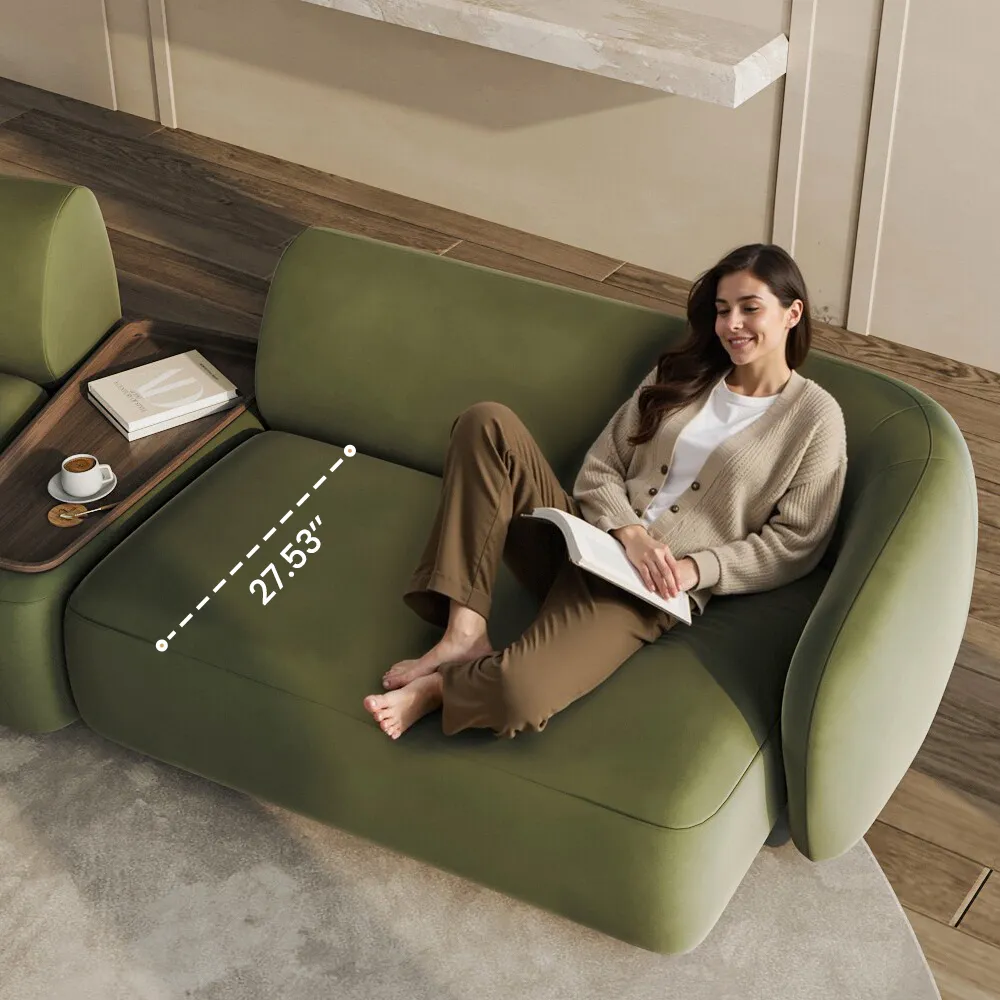
For day-to-day comfort, seat depth matters more than overall depth. Design magazines like Livingetc and Architectural Digest generally place a standard seat depth around 21–24 in, with anything under 21 in feeling quite upright and anything above about 24 in entering “deep couch” territory. If you like to sit straight with your feet on the floor, aim near 21–22 in; if you prefer to curl up or you’re tall, 23–24+ in usually feels better.
Seat height and width per person fine-tune that comfort. Most sofas sit roughly 17–18 in from floor to the top of the seat cushion, and ergonomic research suggests that 16–19 in lets most adults rest their feet flat and stand up easily, while about 22–24 in of seat width per person matches typical body breadth and personal space (Ergo Center and related anthropometric data). As a quick rule, a 78 in sofa comfortably seats three adults; 100–108 in is more realistic for four.
Step 1 – Match Couch Size to Your Room & Layout
Read the room: focal point, traffic flow, and sightlines
Before you fixate on standard couch sizes, decide what your room is really about. Is the focal point the TV, a fireplace, a big window, or a conversation area? Your couch should point toward that focal point and not block it.
Next, map out traffic flow. Leave clear paths between doors, hallways, and key zones like the kitchen. You don’t want people squeezing past knees every time they cross the room. Finally, check sightlines: with the couch in place, can you still see the TV, window, or entry without craning your neck? I once had a sofa that technically “fit” but blocked half the patio doors; it drove me nuts until I swapped to a slightly shorter model.
Proportion rules: wall length, rug size & coffee table distance
A good rule of thumb is to choose a couch that is about 2/3 the length of the wall it sits on. That keeps things balanced—big enough to anchor the space but not so long that it feels crammed. Your rug should be large enough that the front legs of the sofa and chairs sit on it, which usually means the rug is wider than the couch by 6–12 inches on each side.
For comfort and movement, keep 16–18 inches between the front of the sofa and the coffee table; close enough to reach your drink, but not so close that you bang your shins as you walk through. (Homestyler) When you’re checking online dimensions, mentally add that gap—you’re not just fitting a couch, you’re fitting a couch plus access.
Size suggestions for small, medium & large living rooms
You can use room “templates” as a starting point and then tweak from there. Small living rooms around 10×13 feet usually work best with a loveseat or compact apartment-size sofa plus a chair, rather than an overstuffed 3-seater. Medium rooms near 12×18 feet comfortably take a standard 3-seater, often with an accent chair or two. Large living rooms over 15×20 feet can support oversized sofas or sectionals without feeling crowded. (Angi)
For many design-conscious city families, that medium range is the sweet spot: they want a standard couch size that anchors movie nights and gatherings but still leaves room for toys, a dog bed, or a work-from-home corner.
Once you know the width range your room can handle, check depth before narrowing down a specific sofa. Two three-seaters with similar widths can occupy very different amounts of usable floor space. In a medium living room, a conventional overall depth can leave more room for circulation, a coffee table, or other everyday furniture.
The Atticus 89″ Sofa fits that situation with an 89-inch width and 40.7-inch overall depth, giving you standard three-seat proportions without moving into an extra-deep footprint. That makes it easier to preserve front-to-back clearance when the sofa shares the room with a coffee table or regular walking paths.
Step 2 – Match Couch Size to Your Body & Lifestyle
Your height, leg length & preferred seating posture
Two people of the same height can like completely different couches, because posture matters. If you sit very upright, work on a laptop, or have sensitive knees, a shallower seat depth and slightly higher seat will feel better. If you love to tuck your feet up or lie down for naps, you’ll want a deeper seat or chaise.
Try this: sit on a chair that feels perfect and measure its seat height and seat depth. Use those numbers as your “comfort baseline” when you compare standard couches. When I did this, I realized I liked a surprisingly low 17-inch seat and a 22-inch depth; that changed which models and sizes I filtered for online.
How many people really need to sit here (everyday, not “party maximum”)
Be honest about your everyday headcount. If two people watch TV most nights, you don’t need a 110-inch monster just in case eight guests visit twice a year. A comfortable rule: plan one true seat per daily user plus one extra, then rely on occasional chairs, poufs, or dining chairs pulled in for parties.
In practice, that means a couple might choose a standard 3-seater, while a family of four might lean toward a 3-seater plus a chair, or a small sectional, rather than chasing the absolute longest sofa available. This also keeps your standard couch size more flexible if you move to a smaller home later.
Special scenarios: kids, pets & overnight guests
Kids and pets push you toward durability and circulation as much as size. You might prioritize a slightly shorter couch that leaves more open floor space for play, or fabric and legs that are easy to clean under. If pets like to sprawl, deeper seats and wider arms become bonus “pet perches.”
If your couch doubles as a sleeper sofa, check the total length (ideally 80 inches or so for taller sleepers) or consider a chaise sectional that lets someone stretch out fully. In that case, make sure your standard couch size leaves enough room to pull out a sleeper mechanism or fully use the chaise without blocking doors or walkways.
Standard Couch Sizes by Type & Configuration
Straight sofas vs. sectionals vs. modular couches
A straight sofa is the classic option: a simple rectangle that’s easy to place along a wall. Lengths typically range from 72 to 96 inches, and they’re ideal when your room is narrow or you need flexibility to rearrange.
L-shaped sectionals use a long side and a shorter chaise or return. Short-chaise sectionals might be 90–110 inches on the long side and 60–70 inches on the short, while larger ones can reach 120 inches or more. U-shaped sectionals wrap even farther into the room and can easily run 110–140 inches wide. Modular systems are built from repeating pieces; add up the total width of all modules in one direction and the maximum depth from the back to the furthest chaise to see how much floor space they occupy.
Standard, apartment-size & oversized: what changes besides the number?
Apartment-size sofas shrink length first, often to 68–78 inches, and sometimes trim depth or arm bulk to feel lighter in small or open-plan spaces. Standard couches around 80–90 inches work well in average living rooms and can anchor a conversation area without dominating it. Oversized sofas stretch beyond 90 inches and often add depth and chunkier arms, which can look amazing in large rooms but overwhelm narrow ones.
These categories should relate to your room width and ceiling height. In a compact 10-foot-wide apartment living room, an 80-inch sofa leaves breathing space and walking paths. In a 15-foot-wide room with 10-foot ceilings, that same sofa might feel a bit lost, and stepping up to a wider or deeper piece can restore balance.
Style & ceiling height: why the same numbers can “feel” different
Two couches can share the same dimensions but feel very different because of back height, leg style, and overall visual weight. A low-back, slim-armed modern sofa with tall, open legs feels lighter and less imposing, so you can get away with a slightly longer length in a small room. A traditional high-back sofa with rolled arms and a skirt looks heavier, so sizing down a bit often works better.
Ceiling height and window placement also play a role. Under low or standard 8-foot ceilings, a massive high-back couch can make the room feel shorter and more cramped. In a space with tall ceilings and large windows, you can use a higher-back or deeper sofa to visually “ground” the room so it doesn’t feel too empty or echoey.
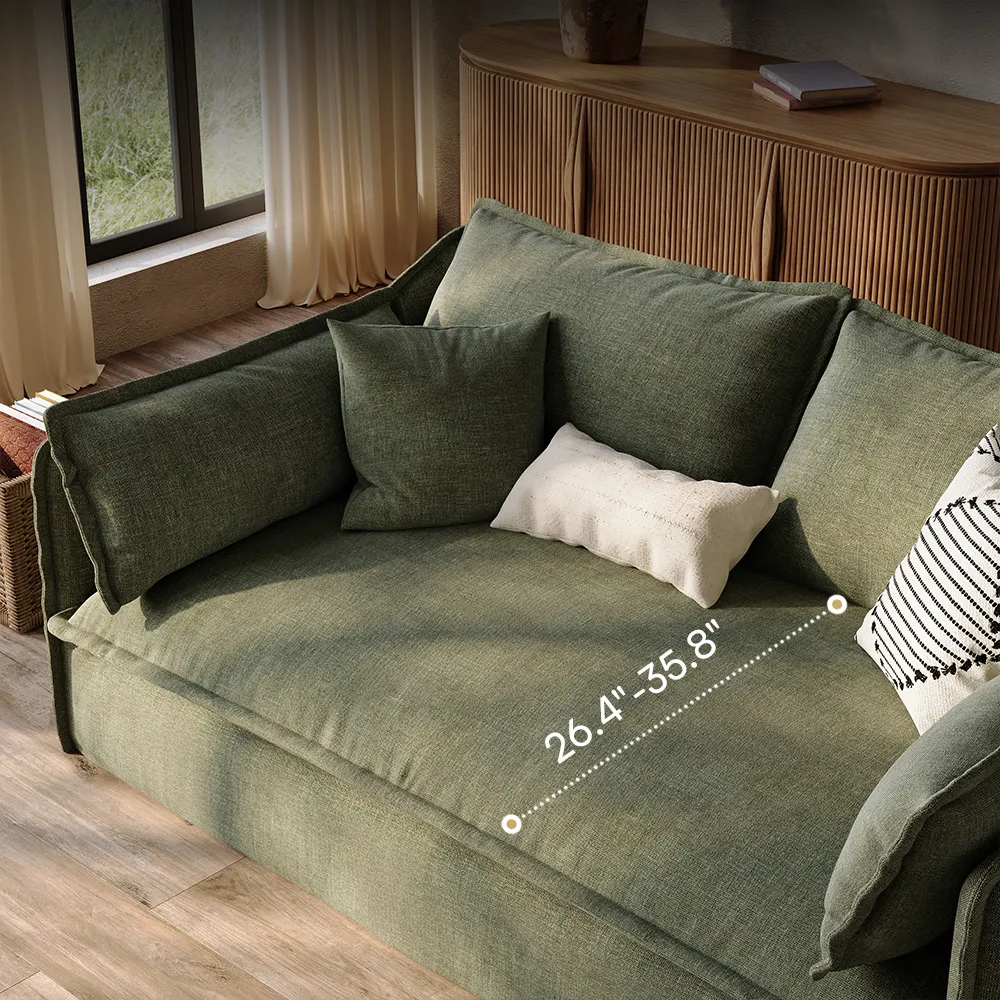
How to Measure& Mock Up
Measure the delivery path (doors, stairs, elevators, tight turns)
Before you fall in love with any standard couch size, measure how it will actually get into your home. Measure the height and width of every doorway, hallway, stairwell, and elevator it must pass through. Pay special attention to any tight turns at the top of stairs or near your front door.
You’ll also want to check the sofa’s diagonal depth (measured from the top of the back corner to the front bottom corner). As a simple rule, that diagonal should be at least 1–2 inches smaller than the narrowest opening along the delivery path. That gives movers enough wiggle room to tilt and pivot the couch through turns without damaging walls or the frame.
Use tape or cardboard to “test drive” standard couch sizes at home
Once you’ve confirmed a couch can be delivered, it’s time to see how its footprint feels in real life. On your floor, mark out the length and depth of the sofa using painter’s tape or flattened cardboard boxes. Include the space for a coffee table and normal walkways.
Then actually live with that outline for a day—walk around it, pretend to vacuum, open doors and drawers, and sit on dining chairs where your couch would be. If you keep stepping into the taped area or it visually crowds the room, scale down. This low-tech mockup often reveals that a slightly smaller standard couch size will feel more relaxed and functional over time.
Mocking up the full footprint becomes especially important when you are considering a deeper sofa. A width that looks manageable on the product page does not show how far the sofa will project into the room or how much space will remain between the seat, coffee table, and main walkway.
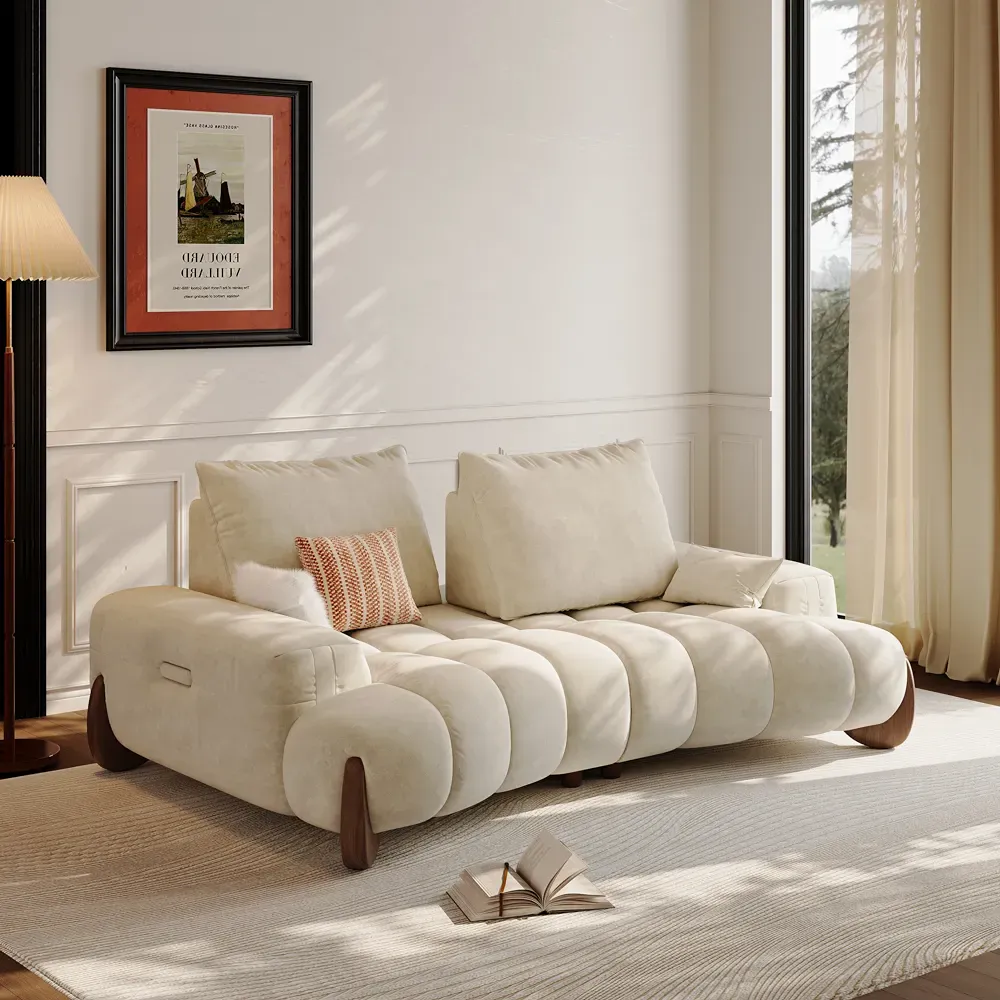
The Arlo Deep Sofa shows why that second measurement matters. Although its 85.2-inch width can fit within many standard sofa layouts, the 55.1-inch overall depth creates substantially more lounging space from front to back. Adjustable cushions also let the seating support change with different lounging positions, making that extra depth functional rather than purely dimensional.
Conclusion – Your Simple Checklist for Picking the Right Standard Couch Size
- Confirm your room size, focal point, and traffic paths before picking dimensions.
- Choose a couch length that’s roughly 2/3 of the wall it sits against.
- Check comfort numbers: seat depth, seat height, and realistic width per person.
- Match couch type (straight, sectional, modular) to how many people use it daily.
- Measure doors and hallways, then compare with the couch’s width and diagonal depth.
- Mock up the footprint with tape or cardboard and “test drive” it for at least a day.
Choosing the right standard couch size comes down to three things: knowing your room, knowing your body, and being honest about how you live day to day. Use the ranges and comfort numbers we covered to narrow options, then test the footprint with tape and double-check your delivery path before you buy. Ready to find your sofa match? Grab a tape measure, pull up your favorite models, and run through this checklist before you hit “add to cart.”
FAQ About Standard Couch Sizes
1. What is the standard size of couch for a small living room?
For a small living room around 10×13 feet, a loveseat or compact apartment-size sofa between 60–78 inches long usually works best. It leaves space for a slim coffee table and walkways while still seating two to three people comfortably.
2. Is there a universal standard couch size, or does it vary by brand?
There’s no single global standard. Most brands cluster 3-seater couches around 80–90 inches long, but arm thickness, cushion style, and back height can vary a lot. Always check the exact product dimensions and compare them with your room and comfort needs.
3. How long should a couch be to seat 3 or 4 people comfortably?
To seat three adults in comfort, look for a length of 78–90 inches. For four people, you’ll typically need over 100 inches or a sectional, because armrests and side cushions take up space. Remember that “technically fits” isn’t the same as “no one feels squished.”
4. What is a good standard couch size for apartments?
In most apartments, sofas between 68 and 82 inches hit the sweet spot. They give enough seating for two to three people without overwhelming open-plan layouts or blocking doors and windows. Pairing that with a smaller coffee table or nesting tables keeps the room flexible.
5. When should I consider going custom instead of using couch standard sizes?
Custom makes sense if you have very tight dimensions, unusual architecture, or specific ergonomic needs—like very tall or very short household members, accessibility requirements, or built-in storage. If no standard couch size fits without blocking doors or walkways, it’s time to explore custom or modular solutions.


