 By Charles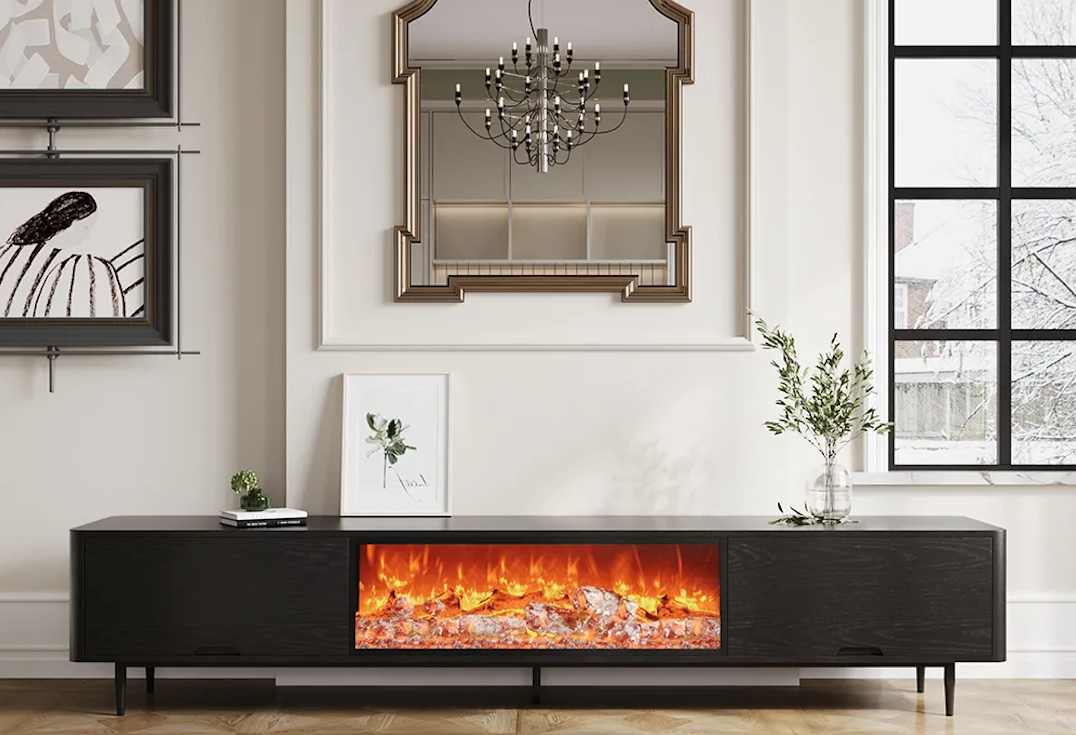
I’ll admit it: the first time I saw a fireplace TV stand in a product photo, my reaction was somewhere between “that looks incredible” and “that looks like a lot.” A glowing hearth built into the base of your media console, no chimney required, no gas line, just plug in and suddenly your living room has a completely different energy. It’s a compelling idea. But compelling ideas and practical furniture decisions don’t always overlap, and this one deserves an honest look before you commit.
This isn’t a style guide. It’s a decision guide for people who want the atmosphere but aren’t sure whether the tradeoffs are worth it in their specific space.
Why Buyers Consider a Fireplace TV Stand
The appeal is straightforward: you’re solving two problems with one piece of furniture. You get a TV stand with real storage, and you get a visual focal point that works even when the TV is off. In rooms that feel a little blank or cold — especially in fall and winter — the flickering flame effect transforms how the space feels without any renovation, no contractor, no permits.
For renters especially, this is the entire pitch. You can’t install a real fireplace. You probably can’t paint the walls. But you can bring in a piece of furniture that makes the room look intentional and warm, and take it with you when you move.
That said, “looks good in a photo” and “works well in your actual room” are two different standards. And this particular category of furniture has a few tradeoffs that are easy to miss until the piece is sitting in your living room.
Best Rooms for This Type of TV Stand
Apartment and Condo Setups
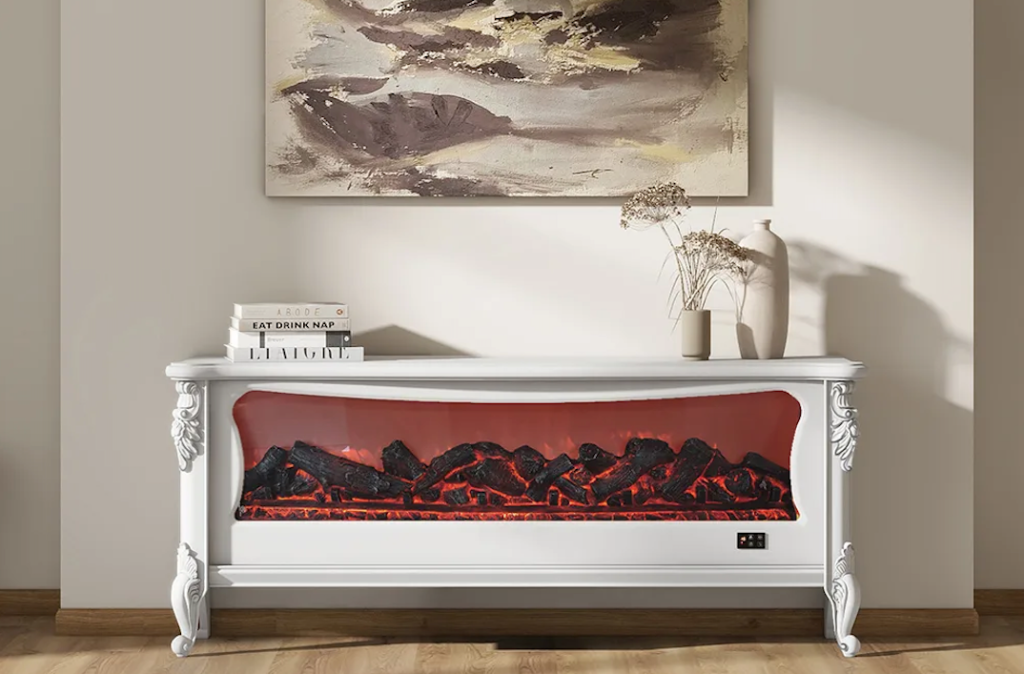
This is where fireplace TV stands make the most sense to me. You’re working with a defined wall, often limited floor space, and you genuinely can’t alter the structure of the room. A fireplace TV stand in a 350–600 sq ft living area does real work: it consolidates your TV, your media storage, and your ambient lighting into one footprint.
The key constraint to watch is width. Most fireplace TV stand models run 58–70 inches wide. In an apartment living room, that’s often right. But if your sofa is floating in the middle of the room and the wall behind it is 10 feet wide, a 60-inch console can look underwhelming under a 65-inch TV. You want the stand to be at least as wide as the TV itself, ideally 4–6 inches wider on each side.
Low-profile versions (18–22 inches tall) work better in smaller apartments because they keep the TV at proper viewing height and don’t make the room feel shorter. Taller cabinet-style models are better suited to rooms with higher ceilings.
Family Living Rooms
In a dedicated family room or larger living space, a fireplace TV stand can work well — but the calculus shifts. Now you’re asking a single piece of furniture to anchor a bigger wall, manage more gear, and hold up visually in a room where people actually spend significant time.
The main thing that changes: storage requirements go up. One soundbar, two game consoles, a streaming box, a router, and kids’ controllers require a unit with real cabinet depth (18–20 inches minimum) and ideally a mix of open and closed storage. Many fireplace TV stands in this category prioritize the visual feature over storage engineering. Check the spec sheet before the product photo.
One practical note worth flagging: if you’re buying this for a family room with young children, confirm the unit’s stability rating and whether it includes anti-tip hardware. The CPSC’s Anchor It! campaign is a useful reference for what to look for in terms of securing furniture to the wall — worth reading regardless of which unit you’re considering.
When It Helps and When It Feels Too Bulky
Here’s the version of this question nobody quite asks directly: does a fireplace TV stand make a room feel finished, or does it make it feel heavy?
The answer depends almost entirely on two things — the ceiling height of the room, and the color/finish of the unit.
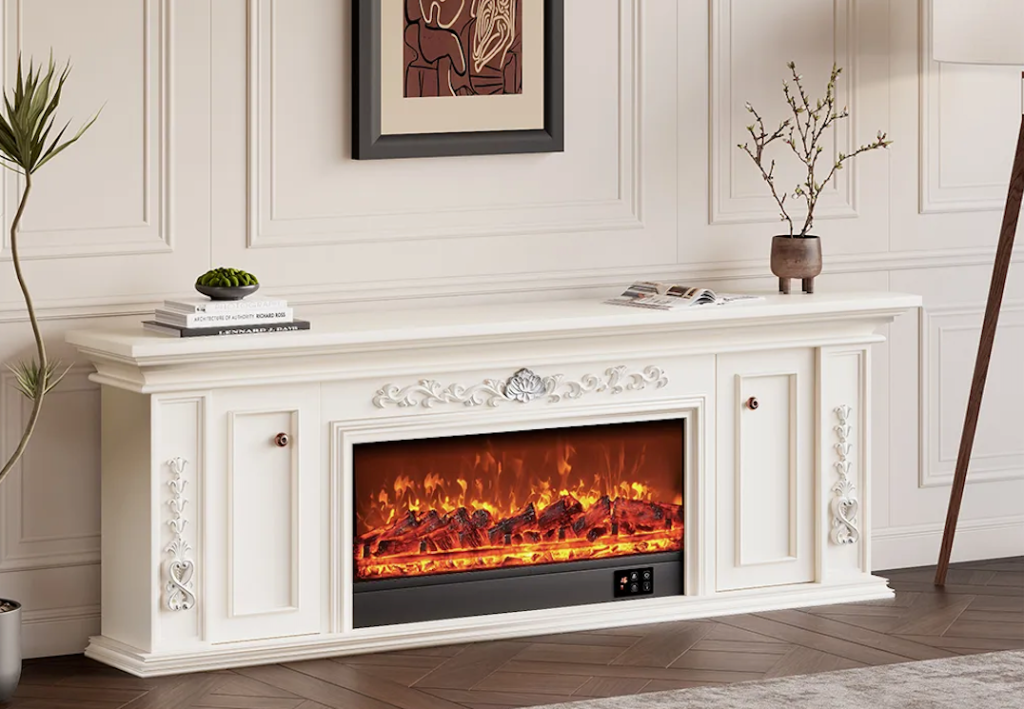
In rooms with 8-foot ceilings (which is most apartments and a lot of family rooms), a fireplace TV stand in a warm wood tone or dark finish works well. The visual weight reads as intentional, not cramped. The same unit in a room with low ambient light or dark walls can start to feel like it’s eating the space. In those situations, a lighter finish — natural wood, white-washed oak, anything in a warm neutral — will keep the room feeling open.
Where these units genuinely feel too bulky: rooms under 160 square feet with low ceilings, or any setup where the sofa is within 8 feet of the TV wall. At close range, the combined visual weight of the console, the flame insert, and the TV above it is a lot to take in. The room starts to feel like the furniture is in charge.
If you’re on the edge, the practical test is this: tape out the console footprint on your floor and stand where your sofa would be. If the taped rectangle already feels dominant, the finished unit will feel more so. If it looks proportional, you’re probably fine.
What to Compare Before Buying Online
A few things get skipped in the excitement of finding a unit that looks good. These are the ones that have actually mattered in my experience.
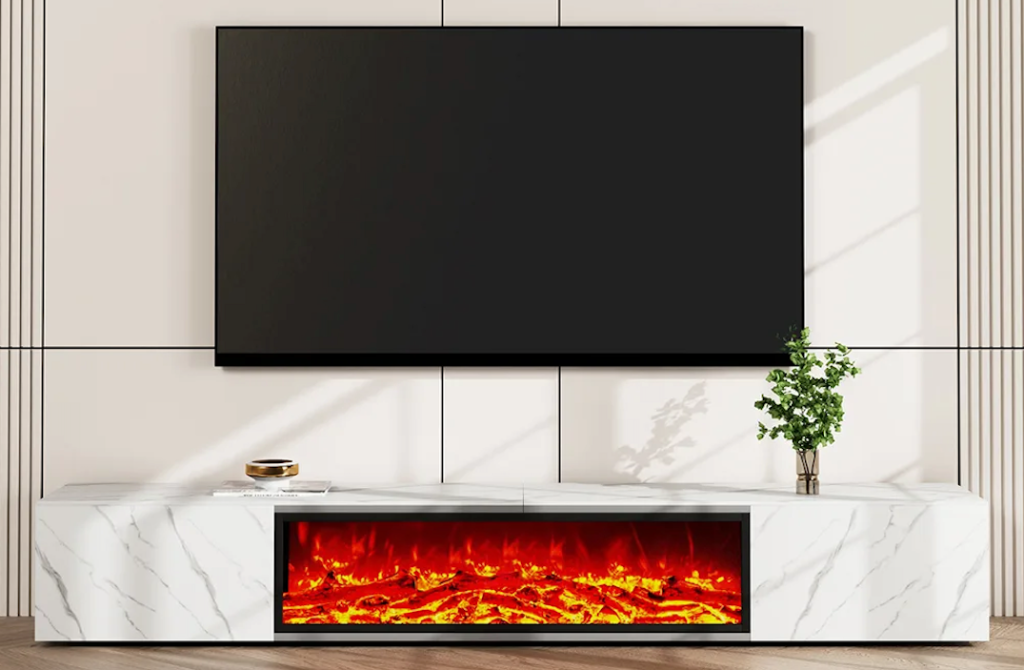
TV size compatibility. Most listings show the maximum TV size the unit can support. Take that seriously. A 70-inch console can physically hold a 75-inch TV, but it’ll look off-balance — the screen overhangs the base on each side and the whole setup feels unstable. Your TV should sit comfortably within the stand’s width with at least 3–4 inches of clearance on each side.
Weight capacity. The stand itself needs to support the TV plus whatever components you’re running. A 65-inch TV can weigh 50–70 lbs; add a soundbar and gaming gear and you’re past 100 lbs quickly. Always check the stated load rating and confirm it covers your actual setup.
The flame insert details. Flame effect inserts vary significantly in quality — some look genuinely convincing, others look like a screensaver. Look for customer photos taken in actual rooms, not staged product shots. Reviews that mention what the insert looks like in daylight versus evening are the most useful.
Heating specs — verify independently. Most electric fireplace inserts list a heating area and BTU rating. These numbers vary significantly by model and installation context. I’m not going to quote specific heating performance here because the reality depends on your room’s insulation, ceiling height, and other factors I can’t verify. If heating is a real priority for you, cross-reference the manufacturer specs against independent reviews before buying. Treat the heat as a bonus if it works for your space, not the primary reason to buy. The NFPA’s home heating safety guidance is a useful reference for understanding how heating equipment behaves generally — worth a read if this is a factor in your decision.
Assembly and delivery. Fireplace TV stands often arrive partially disassembled. The insert may need to be seated, doors attached, legs installed. Confirm whether the unit ships fully assembled or requires significant on-site assembly, and whether delivery includes room placement or just curbside drop-off. For units over 70 inches, the weight alone makes room-of-choice delivery worth paying for.
Trade-Offs Buyers Often Miss
The glow is directional. The flame insert faces forward. That looks great when you’re sitting on the sofa. From a side angle — a dining area that opens into the living room, or a kitchen with sightlines to the console — the effect can look flat or odd. If your space is open-plan and the TV wall gets seen from multiple angles, walk through all of them before you buy.
You’re committing to the aesthetic. A fireplace TV stand has a specific visual identity. It reads warm, a little traditional, and somewhat substantial. That works brilliantly with certain styles — transitional, farmhouse, mid-century with warm tones. It sits awkwardly in very minimal or industrial spaces where the hearth motif feels out of place. Be honest about whether it fits your actual room or just the room you’re imagining.
The insert takes cabinet space. This varies by model, but in many units the fireplace insert occupies a central compartment that would otherwise be usable storage. Check the storage layout carefully: how many actual cabinets remain after the insert, and are the remaining compartments sized for real gear (a soundbar is 36–45 inches wide; most game consoles need a shelf at least 14 inches deep).
You can turn off the flame. This is obvious in retrospect, but easy to forget: the flame insert is an optional feature, not a permanent visual. If you want it off for summer or just for a given evening, it’s off. The unit still functions as an entertainment center regardless.
Povison’s Fully Assembled TV stand collection includes options across this category — worth browsing if you want to see how different finishes and scale read in real room photography.
FAQ
Is a fireplace TV stand worth it in a small living room?
It can be, if the proportions are right. In rooms under 200 square feet, a low-profile model (18–22 inches tall, 58–65 inches wide) works better than a taller cabinet-style unit. The flame effect adds ambient warmth without renovation — which is genuinely valuable in smaller spaces where your options are limited. The risk is visual weight: in a tight room, the combined mass of console, insert, and TV can feel heavy. A lighter finish (natural wood, warm white) mitigates this more than most buyers expect.
Can a fireplace TV stand work under a large TV?
Yes, but size matching matters. For a 65-inch TV (approximately 57 inches wide), you want a stand at least 63–70 inches wide. For a 75-inch TV, look for 72–84 inches. The TV should sit within the stand’s footprint with clear overhang on each side, not perched on top of it. Also verify weight capacity: larger TVs are heavier, and fireplace inserts add weight to the unit itself.
Does an electric fireplace TV stand add too much bulk?
In rooms with 8-foot or higher ceilings and walls over 10 feet wide, usually not. In rooms under 160 square feet with low ceilings, it can. The practical test: tape out the unit’s footprint on your floor before ordering. Also consider finish — darker units read as heavier than the same dimensions in a lighter wood tone. If the room already feels full, a fireplace TV stand will read as more furniture, not as an upgrade.
What should I ask before ordering one online?
Four questions: (1) What is the total width, and does it match or slightly exceed my TV’s physical width? (2) What storage remains after the fireplace insert — actual cabinet dimensions, not just compartment count? (3) Does it arrive fully assembled or require significant on-site setup? (4) What does the flame insert look like in real room conditions — daylight, evening, from an angle? Customer review photos are more reliable than product shots for that last one.
Conclusion
A fireplace TV stand is worth it when you need a single piece of furniture to do several things at once: anchor a TV wall, provide real storage, and add ambient warmth that makes a room feel finished rather than functional. For renters and apartment dwellers especially, it’s genuinely the best available option for that effect without structural changes.
It’s not worth it when the room is too small for the visual weight, when the storage layout doesn’t match your actual gear, or when the style doesn’t fit the rest of the space.
The flame effect is real, the convenience is real, and the Effortless Ownership that comes with a well-chosen, fully assembled unit is real. But so are the tradeoffs. Measure your wall. Check the storage spec sheet. Look at customer photos taken in actual rooms. And if the taped-out footprint on your floor looks proportional — go for it.
Related Reading:


