 By Jenny Smith
Your coffee table’s design subtly influences how you sit, move, entertain, and even how secure your living area feels. Whether you choose a round or rectangular coffee table determines whether your sofa arrangement seems anchored or awkward, whether kids bump into corners, and whether guests can easily pass one another. It’s wise to consider what your area truly needs from the shape of the coffee table rather than just replicating a lovely Pinterest image.
Round vs Rectangular Coffee Table at a Glance
Before you get into style and trends, it helps to see the basics side by side.
| Feature | Round Coffee Table | Rectangular Coffee Table |
| Typical proportions | Diameter 28–40″, visually compact, soft outline | Length 40–60″, slimmer width, strong linear presence |
| Best sofa pairings | Sectionals, curved sofas, U-shaped or conversation groupings | Standard 3-seaters, sofas with chaise, long modular or deep sofas |
| Seating reach & serving area | Great central reach for everyone; slightly less surface per inch | Maximum surface along the sofa; ideal for snacks, laptops, board games |
| Safety | No sharp corners; easier in tight walkways | Corners can be bump points unless softened or rounded |
| Space efficiency & flow | Helps circulation in small or square rooms | Efficient in long, narrow rooms and on rectangular rugs |
Round tables shine in compact, conversation-first spaces and kid-friendly homes. Rectangular designs win in long rooms, TV-focused layouts, or whenever you want maximum usable surface. In many open-plan homes, people even mix shapes—say, a rectangular coffee table plus a small round side table—to balance flow and function.
Flow & Safety: How Shape Changes the Way You Move
Walking Paths, Clearance & “No Bump Zones”
Your coffee table sits right in the middle of the main traffic lane, so shape really changes how easily people move. Rectangular tables line up neatly with sofas and rugs, which can make walkways more predictable: you know exactly where the edges are, and you can keep one clean “corridor” along a side or at the ends. When I helped a family with a long, narrow living room, a slim rectangular table actually improved flow because it stopped guests from cutting diagonally through the space.
Round tables feel softer in motion because you’re never turning your body to avoid a corner. In tighter, more square rooms, they’re great for letting people slide past each other without side-stepping. But in very narrow layouts, a round table can drift into the center of the walkway and make the room feel pinched. Whichever shape you choose, watch the clearance band around the table: people should be able to pass without shuffling or bumping shins.
Homes with Kids, Pets, and Older Adults
For safety, both shapes can work as long as you manage edges, stability, and space. Round or oval tables naturally avoid sharp corner impacts, which matters in homes with toddlers or energetic pets. At the same time, a well-designed rectangular table with softened corners, a heavy, stable base, and generous clearance can be just as safe in daily use.
A rectangular coffee table can offer a straight, easy-to-grip edge for standing up, while a round table reduces the chance of catching a hip or knee on a corner during a stumble. The safest choice is the one that pairs the right shape with your household: stable construction, rounded or well-protected edges, and enough breathing room around the piece so that everyone can move confidently.
Best Coffee Table Shapes for Small Spaces
Tiny Living Rooms, Studios & Apartments
In truly small homes, every inch around the coffee table has to earn its keep. Micro-apartments under about 441 sq ft already make up roughly 2.4% of newly built U.S. rentals, so many living rooms are sharing tight footprints with dining or work zones (StorageCafe, 2025). In a boxy or nearly square room, a round coffee table usually works better: you keep the same usable surface without “slicing off” corners of the rug, and it’s easier to weave from sofa to door without side-stepping.
If your living room is long and narrow, a compact rectangular table often wins. You can align it with the sofa and TV stand, then keep a clean lane along one side. As a starting point, aim for a length about half to two-thirds of your sofa and keep roughly 16–18 inches between sofa and table so people can walk and still reach a drink comfortably (Livingetc, 2025). When I lived in a 430 sq ft studio, a 30-inch round table felt right at first—but once I taped out the layout, a slim 38-inch rectangle against a 70-inch sofa gave me both better reach and a clearer path to the balcony.
Small Spaces with Sectionals & Open-Plan Layouts
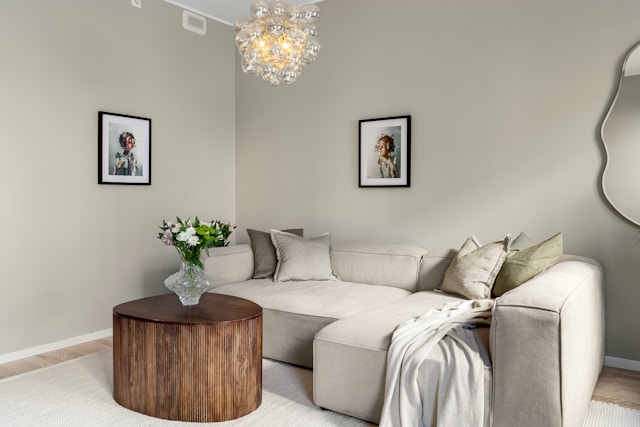
In compact rooms with an L-shaped sectional, round or oval tables usually behave best. They tuck into the “L” without jabbing into the corner seat, and their curve keeps circulation smooth when you’re sliding past the chaise. For a sectional in a small living zone, choose a round table whose diameter is about 60–70% of the shorter leg of the sectional; that’s big enough for snacks and laptops, but small enough that feet and knees aren’t trapped.
Open-plan apartments add another layer: the living zone often shares space with the kitchen and dining area, and the average U.S. apartment is still only about 908 sq ft overall (RentCafe, 2025). If your seating area is long and skinny, a rectangular coffee table helps “underline” the sofa and visually anchor the zone so it doesn’t feel like furniture floating in a hallway. If the main walkway cuts diagonally across the rug—from kitchen to sofa to balcony—a round table is usually kinder to shins. For more layout ideas specific to tiny rooms, Povison’s guide to coffee tables for small living rooms shows real proportions that work in tight spaces.
Style & Mood: How Table Shape Influences Your Design
What Round vs Rectangular Tables “Say” Visually
Round tables feel informal, social, and a bit softer—great for “conversation pit” style rooms where people face each other rather than the TV. They echo other curved pieces like arched floor lamps, boucle chairs, and rounded sofa arms, and they help counteract the grid of windows, doors, and media consoles. Rectangular tables, by contrast, read as tailored and linear. They reinforce the lines of a long sofa, wall-mounted TV, and rectangular rug, which suits more structured, TV- and work-friendly living rooms.
You can use shape to balance your architecture. In a very boxy room with sharp corners everywhere, a round or oval coffee table instantly relaxes the mood. In an ultra-organic space with curvy sofas and wavy textiles, a low rectangular table can add just enough structure to keep things from feeling messy. If you’re also juggling materials, Povison’s How to Choose a Coffee Table: Ultimate Guide 2026 walks through finishes and bases that support the look you’re after.
Matching Shape to Sofa Type & Design Style
For classic straight sofas, rectangles or slim ovals give everyone easy reach without wasting depth. Deep, loungey sectionals do well with round tables or soft-cornered rectangles that tuck into the “L” so no seat feels stranded. Curved or cloud-like sofas tend to look best with round or oval tables that echo their silhouette instead of chopping across it.
Design-style-wise, modern and minimalist rooms love low, clean rectangles or simple round tables with thin legs. Scandinavian and Japandi spaces lean into light wood rounds or pill-shaped rectangles that feel calm and airy. Traditional or classic rooms often favor more substantial rectangular tables with storage or lower shelves for books. If you think in pictures, imagine a simple infographic: sofa shape on one side, recommended coffee table shapes on the other—your eye will naturally match curves to curves and lines to lines.
How to Choose: A Simple Shape-Selection Checklist
Think of this as a fast filter to decide the winner in your own round vs rectangular coffee table debate.
- Step 1 – Measure your room & sofa. Note room width and length, plus sofa length and depth.
- Step 2 – Map the traffic flow. Sketch where people walk in, out, and across. Highlight any tight spots.
- Step 3 – Rank your priorities. Is safety more important than surface area, or vice versa? Do you need storage?
- Step 4 – Match typical layouts. Long, narrow rooms often suit rectangles; compact, almost-square rooms tend to prefer rounds; corner sectionals love round or oval shapes.
- Step 5 – Check proportions. Aim for a table length around half to two-thirds of the main sofa and a height close to the seat cushion. For more numbers, Povison’s coffee table size guide offers detailed examples.
Conclusion: So, Which Shape Works Better for You?
There’s no universal winner in the round vs rectangular coffee table debate—only a better match for your room, routines, and safety needs. As a rule of thumb, round tables excel at flow, softness, and kid-friendly edges, especially in small or square spaces. Rectangular tables win when you want maximum reach, clear structure, and support for long sofas or heavy hosting. Use the checklist, your floor plan, and real-life habits—not just inspiration photos—to make the call, then explore real-room examples in Povison’s coffee table guides to see each shape in action.
FAQs About Round vs Rectangular Coffee Tables
Is a round or rectangular coffee table better for a small living room?
In most compact, more-or-less square living rooms, a round coffee table works better because it’s easier to weave around and visually softens the center of the room. If your space is very long and narrow, a slim rectangular table can make better use of the rug and still leave a clear walkway at one side or at the ends.
How much space should I leave around my coffee table?
Try to leave a comfortable band of floor around the table so no one has to sidestep. Many designers aim for roughly a hand’s length between knees and table when seated, with a wider “lane” wherever people regularly walk through. If you find yourself turning sideways or catching corners with your shins, the table is probably too big or too close.
Can I mix round and rectangular tables in one room?
Yes—mixing shapes often looks more intentional than using only one. For example, you might anchor the seating zone with a rectangular coffee table, then soften things with a round side table beside the sofa and a round dining table nearby. Keeping finishes and heights related (similar wood tones or metal colors) helps the mix feel designed, not random.
What if I have kids or pets—what’s the safest shape?
For active homes, round or oval coffee tables are usually safest because they remove sharp corners right at forehead or hip height. If you love rectangular designs, look for rounded edges, avoid fragile glass tops, and make sure the base is heavy and stable so it can’t tip if a child leans on it. Leave generous clearance so little ones aren’t forced to squeeze past.
Which shape looks more modern or design-forward?
Both can look modern. Rectangular tables feel sleek and architectural when they’re low, long, and slim. Round tables feel very current when paired with curved sofas, boucle textures, or sculptural pedestal bases. The most “design-forward” choice is usually the one that balances your room’s lines, supports how you live, and coordinates with nearby pieces rather than fighting them.


[…] Round is not automatically better, though. A long rectangular table may provide more usable surface area beside a wide sofa. The better choice depends on room shape, seating layout, and how much tabletop space you use, which is why round and rectangular coffee tables work better in different layouts. […]