 By Stephanie
A sagging sofa can make a whole living room feel older than it is. One low spot may look like a tired cushion, but it can also point to stretched webbing, a bent spring, or a loose frame joint. The fastest way to learn how to fix a sagging sofa is to identify where the support has failed before buying foam or sliding a board underneath. This guide walks through a simple at-home test, realistic repair options, and the signs that tell you it is smarter to replace than repair.
Table of Contents
Why Your Sofa Is Sagging
Think of a sofa as a stack of support layers, not one soft seat. The visible cushion is only the top layer. Before choosing a fix, separate normal softening from real structural sagging; that prevents an easy refresh from becoming a frustrating, short-lived patch.
Common Causes of Sofa Sagging
Most sagging starts in one of four places:
- Loose fill: Feather, down, or fiber fill shifts and leaves the center hollow.
- Worn foam: A cushion that stays dented has lost resilience.
- Weak base: Stretched webbing, a tired seat deck, or a broken spring lets the seat sink.
- Loose structure: A low corner, wobbling leg, or creak points to a joint or frame issue.
A nightly center seat often drops before the less-used end seat. The best fillings for couch cushions and seats react differently to repeated pressure.
Normal Settling vs. Structural Sagging
New cushions often feel softer after the first few weeks of use, especially if they contain loose fiber or feather fill. Back pillows may also look flat until they are fluffed and reshaped. That kind of settling is usually even across the seat and improves after routine care.
Structural sagging is different. The dip stays visible when no one is sitting there, feels deeper in one specific spot, or remains after you remove the cushion. You may also notice a hard edge, uneven support, or a creak when you sit down. Those signs usually mean the issue goes beyond normal break-in wear and deserves a closer look.
If the dip turns out to be more than a cushion issue, it may be worth keeping future sofa options in mind—especially cushion layout, seat depth, and how easy upholstery is to maintain. For now, the quick test below will help you pinpoint whether the problem is in the cushion, the base, or the frame.

Find the Cause With a 2-Minute Test
Before you buy foam, add a support board, or take the sofa apart, do a quick check. This simple test can help you tell whether the sagging follows a cushion or stays in the sofa itself. It may also reveal signs that the issue involves the frame or support system rather than the seat cushions.
How to Test the Cushions and Seat Base
- Remove the seat cushions and place them on a flat, hard surface.
- Swap the cushions into different positions. If the low spot moves with one cushion, the cushion is likely the source of the problem.
- Press down on the empty seat base in the center and near the edges. Notice whether one area gives more than the rest.
- Check the legs and floor contact. Each leg should sit firmly on the floor without rocking or wobbling.
- Listen as you sit down. Repeated creaks, scraping, popping, or metallic sounds can point to loose hardware, weakened webbing, or damaged springs.
You do not need to remove the bottom dust cover for this first check. Stop and avoid further DIY work if you see exposed metal, a cracked wood rail, or signs of trouble with a recliner, sleeper, or power-sofa mechanism.
Understanding Your Sofa Test Results
You do not need to identify every internal part on the first try. The goal is simply to narrow the issue down enough to avoid the wrong fix. Use the comparison below to decide whether you are dealing with a cushion problem, a base-support issue, or a repair that needs professional attention.
| What you notice | What it usually means | Best next step | What not to assume |
| The low spot moves when you swap cushions | The fill or foam inside one cushion has lost support | Fluff loose fill, rotate the cushion, or replace the foam insert | Do not assume the frame is damaged |
| The cushions look fine, but the empty seat base still sinks | Webbing, springs, or the seat deck may be weakening | Inspect the underside if it is safely accessible, or get a repair estimate | Adding more pillow fill will not fix the base |
| One corner sits lower or rocks slightly | A leg, connector, or frame joint may be loose | Check visible legs, screws, and floor contact | A support board will not correct a loose joint |
| You feel a hard edge or metal under the seat | The cushion may be compressed, or an internal support part may be out of place | Stop using that seat heavily until you can inspect it further | Extra foam alone may hide the real issue |
| You hear a pop, scrape, or metallic creak when sitting down | A spring, clip, or frame connection may be under strain | Arrange professional repair if the sound repeats | Noise is not always “normal settling” |
| One sectional module sags while the others feel fine | The issue may be isolated to that module, its legs, or its connector | Separate and test the modules one at a time when possible | The most-used chaise is not always the source of the problem |
For a sectional, test each module separately before treating the entire sofa as the problem. A favorite chaise may look like the weak spot, but the dip can come from a connector or base section beneath the neighboring module.

Fixing Sagging Sofa Cushions
Cushions are the least invasive place to start, but they are easy to misread. A rumpled cushion may need a reset; a smooth, body-shaped dent often needs a new core. First identify whether fill has shifted or the foam itself has stopped bouncing back. That distinction keeps you from spending on a repair that cannot last.
When Fluffing and Rotation Help
Fluffing works when loose fill has migrated, not when foam has collapsed. Remove the cushion when possible, work fill from the edges toward the center, and smooth the cover. Rotate loose cushions left to right; flip only if both sides are made for sitting.
A weekly routine for fluffing sofa pillows and cushions helps soft back pillows and feather-filled seats look even. Use gentle pressure. Hard punching can distort corners and stress seams without improving couch cushion support.
When to Replace the Foam Insert
Replace the insert when it stays low on a flat floor, feels lumpy, or bottoms out after rotation. Measure the old insert before ordering a new one. Foam that is too thick can strain the cover; foam that is too firm can make one seat feel out of place.
If the cushion has no zipper, an upholsterer can often replace the inner material without changing the sofa’s exterior. That option can be worth considering when the frame and upholstery are still in good shape.
Repairing a Sagging Sofa Base
When cushions look healthy but the empty seat deck gives way, the repair belongs below the upholstery. Webbing, springs, clips, and rails share the load. A temporary support can improve comfort, but it cannot rebuild a broken part. The aim is to separate mild, even softness from a fault that needs real structural work.
When Sofa Support Boards Help
Sofa support boards can spread weight across a soft but level base. They are a short-term comfort measure for a stationary sofa with no obvious damage. Measure the inside space, use a smooth board with padded edges, and make sure it lies flat.
A board will not repair a cracked rail, broken spring, detached clip, or collapsed foam. It can make a seat feel firmer while the real problem continues underneath. Do not use one on power recliners, sleeper sofas, or furniture with folding hardware.
Signs You Need Professional Sofa Repair
Get a repair estimate when you find:
- A bent, broken, or detached spring
- Loose webbing across a wide area
- A cracked frame rail or shifting joint
- Exposed metal parts
- An uneven recliner or sleeper mechanism
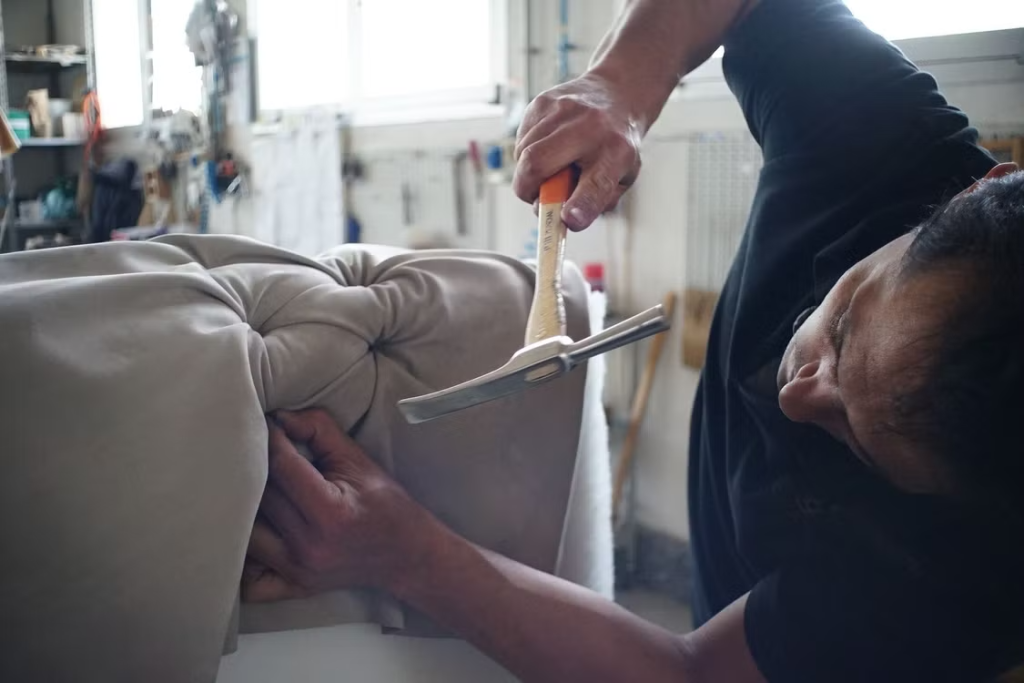
These jobs can require opening the underside and resetting tension. That is not a safe one-size-fits-all DIY project.
Repair or Replace: Making the Call
A low seat does not automatically mean the sofa is done. Ask whether one focused repair can restore comfort, or whether the cushions, base, frame, and upholstery are all declining together. This is the point where a repair quote, the sofa’s condition, and your daily needs matter more than its age alone.
When Repair Is Worth It
Repair is usually worthwhile when the frame is level and solid, the upholstery is in good condition, and the failure is limited to cushions, webbing, a few springs, or accessible hardware.
A sofa with one weak layer can feel substantially better once that layer is repaired correctly. This is especially true when the fabric, size, and style still work well for your home.
When Replacing a Sofa Makes More Sense
Replacement makes more sense when several parts of the sofa are failing at once. If the frame creaks or shifts, the base sags, the cushions are flat, and the upholstery is worn or stained, a single repair may not restore lasting comfort. In that situation, continued repairs can cost more over time without solving the underlying support problem.
When replacing the sofa, prioritize features that make upkeep easier, not a promise that any new seat will stay firm forever. A sofa with removable cushions makes rotation and inspection simpler. Its 97% polyester, 3% linen fabric is breathable and skin-friendly, with a textured cotton-linen feel that softens with use. It is moisture-wicking and pill-resistant; keep it out of direct sun and heat, spot-clean gently, and dry clean when needed.

Preventing Sagging Before It Starts
A sofa usually does not sag overnight. More often, one seat takes most of the pressure while cushions, legs, and internal support slowly wear down. A few simple habits can help distribute that wear, keep small issues visible, and protect the comfort you paid for without turning sofa care into a major project.
Everyday Habits That Protect Cushion Support
Start with the parts you can see and adjust easily. Regular rotation helps prevent one cushion from carrying the same body weight, pets, and movie-night traffic week after week.
- Rotate removable seat cushions every few weeks so the same spot is not always under pressure.
- Switch seating positions from time to time, especially in a busy family room.
- Fluff loose-fill cushions as needed to keep the filling distributed instead of packed into the corners.
- Blot spills quickly and follow the fabric-care instructions rather than soaking the cushion.
- Keep the sofa away from strong direct sun and heat, which can dry out upholstery and affect how some cushion materials perform over time.
On a sunny Saturday, kids, a dog, and a bowl of popcorn can all end up in the same corner seat. Moving that cushion before the next gathering takes only a minute, but it can help prevent that favorite spot from becoming the first one to flatten.
Check the Base Before Small Problems Get Bigger
Cushions are only one part of the support system. A quick check around the base can help you catch loose hardware or uneven pressure before it turns into a noticeable dip.
- Vacuum cushion gaps and under the sofa so you can spot loose screws, worn connectors, or debris around the legs.
- Check that every leg sits firmly on the floor and does not rock when the sofa is empty.
- Recheck legs, connectors, and sectional attachments after a move or after rearranging the room.
- Pay attention to new creaks or uneven seating instead of assuming they will disappear on their own.
- Avoid repeatedly dropping into the same seat, especially on a deep, low sofa where the base absorbs more force.
A quick look under the sofa during routine cleaning is often enough to catch a loose leg or shifting connector early. That is far easier to handle than discovering the issue after the seat base has already started to sag.
Conclusion
Fixing a sagging sofa starts with an honest diagnosis, not the quickest-looking fix. Refresh loose fill when it has shifted, replace foam that no longer rebounds, and treat base or frame damage as a structural issue. A sturdy sofa with one failed layer can be worth repairing; one with several failures may not be. Once you know where the support is gone, your next step becomes clearer—and your living room can feel comfortable again without wasting money on a repair that only hides the problem for a few weeks.
FAQs About Fixing a Sagging Sofa
Are Sagging Cushions Covered by a Sofa Warranty?
Coverage depends on the warranty wording, the sofa’s age, and whether the problem comes from materials or everyday wear. Take photos of the dip, the cushion on a flat floor, and the underside of the seat. Clear documentation gives customer service a better picture before you attempt a repair.
Why Does Only One Sectional Module Sag?
One low module may have a loose connector, uneven leg contact, a shifted base, or simply much heavier use than the other seats. Separate modules when the design permits, test each one on the floor, and reconnect them only when the legs and latches sit evenly.
Can a Sofa Feel Too Soft Without Being Defective?
Yes. Deep, plush seating can feel low without having failed, especially for shorter users or people who prefer upright support. The warning sign is not softness alone; it is a seat that continues sinking, feels uneven, or changes noticeably from one side to the other.
Will a Sagging Sofa Get Worse If You Keep Using It?
It can. Continued pressure may flatten weakened foam further, stretch loose webbing, or put more stress on a damaged spring or frame joint. Avoid heavily using the affected seat until you know the cause, especially when you hear repeated creaks or feel metal beneath the cushion.


[…] deck, stretched webbing, or weakened spring system needs a different repair path. In that case, how to fix a sagging sofa is more useful than adding material to a healthy […]
[…] the weakness is below the upholstery, how to fix a sagging sofa is the more useful repair […]