 By Charles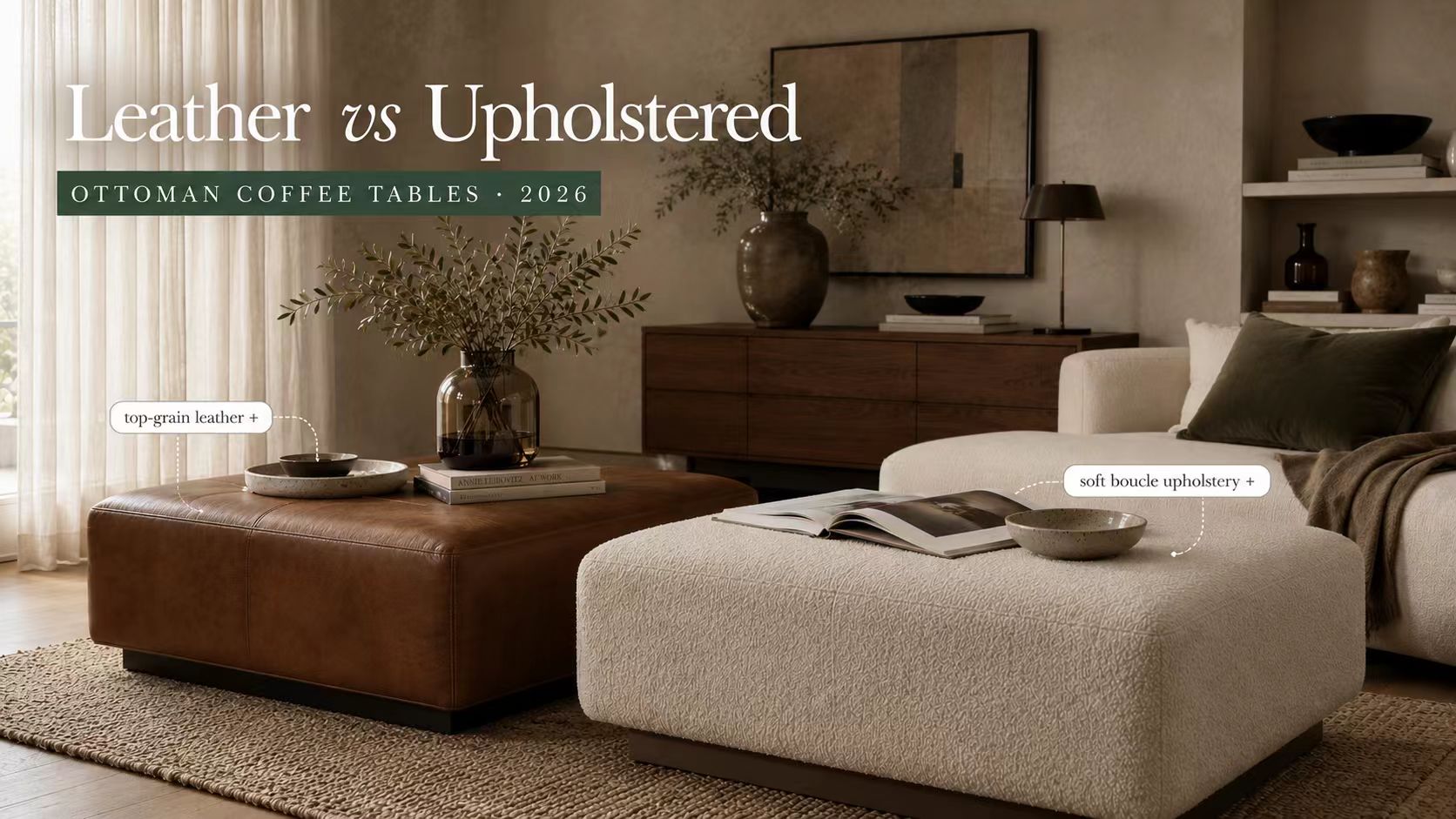
The honest answer between leather and upholstered ottoman coffee tables in 2026: leather wins on spill resistance and adult-only formality, upholstered wins on warmth, family forgiveness, and most price points — and both work as actual coffee tables only with a proper tray and a stable base. The material decides the kind of room it fits, not whether the ottoman can replace your hard-top table.
I’ll tell you where this comes from. I almost bought a deep brown leather ottoman a year ago — beautiful in the listing, $1,200, ready to ship. Same night I was at a friend’s apartment where their cream linen ottoman caught a full glass of red wine off the side of the tray. We mopped, blotted, tried club soda. There’s still a faint shadow. I closed the leather tab, opened a velvet one, closed that too, and actually learned what I was looking at. Here’s what I wish I’d known before the cart got that far.
Leather vs Upholstered Ottoman Coffee Tables
The first thing to get straight is that “leather” on a product page is not one material — it’s a category that quietly hides four very different things, and the price gap between them is enormous.
Top-grain and full-grain leather are the genuine articles, made from intact hide. They age into a patina, resist most liquids if sealed, and last 15–20 years with care — and typically cost $1,000+ on an ottoman of any real size. Bonded leather is shredded leather fiber glued to a fabric backing — the FTC’s Leather Guides require that products which appear to be leather but aren’t be clearly disclosed, including the percentage of leather fibers in bonded materials. In plain terms: bonded leather tends to crack and peel within 2–5 years and is a category I’d skip on furniture you’ll actually use. Faux leather (PU or PVC) is plastic — better PU hybrids hold up reasonably; cheap vinyl cracks fast. Read the spec, not the headline word.
Upholstered ottomans are simpler because the label is honest: fabric over foam over a frame. The real variable is which fabric. Performance polyester, poly-linen blends, and short-pile pet-friendly weaves shrug off most household spills if you wipe quickly. Velvet looks luxurious, but tight-weave performance velvet behaves very differently from vintage cotton — the former resists daily wear; the latter shows every press of a palm. The deciding question isn’t the look; it’s whether the cover unzips and goes in the wash, because that single feature is the difference between “a stain is a Tuesday” and “a stain is a replacement.”
Rule of thumb: leather is a long-term financial commitment that pays back in spill resistance and adult-room formality; upholstered is a flexibility commitment that pays back in warmth, sound dampening, and forgiveness when the cover comes off.
Which One Fits Your Living Room Better
Material is half the question. Room context is the other half.
Family Rooms With Kids
In a room where kids actually play, an upholstered ottoman is the more honest choice — and not for the reason most articles say. The usual line is “soft edges, fewer ouchies,” which is true. The deeper reason is replaceability. Removable washable covers mean a juice-box explosion is a wash cycle, not a refinishing project. A bonded-leather top on a kid-shared ottoman starts cracking near the corners within 18 months because small bodies climb and pivot on the same square inch every day.
Two specs to insist on for an upholstered family pick: covers that physically unzip (don’t accept “spot clean only”), and certifications you can verify — CertiPUR-US for foam, OEKO-TEX® STANDARD 100 for the fabric, which independently tests every component against a list of over 1,000 harmful substances. Kids press their faces into this surface for hours; certification is the part most worth being picky about, more than color.
If you’re set on leather in a family room, go top-grain only and accept that surface scratches will show within the first year. Real top-grain develops character with use; bonded or thin faux will just look damaged. There’s no “kid-proof” version of either material.
More Polished Living Rooms
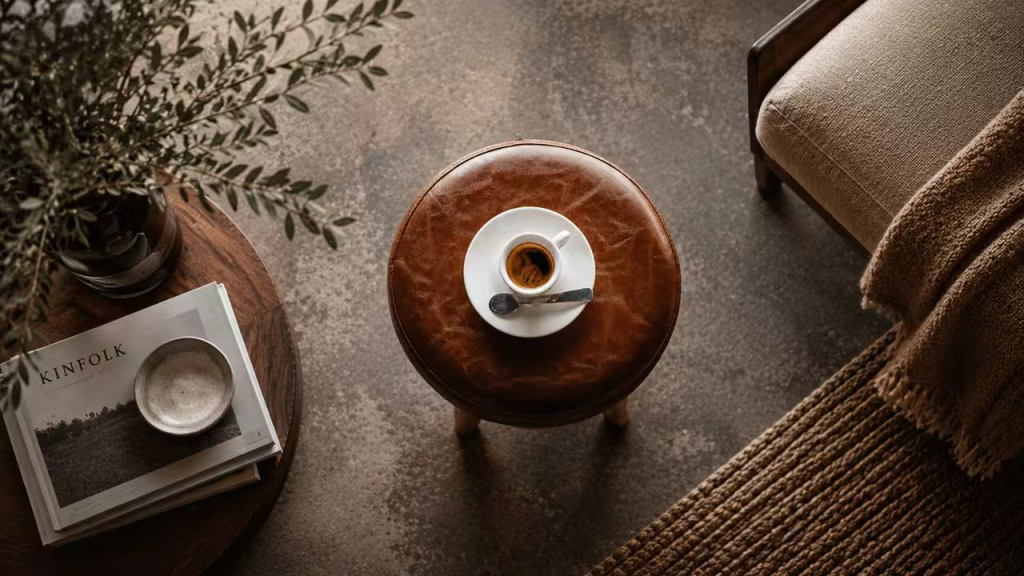
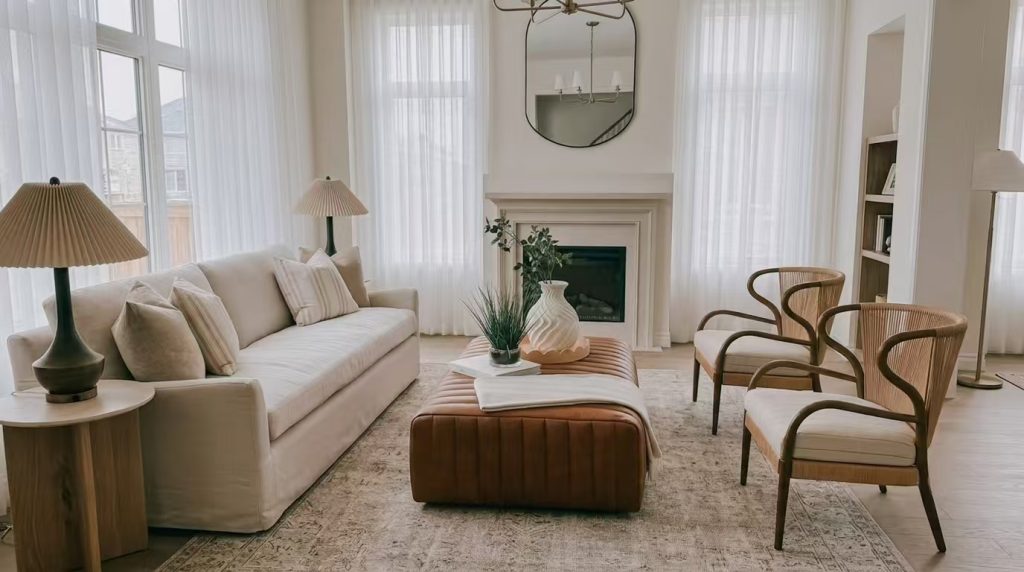
In an adult-leaning living room — formal seating, more curated styling, fewer hands on the surface — leather earns its higher price. Full-grain in cognac or deep brown reads as a statement piece the way fabric rarely does, and it ages visibly better than fabric in low-traffic settings because leather softens and patinas instead of compressing and pilling.
Upholstered still works here, but the look hinges on getting silhouette and fabric family right. A coordinated set — ottoman, sofa, and accent chair in the same finish family — keeps a polished room deliberate instead of accumulated. The fabrics that work in formal rooms are usually the same tight-weave performance options that hide use; bouclé and chenille photograph beautifully but snag under daily contact.
The practical test for either material: lay painter’s tape in the exact footprint and live around it for 2 days. Reach over it from the sofa, walk past it carrying a laptop, sit on it as a footrest. An ottoman that photographs perfectly in a wide shot can eat a small room alive.
Cleaning, Texture, and Daily Wear
This is the section product pages skip.
Cleaning is leather’s strongest argument. A damp microfiber cloth and a quarterly conditioner is the entire routine on top-grain — coffee, wine, oil-based spills usually wipe off within seconds if you catch them fresh. Bonded leather is closer to upholstered in maintenance and worse in repair: once it starts peeling, there’s nothing to seal back. Faux leather sits in between — wipes clean easily, but body oils, sunscreen, and heat break down the coating in 3–5 years.
Upholstered cleaning honestly depends on the fabric and the cover. Performance fabrics in mid-tone neutrals (greige, mushroom, dark linen) handle daily life remarkably well — a 30-second blot clears most fresh spills. Light cotton or natural linen on an ottoman is where I’d push back; red wine, marinara, coffee, and ink can absorb before you reach the cloth. A set-in stain on cream linen may not fully lift. Removable washable covers separate “manageable” from “expensive lesson.”
Texture matters more than people credit it for. Leather is cool and slick under bare legs in summer — pleasant in some rooms, unpleasant in others. Fabric is warm, quieter (it absorbs sound rather than reflecting it), and forgiving on a tired afternoon. If you work from the sofa with your feet up, the difference is felt every day.
Pet households add a third axis. Cat claws are the natural enemy of both materials but show damage differently: leather scratches as visible surface marks, loose-weave fabric snags into pulls that spread into runs. The defense is the same — a tight, dense surface beats a loose, plush one, regardless of which side of the leather/fabric line you’re on. No “pet-proof” claim survives a determined cat; tight construction just ages more gracefully.
Using an Ottoman as a Coffee Table
Here’s where the marketing photo and the Tuesday-night reality diverge.
An ottoman replaces a coffee table for two things: a soft footrest and bonus seating. It does not replace a hard surface. You need a tray. Not a tiny styled one with a candle; a real, flat-bottomed tray of at least 16×20 inches with a non-slip backing. Anything smaller wobbles the moment someone leans on the cushion — that’s how the glass of red wine I mentioned earlier ended up where it did.
Stability is its own conversation. Ottomans by design are low and wide, which is the safer geometry — the U.S. Consumer Product Safety Commission’s furniture stability guidance consistently favors low, grounded, well-balanced pieces over tall narrow ones, especially around toddlers. Lift-top ottomans add a consideration: ask the brand for the lid weight spec and test the mechanism in person if you can. A heavy lid can pinch fingers, on either leather or fabric versions.
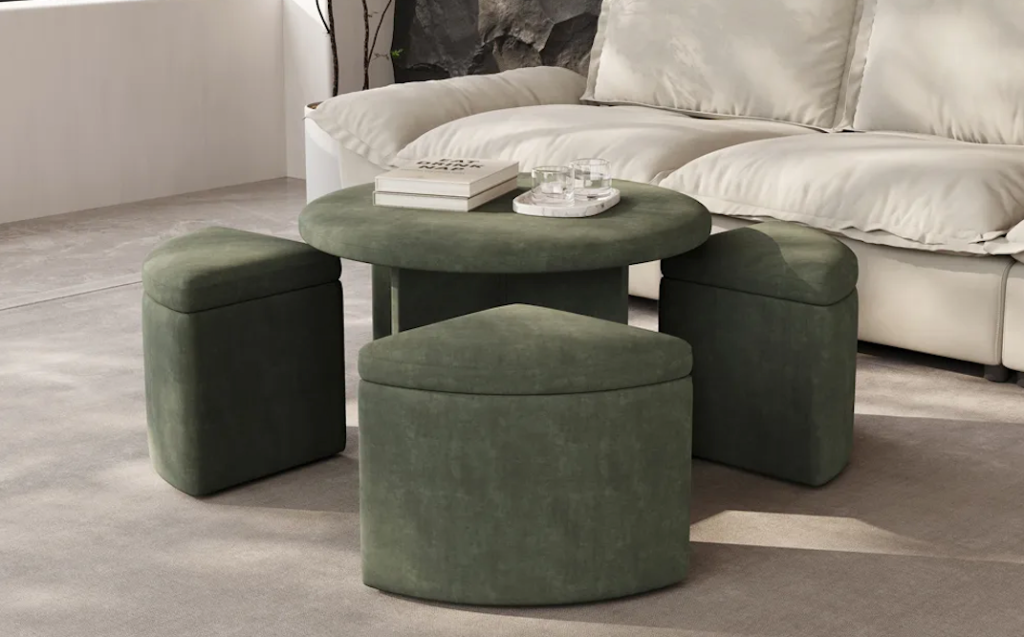
Weight capacity matters if anyone actually sits on it. Look for at least 250 lbs rated on the top — less and you’ve bought a footstool, not a piece of furniture that doubles as a seat. A good ottoman coffee table also ships fully assembled, which matters more here than on a hard table: wrestling with hardware on a 60+ lb upholstered or leather body almost guarantees a scuff or misaligned cover before you’ve used it once. POVISON’s Storage & Coffee Table Ottoman ships fully assembled at 34×39.5×21.5 inches with OEKO-TEX®-certified velvet, performance poly-linen, or short-pile pet-friendly fabric — useful as a concrete upholstered example, with no leather version. A leather equivalent in similar dimensions usually runs $1,400–$2,200; that price gap is part of the material decision, not separate from it.
One honest note: an ottoman coffee table is genuinely worse than a hard table for working from the sofa with a laptop, for an actual cocktail evening, or for any meal more involved than snacks. It’s better for movie nights, kids on the rug, and feet-up Sunday afternoons. Pick for the version of your life that happens more often.
FAQ
Is a leather ottoman coffee table easier to clean than upholstered?
A top-grain leather ottoman is easier for most everyday spills — a damp cloth clears coffee, wine, and food within seconds if you catch them fresh. Upholstered cleaning depends entirely on fabric: performance polyester and poly-linen wipe easily, but light cotton or natural linen may hold set-in stains permanently. Removable washable covers close that gap; spot-clean-only fabric does not.
Is an upholstered ottoman coffee table suitable for families with kids?
An upholstered ottoman is generally a better fit for kids: soft edges reduce injury risk, the cushion forgives climbing, and removable washable covers turn most spills into a wash cycle. Insist on covers that physically unzip, plus low-emission certifications — CertiPUR-US for foam and OEKO-TEX® for fabric, since kids contact this surface daily. Skip bonded leather entirely for shared family use.
Can you safely put drinks and food directly on an ottoman coffee table?
You should not place drinks or food directly on any ottoman coffee table without a tray. The cushion is soft and shifts under weight, so a glass placed directly on it tips easily — and a fabric or unfinished leather surface will absorb whatever lands. A flat-bottomed tray of at least 16×20 inches with non-slip backing creates the stable surface the ottoman alone doesn’t provide.
Do you need a tray when using an ottoman as a coffee table?
Yes — a tray is the single most important accessory, on either leather or upholstered. It gives drinks and dishes the stable, level surface the cushion can’t, and physically separates spills from the upholstery underneath. Size matters more than style: at least 16×20 inches, flat-bottomed, non-slip backed. Decorative trays smaller than that are styling props, not functional surfaces.
Conclusion
The leather-versus-upholstered decision is really a decision about which version of your living room you’re furnishing. If your space leans adult, lower-traffic, and design-forward — and you’re prepared to invest in top-grain rather than bonded — leather pays back in a piece that softens and gains character over a decade. If your space hosts kids, pets, weekend movie nights, or a budget under $800, upholstered with removable washable covers and certified materials gives you forgiveness leather can’t.
What matters more than the material is what neither side solves alone: a proper tray for drinks, a stable low frame, and a clear-eyed look at how your household uses the room on a Tuesday at 9pm — not in the styled photo on a Saturday afternoon. Tape out the footprint, live around it for 2 days, and let the room decide.
There’s no version of either material that’s spill-proof or scratch-proof. Anyone selling you that is overpromising. Pick the trade-offs you can live with, and pick the tray first.
Related Reading:


