 By Charles
If you are currently staring at a pile of clean laundry on a chair (the dreaded “floordrobe”) and wondering where on earth to put it, you are not alone. As a recovering flat-pack victim and a dad who has spent way too many weekends wrestling with hex keys, I know the struggle. You need storage, you need it yesterday, and you don’t want to buy the wrong piece of furniture that eats up your entire bedroom floor plan.
The dilemma usually comes down to two heavy hitters: the Dresser vs Chest of Drawers.
Most people use the terms interchangeably, but if you have a small room, a toddler who touches everything, or a Golden Retriever with a tail like a whip, the difference is massive. After testing various configurations in my own chaotic household over the last 3 years, I’ve broken down exactly which one saves you time, space, and sanity. Here is what I discovered after measuring, loading, and living with both.
The Verdict: Buy or Pass?
The Quick Take: If you have a room smaller than 12×12 feet, buy a Chest of Drawers to maximize vertical storage. If you need a changing table or TV stand and have the floor space, buy a Dresser.
- Buy a Chest of Drawers If:
- You are tight on floor space (apartments, guest rooms).
- You want to keep items out of reach of toddlers or pets (44″+ height).
- You primarily store folded clothes like t-shirts and socks.
- Buy a Dresser If:
- You need a dual-purpose surface (TV stand, vanity, changing table).
- You have a master bedroom with a wide, empty wall.
- You prefer deep, wide drawers for bulky sweaters or jeans.
- Key Specs Comparison:
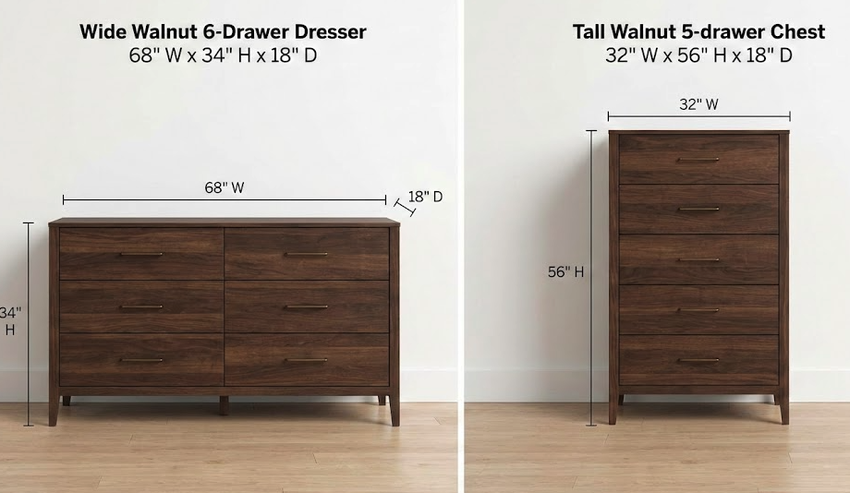
- Standard Chest: 30″-38″ Wide | 44″-60″ High | Footprint: ~5 sq ft
- Standard Dresser: 60″-72″ Wide | 30″-36″ High | Footprint: ~9 sq ft
- Price Insight: A solid wood chest often costs 15-20% less than a matching double dresser simply due to lower material volume.
What Are the Definitions and Key Differences Between a Dresser and Chest of Drawers?
Here is the 40-word breakdown: A Dresser (or dressing table) is wide, short, and deep, designed for dressing options and mirror attachment. A Chest of Drawers is tall and narrow, designed to maximize vertical storage in tight footprints. Think of the Dresser as a “landscape” photo and the Chest as a “portrait.”
Why I Chose to Compare These (The Homework)
I didn’t just Google this; I lived it. When we moved my son into his “big kid” room, I bought a wide dresser because it looked nice in the catalog. Two days later, I realized I couldn’t fully open the closet door because the dresser was 6 inches too wide. I had to disassemble it (nightmare) and swap it for a chest.
Understanding the technical differences saves you that return-shipping headache. For more inspiration on maximizing small bedroom storage, consider how vertical solutions can transform tight spaces.
| Feature | Dresser (Double/Triple) | Chest of Drawers (Tallboy) |
| Primary Shape | Horizontal, Squat, Wide | Vertical, Tall, Narrow |
| Standard Height | Waist High (30-36 inches) | Chest/Shoulder High (44-60 inches) |
| Footprint Required | Large (9-12 sq ft) | Compact (4-6 sq ft) |
| Storage Type | Bulky items (Jeans, Sweaters) | Small foldables (Socks, Shirts, PJs) |
| Accessibility | Accessible to kids/pets | Top drawers secure from kids/pets |
| Ideal For | Master Suites, Nurseries | Guest Rooms, Small Apartments |
The Cost of Getting It Wrong:
Replacing a $400 particle board dresser after 2 years because the wide drawers sagged creates a cost of $200/year. Investing in a solid wood chest for $600 that lasts 15 years brings your cost down to $40/year.
How Do Sizes and Shapes Compare for Small Bedrooms?
Summary: In bedrooms under 144 square feet (12×12), a Chest of Drawers is superior because it utilizes “dead” vertical air space rather than valuable floor real estate. A standard chest saves approximately 4 square feet of walking path compared to a dresser.
Which Option Fits Better Under 3 Feet Wide?
If you have a narrow wall—common in city apartments or between two windows—the Chest of Drawers is your only logical option. Most standard chests are designed to be 30 to 38 inches wide.
I tested this in our guest room, which has a small nook exactly 40 inches wide. A standard double dresser (usually 60+ inches) was impossible. The chest slid in with 2 inches of clearance on either side.
- Pro Tip: Always measure your baseboards, not just the wall. Baseboards can eat up 1-2 inches of width.
- Traffic Flow: You need at least 30 inches of clearance in front of any furniture to walk comfortably. A dresser often eats into this walkway in small rooms, resulting in bruised shins.
How Does Height Affect Accessibility for Parents?
The height difference isn’t just aesthetic; it changes how you use the room.
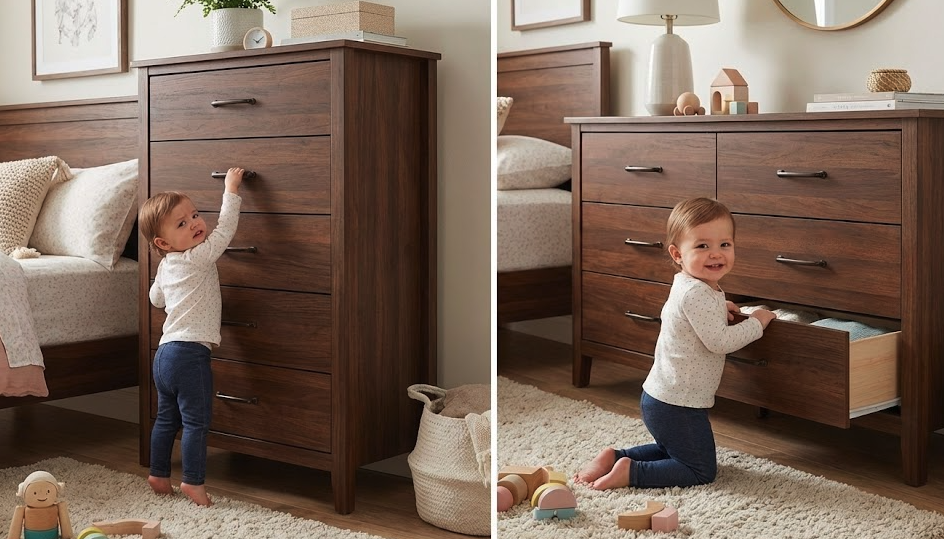
- The Dresser (30-36″ High): This is the perfect “drop zone.” Keys, mail, laundry baskets, and coffee cups naturally migrate here. However, it is also perfectly accessible to my 4-year-old.
- The Chest (44-60″ High): The top two drawers are the “Parent Safe Zone.”
Real Life Test: I keep my watch, wallet, and sharp grooming scissors in the top drawer of my chest (approx. 50 inches high). My toddler cannot reach them without a ladder. If you need secure storage without a lock, height is your best friend.
Why Choose a 5-Drawer Chest for Pet-Safe Stability?
If you have a large dog, you know the “Tail Whip of Destruction.” A low dresser surface is right at tail height for a Golden Retriever or Lab. We lost three picture frames and a glass of water to a happy dog tail before switching to a chest.
- The Tail Test: A chest of drawers usually stands 44 inches or higher, placing the top surface safely above the “wag zone.”
- Stability Note: Because chests are taller and narrower, wall anchoring is non-negotiable. According to Consumer Reports testing on furniture tip-over safety, proper anchoring is essential for tall storage units. While a low dresser is harder to tip, a 5-drawer chest loaded with heavy denim in the top drawer becomes top-heavy.
- Povison Value: Look for chests with anti-tip kits included and solid wood construction. A heavier bottom (solid wood legs vs. particle board) lowers the center of gravity, making it safer for pets who might bump into it during “zoomies.”
What Storage Capacity Suits Busy Parents and Pet Owners?
Summary: While a dresser technically offers more total cubic inches of storage, a chest of drawers forces better organization. A standard 6-drawer dresser holds roughly 12-15 cubic feet of volume, while a 5-drawer chest holds 8-10 cubic feet, but the vertical stacking makes items easier to see.
How Many Drawers Handle 20 Outfits Efficiently?
I did the “Laundry Mountain” test. I took 20 of my work outfits (jeans + t-shirts) and attempted to store them in both units.
- The Chest Strategy: Using the KonMari (vertical fold) method, I fit 20 t-shirts in one chest drawer. Because the drawers are often narrower (front to back), rows stay neat.
- The Dresser Strategy: Dresser drawers are wide. Unless you use drawer dividers (an extra purchase), t-shirts tend to fall over and mix together.
If you are a busy parent, you don’t have time to re-organize drawers every week. The narrower drawers of a chest naturally limit the chaos. You can dedicate one drawer entirely to socks, one to gym clothes, etc.
Which Design Stores Kids’ Toys Without Tipping Risks?
If you are repurposing this furniture for a playroom or kid’s bedroom:
- Go with the Dresser (Lowboy).
- Why? Kids want to see everything. A low, wide dresser allows them to reach every drawer safely.
- The Tipping Factor: A wide dresser has a much lower center of gravity. While you should always anchor furniture, a dresser is significantly harder for a climbing child to pull over than a tall chest.
- The “Stuff” Test: Dresser drawers are often deeper front-to-back, making them better for bulky items like stuffed animals or blankets.
Why Avoid Dressers If You Need Deep Drawer Space?
Here is a physics lesson I learned the hard way.
- Wide Drawers (Dresser): A 30-inch wide drawer full of heavy jeans puts immense strain on the drawer bottom. If the unit uses cheap particle board bottoms, they will bow and eventually pop out of the groove.
- Narrow Drawers (Chest): A 15-inch wide drawer in a chest has a shorter span. Even if you load it with heavy winter sweaters, the bottom is supported better structurally.
My Experience: My cheap wide dresser failed after 14 months (bottom fell out). My solid wood chest has held my collection of heavy hoodies for 3 years with zero sagging. If you have heavy clothes, the chest of drawers is structurally superior over time.
Where Should You Place Each in a Home With Kids and Pets?
Summary: Placement is dictated by traffic flow and function. Place dressers in large master suites or nurseries where they serve dual purposes. Place chests in corners, hallways, walk-in closets, or guest rooms where floor space is premium.
How Does a Dresser Work Best in Master Bedrooms?
In a master bedroom, the dresser is the anchor piece.
- Visual Balance: A King or Queen bed is massive. A tiny chest looks dwarfed next to it. A 60-inch wide dresser balances the visual weight of the bed.
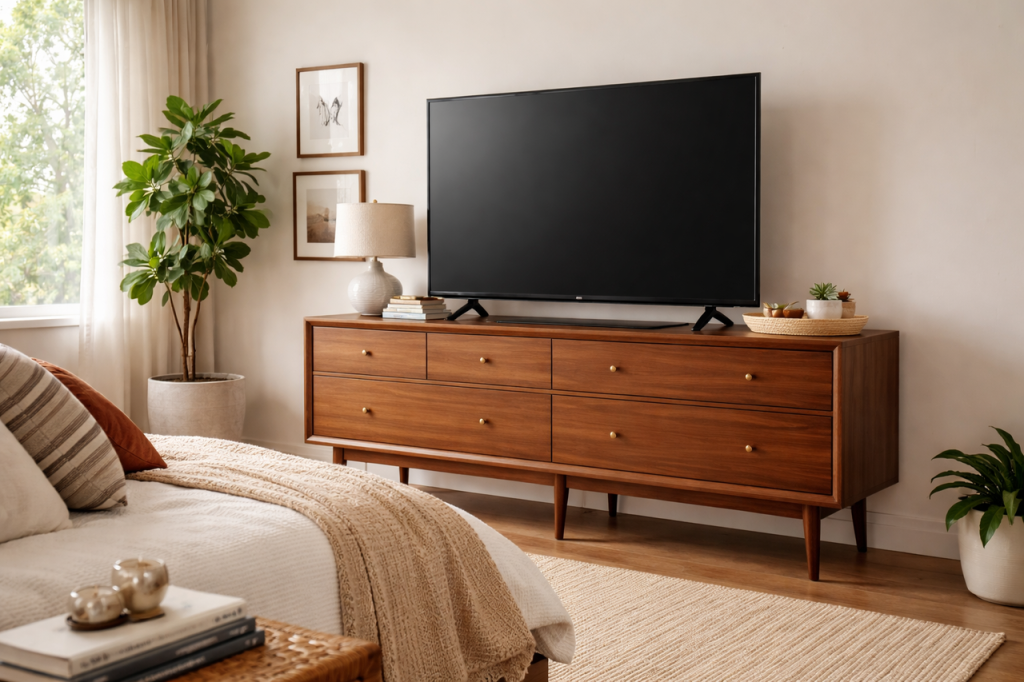
- The TV Stand Hack: We use a wide walnut dresser across from our bed. It holds our 50-inch TV perfectly, and the drawers hold all the media cables (plus my wife’s yoga pants). You cannot safely put a large TV on a tall chest—it’s too high for viewing and too unstable.
For those interested in current interior design trends, mid-century modern dressers remain popular for their clean lines and functional elegance.
Why Position a Chest of Drawers in Hallways?
This is a secret weapon for small homes.
- The “Landing Strip”: If you have a wide hallway or a landing at the top of the stairs, a chest of drawers fits perfectly.
- Usage: We put one in our upstairs hall to store linens and “overflow” seasonal clothes.
- Measurement Check: Ensure you have 36 inches of clearance for walking past the chest. Since chests are usually only 18-20 inches deep, they rarely block the flow, whereas a dresser would block the entire hall.
What Placement Avoids Pet Damage Over 6 Months?
- The Corner Defense: Placing a chest of drawers in a corner protects two of its four sides.
- The Flat Wall Risk: A dresser takes up 5-6 feet of wall space. That is 6 feet of “runway” for your dog to rub against, scratch, or chew.
- Durability Data: After 6 months, my dresser had scuffs along the entire front edge from the dog’s collar tags. The chest, tucked in a corner, remained pristine. If you have a frantic household, minimizing the exposed surface area helps your furniture survive longer.
Which One Should You Buy After Comparing 4 Metrics?
Here is the final breakdown based on my testing criteria:
| Metric | Winner | Why? |
| Floor Space Efficiency | Chest | Saves ~4 sq ft; fits in nooks. |
| Storage Vol. per Dollar | Dresser | You generally get more total cubic inches for the price. |
| Accessibility | Dresser | Easier to see into; useful top surface. |
| Safety (Kids/Pets) | Chest | Keeps items out of reach; less surface for clutter. |
The ROI Calculation:
- Time Saved: A chest promotes better organization (less rummaging). I save about 5 minutes every morning finding socks because they have a dedicated, small drawer in the chest.
- Financials: If you move frequently (apartments), a Chest of Drawers fits in any room. A huge dresser might not fit your next bedroom. The chest is the safer long-term investment for renters.
Common Questions About Bedroom Storage
How much weight can a solid wood chest hold?
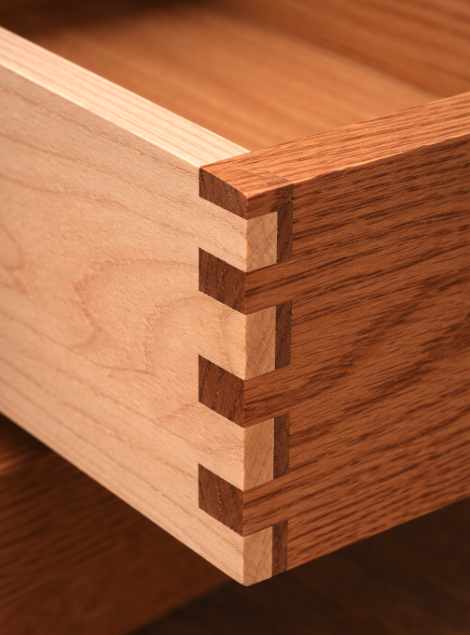
A well-made solid wood chest (like those with FAS-grade walnut) can typically support 20-30 lbs per drawer and 100+ lbs on top. Always check the specific joinery; dovetail joints hold significantly more weight than glued dowels.
Can I use a dresser as a changing table?
Yes, and it’s a smart move. A standard dresser height (30-36 inches) is ergonomically perfect for changing diapers. Buy a removable changing topper. Once the baby outgrows diapers, remove the topper, and you still have a beautiful piece of furniture—unlike a dedicated changing table which becomes useless.
Is it hard to assemble a 5-drawer chest?
If you buy flat-pack, yes—it is a nightmare of alignment. However, if you choose pre-assembled options (my preference), the only setup is attaching the legs. For a chest, this takes about 10 minutes. Building a 6-drawer dresser from scratch can take 3-4 hours.
highboy vs. tallboy: What is the difference?
Generally, they are the same thing—tall chests of drawers. A “Highboy” technically refers to a specific antique style with a chest-on-chest design (two stacked pieces). For modern shopping, “Tallboy,” “Chest,” and “High Chest” are used interchangeably for vertical storage.
My Final Take: Is a Chest or Dresser Worth It?
Dresser vs Chest of Drawers—the battle ends here.
If you are a busy parent in a standard suburban home with a large master suite, buy the Dresser. You need the surface area for the TV, the changing pad, or the pile of laundry you promise to fold tomorrow. It anchors the room and offers maximum bulk storage.
However, if you are an apartment dweller, a renter, or have a small bedroom, the Chest of Drawers is the smarter buy. It respects your limited floor space, keeps your expensive sunglasses away from your toddler’s sticky hands, and survives the “dog tail test.”
My personal ROI: I swapped my low dresser for a solid wood Walnut Chest of Drawers two years ago. I gained back 5 square feet of floor space (which makes the room feel huge), and I haven’t had a single drawer bottom sag.
Ready to Reclaim Your Floor?
If you’re tired of tripping over laundry baskets and want a storage solution that arrives ready to use (seriously, no hex keys required), don’t just guess—choose the one that fits your room’s “traffic flow”:
- Best for Tight Corners & Pet Safety (The “Vertical” Pick): Check out this Mid-Century Modern 6-Drawer Chest with tall legs. It maximizes vertical storage to save floor space and keeps your items safely above the “tail wag zone.”
- Best for Master Suites & TV Stands (The “Statement” Pick): Go for the 59″ Mid-Century Modern 6-Drawer Dresser in Walnut. Its wide surface is perfect for anchoring a large wall or doubling as a media center.
- Best for Modern Aesthetics: See this Modern 4-Drawer Dresser with a Curved Profile. A sleek, sculptural piece that delivers high design without the assembly headache.
- Still Measuring?Browse our complete collection of Pre-Assembled Dressers and Chests to find the perfect fit for your home.
Past Review:


