 By Charles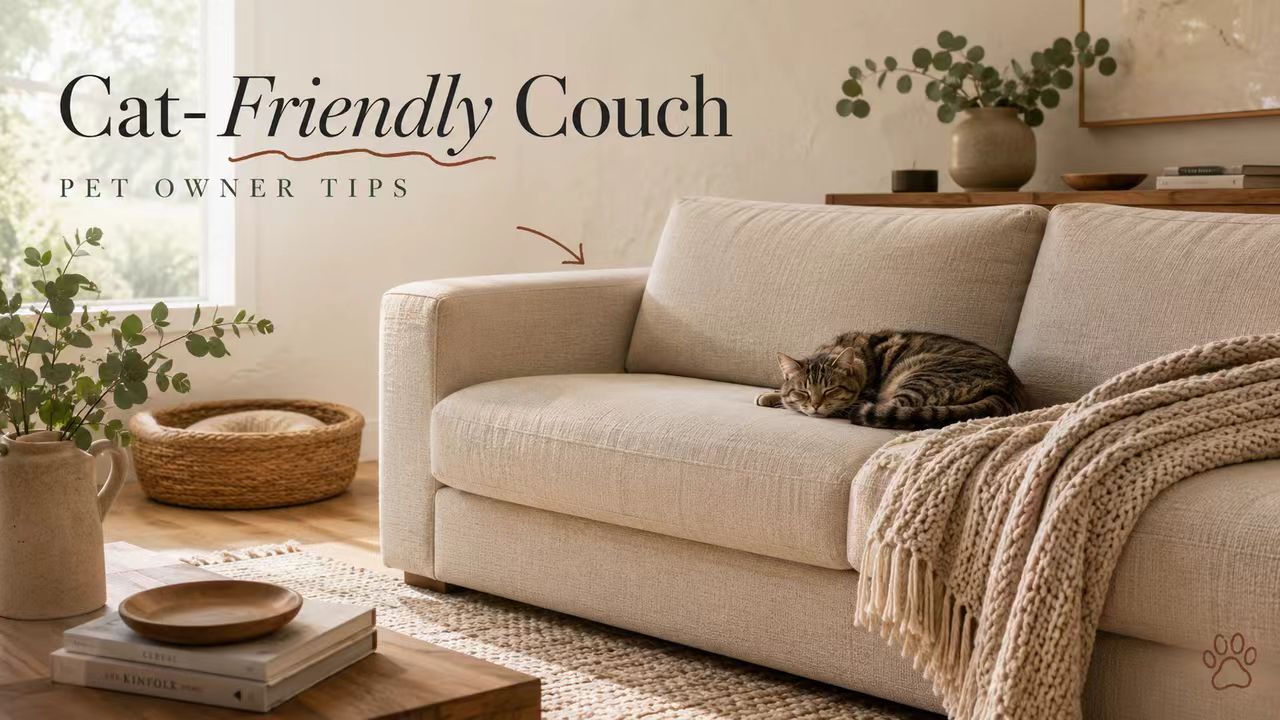
Three years into cat ownership, I finally understood something: my cat wasn’t destroying my couch. She was just doing what cats do.
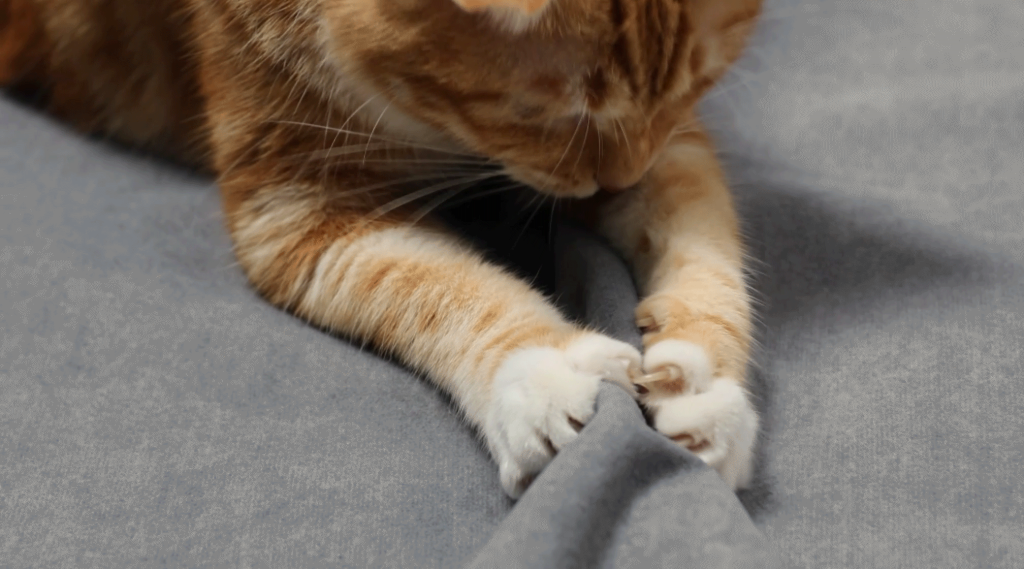
Scratching is how they file their claws, mark their territory, stretch their backs, and burn off stress. My orange tabby Miso spent her first week in my apartment treating the armrest of my old fabric sofa like her personal gym. My reaction back then was to Google “cat scratch proof couch.” Three years later, I have to tell you something: that phrase is a marketing trap.
There is no such thing as a cat-scratch-proof couch. There are only couches that tolerate scratching better and couches that fall apart faster.
This guide is for people like me. You love your cat, you want a living room you’re not embarrassed of, you’re willing to do the work and make trade-offs — but you don’t want to get burned by another inflated “scratch-proof” promise.
What Cat Owners Need From a Couch
I asked about a dozen cat-owning friends what they prioritize when shopping for a sofa. The answers were strikingly consistent — and very different from what most furniture guides emphasize.
Here’s what cat households actually need, in order:
- Fabric that handles claws without falling apart — not “indestructible,” but “wears slowly and doesn’t show damage easily”
- Easy to clean — vomit, shedding, the occasional accident. These are routine, not emergencies.
- Chemical safety — cats groom themselves 8–10 hours a day, which means whatever’s on your couch ends up in their stomach eventually
- Structural stability — cats jump on and off furniture constantly. Wobbly frames give out within two years.
- Style — yes, this comes fifth. But having a cat doesn’t mean you give up on a beautiful room.
According to the ASPCA’s behavioral guidance on destructive scratching, scratching is a normal physiological need, not a behavioral problem. That sentence matters. It means no couch you buy will change the fact that your cat will scratch. What you can change is where they scratch and how visible the damage becomes.
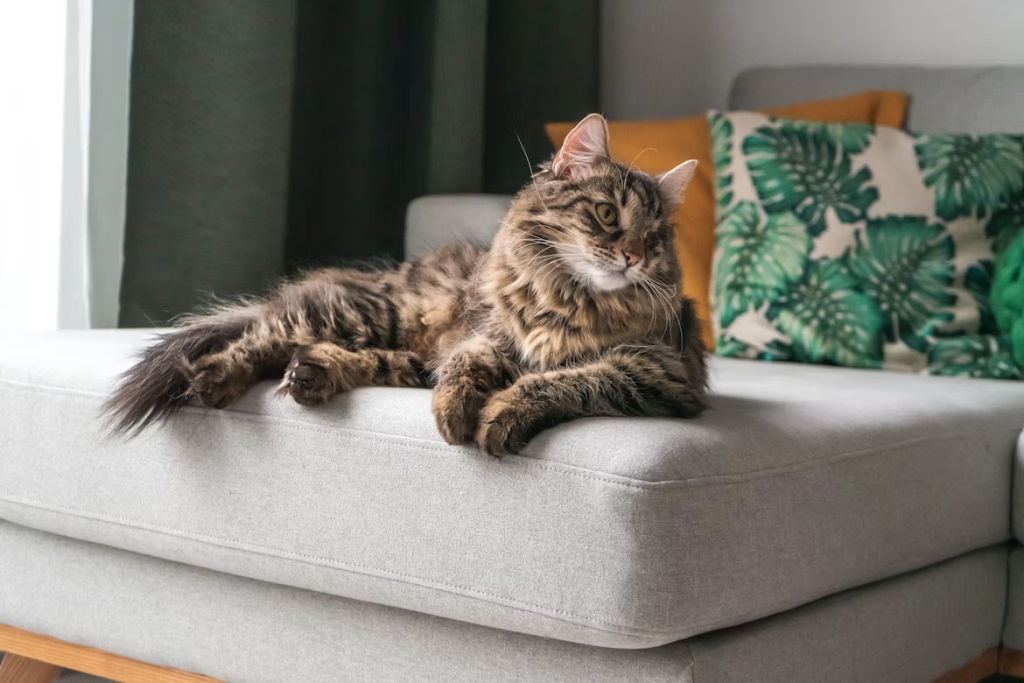
Couch Features That May Help With Scratches
I’ve done the research, made the mistakes, and tested several fabrics under Miso’s claws personally. Below are the actual indicators that separate “holds up well” from “falls apart” — not marketing claims, real specs you can ask about.
Tighter Weaves
Fabric durability is measured by Wyzenbeek double rubs. The short version: a machine rubs sandpaper across the fabric repeatedly until it breaks down, and they count the cycles.
- Heavy-duty: ≥ 30,000 double rubs
- Performance grade: ≥ 100,000 double rubs (the floor for cat households)
- Contract grade: ≥ 250,000 double rubs (commercial spaces)
These benchmarks come from the Association for Contract Textiles’ performance guidelines — an industry standard, not a brand invention. Ask the retailer for the fabric’s double rub number before buying. If they can’t tell you, that’s a signal to walk away.
The other advantage of a tight weave is that claws can’t catch the fibers. When Miso scratches loose-weave chairs, her claws dig into the fibers and pull long threads out. On tightly woven flat fabrics, her claws slide across with almost no trace.
Most sofas in the POVISON couch collection use performance-grade woven fabrics, and each product page lists the specific material composition. That’s my recommended first move — check the fabric data before falling for the styling.
Smoother Surfaces
Surface smoothness matters more than “hardness.”
I used to think leather was the answer for cat homes. Wrong — I’ll get to why leather is actually a trap. What actually works is a flat, low-pile, tightly woven surface. Specifically:
- Microfiber: extremely high surface density; claws struggle to hook in
- Crypton / Sunbrella performance fabrics: originally designed for commercial and outdoor use, they hold up exceptionally well against cats
- Tightly woven canvas: flat, dense, easy to clean
What to avoid: chenille, velvet, loose-weave linen, bouclé. To a cat’s claws, those textures basically read as premium scratching pad.
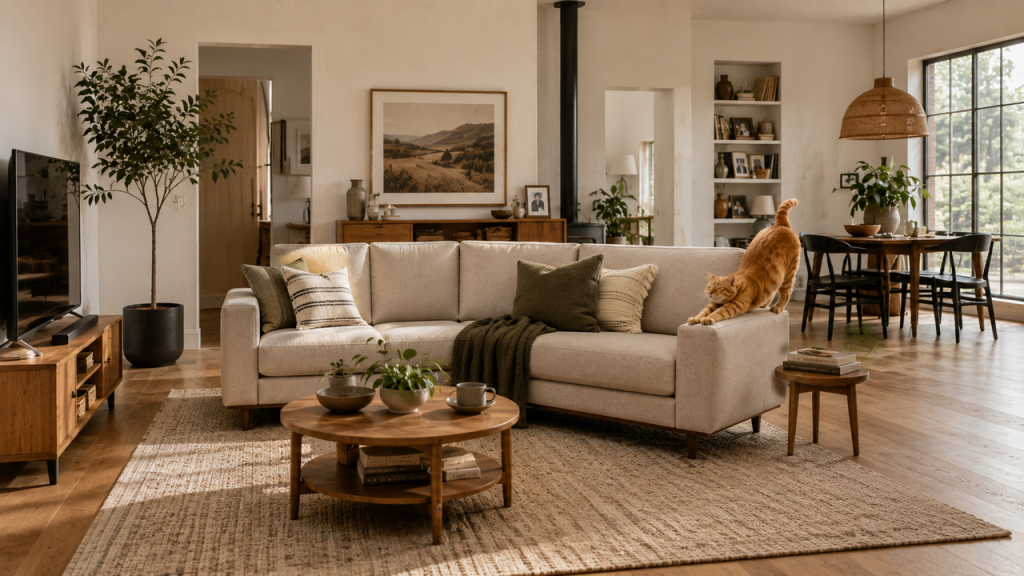
Materials to Be Careful With
Now the materials you should actively avoid. I’ve made these mistakes, so you don’t have to.
Genuine leather — the biggest misconception
A lot of people assume leather is scratch-proof. It isn’t. Once a cat’s claws go across leather, you get permanent fine-line scratches. Because leather has a directional grain, those marks catch the light and become very visible. Repair requires a professional leather technician — a few hundred dollars per session.
The only real advantage of leather is wipeability. The cost is scratches you live with forever.
Bonded leather — a three-year lifespan, max
This is the most aggressively marketed “fake leather.” It’s essentially leather scraps bonded with polyurethane coating. After two years of cat use, it starts peeling and flaking off like old wallpaper. Cheap-and-cheerful does not apply to cat households. Skip it.
Loose weaves — destroyed in a week
Linen, coarse cotton, hand-woven aesthetics — the fiber gaps are wide. One claw hook produces a five-inch pull. Miso could make a loose-weave linen chair look like it had been through a tornado in about three days.
Chemical safety — easy to overlook, hard to undo
Cats spend 8–10 hours a day grooming themselves. Chemical residue, flame retardants, and formaldehyde from your couch travel through their paws and fur into their bodies.
Look for two labels:
- CARB Phase 2 compliance — the California Air Resources Board’s formaldehyde emission standard for composite wood, currently the strictest in North America
- OEKO-TEX Standard 100 — international certification testing textiles for 100+ harmful substances
POVISON’s frames are built to CARB Phase 2, and the finishes are water-based low-VOC formulations. You can verify the certifications on each product specification page. When your cat is licking surfaces all day, the bar for chemical safety should be higher than what you’d set for yourself.
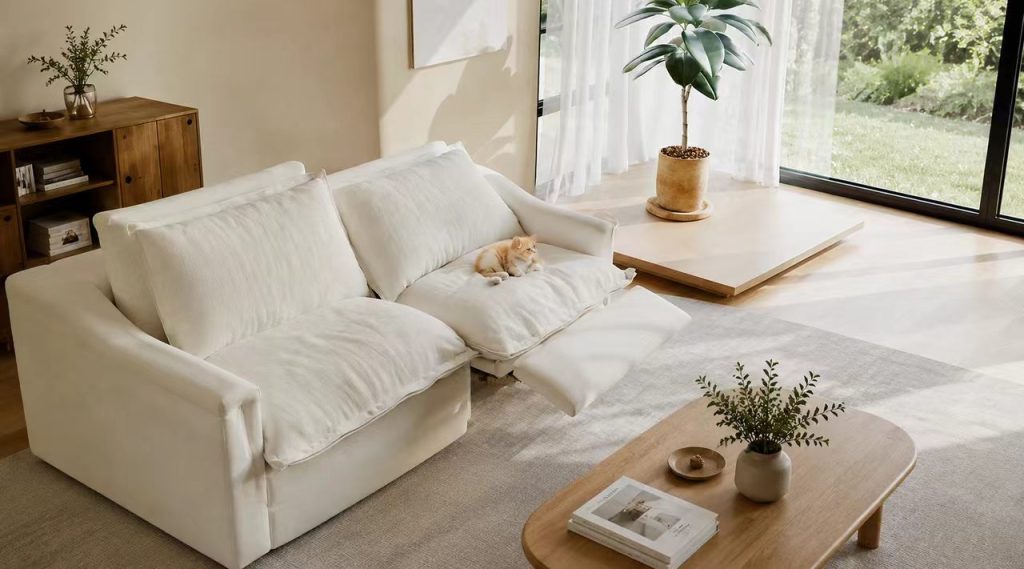
Setup Tips That Reduce Damage
This is the part you can’t buy. Three years of learning the hard way, ranked by impact:
- Provide a legitimate alternative the day the couch arrives
Place a sisal vertical scratching post within three feet of the new couch — at least 32 inches tall, because cats need to stretch fully when they scratch. The Cornell Feline Health Center notes that most “destructive” scratching is really a sign that the cat doesn’t have an appropriate alternative nearby.
I have three posts in my apartment — one beside the sofa, one near the bedroom door, one by the window. Miso now does about 95% of her scratching on the posts.
- Choose removable covers and modular construction
This is where POVISON sofas fit cat households especially well. Most styles use a modular sectional construction — individual pieces come apart for cleaning, rearranging, or replacement. When Miso eventually wears down one armrest piece, I can swap that single unit instead of replacing the entire couch.
Machine-washable, removable covers are non-negotiable for cat homes. Not a nice-to-have. If a retailer can’t confirm this, move on.
- Seven minutes vs. two hours of stress
POVISON ships fully assembled, and this matters more than you’d think for cat owners. Flat-pack sofas mean two to four hours of unboxing, building, and adjusting — during which your cat is treating the foam padding, plastic ties, and loose screws as new toys. The first time Miso encountered flat-pack packaging, she chewed through three zip ties before I noticed.
Pre-assembled means the couch is placed and ready immediately. Your cat adapts to the new furniture from minute one, not after watching you swear on the floor for half an afternoon. The difference matters more than the spec sheet suggests.
- Double-sided tape and pheromone sprays
If your cat still targets a specific spot on the couch (usually the front of the armrest), put double-sided tape there or spray a pheromone product like Feliway. Cats hate the sticky sensation, and pheromones signal “this area is already marked, no need to mark it again.” That combo saved my armrests by week two.
- Trim claws every two weeks
Rounded tips do far less damage than sharp ones. Free, easy, and the single most effective preventive habit.
FAQ
What couch material is most cat-friendly for scratch-prone homes?
The most cat-friendly couch materials are high-density, tightly woven performance fabrics — microfiber, Crypton, Sunbrella, and densely woven canvas. Look for a Wyzenbeek double rub rating of 100,000 or higher. These fabrics have smooth surfaces and dense fiber structures, so claws can’t hook in and damage doesn’t show easily. Cleaning is also easier. Avoid chenille, velvet, loose-weave linen, bouclé, and genuine leather.
Is there really such a thing as a cat scratch proof couch?
No. Any couch marketed as “cat scratch proof” is using sales language, not engineering reality. A cat’s claws can mark any soft material — the difference is only in how visible the damage is and how fast it accumulates. The honest terminology is “scratch-resistant” or “scratch-tolerant,” not “proof.” If you see the word “proof,” treat it as a warning that the seller is overpromising.
Are leather couches a good choice for cat owners?
Generally no. Genuine leather develops permanent fine-line scratches that catch the light and become very visible, and professional repair is expensive. Bonded leather is worse — it peels and flakes within two years of cat exposure. Leather’s one advantage is easy wiping, but the cost is permanent claw marks. If you’re committed to leather, choose top-grain over bonded and accept that the surface will develop a worn, lived-in patina.
How can I reduce cat scratching damage on a new couch?
Combine four moves. First, place a sisal vertical scratching post at least 32 inches tall within three feet of the couch on day one. Second, choose a sofa with removable covers and modular pieces so single sections can be cleaned or swapped. Third, apply double-sided tape or Feliway spray on the spots your cat targets most. Fourth, trim claws every two weeks. Together, these keep damage well below what most cat owners think is inevitable.
Conclusion
You don’t have to choose between loving cats and having a living room you’re proud of. But you do need to shift your mindset — stop searching for a scratch-proof sofa and start managing risk.
On the couch side: tight weaves, smooth surfaces, removable covers, certified-safe materials. On the cat side: a good scratching post, double-sided tape, regular nail trims. Get both right and your new sofa lasts five to ten years instead of falling apart in two.
If you want zero risk and zero marks, this guide isn’t for you — that option doesn’t exist, and anyone telling you otherwise is selling you something.
But if you’re willing to make smart trade-offs and accept “more tolerant plus better setup” as the goal, you can absolutely have a living room that works for both of you.
Miso is sleeping on my POVISON sofa right now. The armrests are intact. We’re both doing fine.
Related Reading:


