 By Charles
Raise your hand if you’ve ever fallen in love with a dining table online… only to discover once it’s in your house that your chairs can’t even slide out.
When you’re choosing a top-rated dining table set for 6, it’s not just about the style. It’s about whether you can actually walk around it, pull out chairs, and host a birthday dinner without everyone playing knee hockey.
This guide walks you through the real-world space you need, the best table dimensions, and how to keep things comfortable for kids, pets, and actual human movement, not just pretty photos.
Minimum Room Size for 6-Person Dining
Before you look at finishes or leg styles, you need to know if your room can comfortably handle a dining table set for 6.
As a simple starting point, most 6-person setups work best in a space that’s at least 10′ x 10′ (about 3 x 3 meters). Bigger is better, but this gives you a ballpark.
The 36-Inch Clearance Rule
Here’s the sanity-saving rule: aim for 36 inches (3 feet) of clearance from the edge of your table to the nearest wall, cabinet, or big piece of furniture.
That 36-inch zone gives you room to:
- Pull chairs out without smashing into a wall
- Walk behind someone who’s already seated
- Help a kid into a booster seat without contorting your spine
If you’re really tight on space, you can dip down to 30 inches on one side, especially if it’s against a low piece like a bench or console. But if you consistently drop under 30 inches, everyday use will start to feel cramped.
Traffic Flow Considerations
Clearance numbers are helpful, but you also have to think about how you actually move through the space.
Ask yourself:
- Is this the main path from the kitchen to the living room?
- Do kids and pets barrel through here at full speed?
- Do you often carry hot pans or big serving dishes through this area?
If the answer is yes to any of those, you’ll want more generous clearance on the “main highway” side, closer to 42–48 inches if you can swing it.
If you’re working with a small space, consider:
- Using a bench on one side (it slides in fully under the table)
- Choosing a pedestal-style table to avoid leg-clutter
- Skipping bulky sideboards and instead using wall-mounted storage or a slim console
If you’re not sure your space can handle it, you can also tape out the footprint on the floor and place chairs where they’d actually sit. That quick test will tell you more than any product photo ever will.
Ideal Table Dimensions
Once you know your room can handle it, the next question is: how big should the table itself be for six people to sit comfortably?
For everyday family life, assignments, crafts, laptops, random snack plates, you don’t want everyone squeezed in like a folding-chair wedding.
Rectangular: 72″ x 36″ Minimum
For rectangular dining tables set for 6, a minimum of 72″ length x 36″ width is the sweet spot.
Why it works:
- 72″ gives each person about 24″ of elbow room on the long sides
- 36″ gives you enough depth for plates on both sides and a simple runner or narrow serving dishes
If you often serve food family-style in the middle, consider going to 38–40″ wide so you can keep platters out without everyone dodging elbows. For flexible sizing, an assembly-free extendable table can expand from 71″ to 95″, accommodating 6 to 10 people when needed.
Round: 54″ Diameter Minimum
Round dining tables are great if you want better conversation and softer corners for kids.
For six people, look for at least 54″ in diameter.
- 48″ is usually too tight for six adults
- 54″ works for six, especially if the base is a pedestal and not four chunky legs
If you host often, 60″ is more comfortable, but make sure your room can handle the extra footprint. A scratch-resistant round dining table offers both the pedestal-style base and durable materials families need.
Oval: 72″ x 42″ Minimum
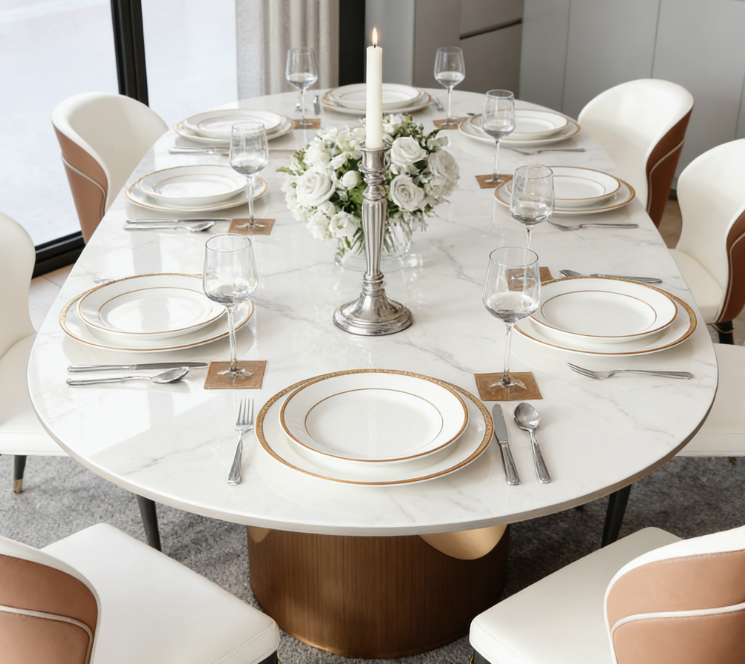
Oval tables are like the peace treaty between round and rectangular:
- Softer edges
- Great for tighter walkways
- Still easy to line up with a wall or rug
For six adults, a good starting size is 72″ x 42″.
- 72″ length = 2 people per long side, 1 on each end
- 42″ width = a bit more room in the middle for serving dishes than a 36″-wide rectangular table
A sculptural modern oval dining table combines the best of both worlds with its butterfly-shape carbon steel base and heat-resistant surface.
If you’re trying to compare different shapes, it can help to look at the overall footprint rather than just the shape. You can even check other layout guides or see how kid-proof tables are arranged in smaller spaces to get ideas.
Chair Spacing Guide
You’ve got the room and the table size sorted. Now it’s time to make sure your chairs aren’t bumping shoulders at every meal.
Per-Person Width (24″ Rule)
A simple guide: give each person about 24″ of linear space along the table edge.
On a 72″ table, that looks like:
- 3 chairs per long side (3 x 24″ = 72″)
- 1 chair at each end
You can squeeze down to 21–22″ if your chairs are slim and your guests aren’t giant line-backers, but for everyday comfort, 24″ is your friend.
If you’re buying new chairs, check:
- Actual width of the chair (especially at the widest point, often the arms or back)
- How many chairs you can realistically tuck between the legs of the table
Armchair vs Side Chair
Armchairs feel great, but they eat up more width. Side chairs are slimmer and easier to fit.
General tips:
- Use armchairs only at the heads of the table if you’re short on space
- Go with armless side chairs along the long sides to keep things roomy
Also think about kids’ gear:
- High chairs
- Booster seats
- Clip-on seats
Make sure you leave enough wiggle room so you’re not constantly rearranging everything just to sit down. If you want more flexibility, consider a set where you can mix and match chairs and benches like some of the family-friendly sets you’ll see in other sturdy dining setups.
Round vs Rectangular for 6
Even once you know the right size, the shape of your table changes how the room feels, and how you all interact.
Conversation Flow
If you love long, chatty dinners where everyone’s part of the same conversation, a round dining room table often wins.
- Everyone faces toward the middle
- No one is “stuck at the end”
- Easier for kids to talk to grandparents or guests
Rectangular tables can still feel social, especially in a cozier width like 36–38″, but conversation tends to split into “sides.” That’s not bad: it’s just a different vibe.
Space Efficiency
When floor space is tight, shape really matters.
- Rectangular tables slide neatly into narrow rooms and align cleanly with rugs, walls, and lighting
- Round tables can actually take up more useable space because of their circular footprint, but they’re brilliant in square rooms or corners where you’ll bump into sharp corners otherwise
If you have a tight walkway on one side, an oval can be a clever compromise: softer corners, easier flow, but still efficient along the walls.
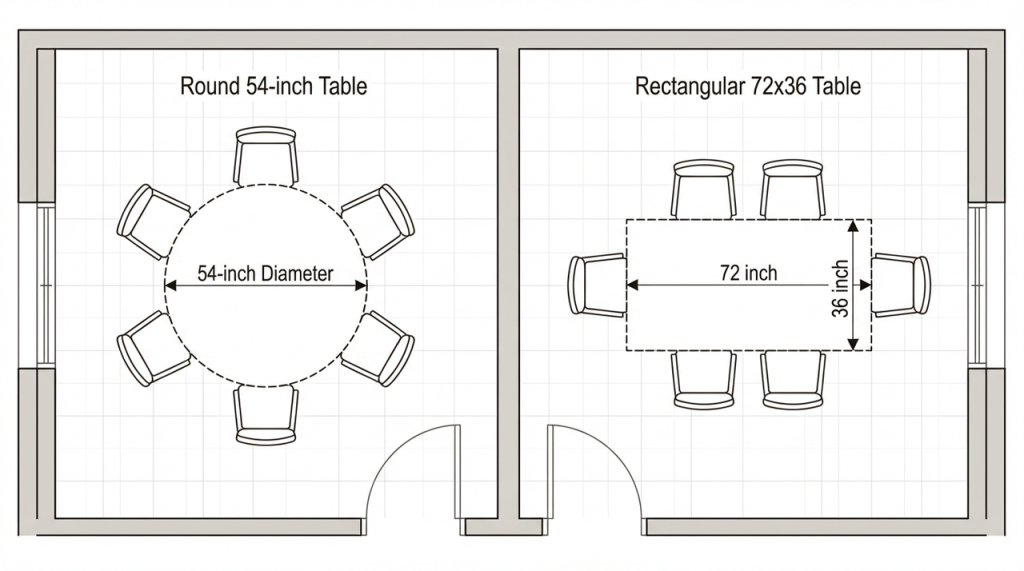
When you’re torn, tape out both shapes on the floor and try walking around them. Your feet will tell you which one works before your eyes do.
3 Layout Examples (With Diagrams)
Let’s put this into real-life context. Here are three common layouts for a dining table set for 6 and how the space usually shakes out.
Open Floor Plan
In an open living–dining–kitchen space, the dining area often has to share traffic flow with everything else.
What tends to work best:
- A rectangular 72″ x 36″ or 72″ x 40″ table
- Long side running parallel to the sofa or kitchen island
- At least 42″ of clearance on the “main walkway” side
Use a rug that’s big enough so chairs stay fully on the rug even when pulled out. It visually anchors the dining zone so it doesn’t feel like your table is floating in no-man’s-land.
Dedicated Dining Room
If you’re lucky enough to have walls around your dining area, you get more freedom.
Great options:
- Oval or rectangular 72–78″ table centered under a light fixture
- Round 54–60″ table if the room is closer to square
Keep at least one side a little more open for serving and for easy access to any storage you use for dishes or table linens. For more inspiration, check out these dining room ideas from statement wallcoverings to nontraditional tables.
Kitchen-Adjacent
This is the breakfast-nook situation, maybe a bay window or a small area just off the kitchen.
For these tighter spaces:
- A round 54″ table or oval 72 x 42″ table usually fits better
- Consider one side with a bench up against a wall or window
- Leave your widest clearance on the side facing the kitchen so you can move hot food safely
In these spaces, light colors and slimmer chairs can make everything feel a little more open, even when square footage is limited.
Material & Durability Guide
Size and layout are one thing, but if you’ve got kids, pets, or both, you also care about what the table is made of.
Solid Wood vs Sintered Stone
For a hard-working family table, you’ll most often be choosing between solid wood and sintered stone tops.
Solid wood
- Warm, classic, and easy to live with
- Can usually be refinished or touched up over time
- Dings can become “character” rather than disasters
Look for hardwoods like oak, ash, walnut, or maple. They’ll handle daily use better than softwoods like pine.
Sintered stone
- Extremely heat- and scratch-resistant
- Doesn’t stain easily (great for red wine, tomato sauce, and kid experiments)
- Has a sleeker, modern look
If you’re rough on furniture and don’t want to worry about coasters, sintered stone is a very low-maintenance choice.
Scratch Resistance
Whether it’s a dog’s claws on the bench, kids doing assignments directly on the table, or someone dragging plates around, your table will take hits.
To keep your sanity:
- Check if the finish is matte or satin (glossy finishes show scratches more)
- Look for terms like “scratch-resistant finish” or “high-performance top coat”
- For wood, a slightly textured grain hides everyday wear better than a perfectly smooth surface
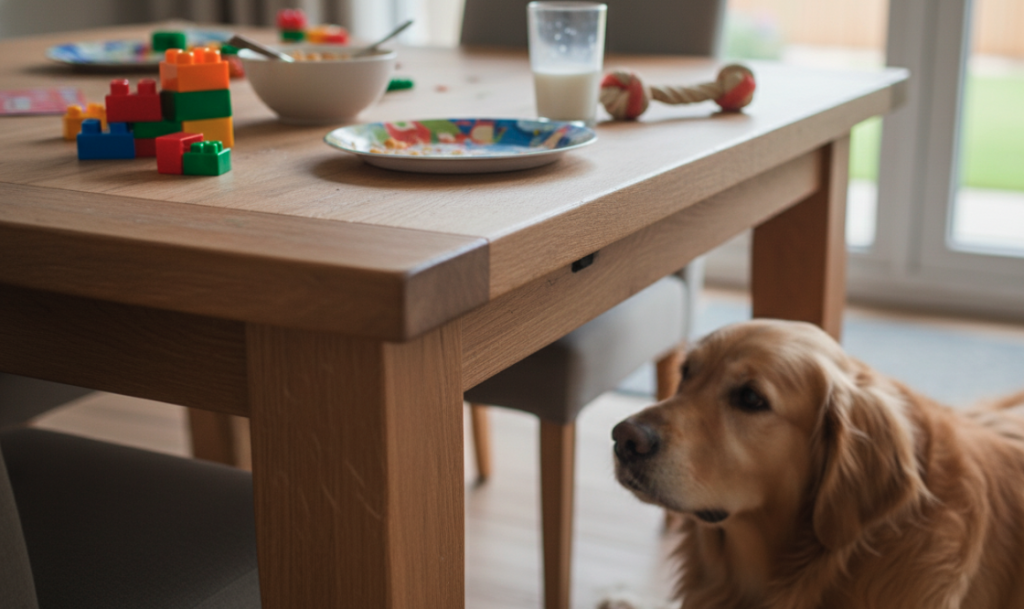
If you’re willing to invest a bit more upfront, a durable material and finish will save you from replacing your table every few years, and that’s where the real value shows up.
If you remember nothing else, remember this: measure your room, respect that 36-inch clearance, and give each person around 24 inches of space. Do that, and your dining table set for 6 will actually work for real life, not just staged photos.
The Verdict: Buy or Pass?
Buy this size and setup if…
- You have at least a 10′ x 10′ area and can keep around 36″ of clearance
- You want space for family-style meals and assignments/projects
- You care about durable materials that won’t fall apart in a year
Re-think or pass if…
- Your space forces you under 30″ of clearance on multiple sides
- You regularly host 8+ people (you may want a larger table or extendable option)
- You prefer bar-style seating or eat mostly at an island
Frequently Asked Questions
What size room do I need for a dining table set for 6?
For a comfortable dining table set for 6, aim for a minimum room size of about 10′ x 10′ (around 3 x 3 meters). This allows you to keep roughly 36 inches of clearance around the table so people can pull out chairs and walk behind them easily.
What are the ideal dimensions for a rectangular dining table set for 6?
A great starting size for a rectangular table for 6 is 72″ long by 36″ wide. This gives each person about 24″ of elbow room on the long sides and enough depth for plates on both sides plus a runner or small serving dishes down the middle.
How much space should I leave around a dining table set for 6?
Try to keep at least 36 inches (3 feet) of clearance from the edge of your table to the nearest wall or large furniture. This makes it easy to pull chairs out, walk behind seated guests, and move hot dishes safely. You can dip to 30 inches on one tighter side if needed.
Is a round or rectangular table better for seating 6 people?
Both work, but they feel different. A round or oval table is best for single, shared conversations and softer edges, great for kids. A rectangular table fits narrow rooms and aligns better with walls and rugs. For 6, look at 54–60″ round or about 72″ x 36″ rectangular.
What is the best table material for families with kids and pets?
For a family-friendly 6 seater dining table, solid wood and sintered stone are top choices. Solid wood is warm, repairable, and ages well, while sintered stone is extremely heat-, stain-, and scratch-resistant. In busy households that don’t want to worry about coasters, sintered stone is especially low-maintenance.
Past Review:


