 By Charles
Have you ever stared at your tiny living room in December and thought, “Where on earth is the tree going to go this year?” When you’ve got a Christmas tree, a small living room, kids’ toys, pet beds, and a couch that already feels too big, holiday decorating can feel like a puzzle with missing pieces.
The key to 2025 holiday styling is prioritizing the “tree footprint.” A standard traditional tree requires a 40–50 inch diameter, but by switching to a slim or pencil tree, you can reclaim up to 60% of that floor space without losing the festive impact. Let’s walk through how to make room for the holidays without sacrificing your walking space, your storage, or your sanity.
The Verdict: Buy or Pass?
- Buy a slim, pencil, or tabletop tree if you’re short on floor space but still want a full holiday vibe. A 6-foot pencil tree usually has a base diameter of only 20–22 inches.
- Pass on giant, wide traditional trees unless you’re ready to rearrange half your living room and play obstacle course all December.
- Buy trees with built-in LED lights to eliminate the bulk of extra extension cords and tangled wires in tight corners.
- Pass on top-heavy trees that lack a weighted metal base, especially in high-traffic households with pets or toddlers.
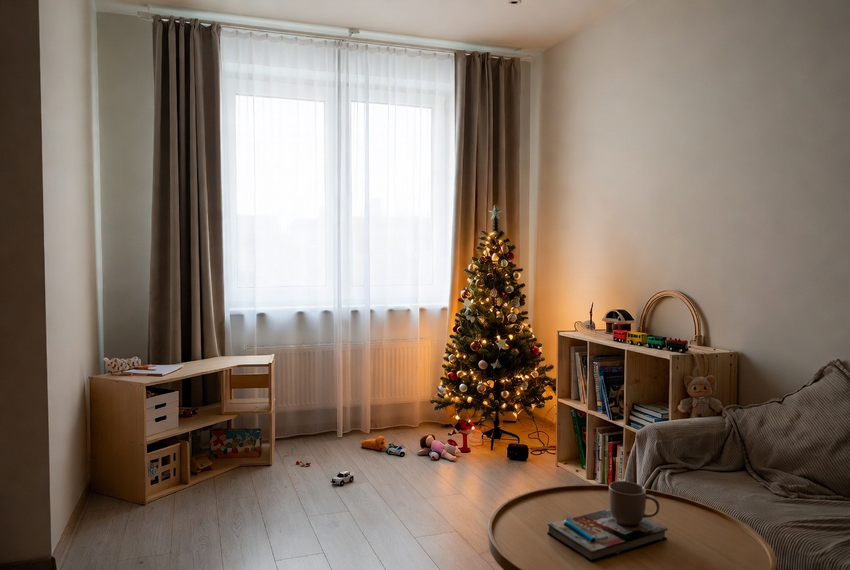
How Do You Overcome Layout Limits in a Small Living Room?
Before you drag a box out of storage and start moving furniture like a human forklift, it helps to zoom out and look at your living room like a floor plan. For additional inspiration on maximizing your space, check out these small living room ideas that work year-round.
How to Map Your Traffic Flow for a Zero-Obstacle Layout? Your first priority isn’t where the tree will look cutest, it’s how you actually move through the room every day. To maintain safety and flow, you need at least 30–36 inches of clear walking space in main “traffic lanes.” You want to be able to:
- Walk from the door to the sofa without sideways shimmying.
- Open doors and drawers fully.
- Let kids and pets zoom around without taking out the tree.
What is the Ideal Christmas Tree Footprint for Your Space? Instead of thinking “I have a small living room,” target a specific footprint. For most apartments, a 24–30 inch diameter is the “sweet spot.” Take two quick measurements:
- Width: How far out can a tree come from the wall before it blocks a walkway? (Target 18–24 inches for ultra-narrow spots.)
- Height: Measure from floor to ceiling and subtract 6–12 inches for the tree topper to avoid a cramped, “ceiling-heavy” look.
This precision ensures you are shopping for a pencil tree (18–22″ diameter) or a slim tree (24–28″ diameter), rather than a full-profile tree (45–50″ diameter). Switching to a pencil tree can save you approximately 5.5 square feet of floor area.
Where are the Most Space-Efficient Spots for a Christmas Tree?
Once you know your realistic footprint, you can get strategic. Here are the best spots that work with small living rooms instead of fighting them.
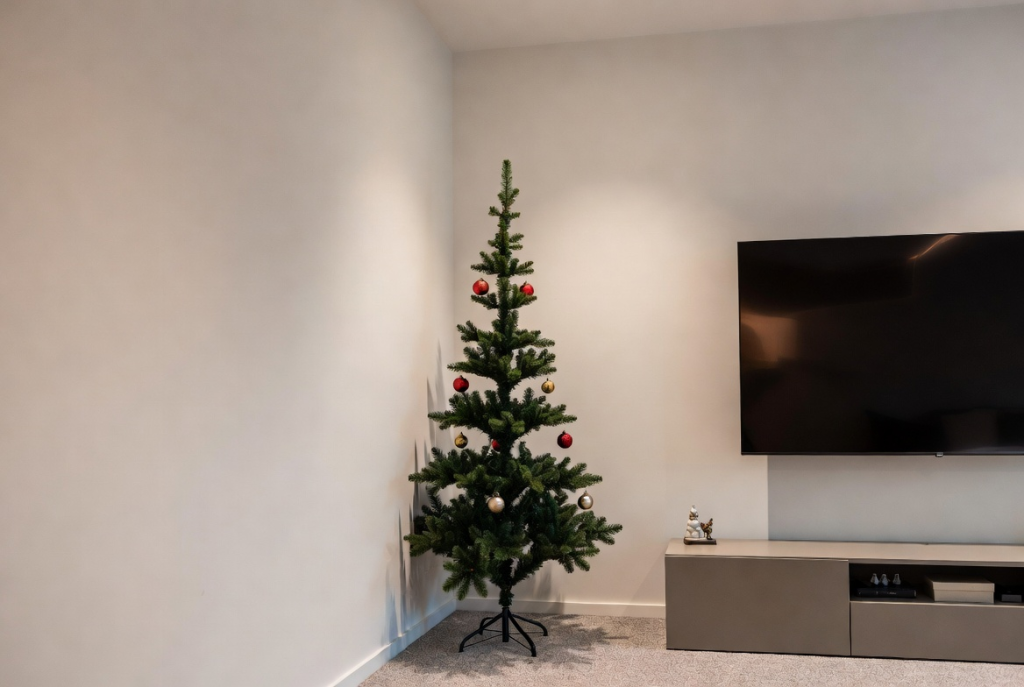
1. The “TV-side” corner
If your TV is centered on a wall, the corner to the left or right often becomes accidental dead space. A slim tree there balances the TV visually and stays out of main traffic paths.
The Fix: Pairing Your Tree with the Right TV StandIf you’re squeezing a tall pencil tree next to your TV, a standard-height, bulky cabinet will make that wall look cluttered and “heavy.”Go low to go high. Pairing a tall, slim tree with a Low-Profile Media Console creates a visual “high-ceiling” effect.
- The Logic: The long, horizontal lines of a low console balance out the vertical lines of the pencil tree.
- The Storage Hack: Look for a model with closed doors to hide all the extra extension cords and timer plugs that come with holiday lighting.
2. Behind or beside the sofa
If your couch floats even a little off the wall, there’s often 8–12 inches of unused space back there.
- Slide the sofa forward 4–6 inches.
- Tuck a pencil tree behind one arm.
The Upgrade: The “Best Seat in the House” PivotIn a tight layout, you often lose the perfect viewing angle—you’re either facing the TV or facing the tree.Replace a static armchair with a Swivel Accent Chair.
- Why it’s a holiday hack: It lets you pivot 90 degrees to watch a movie, then swivel back to admire the tree lights or chat with guests, all without dragging furniture across your scratched floors.
- Small Footprint: Swivel chairs typically have a smaller base than recliners, saving you those critical few inches needed for the tree branches to spread out.
3. By the window (if you have curtains that cooperate)
A small tree in front of a window looks festive both inside and from the street. Just make sure:
- Curtains can still open and close.
- Baseboard heaters or radiators aren’t blasting the tree.
- There’s still a clear route to open the window in case of emergency.
4. The entry “landing zone”
If your living room opens straight from the front door, you might have a little entry nook with a bench or shoe rack. Swapping that bench for a tabletop tree on a sturdy console gives you sparkle without surrendering the whole room. Consider using shoe storage solutions that are more compact to free up this valuable entry space.
How Should You Arrange Furniture to Prepare for the Holidays?
Before the tree goes up, you’ll want to give yourself a clean slate, without turning your house into a storage unit.
Swap bulky furniture for smarter pieces
Don’t just move furniture—upgrade it to solve the “Christmas Squeeze.”
Let’s be real: In a small living room, a 7-foot tree usually means sacrificing your coffee table. But you still need somewhere to put your hot cocoa.
The Solution: The “Space-Saver Swap”Instead of a giant rectangular slab, switch to Povison’s Nesting Coffee Tables.
- Why it works for Christmas: When the tree goes up and space gets tight, you simply tuck the smaller table underneath the larger one to reclaim precious floor area.
- When guests arrive: Pull them apart instantly to double your surface area for drinks and gifts.
- Kid-Safe Bonus: Their rounded edges mean fewer bruised shins when the kids are running circles around the tree.
Create a “no-tip” zone
If you have toddlers or pets, plan your layout so the tree isn’t right next to:
- The main wrestling/play zone.
- The door kids burst through when they get home.
- The dog’s usual running path.
If you can’t avoid it, at least keep the tree base tucked behind a heavier piece like the sofa arm or TV stand so it’s harder to knock over.
Expert Picks: Top Slim, Pencil & Tabletop Christmas Trees for Small Living Rooms
You can make almost any layout work if you pick the right kind of tree. Think of this as choosing the right tool for the job, not the biggest, but the smartest.
Slim & pencil trees (for corners and sofa-sides)
Look for:
- Diameter under 30 inches at the widest point.
- Pre-lit branches, so you’re not spending an hour untangling lights.
- A sturdy metal base (bonus points if you can weigh it down).
These trees give you the classic floor-to-ceiling look without stealing half your living room. They’re perfect if you’re working with that TV-side corner or behind-the-sofa setup.
Tabletop trees (for consoles, cabinets, and window ledges)
If your living room is truly tight, a tabletop tree can still feel magical. To keep it from looking like an afterthought:
- Go for 24–36 inchestall so it has presence.
- Park it on a solid console or cabinet, not a flimsy side table.
- Use a simple color palette (like warm white lights and 1–2 ornament colors) so it looks intentional, not cluttered.
Materials and durability to watch for
Since you’re decorating in a high-traffic space with kids and pets, prioritize:
- Hinged branches instead of cheap “hook-in” ones that fall off when brushed.
- Flame-retardant PVC or PE for peace of mind.
- Weighted bases so the tree can survive an excited kid or a curious cat.
You’re aiming for the same philosophy you use for everyday furniture: something that looks good but can take a beating, like the solid wood, pet-friendly pieces you’d find in a pet-friendly furniture guide rather than bargain-bin fast furniture.

Maximizing Floor Plan: Space-Saving Hacks with a Christmas Tree in a Small Living Room
Once the tree is in, it’s all about keeping the room usable and calm instead of chaotic.
Use vertical space like a pro
When floor space is limited, you decorate up, not out:
- Hang stockings on a wall-mounted shelf or media unit instead of needing a full mantel.
- Use wall hooks for garlands instead of bulky stands.
- Add a narrow, wall-hugging bookshelf or ladder shelf for decor instead of another side table.
Rethink the tree skirt and gifts
Traditional tree skirts can eat up precious floor space. In a small living room, try:
- A basket or low planter around the base to keep it visually tidy and compact.
- Stashing wrapped gifts in another room until closer to Christmas, then bringing out a few showpieces.
This keeps your main floor area open so you’re not stepping over presents every morning.
Cable management: the un-glamorous sanity saver
A beautiful tree plus messy cords is… less beautiful.
- Plug into an outlet that’s already part of your TV setup, and run the tree lights along the same path.
- Use simple cord clips or a cable raceway along the baseboard.
- If your current TV stand can’t hide cables at all, consider upgrading after the holidays to a closed-storage media console with cable cutouts (the kind you’d see in a guide to no-fuss, no-assembly TV stands).
In the end, the best christmas tree small living room setup is the one that lets you walk around barefoot, cup of cocoa in hand, without dodging branches, cords, or clutter.
You don’t need more square footage to get that. You just need a realistic tree size, a smart layout, and a few space-saving habits that respect how your family actually lives, not how a catalog thinks you live.
Frequently Asked Questions
What is the best type of Christmas tree for a small living room?
For a small living room, choose a slim, pencil, or tabletop Christmas tree. Aim for a diameter under about 30 inches, pre-lit branches to save time, and a sturdy, weighted metal base. These styles give you full holiday impact without blocking walkways or overwhelming the room.
Where should I put a Christmas tree in a small living room?
Top space-smart spots include the corner beside the TV (paired with a low-profile console), tucked behind a sofa, or in front of a window. Always keep main traffic paths and door swing areas clear.
How do I arrange furniture to fit a Christmas tree in a small living room?
Do a temporary “December shuffle.” Swap bulky coffee tables for nesting tables that can be tucked away. Replace static armchairs with swivel chairs to maximize viewing angles. Slide the sofa forward a few inches to create tree space behind one arm.
How can I decorate a Christmas tree in a small living room without making it look cluttered?
Focus on vertical impact and simplicity. Use a cohesive color palette (one or two colors plus warm white lights), skip oversized ornaments, and consider a basket or planter instead of a wide tree skirt. Keep gifts minimal around the base.
Is a real or artificial Christmas tree better for a small living room?
For most small living rooms, an artificial Christmas tree is more practical. Slim and pencil artificial trees are easier to size correctly, shed less, and can be pre-lit. They’re also lighter to move when rearranging furniture and generally safer in tight, high-traffic spaces with kids and pets.


[…] Dining Table Setup for Dinner: A Complete Guide How to Fit a Christmas Tree in a Small Living Room How to Arrange Your Living Room for Christmas Gatherings Share on […]