 By Stephanie
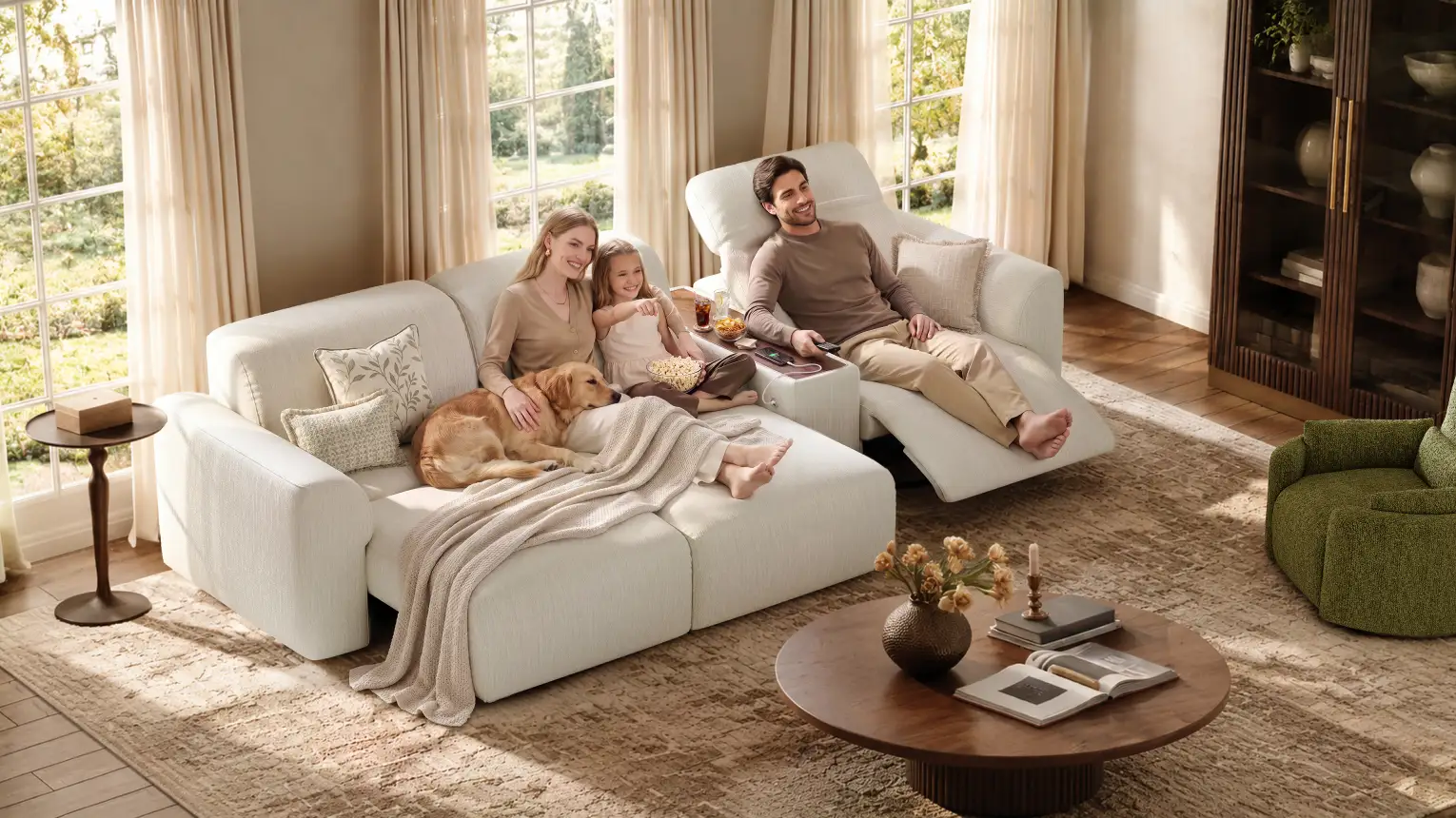
Choosing a sofa involves more than deciding whether its cushions feel soft or firm. Sofa cushion foam density helps indicate how much material is packed into the seat and how well it may retain its shape over time. This guide explains how to read PCF ratings, compare density with firmness and support, and evaluate cushion construction before buying. You’ll also learn which specifications to check when a product listing uses broad labels such as “high-density foam.”
Table of Contents
What Does Sofa Cushion Foam Density Actually Tell You?
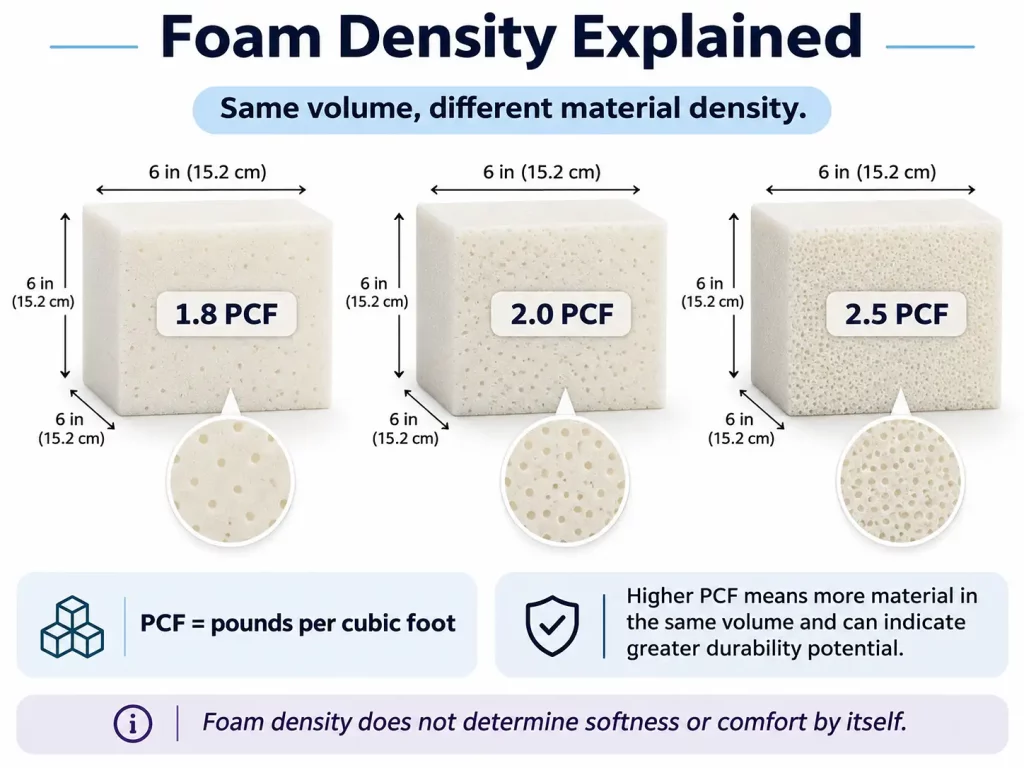
Foam density measures the mass of a foam material per unit of volume. In the US furniture industry, it is commonly expressed in pounds per cubic foot (PCF). A foam rated at 2.0 PCF weighs two pounds per cubic foot, while a 2.5 PCF foam contains more material within the same volume.
For flexible polyurethane seat foam, polymer density is primarily an indicator of durability potential, not a measure of how soft or firm a cushion feels.
The Polyurethane Foam Association (PFA) cites industry research indicating that conventional, unfilled polyurethane foams with polymer densities of 1.8 PCF or higher generally perform better in seating applications than lower-density foams. For specification purposes, polymer density is more useful than total density that includes fillers or reinforcements.
What Density Foam Is Best for Sofa Cushions?
For an everyday sofa seat cushion made with conventional, unfilled flexible polyurethane foam, a polymer density of at least 1.8 PCF is a useful reference point. Buyers seeking more demanding seating performance can compare higher-density options, but should also consider firmness and support specifications rather than automatically choosing the highest number.
The following table helps put common density figures into context.
| Example Foam Density | How to Interpret It | What Buyers Should Consider |
| Below 1.8 PCF | Below the commonly cited seating benchmark | Check the intended application and available performance data. |
| 1.8 PCF | An industry-supported reference point for seating | A useful starting specification, not a quality guarantee. |
| 2.0 PCF | Higher polymer density than 1.8 PCF | Compare firmness, support factor, and foam formulation. |
| 2.5 PCF | Higher polymer density than 2.0 PCF | Consider whether the additional density provides value for your usage needs. |
For everyday seating, consider these situations:
- Main living room or family-room sofas: For seats used several hours a day, prioritize a documented foam density, suitable firmness, and adequate support under deeper compression. Pay particular attention to the seats that receive the most frequent use.
- Guest room sofas: If the sofa is used occasionally, you may not need to pay extra for the highest-density specification available.
- Deep-seat lounge sofas: Check both the foam’s support characteristics and the cushion’s construction. A generous seat depth does not automatically mean the cushion can support your body comfortably.

Foam Density vs. Firmness: What Else Affects Comfort?
Foam density and firmness describe different aspects of cushion performance. Use the following specifications together to understand how a cushion feels when you sit down and how it responds under continued pressure. That’s why high-density foam for sofa cushions can still feel soft, while lower-density foam can be made firmer.
| Property | What It Measures | What It Tells Buyers |
| Density | Mass per unit volume | Material quantity and durability potential |
| IFD/ILD | Force needed to compress foam by 25% | Initial firmness |
| Support Factor | Ratio of 65% IFD to 25% IFD | Resistance to deeper compression |
| Resilience | Foam’s springiness and recovery | How responsive the cushion feels |
Your preferred sitting experience should guide the combination:
- If you prefer a plush surface, look for a softer IFD specification with an adequately supportive foam core.
- If you prefer a firmer seat, compare IFD ratings rather than assuming higher density means greater firmness.
- If you tend to sink too deeply into a cushion, ask about support factor and the foam’s resistance to deeper compression.
If an existing sofa feels too soft, the issue may involve its original firmness specification or worn cushioning rather than density alone. The appropriate way to make sofa cushions firmer without replacing them depends on identifying which part of the seat needs attention.
How Does Cushion Construction Change the Sitting Experience?
To understand why sofas with similar PCF ratings can feel different, look at how their cushions are constructed. Seat and back cushions serve different functions, while the foam core, surrounding layers, and seat suspension work together to shape the sitting experience.
Seat Cushions and Back Cushions Have Different Needs
Seat cushions carry most of the body’s weight and experience repeated compression throughout the day. Their foam cores therefore need to balance durability, firmness, and deeper support.
Back cushions have a different job. They help the upper body settle into a comfortable position, so their construction may prioritize softness, contouring, and shape retention. Depending on the design, they may contain softer foam, polyester fiberfill, or a combination of materials.
When comparing sofas, evaluate seat and back cushion specifications separately. A single foam density rating may not describe the construction of every cushion.
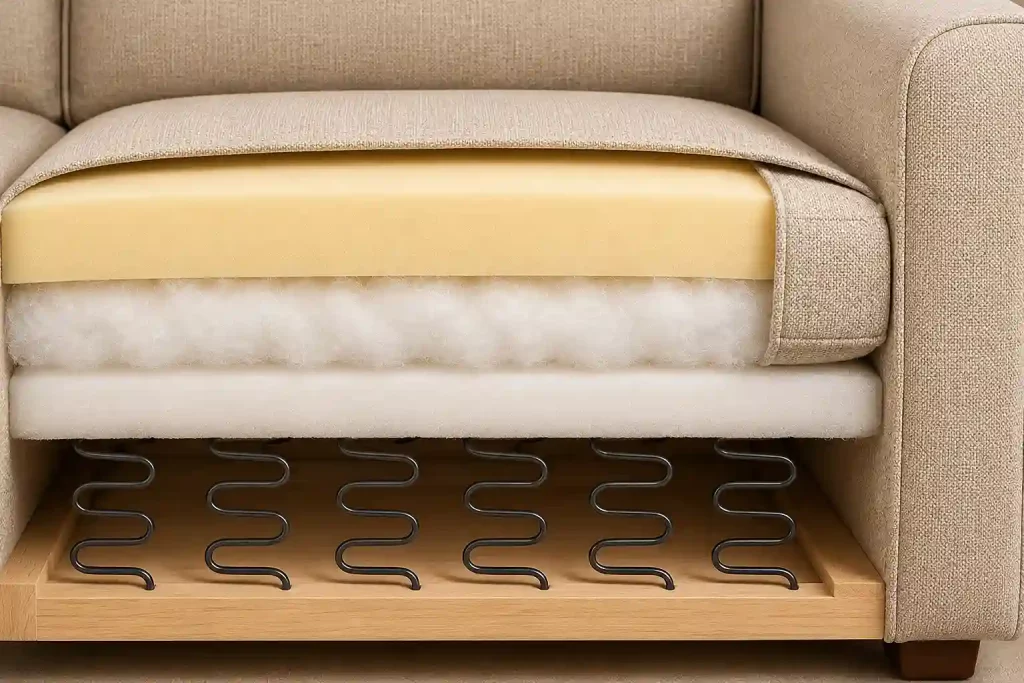
Foam Cores, Comfort Layers, and Suspension Work Together
Several components contribute to how a sofa feels:
- Foam core: Provides the main cushioning and support.
- Comfort layers: Softer foam or other cushioning materials can improve the initial surface feel.
- Fiber wrap or batting: Adds fullness, softens the cushion’s surface feel, and smooths its edges without changing the foam core’s PCF rating.
- Seat suspension: Springs or webbing beneath the cushion help distribute weight and support the seating surface.
An Electric Sofa Bed Alternative to a Fixed-Depth Sofa
Even well-constructed cushions cannot make a fixed seat depth suit every posture. For households that alternate between upright sitting, stretching out, and hosting overnight guests, an electric sofa bed addresses a different part of comfort by combining adjustable seating with a sleep function. Compared with manual sleeper sofas, its powered mechanism makes switching between seating and lounging positions easier, with less physical effort.
The POVISON Aurora Power Sofa Bed pairs high-resilience foam cushioning with one-touch lounge, recline, and sleep modes. Its powered seat-depth adjustment lets you extend the seating area for lounging without manually rearranging cushions. This gives households more flexibility when switching between everyday seating and relaxed positions. The product page does not disclose a PCF rating, so its high-resilience foam should not be treated as proof of a particular density.

Aurora Power Sofa Bed
A practical option for households that want more room to lounge without committing to a permanently deep seat.
How to Evaluate Sofa Cushion Foam Before Buying
Product listings vary in how much detail they provide. A useful comparison is not simply which sofa has the larger PCF number, but whether each manufacturer is describing the same foam component and supplying enough performance information to interpret it.
Before choosing a sofa, use the following checklist.
1. Confirm What the Density Rating Describes: Check whether the stated PCF applies specifically to the seat cushion’s foam core, rather than the entire cushion. If the listing does not identify the measured component, ask the manufacturer before comparing it with another sofa.
2. Compare Like-for-Like Specifications: Compare ratings only when both listings describe the same type of foam and use the same density basis. Do not rank conventional polyurethane foam against specialty or filled foam by PCF alone.
3. Ask for Firmness and Support Information: Ask for the 25% IFD and support factor if they are not listed. Use these figures to compare the firmness and deeper support of similar seat foams.
4. Look for Durability Information: Ask whether the manufacturer has flex-fatigue test results or other performance information showing how well the foam retains its firmness and height after repeated use. Also check what the warranty covers.
If one listing specifies 2.2 PCF seat foam while another only says “high-density foam,” treat the first as more transparent, not automatically better. Ask the second manufacturer for a comparable seat-foam rating before deciding which sofa offers better value.
If your current sofa has developed permanent cushion dents, our guide to fixing sagging couch cushions covers the repair options.

Compare More Than Foam Density
Explore flexible seating that supports everyday lounging and accommodates overnight guests.
Q&A
Can PCF Tell Me How Long a Sofa Cushion Will Last?
No. PCF measures foam density, not years of service. Two cushions with the same PCF can wear differently, so use durability test results and warranty terms rather than the density number alone to estimate long-term performance.
Does Foam Density Determine a Sofa’s Weight Capacity?
No. PCF describes the foam, not the sofa’s structural load limit. Check the manufacturer’s per-seat capacity, which depends on the frame, joints, legs, and seat support system.
Is Foam Density the Same as Cushion Thickness?
No. Density is mass per unit volume, while thickness is the height of the foam insert. A thick cushion can use lower-density foam, so compare both specifications rather than using one to infer the other.
Is a Higher Support Factor Always Better for a Sofa Cushion?
Not necessarily. A higher support factor indicates greater resistance as foam is compressed more deeply, but it does not guarantee a more comfortable seat. Compare it with the IFD rating and your preferred sitting feel.
What Is Compression Set in Sofa Foam?
Compression set measures how much a foam sample remains deformed after being compressed and allowed to recover. A lower result generally indicates better recovery under the specified test conditions. Ask which test method was used.


[…] sectional can easily last 7–10 years or more of daily use. Lifespan depends on frame materials, cushion density, and how well you care for it—regular vacuuming, prompt stain treatment, and occasionally […]
[…] design. The hardwood frame and legs can well support heavy people and the elastic and cozy cushion of high density sponge won’t make you sit uncomfortably. The combination of black and brown colors, and the […]