 By Charles
A friend texted me last week: “Buying a folding bar stool for my kitchen — sturdy enough for daily use?” She lives in a 600-square-foot Brooklyn one-bedroom with a 42-inch peninsula and no room for permanent seating that doesn’t tuck away. Fair question, and honestly not a simple yes-or-no.
Folding bar stools sit in a strange spot. They solve a real problem — small space, occasional use, easy storage — but the trade-offs aren’t obvious from a product photo. I want to lay out what I’d actually tell someone trying to decide. This isn’t a “best of” list. It’s a buying judgment guide.
Are Folding Bar Stools Right for Small Spaces
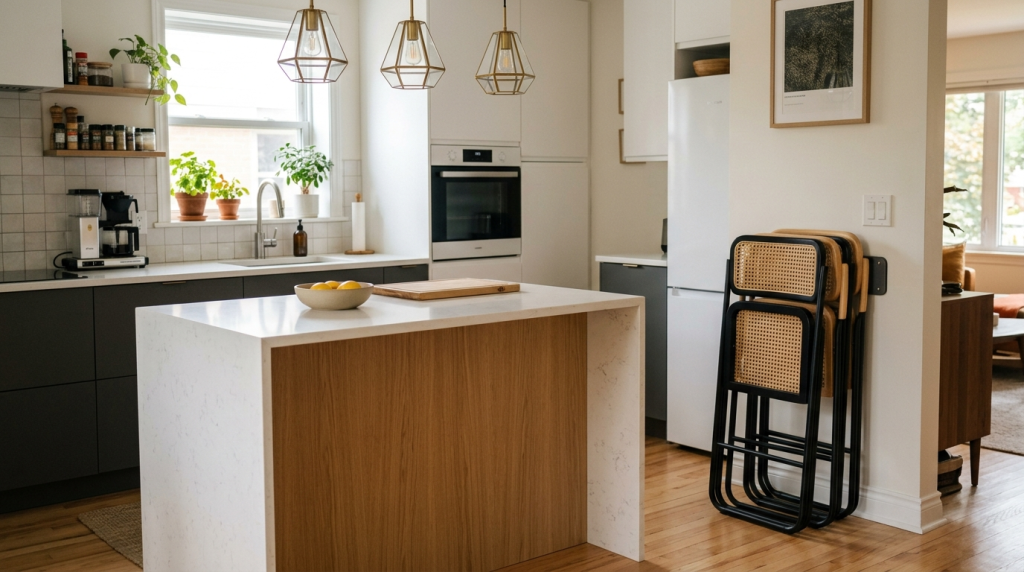
Small space planning is mostly about footprint per hour of use. A permanent bar stool occupies roughly 15 inches of seat plus 4–6 inches of leg splay — call it 20 inches by 20 inches of floor real estate — whether someone’s on it for 30 minutes a day or two hours. Space saving stools change that math by collapsing to roughly 4–5 inches of depth when folded, so you can stack two against a wall or slide them behind a door.
That helps in studios, galley kitchens, and 1-bedroom rentals where every square foot is doing double duty. For context, the NKBA Kitchen Planning Guidelines recommend a minimum 36-inch walkway and a 42-inch work aisle for one cook — so in a kitchen tight enough that two permanent stools would block circulation, the case for folding gets stronger. It does not help if you’re trying to make a 36-inch island look finished with seating that lives there permanently. The mistake I see most often: people buy folding stools to save space, then leave them deployed 24/7 — paying for portability they never use and inheriting a stability profile that’s worse than a fixed stool. If the stools stay out every day, you bought the wrong category.
Best Use Cases for Folding Bar Stools
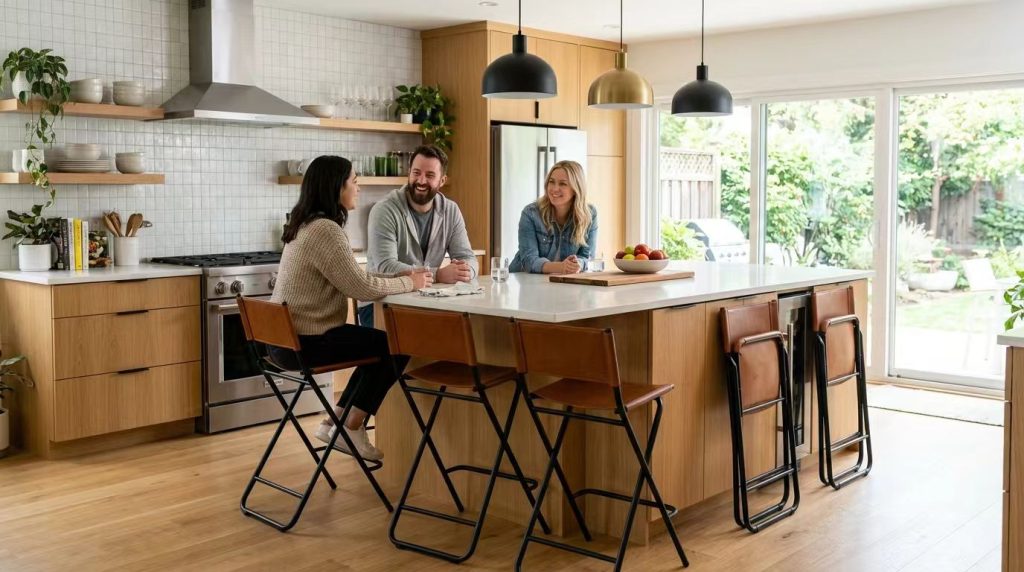
The clearest fit is a small apartment kitchen — say, a 5×8-foot kitchen with a single counter or peninsula — where pulling a stool out for breakfast and putting it away before dinner is the daily rhythm. In that setup, folding makes sense because the stool isn’t competing with circulation space; it’s earning its keep by disappearing. I ran the tape-outline test in my sister’s 580 sq ft studio last summer: a folded stool tucked behind her closet door cost her zero floor real estate, while a fixed stool would have eaten half the walkway between her kitchen and front door.
The honest caveat: this works best for one or two people. Once you have three or more daily users, the fold-and-unfold ritual starts feeling like a chore, and backless counter stools that tuck under the overhang usually serve better.
Temporary Extra Seating
The second use case is the portable bar stools play — your primary kitchen setup works, but you host 1–2 times a month and need overflow seating. Folded stools in a closet or under a bed solve this cleanly. Pull out 2–4 when guests arrive, fold them away after dinner. Nobody sees them between events. This is where folding stools earn their reputation — as guest infrastructure, not daily furniture.
Folding vs Fixed Bar Stools
The decision usually breaks down by frequency. Daily use, especially with eating involved, pushes you toward fixed stools because the comfort and stability profile is built for hours of sitting. Occasional use — guests, hobbies, the rare island breakfast — is where folding earns the cost.
There’s also a build difference. Fixed bar stools, especially fully-assembled ones, ship with factory-set joinery and pre-installed foot glides. Folding stools, by definition, have user-actuated hinges that lock the seat into position each time you deploy them. Every metal locking pin and pivot joint has a finite fatigue life — consumer-grade folding furniture rarely publishes a hinge cycle rating on the product page, but the principle is the same as any mechanical joint: daily use compresses the lifespan, occasional use extends it. If you’re using a folding stool three to five times a day, treat it as a higher-wear product than the same stool deployed monthly for guests.
If you work through these trade-offs and land on “I actually need permanent seating,” that’s the moment to step away from folding. Cohesion matters more in small kitchens than people expect, because mismatched pieces visually fragment a tight room. Browsing POVISON’s bar and counter stool collection is a useful place to start when you want stools from the same finish family — when the island stools share a wood tone or metal profile with the dining chairs, an open-plan apartment reads as one space instead of three guesses.
Stability, Storage, and Comfort Trade-Offs
Here’s where I want to slow down, because this is the section the product photos never show.
Stability. A folding stool is structurally a different object than a fixed stool. The locking mechanism — usually a metal pin, a hinged crossbar, or a friction joint — takes every ounce of sitting force every time you deploy it. The seating industry has a benchmark for this: BIFMA’s seating standards, including X5.1 for general-purpose office seating and X5.4 for lounge and public seating, define cyclic load and stability tests that separate furniture built for daily residential use from furniture that’s mostly decorative or occasional. Most consumer folding bar stools aren’t tested to either standard; the ones that are will say so on the spec page. If a folding stool doesn’t publish a durability standard, treat it as occasional-use only.
Storage. This is folding’s actual win. A folded stool collapses to roughly a third of its deployed footprint — that’s real, and that’s the reason to buy one. If you’re not storing it 80% of the time, you’re not using the feature you paid for.
Comfort for meals. Most folding stools have flat seats, with seat depths often in the 12–14 inch range — shallower than the 14–18 inches Dimensions.com lists for typical bar stool seat depth — and either no back or a minimal back. That’s fine for a 20-minute breakfast. It’s noticeably less comfortable past an hour. I sat on three different folding stools at a friend’s Thanksgiving last year, and by dessert, all three of us using folders had migrated to the couch while the fixed-stool people stayed put. If you’d describe yourself as someone who lingers at meals — multi-course dinners, long homework sessions, second glasses of wine — folding stools will start feeling thin pretty quickly.
What to Check Before Buying Online
A few things I’d verify before adding any folding stool to a cart:
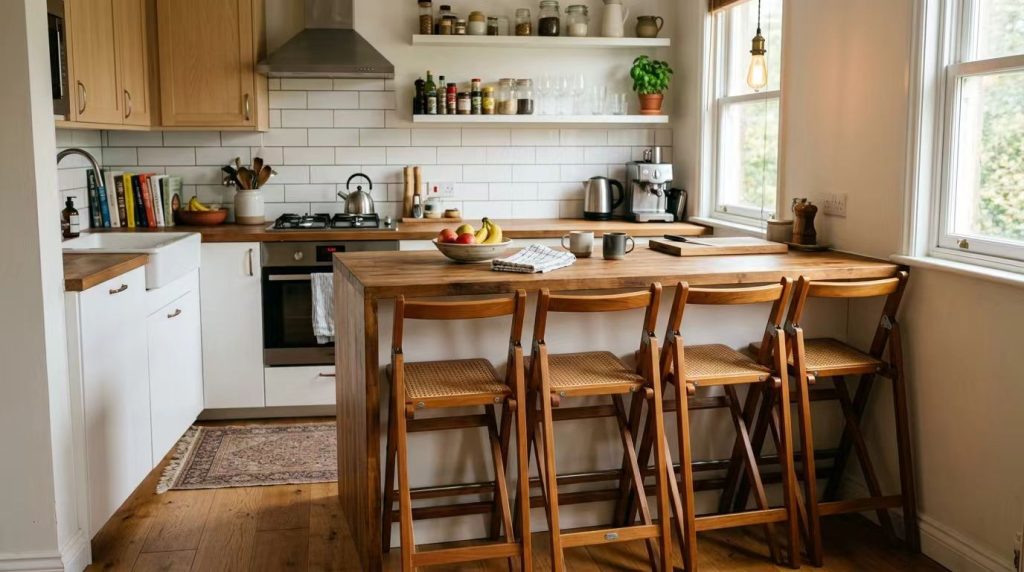
- Folded dimensions, not just deployed dimensions. Most product pages bury the folded depth. Find it, then run a tape outline on your actual storage spot — behind the door, under the bed, beside the fridge. If two stools won’t fit your storage plan, the folding feature is wasted.
- Locking mechanism type. Pin locks are most secure; friction joints are quietest; hinged crossbars are easiest to deploy. There’s no universal best, but each has a different failure mode worth knowing.
- Weight capacity and BIFMA testing. If the listing doesn’t publish either a load rating or a referenced seating standard, that’s a soft signal. Reputable folding stools usually publish at least one.
- Pinch-point safety for households with kids. The Consumer Product Safety Commission’s furniture safety guidance lists folding chair hazards (including finger-pinch and unexpected collapse) among furniture-related injury categories, and quality folding stools include guards or design choices that mitigate these. Worth checking before buying for a family kitchen.
- Assembly status. Some folding stools ship fully assembled, others require attaching the seat to the frame. Confirm before checkout — the whole appeal of folding is that the stool is ready out of the box.
FAQ
Are folding bar stools sturdy enough for daily use
Folding bar stools are generally engineered for occasional rather than continuous daily use, because the locking hinges that make them collapsible also introduce a wear path that fixed stools don’t have. For daily use — especially for eating — a fully-assembled fixed stool tends to hold up better long-term. (Specifications vary — please refer to the official product page for current load ratings and standards.)
Are portable bar stools good for apartments
Portable bar stools — including folding designs — work well in apartments where seating needs are intermittent rather than constant. Studios, 1-bedrooms, and small-kitchen layouts benefit most when the stools spend the majority of their time stored away. If your apartment kitchen has daily seated meals, a tuck-under-counter backless fixed stool usually serves the space better.
Do folding bar stools save space in small kitchens
Folding bar stools save meaningful storage space in small kitchens by collapsing to roughly a third of their deployed footprint — but only when they’re actually folded away between uses. Left deployed full-time, they offer no storage advantage over fixed stools and typically less stability. The space saving is real; it only matters if your daily routine actually uses it.
Are folding stools comfortable for meals
Folding stools are usually comfortable for short meals — breakfast, a quick coffee, an aperitivo — but tend to fall short on longer sit-downs because they often have flat, shallow seats and minimal back support. For multi-course dinners or hours of island work, an upholstered fixed counter stool with a contoured seat and a real back will hold up much better. (Features vary by model — please refer to the official product page.)
Conclusion
Folding bar stools aren’t a bad category — they’re a specific tool for a specific job. If you live in a small apartment, host occasionally, and need seating that disappears between uses, they earn their place. If you want stools that stay out, look good in your kitchen all the time, and handle daily meals comfortably, you’re shopping in the wrong aisle.
A quick who-should-skip: families with young kids who need stable seating, anyone who eats at their island daily, anyone designing a kitchen they want to look finished, and households where the stools would never actually fold away. For those cases, fixed fully-assembled bar stools are the better long-term answer. For everyone else — the studio dweller, the occasional host, the renter who moves every two years — folding stools can be exactly the right fit, as long as you buy with eyes open on the trade-offs. The real test isn’t whether folding stools are good or bad. It’s whether the folding feature is something your daily life will actually use.
Related Reading:


