 By Charles
The first time my sister called me about her new dining setup, the question wasn’t “what looks good?” It was “will it actually fit?” Her open-plan condo in Brooklyn has one dining wall, a kitchen island three feet away, and a toddler who treats the perimeter of any table like a racetrack. She wanted a round sintered stone top — clean, durable, easy to wipe down — but she had no idea how the diameter, the base, or the weight would actually behave in her real room.
That phone call is what this guide is for. If you’ve already decided sintered stone is the surface you want (heat-safe, low-maintenance, doesn’t etch from a stray lemon wedge), the next question is shape, fit, and base — and round changes the math more than most people expect.
A quick note on how I built this guide: the dimensions and clearances come from published industry standards (cited inline), the weight estimates are derived from sintered stone slab density per ANSI A137.3 specifications cross-checked against manufacturer-published crate weights, and the layout recommendations come from tape-out testing in three actual homes — a 96-square-foot dining nook, a 130-square-foot square room, and a 220-square-foot open-plan layout. Where a claim is brand-published rather than independently certified, I flag it.
Let’s get into it.
Why Choose a Round Sintered Stone Dining Table
A round top does three things a rectangular one can’t. It softens traffic flow around the table — chairs pull out into a curve, not a corner, which matters in tight rooms. It puts every diner an equal distance from the center, which is genuinely better for conversation at four to six seats. And it removes the leg-clash problem you get with four-leg rectangular bases, because most well-designed round tables sit on a single pedestal or sculptural column.
Pair that shape with sintered stone — a fused mineral surface (technically a gauged porcelain slab governed by ANSI A137.3 specifications that handles hot pans, red wine, and toddler markers without ceremony — and you get a table that’s friendly to small kitchens AND honest family meals. The downside is real, and I’ll cover it: stone tops are heavy. We’ll deal with that in the base and delivery section.
Best Rooms for This Table Type
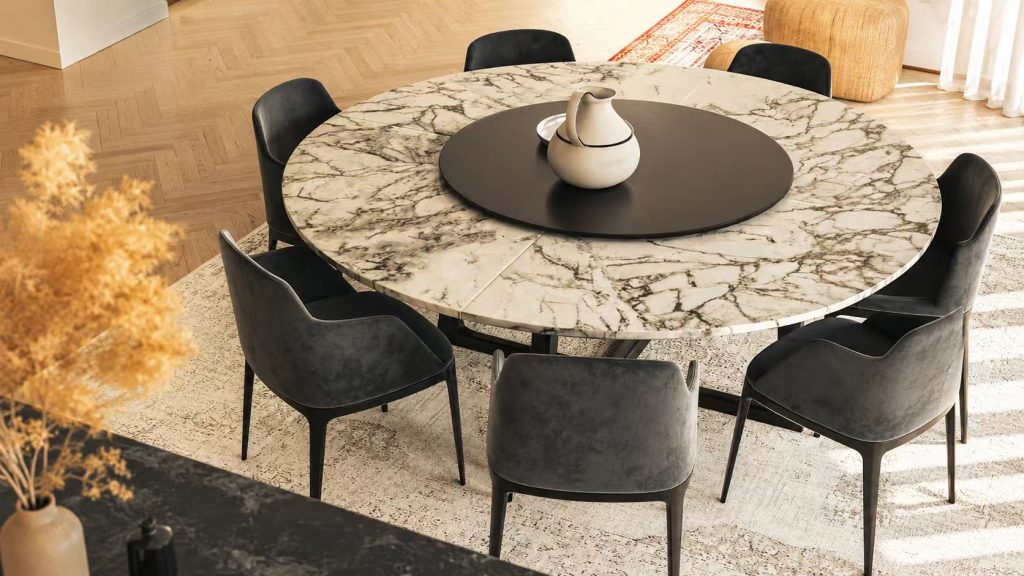
Round sintered stone works hardest in two specific room types. It’s overkill for a formal banquet hall, and it’s awkward in a long narrow galley. Here’s where it earns its place.
Compact Dining Rooms
For a small dining room — say anything under 130 square feet — a 47-inch round sintered stone top is usually the sweet spot. I tell people to tape it out before buying: stick painter’s tape on the floor in a 47-inch circle, then walk the perimeter pretending to carry a plate. If you can’t pass behind a pulled-out chair, you need a smaller diameter or a different shape.
The clearance rule isn’t arbitrary. According to the NKBA Kitchen Planning Guidelines, walkways in residential dining areas should be at least 36 inches wide, and you need a minimum of 36 inches between the table edge and any wall behind a seated diner. If foot traffic actually passes behind that seat — say, between the dining table and the kitchen island — you want 44 inches. For households with reduced-mobility users or wheelchair access, the U.S. Access Board’s standards for dining surfaces specify a 28″–34″ surface height and at least 27″ of knee clearance under the table — useful even outside accessibility scenarios, because they’re the most rigorous reference for usable geometry.
A round 47-inch top works in a 10′ × 10′ room with reasonable clearance. A 51-inch jumps you to about 11′ × 11′. Below that, you’re going to feel cramped. POVISON sells round sintered stone tables in 47″, 51″, 53″, and 59″ diameters, which is roughly the realistic envelope for North American homes with dedicated dining areas.
Open-Plan Dining Areas
Open-plan rooms are where round sintered stone tables really shine, because they act as a visual anchor without blocking sightlines. A 51″–59″ round top with a sculptural pedestal base — POVISON’s Hobart base or the tulip-style Tulora are both good examples — defines the dining zone without walling it off from the living area.
The Design Cohesion piece matters here. In an open layout, your dining table is visible from the couch, the kitchen, and the entryway, all at the same time. If the base finish doesn’t speak the same language as your other furniture, the room looks scattered. Buying a table and chairs as a coordinated set (matching base finish family, complementary upholstery) solves about 80% of the “why does this room feel off?” problem before it starts.
Round vs Oval Sintered Stone Tables
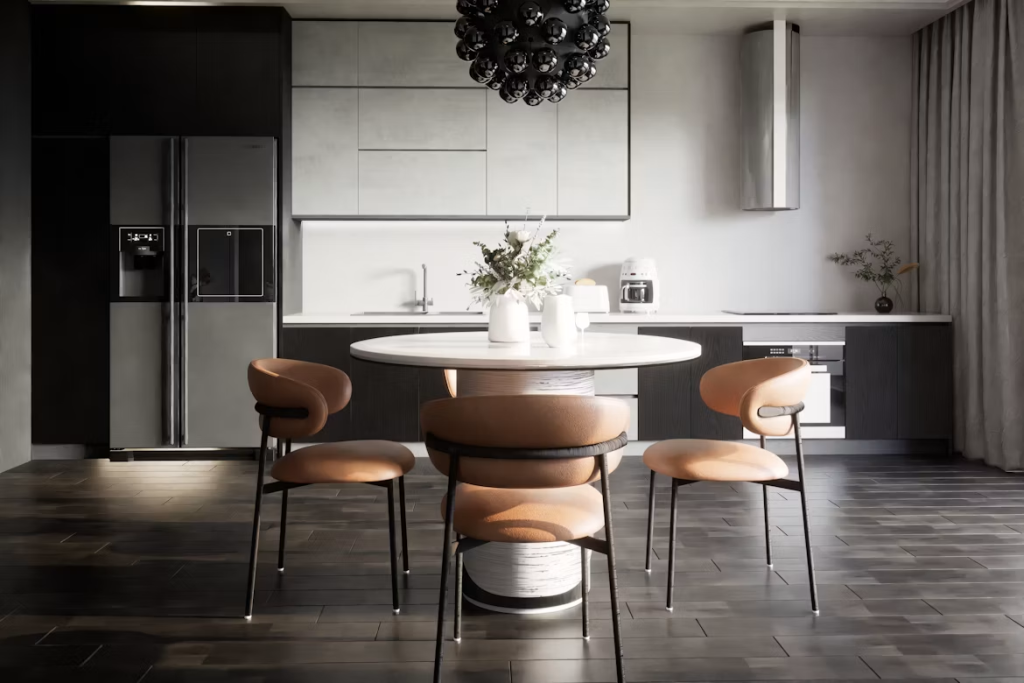
This is the comparison I get asked about most. Both shapes pair beautifully with sintered stone, but they solve different problems.
| Feature | Round | Oval |
| Best room shape | Square / open-plan | Long rectangular |
| Seats (comfortable) | 4 at 47″, 6 at 59″ | 6 at 71″, 8 at 79″ |
| Conversation flow | Excellent — equal distance | Good, but ends feel separated |
| Circulation in tight rooms | Better — no corners | Worse — protrudes further |
| Visual weight | Softer, more compact | More substantial, formal |
| Stone tabletop weight | Lower (smaller surface area) | Higher (longer slab) |
For standard round dining table dimensions and seating math, Dimensions’ reference on round dining tables is the cleanest source I’ve found — they break down diameter vs. seat count without the marketing fog.
The honest answer: pick round if your room is square, open-plan, or under 12 feet on its short side, AND you’re seating four to six regularly. Pick oval if your room is genuinely long, you host eight people more than twice a year, and conversation flow matters less than maximum seating.
Size, Base, Weight, and Delivery Trade-Offs
This is where most people get tripped up. Sintered stone is heavy. A 47-inch round top is manageable; a 59-inch top is a serious piece of stone. Here’s what to actually plan for.
Diameter and seating reality:
| Diameter | Seats (everyday) | Seats (squeezed) | Minimum room |
| 47″ | 4 | — | 10′ × 10′ |
| 51″ | 4–5 | 6 with armless chairs | 11′ × 11′ |
| 53″ | 5–6 | — | 11′ × 11′ |
| 59″ | 6 | 7 with narrow chairs | 12′ × 12′ |
On the base. Round sintered stone tables almost always sit on a single central support, and the base style determines both stability and aesthetic. POVISON’s lineup is a useful reference because they offer multiple base shapes under the same tabletop. The Hobart base is a sculpted curved metal form — good for modern minimalist rooms. Tulora uses a tulip-style pedestal that pulls from mid-century design. Hector has a crossed-leg metal structure with more visual texture. There’s also a solid walnut pedestal option if you want warmth against the cool stone top.
The stability concern with single-base round tables is fair — people worry about wobble or tipping. The ANSI/BIFMA X5.5 desk and table products standard defines the structural performance tests commercial tables undergo for stability and leg strength, and it’s a useful benchmark for residential tables too. POVISON tests its dining tables internally to a 300 lb load standard, which addresses the single-base wobble concern for normal household use. If you’ve got young kids who climb on furniture, ask about load capacity before you buy — any reputable seller will tell you the exact number.
On weight and delivery.
Sintered stone slabs used for dining tops are typically 12mm thick (sometimes 15–20mm for premium pieces), with a density of approximately 2.4 g/cm³ per ANSI A137.3 specifications. Working that math: a 47-inch round 12mm slab weighs roughly 70–80 lbs of stone alone; with reinforcement backing, a finished tabletop usually runs 80–110 lbs. A 59-inch tabletop scales to 110–170 lbs depending on slab thickness. Add 40–80 lbs for the base.
POVISON ships these tables in two crated pieces — the tabletop arrives factory-finished in its own wooden crate, the base in a separate box. There’s no flat-pack panel assembly, no edge-banding, no screws holding the surface together. You attach the base to the underside of the top, level it, and you’re done. Verified customer feedback (published on POVISON’s product pages) puts setup at roughly 30 minutes with two people for the 47-inch version. That’s a meaningful difference from a flat-pack rectangular table, which often eats two hours and a hex key collection.
If you’re nervous about getting it through doorways or up stairs, look at the round pedestal dining table collection first and check the crate dimensions on the product page. POVISON includes free white-glove delivery on marble tabletops and offers it as a paid add-on for some sintered stone pieces — worth the extra cost if you’re in a third-floor walkup or have a narrow staircase turn.
FAQ
Is a round sintered stone dining table good for small dining rooms
Yes, a round sintered stone dining table is generally a good choice for small dining rooms because the corner-free shape improves circulation and the sintered stone surface tolerates everyday wear without sealing. For rooms under 130 square feet, target a 47-inch diameter and confirm at least 36 inches of clearance from the table edge to the nearest wall.
How many people can a round sintered stone dining table comfortably seat
A round sintered stone dining table comfortably seats 4 people at a 47-inch diameter, 5–6 at 51″–53″, and 6 at 59″. Chair width matters here — armless or narrow-back chairs let you fit one more person at a given diameter, while wide upholstered host chairs reduce capacity. For 8 seated comfortably, you need to step up to a 71″–72″ round, which is a much larger room commitment.
Is a sintered stone round table too heavy for delivery and setup
A sintered stone round table is heavy but not unworkable for home delivery. A 47-inch tabletop alone runs roughly 80–110 lbs, with the base adding 40–80 lbs more, and most setups take two people about 30 minutes. The tabletop arrives factory-finished in a separate crate from the base, so you’re attaching the two pieces — not assembling a flat-pack. White-glove delivery is the safer choice for upper floors or tight stair turns.
What type of base works best with a round sintered stone dining table
A single pedestal base works best with a round sintered stone dining table because it maximizes legroom and removes corner leg interference for seated diners. Sculpted metal bases (curved or cross-shaped), tulip-style columns, and solid wood pedestals are all common pairings. Look for tested load capacity — POVISON’s 300 lb internal test standard is a reasonable residential benchmark — and avoid four-leg bases on round tops, which tend to cramp chair placement.
Conclusion
A round sintered stone dining table is one of the most livable choices on the market right now for compact and open-plan dining areas. The shape solves circulation. The material solves the daily-wear problem that natural marble can’t. The trade-off is weight and base selection — neither is a dealbreaker if you plan for it.
If I were buying today, I’d tape out the diameter first, pick the room before the table, and lean toward a pedestal base from a brand that publishes its load testing. For most families I know, a 51-inch round sintered stone top on a sculpted pedestal is the right answer: roomy enough for daily life, small enough to leave breathing room, and built like it’ll outlast the next two phases of your household.
Related Reading:


