 By Charles
Last month, a friend texted me a product listing for a sintered stone dining table. The page had five “resistant” claims in the bullets — scratch-resistant, heat-resistant, stain-resistant, UV-resistant, acid-resistant — and she wanted to know if any of it was true. Fair question. Sintered stone is one of the most over-promised materials in the dining table category right now, and most product pages won’t tell you the difference between resistant and proof.
This guide is the version of that conversation I wish I’d had on hand. We’ll walk through what a sintered stone dining table actually is, why families are picking it over marble and wood, how the three materials compare on numbers you can verify, and — most importantly — what performance claims you should ask a seller to back up before you spend $800 or $2,000 on a 200-pound slab that’s coming to your house in a wooden crate.
What Is a Sintered Stone Dining Table
Sintered stone is an engineered surface made by pressing natural mineral powders — quartz, feldspar, silica, sometimes clay — at very high pressure (around 15,000 tons of force on industrial presses) and firing them at roughly 1,200°C. The result is a dense slab that fuses into a single solid layer. No resins. No polymers. No surface coating doing the heavy lifting.
That last point matters. Materials like quartz countertops use roughly 7–10% resin to bind the minerals together, which is what limits their heat tolerance. Sintered stone uses heat and pressure instead, so the slab behaves more like fired ceramic than like a resin composite. It’s sometimes sold under brand names you may recognize from kitchen showrooms — Dekton, Neolith, Lapitec — but the underlying material category is the same.
For dining tables, sintered stone usually comes in 12mm slabs on the lighter end and up to 20mm on premium pieces. A 60-inch round in 12mm typically lands at 150–200 lbs total assembled, which is meaningful when we get to delivery and assembly later.
Why Modern Buyers Consider Sintered Stone
The honest answer: it solves three problems most dining tables don’t solve at the same time — daily wear, a clean modern look, and food safety in households with kids. Here’s where it shows up.
Everyday Family Dining
If you have kids under ten, a dog, or a partner who treats coasters as a suggestion, the math on a porous surface gets ugly fast. Sintered stone’s water absorption rate, when measured to the ISO 10545-3 water absorption standard, typically falls below 0.5% — the threshold that puts it in the “impervious” tile class. For comparison, marble can absorb 0.2–0.6% (varies dramatically by stone), and wood absorbs water continuously, which is why it warps and stains.
In practice, this means a glass of water sitting on the table for forty minutes during homework time doesn’t leave a ring. Pasta sauce sitting on the surface during the “I’ll get to it after dinner” stretch doesn’t soak in. That’s not me being sentimental about the material — it’s a function of how dense the slab is after sintering. The pores aren’t there to soak anything in. And because the slab is fired mineral with no resins or polymers, there’s nothing to off-gas — no VOCs leaching into the room, no surface coating to wear through. For households with toddlers who treat the table as a teething ring, that’s not a small thing.
Modern Open Dining Rooms
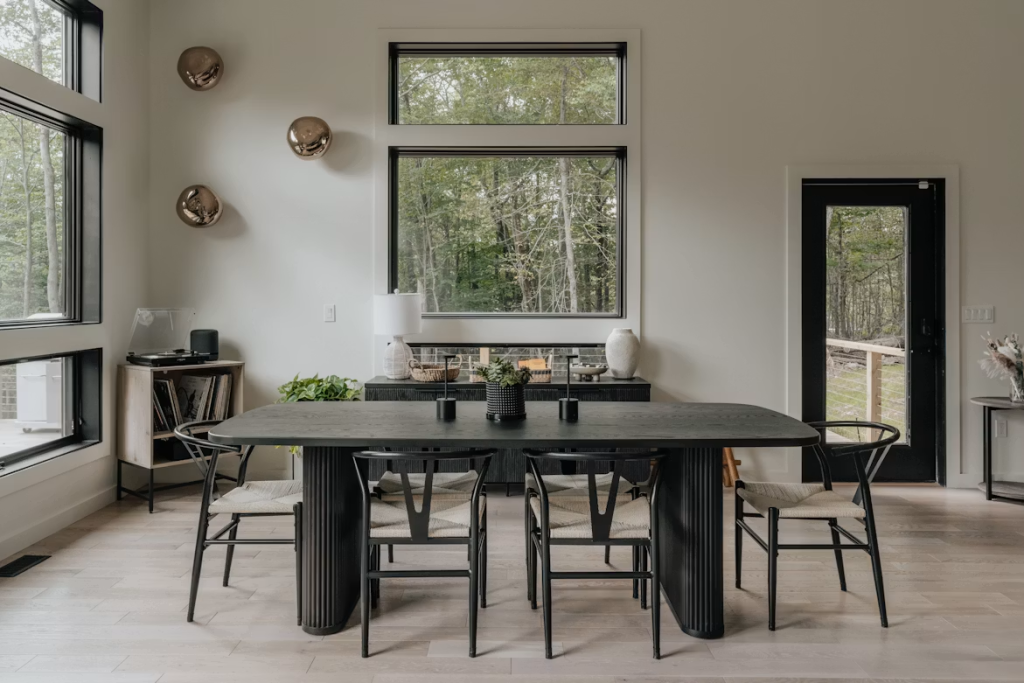
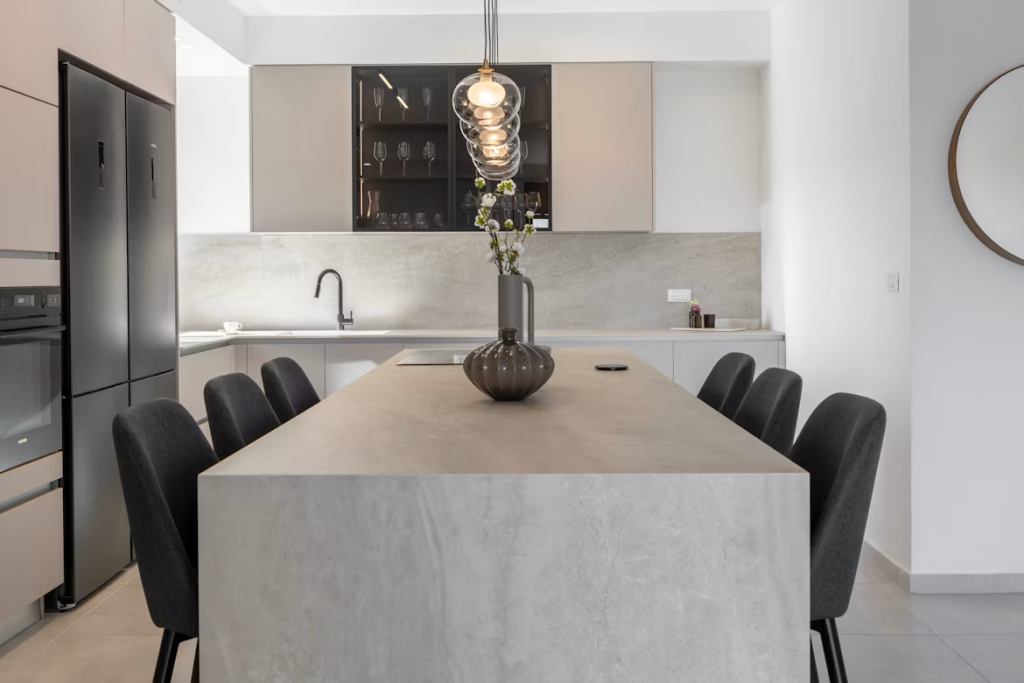
The other reason it’s everywhere right now is visual. Sintered stone holds large-format slabs without seams up to about 126″ × 63″. That means a 78-inch oval dining table can have a continuous top without the visible joints you’d see on quartz or some natural stone fabrications. In an open-plan dining room where the table is the visual anchor — sightlines from kitchen island to living room sofa, with the table sitting between — that uninterrupted surface reads cleaner. White, charcoal, and travertine-look finishes all sit confidently next to wood floors and matte-black lighting, which is most of the open-plan dining rooms I’ve walked into in the last year.
Sintered Stone vs Marble vs Wood
This is the comparison most buyers actually need. Vague descriptions are useless; here are the numbers and trade-offs side by side.
| Property | Sintered Stone | Natural Marble | Solid Wood (Oak/Walnut) |
| Mohs hardness | 6–7 | 3–5 | ~2.5 (Janka varies) |
| Water absorption | <0.5% | 0.2–0.6% | High (continuous) |
| Heat tolerance | Up to ~300°C / 570°F | Up to ~250°C / 480°F (but can crack from thermal shock) | Scorches above 200°F |
| Acid resistance | High (chemically inert) | Very low (etches from lemon, wine, vinegar) | Moderate (finish-dependent) |
| Refinishable | No (surface is fired-through) | Yes (can be re-polished by pro) | Yes (sand and refinish) |
| Typical 60″ round weight | 150–250 lbs | 250–400 lbs | 80–140 lbs |
| Care routine | Mild soap + water | Daily blot, pH-neutral cleaner, seal twice/year | Wipe spills, occasional oil/wax |
| Lifespan with normal use | 15–25+ years | 25+ years if maintained | 20–50 years (refinishable) |
A few things worth saying out loud about this table. Marble’s care requirements aren’t a marketing exaggeration — per the Natural Stone Institute’s consumer care guidance, calcareous stones like marble are sensitive to acids and require non-acidic cleaners plus immediate spill blotting. Sintered stone bypasses that chemistry entirely because the surface is essentially fused mineral, not reactive calcium carbonate. Wood, on the other hand, can be sanded back to new — a sintered slab with a deep chip cannot. Each material wins on something different. The job is matching the material to the actual household, not chasing the one with the most “resistant” labels.
Browsing POVISON’s dining tables collection gives you a side-by-side look at sintered stone, marble, and wood tops in the same shape and base styles, which makes the trade-off less abstract — you can see how a 70″ oval sits at the same footprint across three materials.
Cleaning, Heat, Scratch, and Stain Claims to Verify
Now we get to the part most product pages skip. Sintered stone is genuinely a high-performing material, but “resistant” is doing a lot of work in the marketing copy and I want you to know what to ask for.
Scratch claims. Sintered stone typically rates Mohs 6–7. That makes it harder than a steel kitchen knife (around Mohs 5.5), so a knife dragged across the surface generally won’t leave a visible mark. But — and this is the part nobody prints in the bullets — sand, grit, and ceramic dinnerware bottoms can match or exceed Mohs 7. A heavy ceramic bowl dragged across the table for two years will eventually show. Ask the seller: what Mohs rating does this slab test at, and on what part of the surface — the polished face or the body?
Heat claims. “Heat-resistant up to 300°C” is a common bullet. What that actually means in practice: a pot lifted directly from a hot burner is usually fine. Thermal shock — sudden temperature changes, like a frozen tray landing on a sun-warmed surface — is a different problem and can still cause hairline cracks, especially near edges. The relevant ceramic-tile test method here is ISO 10545-9 (thermal shock resistance), and a seller selling on the heat claim should be able to point to a test result or supplier datasheet. If they can’t, treat the number on the listing as advertising, not a spec.
Stain claims. The honest version: sintered stone is highly stain-resistant because of its near-zero porosity, not because of a coating. Red wine, coffee, turmeric, olive oil — all of these wipe off with a damp cloth even after sitting overnight. The relevant standard is ISO 10545-14 (stain resistance for ceramic tiles), where premium sintered stone typically rates Class 5 (the top class on the scale, meaning the stain comes off with hot water alone). The one caveat: textured or matte finishes can hold pigment in the surface texture more than polished finishes. So if you’re choosing a heavily textured finish, ask what stain-resistance class it tested at — that finish specifically, not the polished version on the brochure.
Acid resistance. This is where sintered stone genuinely beats marble. Marble etches from any acid contact — lemon water, salad dressing, tomato sauce — because of the calcium carbonate reaction. Sintered stone, tested under ISO 10545-13 (chemical resistance), is largely inert to household acids and cleaners. This is the claim I find least overstated, and the easiest one for a seller to back up with a one-page test certificate.
Rule of thumb: any seller who can’t point you to ISO 10545 series test results (or equivalent national standards) for the specific slab they’re shipping you is selling you marketing copy, not data. That doesn’t mean their table is bad. It means you don’t yet know whether it is.
What to Check Before Buying Online
For a sintered stone dining table specifically — separate from the general “buying a dining table online” checklist — there are six things I’d verify before clicking buy:
- Slab thickness. 12mm is the entry standard for dining tables; 20mm is sturdier and less prone to flex on long rectangles. Below 8mm is bonded onto a substrate (often MDF), which is a different product entirely.
- Edge profile. Sintered stone is strong on the face but vulnerable at the edges, particularly sharp 90° edges. A small chamfer or eased edge is more durable. Ask for an edge cross-section photo.
- Test certificates. Specifically: water absorption (ISO 10545-3), modulus of rupture (ISO 10545-4), and stain resistance (ISO 10545-14). A serious seller can email these in under a day.
- Shipping weight and assembly status. A 60″ sintered round top in 12mm typically ships at 200–300 lbs with packaging. If you’re expected to mount a 150-lb slab to a base yourself, you’re one slip away from a $1,200 mistake. Look for fully-assembled or pre-mounted shipping.
- White-glove delivery option. For anything over 100 lbs, threshold delivery (driver drops it at your front door, that’s it) is a recipe for disaster on stone. Confirm white-glove placement is available, and what it includes — most policies cover floor placement and inspection, not stair-carry above one flight.
- Damage replacement terms. Sintered stone can crack in transit. The question isn’t whether the seller will refund you; it’s how fast they’ll replace it and whether they’ll cover the return freight. Ask for the written policy, not the chat-window summary.
This is where POVISON’s “fully assembled” approach actually matters more on sintered stone than on most materials — the tops ship pre-mounted to the base, palletized with foam edge protectors, and arrive via white-glove appointment. If you’ve ever moved a stone slab solo, you already understand why this matters; if you haven’t, trust me, you don’t want the experience.
For room sizing, the National Kitchen & Bath Association’s 36-inch clearance guideline still applies regardless of material — leave 36 inches between the table edge and any wall, sideboard, or piece of furniture so chairs can pull back and people can walk past. My tape-out trick: mark the outer footprint of the table on the floor with painter’s tape, place chairs pulled back, then live with it for two days before ordering. Sintered stone returns are expensive on both sides; the cheaper move is measuring twice.
One more thing worth knowing — the base matters as much as the top. A sintered slab is only as stable as what it sits on. ANSI/BIFMA X5.5 is the North American standard for desk and table structural performance, and while it’s written for commercial-grade use, it gives you a benchmark for what “durable” actually means in tested terms. A solid steel or weighted pedestal base will hold a 200-lb sintered top without flex; a thin tubular base will not, regardless of what the listing says.
FAQ
Is sintered stone a good material for a dining table?
Sintered stone is a good material for a dining table if you want high stain and acid resistance, low daily maintenance, and a modern look that holds large-format slabs without seams. It’s less ideal if you want the warmth of natural wood, the ability to refinish a damaged top, or a lighter-weight table you can move alone. For families with kids, pets, or anyone who eats acidic foods daily, it’s one of the most forgiving surfaces available.
Is sintered stone better than marble or wood for everyday dining?
Sintered stone is generally better than marble for everyday dining because marble etches from common acids (lemon, wine, vinaigrette) and requires sealing twice a year. Wood is more forgiving than marble but less stain-resistant than sintered stone, and a deep gouge in sintered stone can’t be sanded out the way it can in wood. The “better” answer depends on whether you prioritize easy daily care (sintered stone wins), classical elegance (marble wins), or warmth and refinishability (wood wins).
Does sintered stone actually stain or scratch easily?
Sintered stone does not stain easily because its water absorption is typically below 0.5% — there’s almost nowhere for pigment to soak in. It also does not scratch easily from common kitchen items because its Mohs hardness of 6–7 exceeds that of steel cutlery and most ceramic dinnerware. However, sand or grit dragged across the surface over time can cause micro-scratches, especially on polished finishes, and very dark surfaces show micro-wear more visibly than mid-tones.
What performance claims should I verify before buying a sintered stone dining table online?
Before buying a sintered stone dining table online, you should verify five claims: water absorption rate (ISO 10545-3, look for <0.5%), modulus of rupture (ISO 10545-4, indicates structural strength), stain resistance class (ISO 10545-14, ideally Class 5), thermal shock tolerance (ISO 10545-9), and chemical resistance (ISO 10545-13). Ask the seller for the test report or supplier datasheet covering the specific slab and finish you’re ordering — not a generic certificate for the product line.
Conclusion
Sintered stone is a real upgrade over marble for households that cook, host, and live in their dining room — not just a marketing trend. But the “resistant to everything” framing on most product pages oversells a material that is genuinely strong on stain, acid, and water resistance, more conditional on heat and scratch, and not foolproof on impact. Treat product-page bullets as a starting point, ask for ISO 10545 test reports for the slab and finish you’re actually buying, and verify shipping weight, edge profile, and delivery method before you order. If a seller can answer all of that without flinching, you’re probably looking at a table that will outlast most of the furniture in your house. If they can’t, you’ve just learned something useful about who’s selling it.
Related Reading:


