 By Charles
A friend of mine bought a gorgeous mid-century modern couch last spring. Walnut legs, low tailored back, the whole look. Three weeks later she texted me: “Why does my lower back hate this thing?” That’s the question nobody asks until the box is already open.
Here’s the deal. A mid-century modern couch can be one of the most comfortable seats in your home — or one of the most punishing — and the difference comes down to numbers most product photos never show you. Seat depth. Back height. Leg height. Foam type. This guide skips the design-history lecture and gets into what those numbers actually feel like when you live with them. Because the style isn’t going anywhere in 2026, and you deserve to love yours past the honeymoon week.
What Makes a Couch Mid-Century Modern
A mid-century modern couch traces back to the design movement that ran roughly from the 1940s through the 1960s, built around one stubborn idea: form follows function. In plain terms, that means clean straight lines, a low back and low arms, and legs you can actually see — usually tapered solid wood, sometimes slim metal. The silhouette sits lightly. Nothing droops to the floor.
But “looks the part” and “is the part” aren’t the same thing. I’ve seen plenty of couches wearing the costume — fake-MCM legs in painted composite, oversized puffy backs that betray the whole proportion logic. Here’s what separates the real thing from the imitation:
- Leg material is the tell. Authentic MCM uses solid hardwood, not plastic or painted particleboard pretending to be wood. Run your hand along it. Wood has weight and grain.
- Proportions stay human-scaled. No bloated backrests, no over-padded arms. The piece should look intentional, not inflated.
- The frame holds up. Kiln-dried hardwood frame, tight joinery, firm-but-supportive cushions. A stapled particleboard frame will sag and creak inside two years.
The short version: the era prized honest materials and everyday usefulness, and the couches that survive the trend cycle are the ones that took that seriously. If a “mid-century inspired” listing dodges every one of those three checks, it’s wearing the costume — not built on the principle.
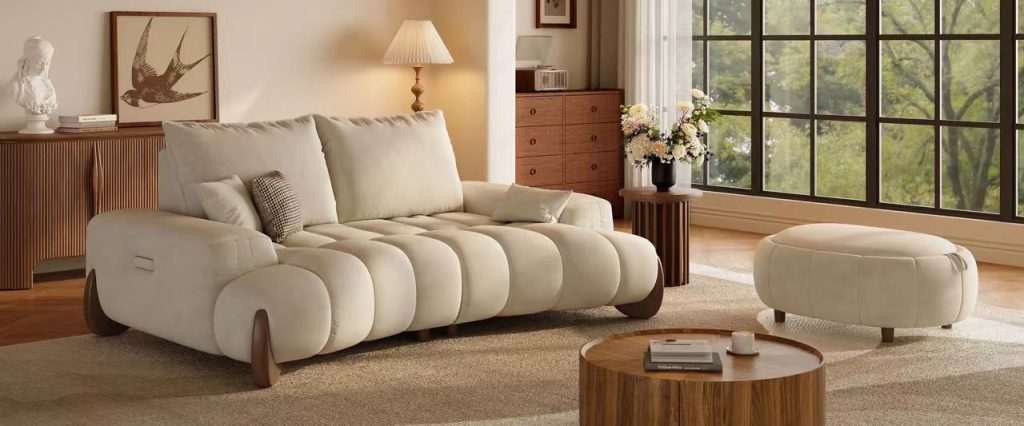
Best Real-Home Scenarios for This Sofa Style
The reason MCM keeps coming back isn’t nostalgia — it’s that the low, leggy profile genuinely solves problems in modern homes. But it shines brightest in two specific situations.
Small Apartments That Need Visual Lightness
Here’s something I didn’t understand until I measured it: a couch on visible legs reads as smaller than a skirted couch of the exact same footprint. Your eye sees the floor continuing underneath. Light passes through. The room breathes.
That’s not a styling trick — it’s the single best argument for MCM in a studio or a tight one-bedroom. A floor-hugging sectional eats the room visually even when it technically fits. A mid-century piece on 6-inch tapered legs occupies the same square footage but feels half the mass.
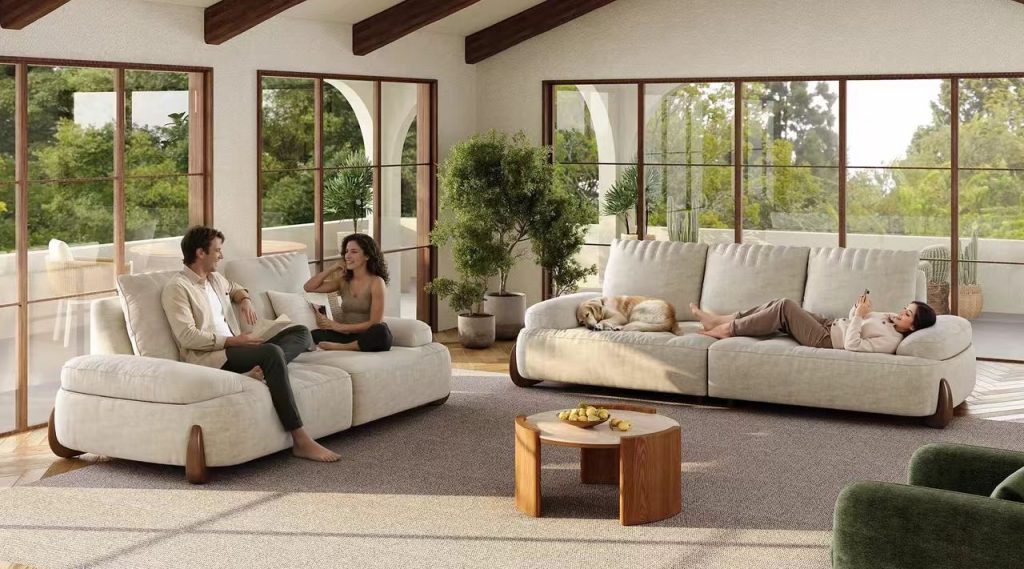
My standard advice before anyone buys for a small space: tape it out. Grab painter’s tape, mark the couch’s exact footprint on your floor, and live with the outline for two days. Walk around it. Open the closet behind it. You’ll learn more in 48 hours than from any product page. POVISON’s mid-century modern sofa collection leans into compact, leg-forward silhouettes specifically — an 89-inch frame with slim arms and a low back can seat two adults plus a dog without dominating a small living room.
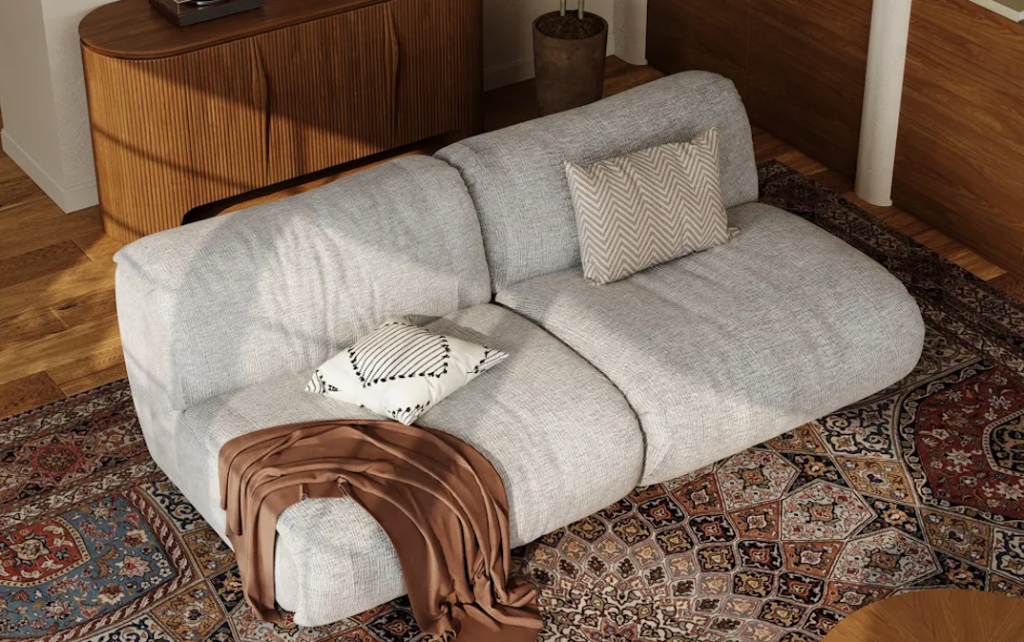
Open-Plan Living Rooms With Wood Floors
The other place MCM earns its keep is the open-plan layout — that great room where the living zone bleeds into the dining and kitchen with no walls to help you out.
In a space like that, a mid-century couch becomes a quiet anchor. Pull it a few inches off the wall so it “floats,” and it draws an invisible line between the lounging zone and everything else. The warm wooden legs talk to a wooden floor instead of fighting it. And because the profile is low, it doesn’t block sightlines across the room — you keep the airy feel that made you want open-plan in the first place.
If you’re furnishing a whole open zone, the trap is buying every piece from a different brand and ending up with five wood tones that clash. POVISON’s guide to mid-century modern house designs makes the case for choosing a few strong coordinated forms instead — a sofa, a media console, a coffee table that share a finish family — so the room looks collected, not assembled by accident. That coordinated-set approach is one of the real advantages of buying within a single line rather than piecing it together yourself.
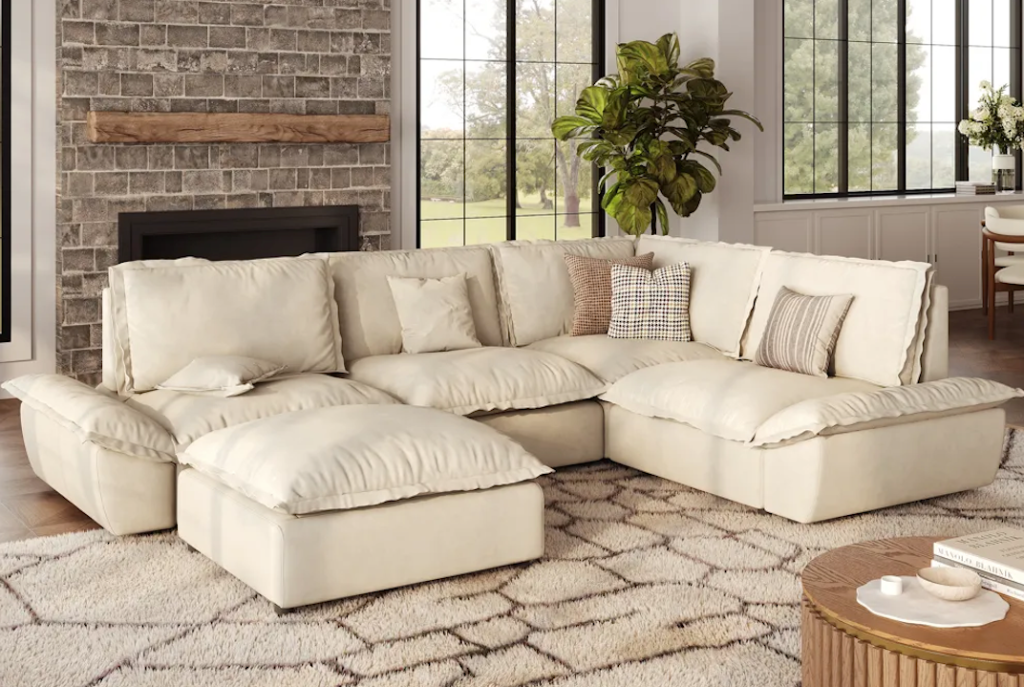
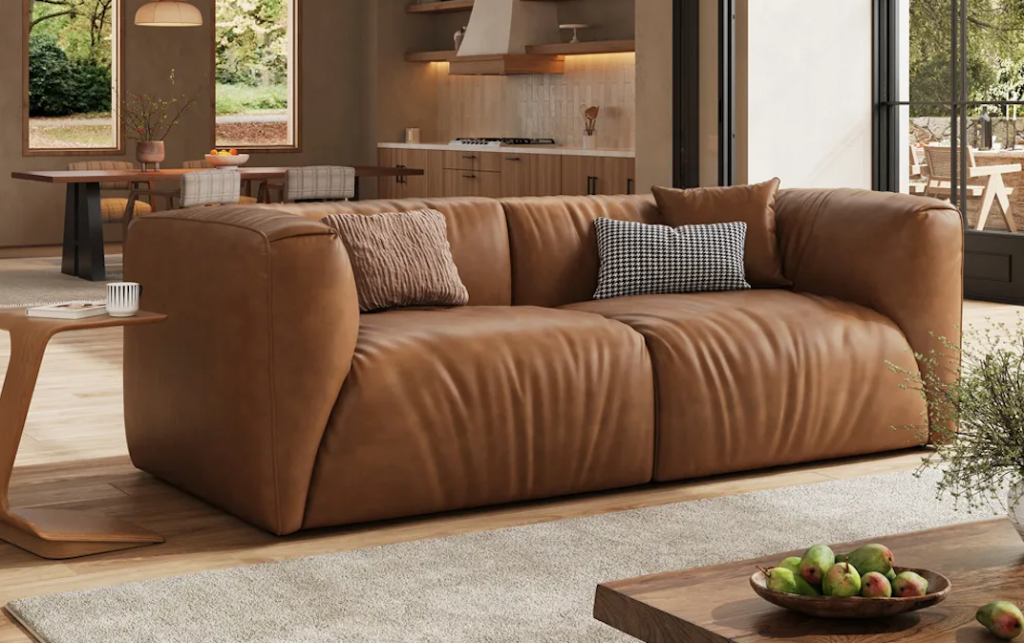
Leather vs Fabric Mid-Century Sofas
This is the question I get most, and the honest answer is: it depends entirely on your household, not on which one is “better.”
Fabric — usually woven linen, performance weave, or chenille on MCM pieces — is the warmer, softer, more forgiving option. A tightly woven performance fabric with a short pile resists claws and shrugs off spills; the everyday stuff wipes up instead of soaking in. Maintenance is mostly a lint roller and the occasional spot clean. If you’ve got kids doing science experiments on the cushions or a dog with opinions, fabric is the lower-stress pick. The downside: lighter fabrics show wear at the contact points over years of heavy use.
Leather — ideally top-grain — brings that warm retro character and ages into a patina instead of just wearing out. A finished top-grain leather resists everyday spills; drinks and sticky fingerprints wipe away rather than leaving rings. The catch is upfront cost and the fact that leather wants a little ongoing care: keep it out of direct sun, wipe it down, condition it once or twice a year. It’s not difficult — it’s just not zero. One thing to know going in: the lower, firmer profile typical of MCM means leather sits with less give than a plush contemporary couch, so test the seat before you commit to the material.
One thing that applies to both: every upholstered couch sold in the US has to meet a federal flammability standard. Since June 2021, the CPSC’s mandatory standard for upholstered furniture (it adopted California’s TB 117-2013) requires smolder resistance and a permanent compliance label. If a sofa can’t show you that label, that’s a real red flag — not a paperwork detail.
And the material question goes deeper than the surface. The frame underneath matters just as much. Look for an FSC-certified hardwood frame — FSC certification means the wood is sourced from responsibly managed forests, which is a verifiable claim, not a vibe. Same with the finish: a low-VOC or non-toxic finish is something you can ask for by name. “Eco-friendly” with no certification behind it tells you nothing.
Comfort Trade-Offs: Seat Depth, Back Height, and Legs
Okay, this is the section that actually changes your daily life. Style gets you at the door. These three numbers decide whether you still like the couch in month six.
Seat depth. This is the big one. For relaxed lounging — reading, napping, sinking in — you want roughly 21 to 24 inches of seat depth. Shallower than that, around 18 to 19 inches, and you’re perched rather than seated; your knees hit the edge and your back never fully relaxes. A lot of vintage-era MCM couches ran shallow on purpose, which is exactly why people call the style pretty-but-punishing. The good modern versions fix this — they keep the clean low profile but give you a genuinely deep seat. If you’re tall or you like to curl up sideways, depth is non-negotiable.
Back height. MCM backs sit low — that’s the look. But low doesn’t have to mean unsupportive. The question is where the top edge lands on your body. If it catches you below the shoulder blades, your upper back has nothing to lean into and you’ll feel it after an hour. Test this with your actual torso, not your eyes. Shoulder support is the difference between a couch you lounge on and a couch you sit up straight on.
Leg height. Legs do double duty. Visually, they give you that lightness I keep talking about. Functionally, they set how hard it is to stand up. A higher leg — say 6 to 8 inches — raises the whole seat, which makes getting up easier on your knees and easier to vacuum under. A very low leg looks dramatic but drops you closer to the floor, and that low rise-up is something to think about seriously if anyone in the house has bad knees or you’re buying a couch to keep for a decade.
The honest trade-off: the most striking MCM proportions — super low back, low legs, shallow seat — are also the least comfortable for daily use. The best 2026 designs thread the needle. They keep the silhouette and quietly fix the ergonomics. You just have to know to check.
What to Check Before Buying Online
Most MCM couches now get bought online, sight unseen. That’s fine — if you check the right things. Here’s my pre-purchase list.
- Get the four numbers. Seat depth, back height, leg height, overall length. If a listing won’t give you seat depth specifically, treat that as the listing hiding something.
- Read the frame spec. Kiln-dried hardwood, ideally FSC-certified. “Solid wood” with no species named is weasel wording. Particleboard or unspecified “engineered wood” in the frame is where sag comes from.
- Confirm the foam. High-resilience foam, or foam wrapped in fiber, holds its shape. All-feather feels plush in photos but needs constant fluffing. Springs add bounce and longevity.
- Check how it arrives — and how the legs attach. This one’s underrated. On a lot of flat-pack MCM sofas, you screw the legs on, and that joint is exactly where the wobble starts six months later. POVISON ships its sofas fully assembled — no leg-attachment step, no hardware bag, no “fully assembled” unit that somehow still rocks when the dog jumps up. For a piece whose entire look depends on slim legs and clean joints, having those joints done at the factory instead of on your living room floor genuinely matters.
- Know the delivery and damage terms before you click buy. A sofa is big and heavy. Ask whether white-glove delivery is included — meaning it gets carried in and placed where you want it, not left in the lobby — and what happens if it shows up damaged. Clear terms upfront save you a bad week later.
- Sanity-check durability claims. If a brand references furniture testing standards, that’s a good sign — the lounge-seating industry benchmark is ANSI/BIFMA X5.4, which puts seating through cycle and load tests built around roughly a decade of normal use. A brand that knows that standard exists is a brand thinking about how the couch holds up, not just how it photographs.
Run that list against any listing before you buy, and you’ve filtered out most of the regret-purchases before they reach your living room.
FAQ
Are mid-century modern couches actually comfortable for daily lounging?
Yes — if you check the dimensions before buying. Daily-lounging comfort comes down to seat depth (aim for 21–24 inches), back height that supports your shoulders, and high-resilience foam over a hardwood frame. The vintage stereotype of “stylish but stiff” comes from shallow seats and low backs on original 1950s pieces. Well-designed modern MCM couches keep the clean profile and fix the ergonomics.
What exactly makes a couch mid-century modern in real life?
What makes a couch mid-century modern is a combination of clean straight lines, a low back and arms, visible tapered legs in solid wood, and human-scaled proportions — no bloated cushions or oversized backs. It comes from the 1940s–60s “form follows function” movement. The quickest authenticity check: solid hardwood legs (not painted composite), tight frame joinery, and a silhouette that looks intentional rather than inflated.
Does a mid-century modern sofa work well in small apartments?
A mid-century modern sofa works especially well in small apartments because its raised legs and low profile create visual lightness — your eye sees the floor continuing under the couch, so the room feels more open than the footprint suggests. Choose a compact length, slim arms, and a neutral upholstery tone. Tape out the footprint on your floor and live with it for two days before you commit.
Is a leather mid-century couch difficult to maintain long-term?
A leather mid-century couch isn’t difficult to maintain, but it isn’t zero-effort either. Top-grain leather with a protective finish resists everyday spills and wipes clean easily. Long-term care means keeping it out of direct sunlight, wiping it down regularly, and conditioning it once or twice a year. In exchange, leather ages into a patina instead of simply wearing out — so the upkeep buys you longevity.
Conclusion
The mid-century modern couch deserves its long run. The proportions are genuinely smart, the leggy profile solves real problems in small and open-plan rooms, and the style has outlasted enough trend cycles to prove it’s not a fad.
But the style symbol and the daily reality are two different purchases. The couch that makes you happy at month six is the one where someone checked the seat depth, confirmed the frame, thought about how the legs attach, and didn’t just fall for the silhouette. That’s the whole job.
Who should skip it? If you want a deep, cloud-soft, sink-all-the-way-in lounge pit, MCM’s tailored structure will always feel a little firm to you — go for something plusher and own that choice. And if you genuinely enjoy DIY assembly as a weekend project, the fully-assembled route isn’t for you. For everyone else — especially anyone furnishing a smaller space or an open-plan room who wants the look and the comfort — it’s hard to beat when you buy it right.
If you’d rather skip the leg-wobble lottery entirely, it’s worth looking at couches that arrive ready to live in — fully assembled, joints done at the factory, carried in and placed for you. Match it with a coordinated console or coffee table in the same finish family and you’ve got a room that looks designed, not pieced together. Either way: get the four numbers first. Your lower back will thank you.
Related Reading:


