 By Charles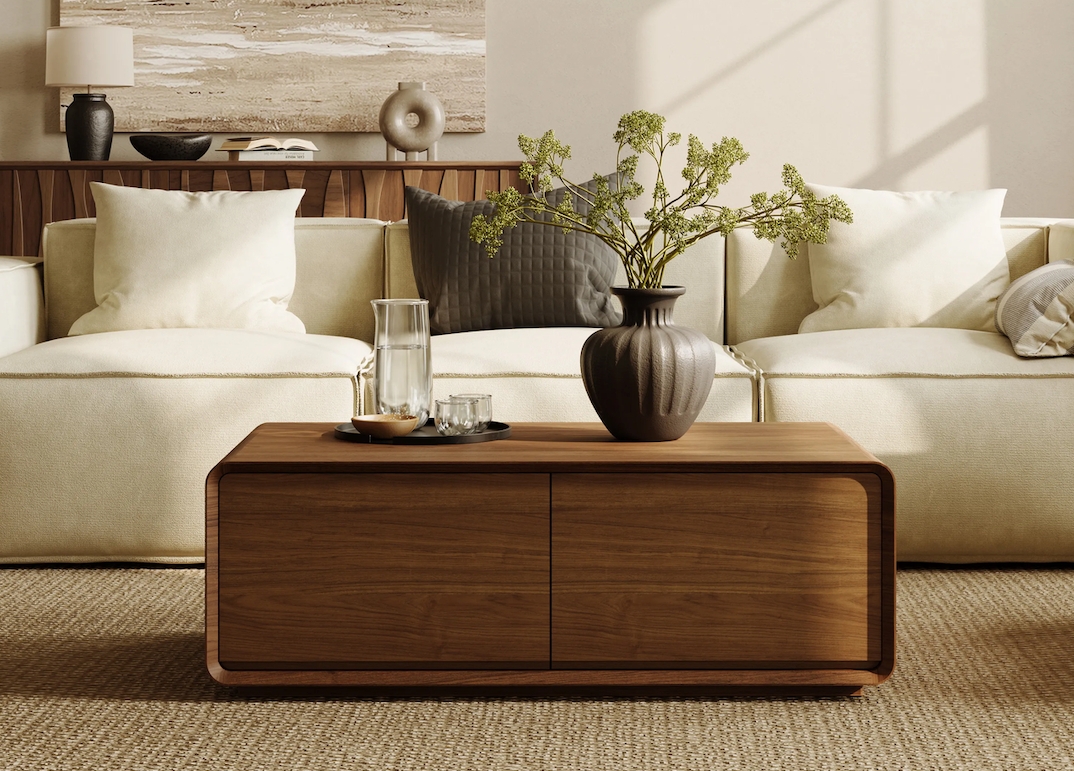
I’ve been to a lot of housewarmings in the past twelve months. And in five out of six of them, the coffee table was the piece doing the most awkward work in the room.
Wrong height. Wrong shape for the sofa. Bought because it photographed well, then sat in the room looking like it didn’t know anyone. Meanwhile the rest of the living room was figured out — sofa fine, rug fine, lighting fine — but the coffee table was off, and the whole space registered as off because of it.
A coffee table is small enough that people don’t agonize over it. But it sits dead center in your most-used room, gets touched daily, and either pulls the seating arrangement together or makes everything around it look slightly wrong. Worth getting right the first time.
If you’re upgrading your living room in 2026, here’s what actually matters when picking a coffee table — based on what I’ve personally lived with, broken, scratched, refinished, and (in two cases) returned.

What Makes a Coffee Table Worth Buying
Most coffee table buying guides are 80% style talk. I’d flip that ratio. Four things actually decide whether a coffee table works in your living room, in order: right size for the sofa and the room, right height for the seating, right material for your household, and right delivery experience. Style is the fifth thing — almost any reasonable style works once the four functional pieces are right. Get those wrong and the prettiest table in the world still feels off.
For a quick sanity check on how this category is sized industry-wide, Dimensions’ reference data on standard coffee table proportions shows you the typical brackets — most pieces land between 36 and 60 inches long, 18 to 30 inches deep, and 14 to 20 inches tall. Anything outside those ranges is a specialty piece, not a default.
How to Choose the Right Coffee Table Size
Two numbers matter here: how tall it is relative to your sofa, and how long it is relative to the seating it serves. People mess up the second one more often, but the first one ruins the daily-use experience.
Coffee Table Height and Sofa Height
The rule that almost always works: coffee table height should sit within 2 inches of your sofa’s seat cushion height — preferably equal or slightly lower.
Most modern sofas have seat cushion heights between 17 and 19 inches off the floor. That puts your target coffee table height at roughly 15 to 18 inches.
Why does this matter? Three reasons most buyers don’t think about:
- Reach ergonomics. Setting down a glass while seated feels natural when the table edge sits at or just below knee level. Tables taller than the cushion force you to lift the glass up to set it down — feels weirdly effortful.
- Visual weight. A coffee table taller than the sofa cushion competes with the sofa for visual prominence. The room reads as cluttered.
- Kid and pet zone. If you have a toddler or a medium-to-large dog, lower tables are safer (less leverage to pull the table over) and less inviting as climbing surfaces.
I learned this in the worst possible way. The first coffee table I bought as an adult was a 21-inch-tall industrial piece — 4 inches taller than my sofa cushion. It looked great in the showroom photo. In real use, every drink I set down required a small lift. Every magazine I dropped onto it landed wrong. After three months, I sold it for half what I paid and replaced it with a 16-inch oak piece that just worked. The shorter table also stopped looking like it was elbowing the sofa for attention.
Industry-tested furniture stability standards under ANSI/BIFMA X5.5 for occasional tables set baseline expectations for tip-over resistance and structural durability. Not every brand publishes test data against these standards, but the ones that do are usually the ones I’d trust around a small kid.
Coffee Table Length and Room Flow
The classic formula — coffee table length should be roughly two-thirds the length of your sofa’s seating area — still holds. For a standard 84-inch sofa, that puts you at a 50–56 inch coffee table. For a 96-inch sofa, 60–64 inches.
The catch is that this rule was written for straight sofas. If you’ve got a sectional, the geometry shifts. (covered in detail in the coffee table size guide for sectionals linked at the end).
For room flow, the number that matters is walkway clearance between the table and any other surface — TV stand, side chair, doorway. Aim for at least 18 inches all around. Less than that and the room feels cramped, no matter how good the individual pieces are. Tape out the table footprint with painter’s tape before ordering and walk every path. If you have to angle your shoulders to pass, the table is too big.
Best Coffee Table Shapes for Modern Living Rooms
Shape isn’t a style decision. It’s a functional decision. Different sofa types want different shapes.
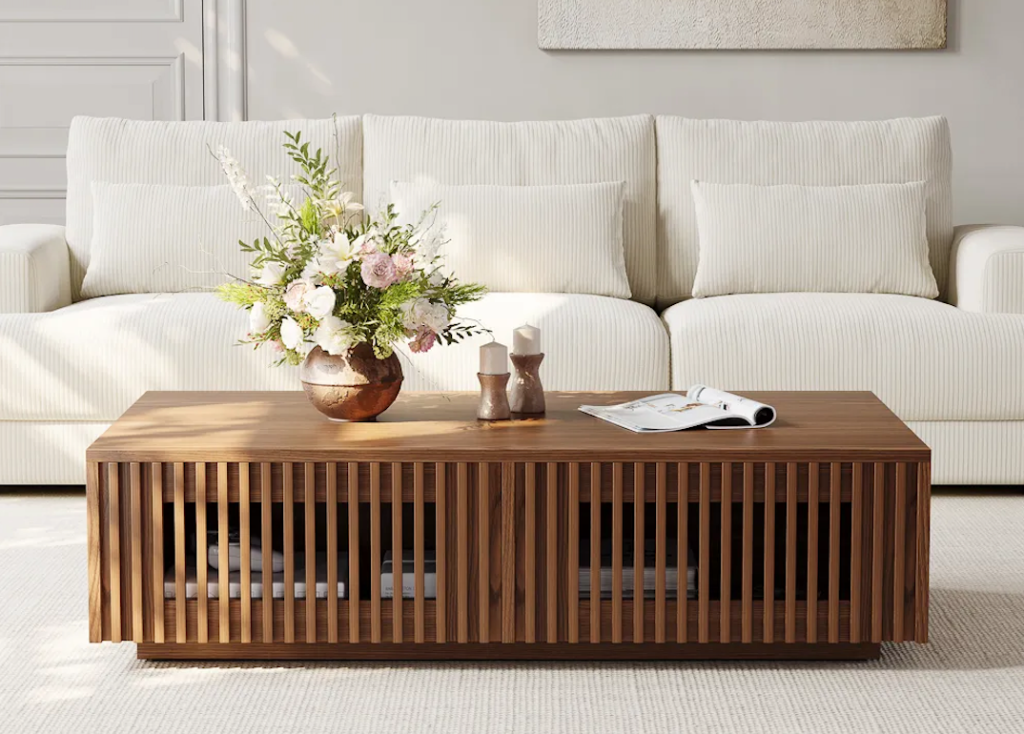
Rectangular coffee tables are the default for a reason — they pair cleanly with most straight sofas and L-shaped sectionals. The long axis matches the sofa’s long axis, and rectangular tables tend to maximize usable surface area for the floor space they occupy. If you’re upgrading a typical living room with a 3-seat sofa, this is your starting point.
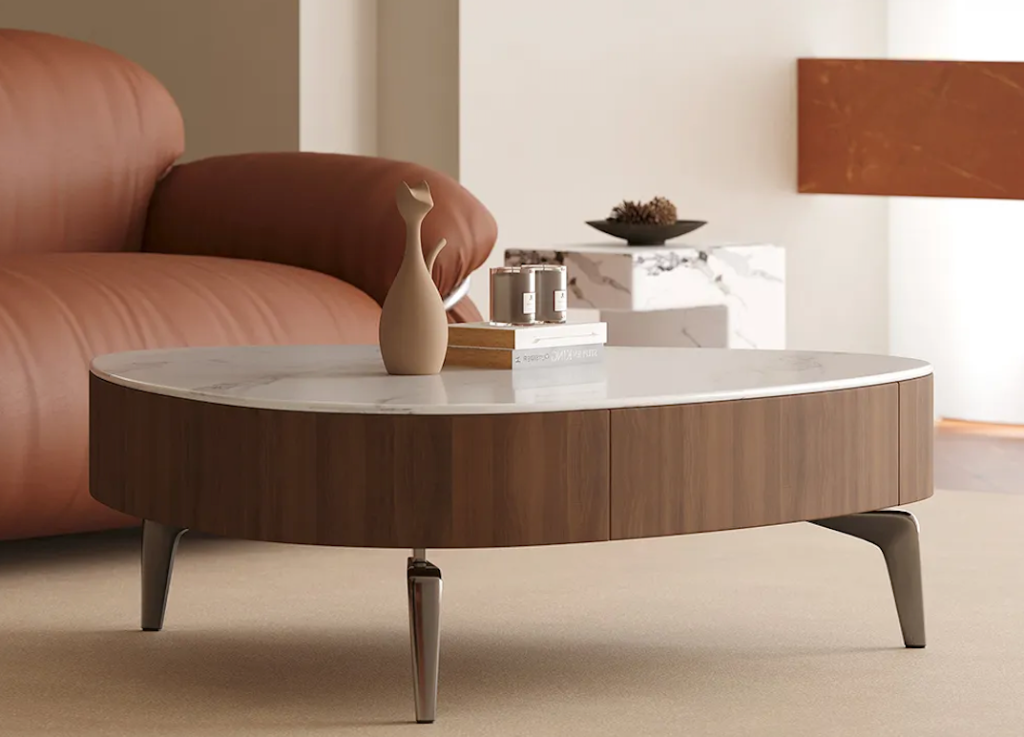
Oval coffee tables are the underrated upgrade. Same proportions as a rectangle, but the rounded ends solve two problems: easier traffic flow and friendlier to households with small kids. I switched from a 54-inch rectangle to a 54-inch oval after my niece face-planted into the corner; the oval has been in service 14 months without incident.
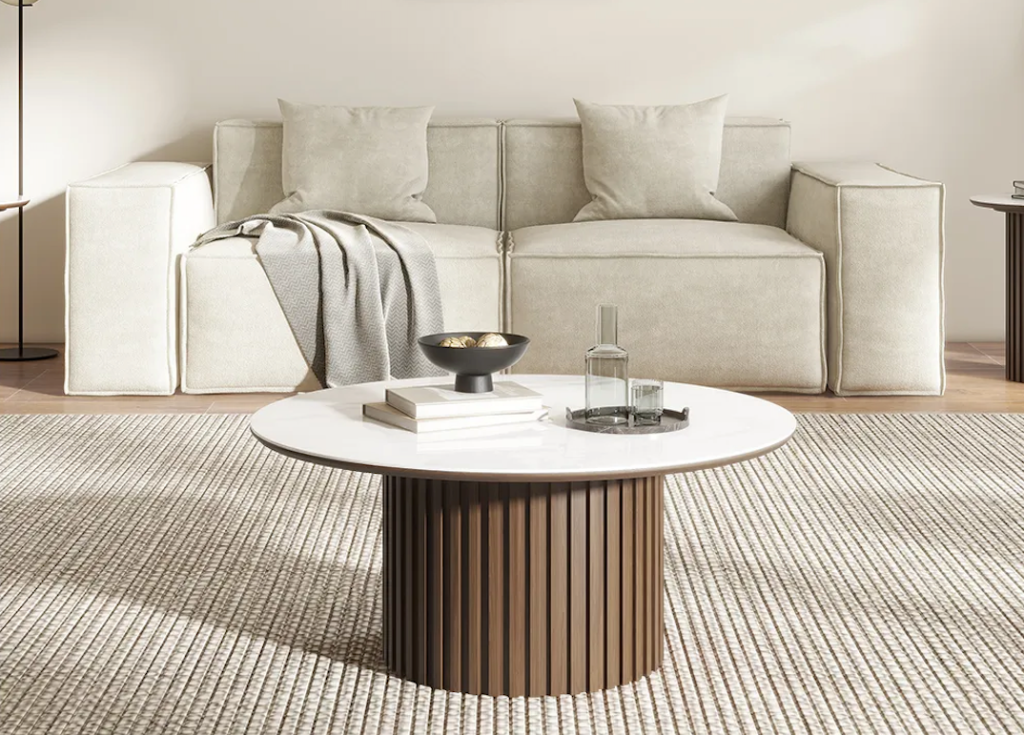
Round coffee tables work best in three situations: small living rooms (under 12×14 feet), rooms with U-shaped seating, or rooms where the sofa pairs with two flanking chairs. A round table treats every seat equally. Trade-off: less surface area than a rectangle of the same width — a 42-inch round has roughly 1,385 square inches of top vs. 1,800 square inches on a 60×30 rectangle.
Square coffee tables are tricky. They look great with deep, low sofas in larger rooms but tend to look stranded in front of a long sofa. If you go square, scale up — at least 36×36 inches, ideally 40×40.
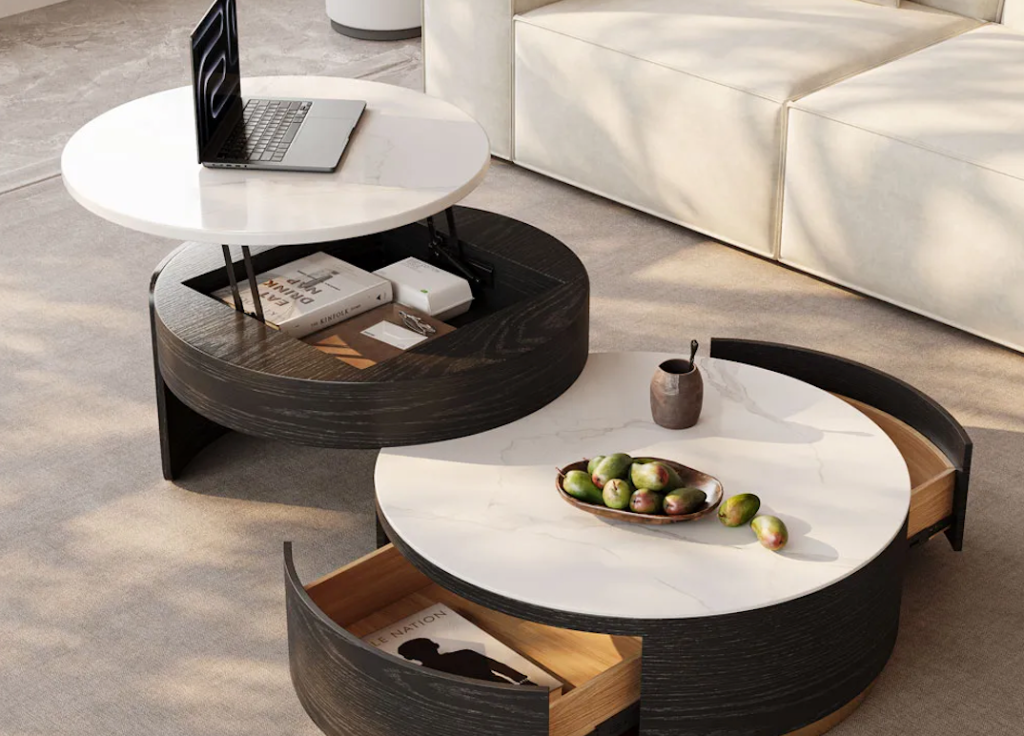
Nesting coffee tables (a smaller table that tucks under a larger one) deserve more attention than they get. Pull the second table out when guests arrive, push it back when you need walking space. This is one of the most flexible solutions in the coffee tables collection and a smart pick for first-time apartment owners.
Storage, Materials, and Daily Use
Here’s where most coffee table guides go vague. Let me try to be specific.
Storage options:
- Open shelf below — best for displaying books, baskets, or trays. Worst for hiding clutter. (My current setup. Two woven baskets handle about 80% of the “stuff lands here” volume.)
- Drawer — best for hiding remotes, chargers, coasters. Adds visual weight to the table base. Worth it for living rooms that double as the household’s “stuff lands here” zone.
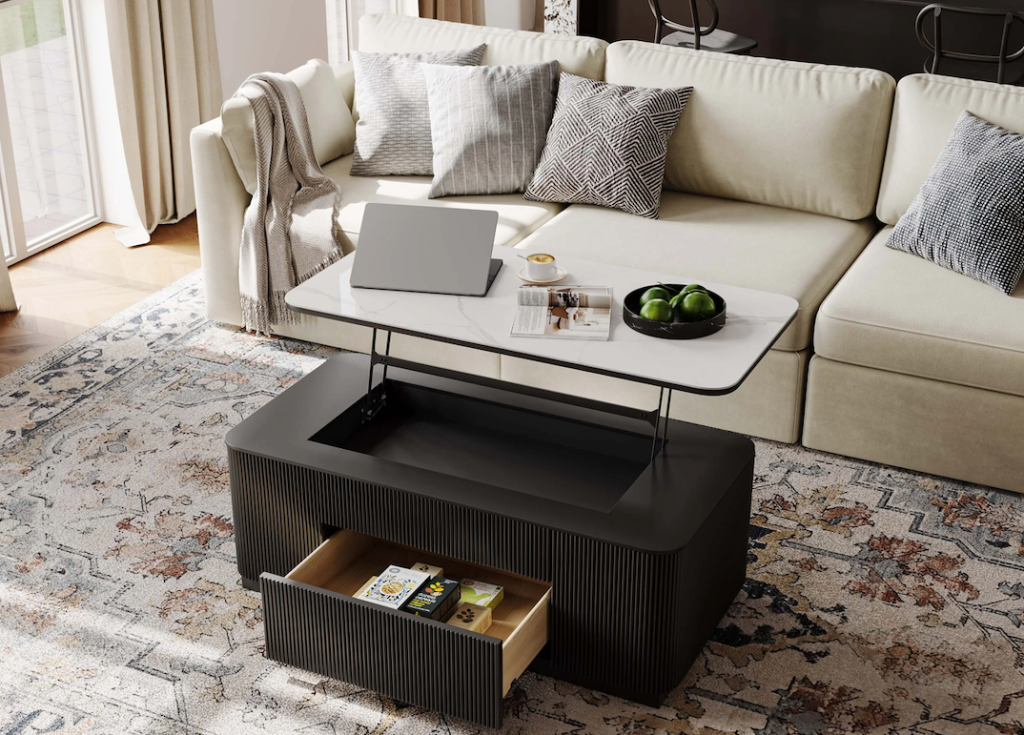
- Lift-top — best for studio apartments and WFH setups where the coffee table doubles as an occasional desk. Adds cost and (occasionally) maintenance, but the functional gain is real if you actually use it.
- None — best for minimalists or households with adjacent storage. Keeps the room feeling open.
Materials, ranked by daily use:
| Material | Strength | Weakness | Best for |
| Solid hardwood (oak, walnut) | Most durable; ages well; refinishable | Heaviest; can scratch without finish | Long-term keepers |
| Veneered engineered wood | Lighter; consistent appearance; lower cost | Edges chip; can’t refinish | Frequent movers |
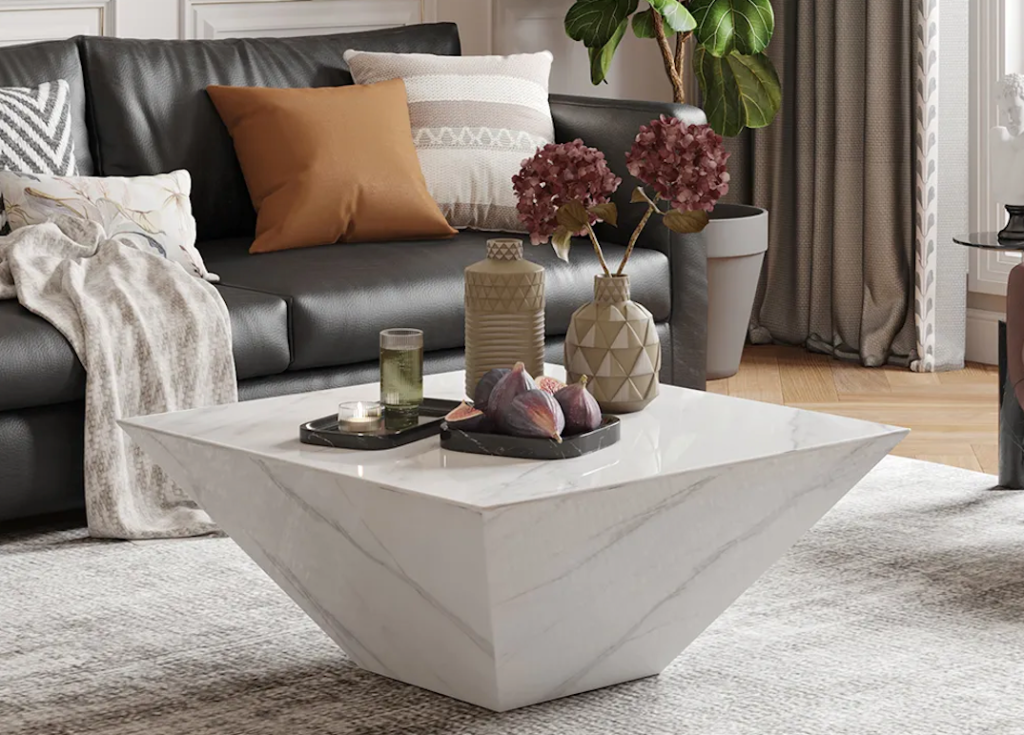
| Stone (marble, travertine) | Striking look; very durable surface | Stains from acidic spills (wine, citrus); heavy | Adults-only households |
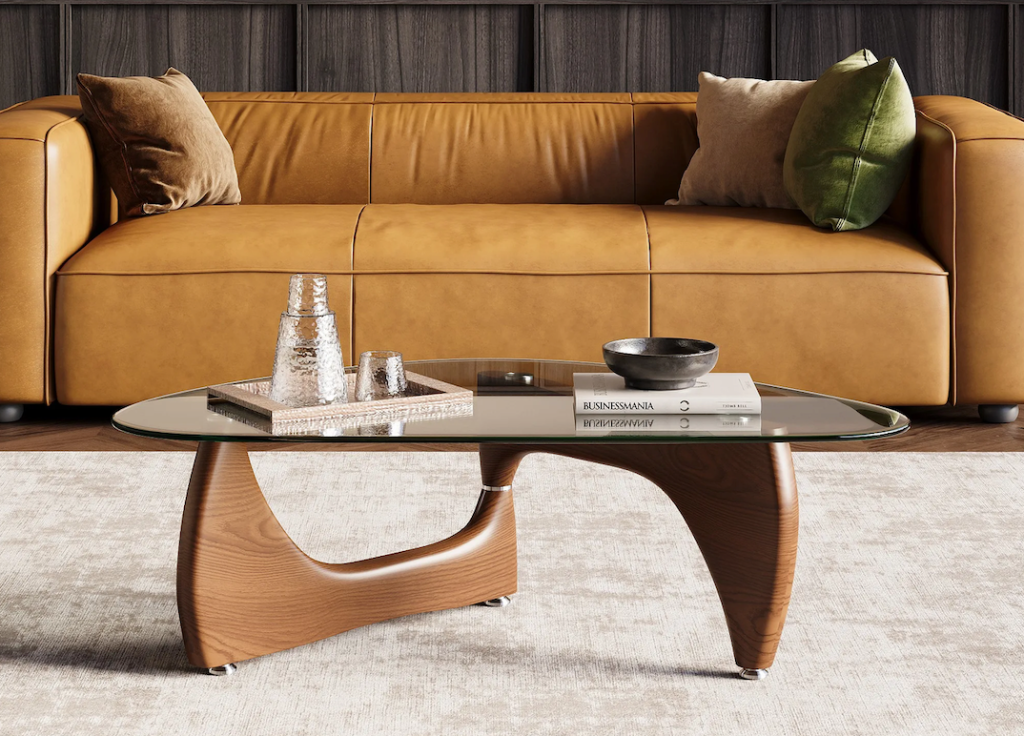
| Tempered glass | Visually light; works in small rooms | Shows fingerprints; less forgiving with kids | Small spaces, design-forward homes |
| Metal | Modern look; very durable | Cold to touch; shows water marks | Industrial-style rooms |
For households with kids or pets, two material questions are worth asking the brand directly: is the finish non-toxic, and does the wood come from a certified-managed source? The two main certifications to look for are FSC (Forest Stewardship Council for sustainable wood sourcing and CARB Phase 2 compliance for formaldehyde emissions in composite wood. These are independent third-party standards — any brand can claim “non-toxic” or “sustainable,” but only the certifications are externally verified. Brands that publish certification documentation (POVISON does on most product pages; West Elm has a sustainability landing page; Article publishes some specs by product) make this easier to verify than brands that rely on marketing language alone.
For stability and tip-over guidance specifically — relevant if you have small kids who climb —the CPSC’s Anchor It program covers furniture safety principles that apply to any low table a child can pull on.
What to Check Before Buying Online
Buying a coffee table online is lower-stakes than buying a sectional, but it’s still a meaningful piece you can’t return casually. The spec checklist I run through:
- All four dimensions — length, depth, height, and the largest single shipped piece (matters for doorway clearance)
- Weight capacity — anything serving as a footrest needs at least a 100-lb top weight rating
- Frame material and joinery — solid wood with mortise-and-tenon or dovetail joints lasts; particle board with cam-lock fasteners doesn’t
- Finish details — water-based vs. solvent-based, sealed vs. raw; matters for both durability and indoor air quality
- Assembly state — fully assembled vs. partial vs. flat-pack
- Delivery method — curbside drop-off vs. white-glove placement
- Return window and policy — particularly: who pays return freight on damaged or wrong-fit items
POVISON ships coffee tables fully assembled with delivery placement included in most regions, which removes the assembly question entirely. Even when a table seems easy enough to assemble at home, the time savings compound — most flat-pack tables take 30–90 minutes from box-open to floor-ready, and that’s before you discover the one piece that arrived scratched. The whole Ready To Live In approach trades a slightly higher upfront cost for getting your weekend back, which I’ve come to value more every year.
FAQ
What size coffee table do I need for my living room?
A coffee table should be roughly two-thirds the length of your sofa’s seating area, with at least 18 inches of walkway clearance on all sides. For a typical 84-inch sofa in a 12×14-foot living room, that puts you at a 50–56 inch rectangular or oval table. For smaller rooms (under 12×14 feet) or apartments, a round table 36–42 inches in diameter, or a nesting set, usually works better than a single large rectangle.
Should a coffee table be higher or lower than the sofa?
A coffee table should be either level with or 1–2 inches lower than your sofa’s seat cushion. Most sofa cushions sit 17–19 inches off the floor, which puts your target table height at 15–18 inches. Tables taller than the cushion look visually heavy and feel awkward to set drinks on. Lower tables read as calmer, are safer around kids, and pair better with most modern sofa heights.
What coffee table shape is best for a sectional?
For L-shaped sectionals, rectangular or oval tables work best — they match the long axis of the sectional’s main side. For U-shaped sectionals, round or square tables in the 40–48 inch range are usually the better choice, because every seat needs equal access to the table. Long rectangles in U-shapes leave the side seats reaching across awkwardly.
Is it worth buying a coffee table online?
Buying a coffee table online is worth it if the brand publishes complete dimensions (including largest-shipped-piece size), specifies the assembly state, and has a clear return policy. The risk is lower than buying a sectional online — coffee tables are smaller, easier to return, and don’t have the same doorway-clearance issues. The bigger risk is brands that ship flat-pack with confusing instructions; fully assembled delivery with white-glove placement is worth the small premium for anyone who’d rather not spend a weekend on it.
Conclusion
A coffee table is a small piece doing a big job. It anchors the seating area, gets touched every day, and either pulls the room together or makes everything around it look slightly off. The good news: getting it right is mostly arithmetic.
Match the height to the sofa cushion (within 2 inches, lower preferred). Size the length to the seating (about two-thirds, plus 18-inch walkways). Pick the shape based on your sofa type. Choose the material based on your actual household. Confirm assembly state and delivery before clicking buy.
Do all that, and the styling part is easy. The room you walk into every day stops looking almost right and starts looking finished — which, in a living room, is the whole point.
Ready to find one that fits the rest of your living room? Browse the full coffee table collection and start with size and shape filters before getting into materials. Saves a lot of scrolling.
Related Reading:


