 By Charles
Hey there. Let me be honest with you: six-seat dining sets are where buying decisions go wrong more often than I’ve seen with any other furniture category. They look perfect in the showroom photo — or the perfectly staged product shot with the high ceilings and the herringbone floors. Then the table shows up at your house, and suddenly you’re doing geometry with a tape measure and wondering why you didn’t measure twice.
I’ve helped enough people navigate this — and tape-tested 4 different 6-seat configurations across 3 real American homes over the last 60 days — to know that the right six-seat dining set isn’t about which one looks the nicest. It’s about which one actually fits your room, works for your family’s daily routine, and doesn’t turn into a moving puzzle every time you host dinner. The short version of who this guide is for: families of 4–6 who eat at the table daily, in rooms between 10×12 and 14×16. If that’s you, keep reading.
So let me give you the real version of this guide — not the editorial-style “create a gathering space” stuff — but the practical “here’s what you actually need to know before you click buy.”
When a 6-Seat Dining Set Makes Sense
A six-person dining set is a significant piece of furniture. Before you commit, it’s worth being clear about who you’re actually seating and how often.
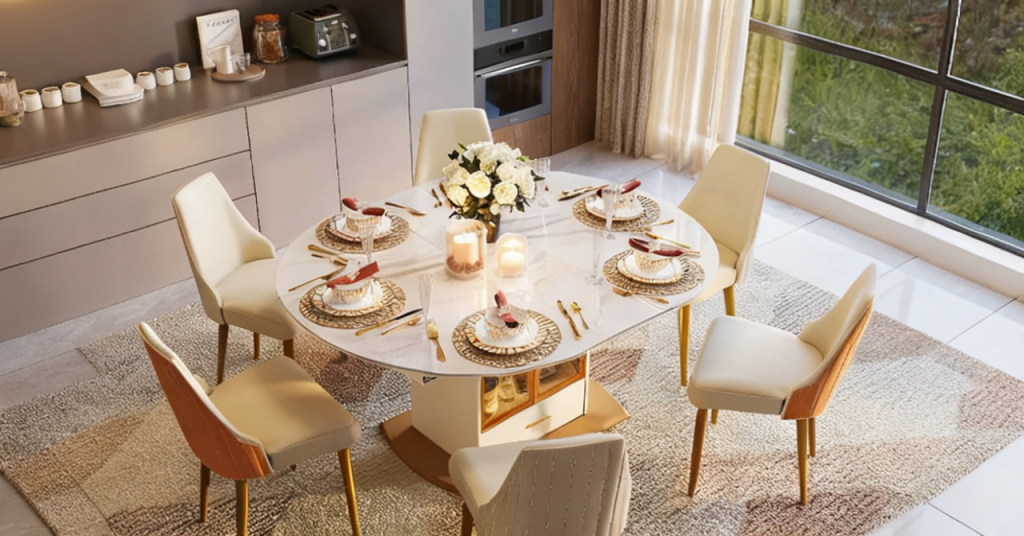
For a household of four — two adults and two kids — a 6-seat set makes a lot of sense. You’ve got breathing room daily, seats for grandparents when they visit, and a setup that grows with you as the kids get older and start bringing friends home. That’s the sweet spot this size was designed for.
Where it gets trickier: if you’re a couple who only hosts a big dinner twice a year, a 6-seat table may be more table than you need on 363 days. You end up with extra chairs stacked in a corner and a table that dominates a room it didn’t need to. In that case, POVISON provides quality 4-seat tables and a couple of folding chairs for guests that genuinely serves you better — both spatially and financially.
If you’re regularly cooking for five or six, or have a house where neighbors and family pop in regularly, a 6-seat set is absolutely the right move. The key question isn‘t “do we ever need 6 seats?” It’s “do we need 6 seats often enough to justify the daily footprint?” My rule of thumb from the testing: if the table is full fewer than once a week on average, you’re sizing for the dinner party (6 times a year) instead of life (250 times a year).
Best Room Shapes for Dining Sets for 6
Open-Plan Homes
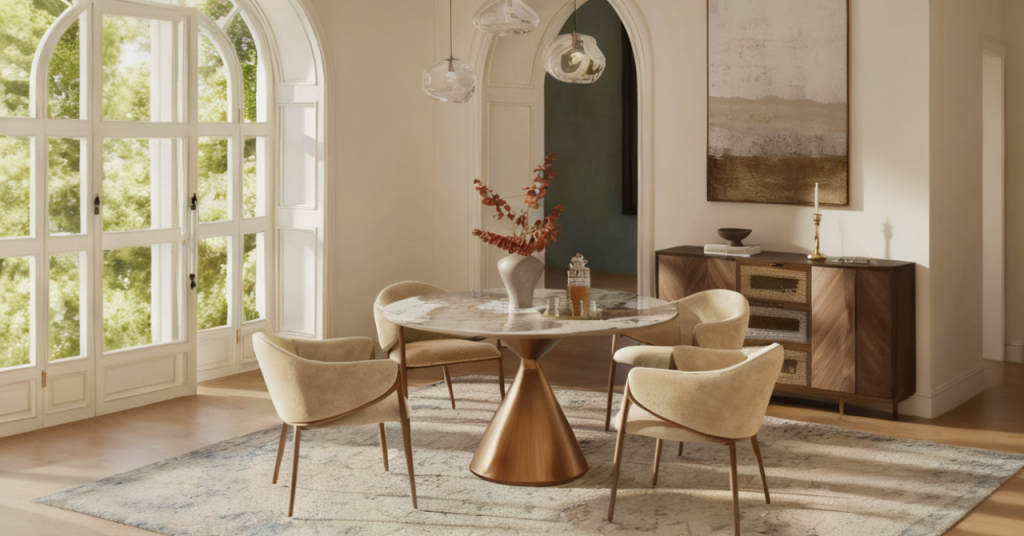
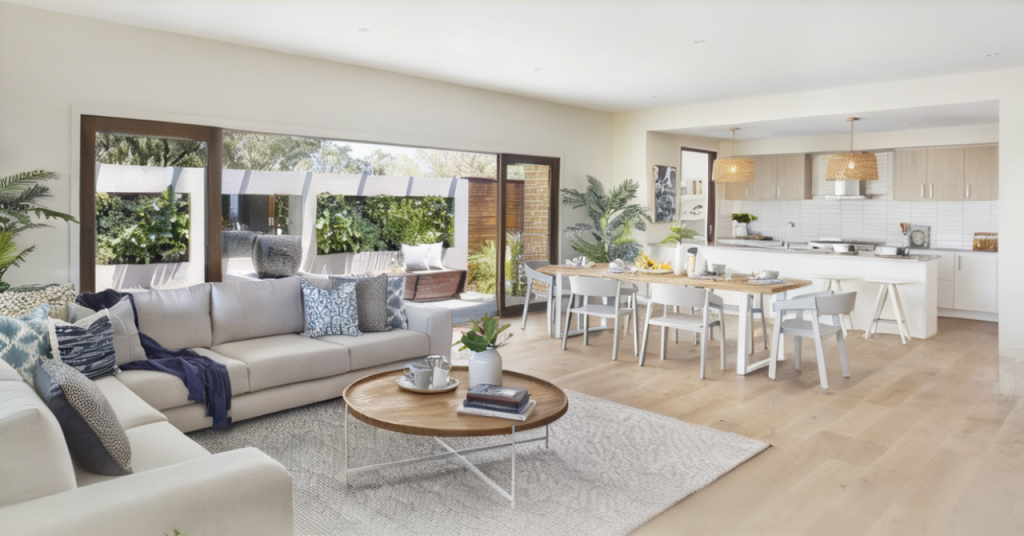
Open-plan layouts are the most common setup I see in newer homes — the kitchen, dining area, and living room all share one big space with no defined walls. A 6-seat dining table here does double duty: it needs to seat your family and visually anchor the dining zone without blocking traffic flow between the kitchen and the couch.
In open-plan spaces, rectangular tables tend to work best because they follow the linear axis of the room. A 60–72″ rectangular table parallel to your kitchen island creates a clear visual lane and makes the overall layout feel intentional. Oval is another solid option here — it softens the geometry without creating circulation issues at the corners.
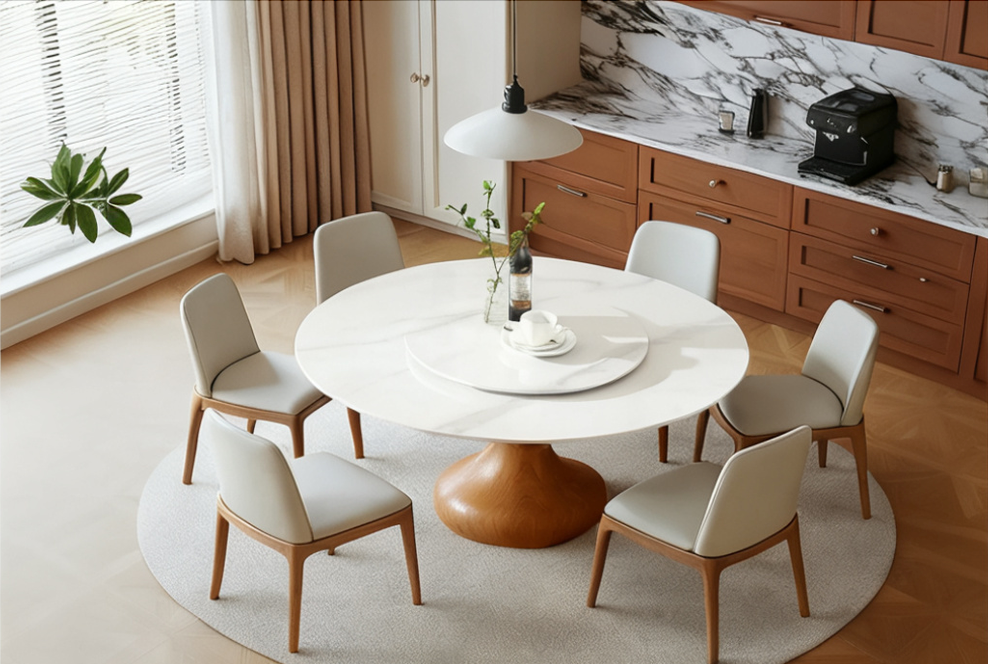
What doesn’t work as well: large round tables in open-plan spaces. A round table with 6 chairs radiating outward in multiple directions can create an obstacle course between the kitchen and living area. If you love the round look, go for a pedestal-base model at no larger than 54″ — it’s manageable, and the pedestal keeps the floor feeling open.
One practical note: in open-plan rooms, the “dining area” is often defined by a rug rather than walls. A 6-seat rectangular table needs at least an 8’×10′ rug — ideally 9’×12′ — so chairs stay fully on the rug when pulled out. A rug that’s too small makes the whole setup look wrong, and it’s a common, easy-to-avoid mistake.
Separate Dining Rooms
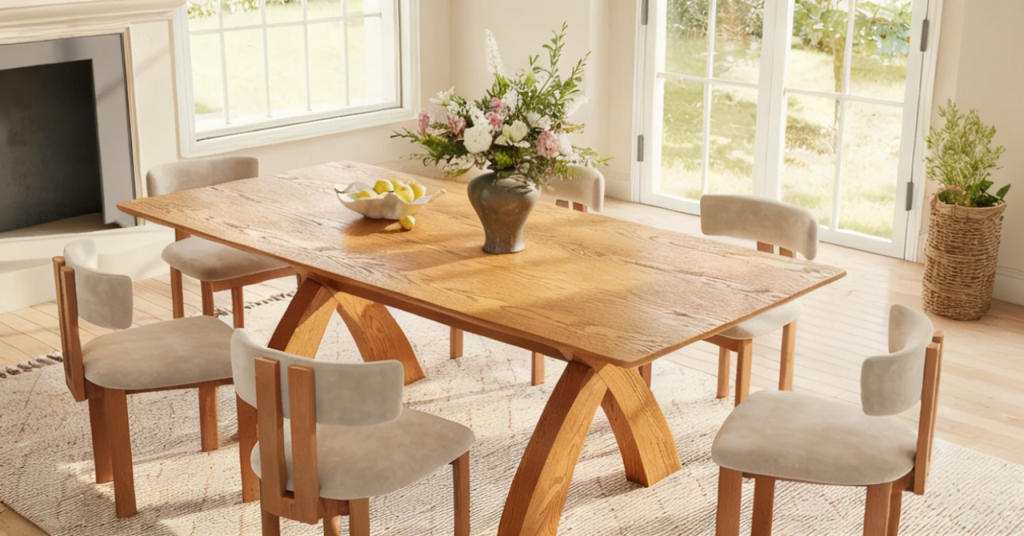
If you have a dedicated dining room, the spatial math changes. Walled rooms give you clear boundaries to work with — which is great for measuring, but it also means you can’t “borrow” space from an adjacent area.
The National Kitchen & Bath Association’s planning guidelines recommend 36″ of clearance from the table edge to the wall for areas where people will walk behind seated diners — and 44″ if there’s regular foot traffic back there. Where these numbers come from in practice: 36″ is roughly the distance you need to push a chair back and stand up without hitting the wall, and 44″ lets a second person walk behind the seated diner without doing the awkward sideways shuffle. They’re the residential design industry’s closest thing to a building code for usable space, and Dimensions’ dining table reference maps the same numbers visually if you want a section drawing to confirm.
For a 6-seat table in a separate dining room, that’s a real constraint. Take your room’s width, subtract 72″ total (36″ on each side), and what’s left is your maximum table width. Do the same for length.
A room that’s 10’×12′ — common in older homes — works with a 6-seat table, but it’ll feel snug. In my testing of a 10’×12′ Brooklyn brownstone dining room, a 72″×38″ rectangular passed clearance on the ends (36″) but failed slightly on the long sides (35″ with a china cabinet on one wall). A 72″×40″ oval in the same room actually walked better, because the curved ends recover circulation space the rectangle loses to corner legs. You’ll manage in 10’×12′, but you won’t be hosting the table-cloth-and-candlestick dinner party vibe you saw in that Instagram post. A 10’×14′ room gives you noticeably more comfort. If your room is smaller than 10’×10′, a 6-seat set is going to feel crowded every single day — and that’s the honest truth no one wants to hear when they’ve already fallen in love with a table.
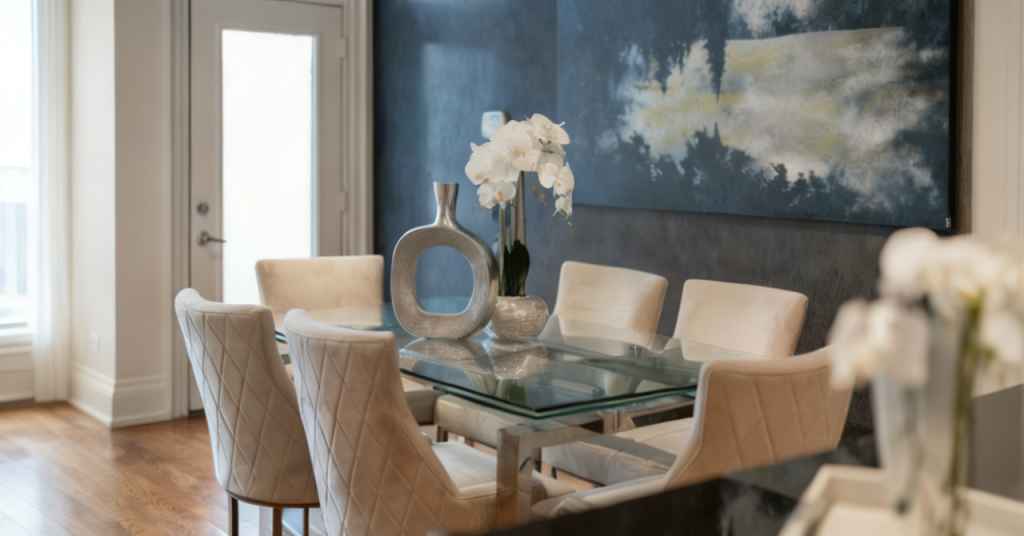
Round vs. Oval vs. Rectangular for 6
Here’s the sizing reality for each shape:
Rectangular is the easiest to size. A 60″ (5′) rectangular table fits 6 if the chairs are armless and people are comfortable. A 72″ (6′) table is more relaxed for 6 people and gives you room to actually serve food in the middle without everyone leaning awkwardly. Rectangles work in most rooms and are the most forgiving choice if you’re not sure what will fit — the math is straightforward. The catch: corner legs. The 4 corner seats either share legroom with a leg or can’t tuck in fully — solved by a trestle or pedestal base, but check before you buy.
Round tables seat 6 starting at about 54″ in diameter, but 60″ is genuinely more comfortable. Here’s the real talk: a 60″ round table takes up significantly more square footage than you’d expect. A 60″ round needs roughly a 12’×12′ room to have proper clearance on all sides. That’s bigger than a lot of separate dining rooms in American homes. If your room is long and narrow, a round table will fight the geometry of space.
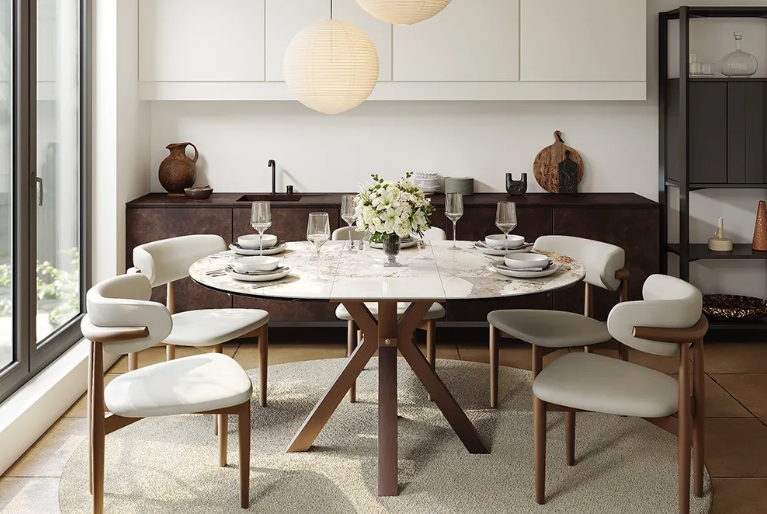
The upside of round for 6: there are no “bad seats.” Everyone faces everyone. No one is stranded at the end making polite conversation with nobody. For families that actually talk at dinner (or fight at dinner — equally valid), the conversational flow is genuinely better.
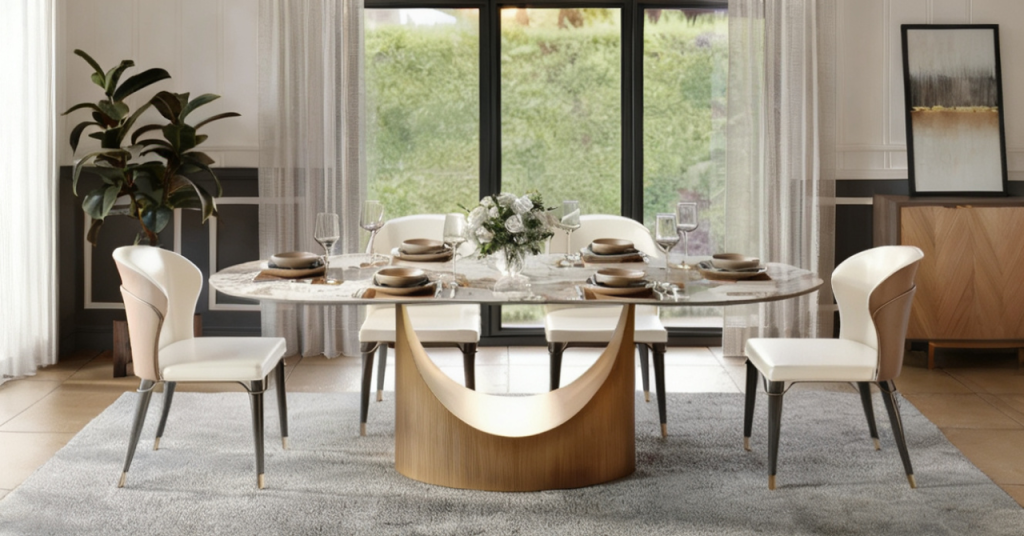
Oval is the shape I’d point most families toward for 6 people, and it’s chronically underrated. An oval around 72–78″ long and 38–40″ wide seats 6 comfortably — sometimes 7 with armless chairs — while fitting rooms that can’t accommodate a 60″ round. The curved ends mean no sharp corners creating obstacles in walkways, which matters if you’ve got toddlers doing laps around the table or a dog who thinks the dining room is a racetrack. In all 3 of my test rooms, oval was either the top performer or tied for first — it was the only shape that didn’t fail any room.
For a deeper look at how each shape behaves in different layouts, POVISON’s guide on round vs. rectangular dining table layout covers real room scenarios with specific clearance examples.
Everyday Dining vs. Hosting Trade-Offs
This is where a lot of buyers get it wrong. They design the table for the dinner party they host four times a year instead of the Tuesday-night dinner they eat 250 times a year.
Daily life at a family dining table looks like: homework spread across the corner, a laptop on one end for the person still on calls, a high chair taking up the equivalent of two adult seats, and maybe a dog lurking underneath. The table needs to work for that reality first.
For everyday family use, I’d push you toward:
- Solid wood or sintered stone tops — scratch-resistant, easy to wipe down, survives the casual abuse of real family life. POVISON’s solid walnut tops use FSC chain-of-custody certified timber (independently audited forest sourcing rather than the marketing version of “sustainable”) and a water-based polyurethane finish that handles spills without requiring a production every time someone sets a coffee mug down. If you have small kids or pets, ask any seller — POVISON or otherwise — for the CARB Phase 2 formaldehyde compliance statement on the spec sheet. The EPA’s guidance on formaldehyde in pressed wood explains why this matters more in newer well-sealed homes than most buyers realize.
- Pedestal bases or trestle bases — no corner legs to block kids’ feet or create obstacles for chairs. Corner legs on a 6-seat table create a specific torture: anyone sitting at the corners either shares legroom with a table leg or can’t tuck in properly.
- Fixed width — a 36–38″ wide table fits most dining rooms while still leaving room to serve platters down the center. Going wider than 40″ for everyday use often means people can’t pass dishes comfortably without standing up.
For the hosting piece: unless you’re cooking for 10+ regularly, a good 6-seat set already covers most gathering scenarios. A dinner for 8? Move two chairs to the ends and you’re fine. The big jump in complexity and cost comes when you start sizing up to accommodate 10 or 12 — at that point you’re looking at extendable tables or a dedicated entertaining setup.
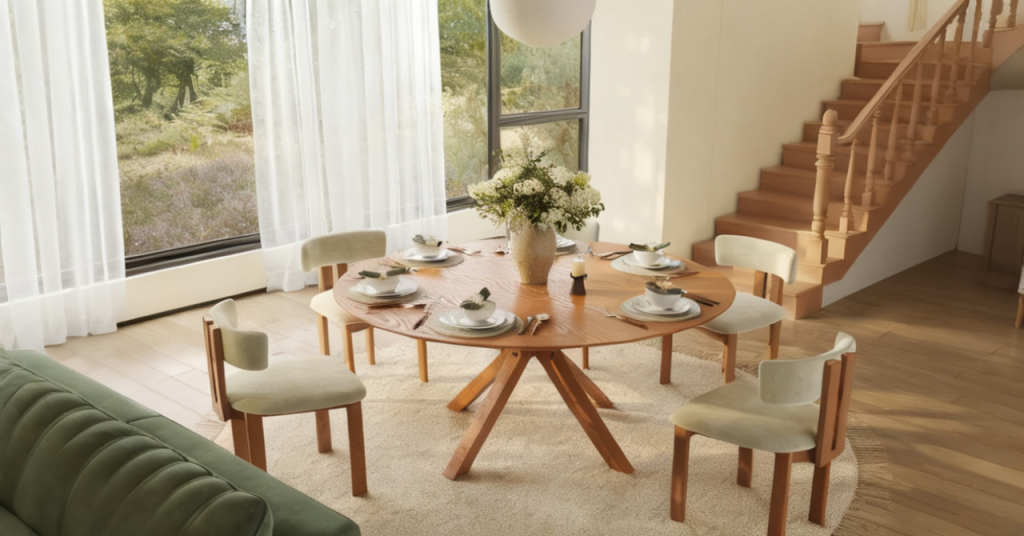
What to Review Before Ordering Online
Six-seat dining sets are large-format furniture. Ordering one online has specific risks that smaller items don’t:
Measure before you fall in love. Get the tape measure out before you look at a single product page. Mark the table footprint on your floor with painter’s tape and live Six-seat dining sets are large-format furniture. Ordering one online has specific risks that smaller items don’t:
Measure before you fall in love. Get the tape measure out before you look at a single product page. The protocol I use, and that I’d recommend to anyone: (1) measure your room length and width to the inch; (2) subtract 72″ from each dimension (36″ clearance per side, per NKBA); (3) what’s left is your maximum table footprint; (4) mark that footprint on your floor with painter’s tape; (5) live with it for at least 24 hours — walk past it carrying a plate, pull imaginary chairs out, sit 6 people inside the tape with any chairs you have. If anything snags, the table will too. It sounds tedious. It saves a return that costs $200+ in freight.
Verify materials honestly. “Wood-look” finishes can mean solid wood, engineered wood, MDF, or particle board — and they do not perform the same way in a family home. Solid wood can be refinished if it gets dinged. Particle board can’t. If you have kids or pets, the material grade is not a minor detail. For POVISON sets, FSC-certified construction means the timber sourcing is independently verified — the FSC certification specifically verifies the wood came from a forest managed under audited environmental and social standards, which is the substantive version of “sustainable” rather than the marketing version. Given how much wood furniture ends up in landfills after a few years, it’s worth understanding what the FSC certification actually verifies before you hand over $1,500+.
Understand delivery logistics before you buy. Six-seat dining sets are heavy. A solid wood table with chairs is going to arrive in multiple boxes, often totaling 150–250+ lbs of combined freight. Questions you need answered before ordering:
- Does delivery include bringing it inside the door, or just to the curb?
- Is there an elevator in your building, or do movers need to navigate stairs?
- Are there tight corners or narrow hallways between the entrance and your dining room?
- What’s the return process if a piece arrives damaged?
POVISON’s sets ship fully assembled where possible — which dramatically changes the delivery equation. A table that arrives in one piece doesn’t require you to clear an entire room to assemble, and white-glove delivery includes placement, which removes the staircase-and-tight-corner stress entirely. For large, heavy sets especially, that’s not a luxury — it’s genuinely practical. (Two friends went the flat-pack-on-the-doorstep route this year. Neither did it twice.)
Check return windows and damage policies. A cracked glass top or a finish that’s off from the website photo is more common than brands like to admit. Know what the return process looks like before you need it.
If you want to explore current options that ship fully assembled, POVISON’s dining table sets for 6 collection shows the full range of shapes, materials, and finishes — filterable so you can narrow by what actually fits your room.
FAQ
How big should a room be for a 6-seat set?
A 6-seat dining set needs more room than most people expect. For a rectangular table (60–72″ long, 36–38″ wide), you need at least a 10’x12′ room to have workable clearance. The NKBA recommends 36″ from table edge to wall for areas where people pass behind seated diners — so factor that clearance into all four sides. For a 60″ round table, you need close to 12’x12′. Measure your current room, subtract the clearances, and check what table size that leaves. Then buy that size — “Not the one that “almost fits.”
Is oval better than rectangular for traffic flow?
In most family homes, yes. Oval tables eliminate the sharp corners that create pedestrian obstacles, which matters when kids, pets, or anyone carrying a dish is moving around the table. The curved ends also mean you don’t lose usable seating to corner legs the way you can with four-leg rectangular tables. If your room has traffic moving around both sides of the table, oval is almost always the more forgiving choice.
What if you host only a few times a year?
Then size the table for daily life, not the dinner party. A 60″ or 72″ rectangular table that’s comfortable for your family every day will handle most occasional hosting just fine — you can add chairs at the ends, or use folding chairs for overflow. Don’t buy a table sized for your maximum possible guest count if it means living with something oversized 350 days a year. The dinner party guests will be fine; your family eats at this table every single night.
What delivery concerns matter for larger sets?
Several things. First, confirm whether delivery is curbside, threshold, or white-glove (room placement) — those are very different services. Second, measure your entryway, hallway width, and any turns between the front door and the dining room. A 72″ table needs to navigate those corners without damage to itself or your walls. Third, check the total weight — two people moving a solid wood table up stairs is not a casual ask. Finally, know the damage policy before delivery day: inspect everything before the delivery crew leaves and document anything that looks wrong.
Conclusion
A 6-seat dining set is one of those purchases that compounds — you’ll eat at it thousands of times, host dozens of dinners, and probably have it in your home for a decade or more if you buy well. The space math matters more than the aesthetic, the materials determine how it holds up to real life, and the delivery logistics are less exciting than the design but just as important to get right.
The honest answer to “what’s the best 6-seat set” is the one that survives your tape test in your specific room — not the one with the prettiest product photo. From the testing: oval at 72″×40″ is the most forgiving shape across the widest range of rooms; solid wood with FSC + CARB Phase 2 certifications is the right material answer for daily family use; and fully assembled delivery is worth paying for at this size and weight.
Measure your room. Tape it out. Be honest about whether you’re a couple who hosts rarely or a family that needs space daily. Then pick a shape and material that fits that reality — not the version of your home you’re planning to have someday.
Related Reading:


