 By Arnold
Introduction
You buy a sofa, a rug, two lamps, and the room still looks random. The usual fix is more shopping, but curated room designs rarely come from adding things. They come from one piece placed with intent, and in most living rooms that piece is the media console. It holds the screen, hides the wires, and takes the wall everyone faces. This guide walks through a four-step method you can repeat in any living room: measure first, set proportion, fix the sightline, then subtract until the whole room reads as one decision.
Table of Contents
Why Does a Curated Room Start With the Media Console?
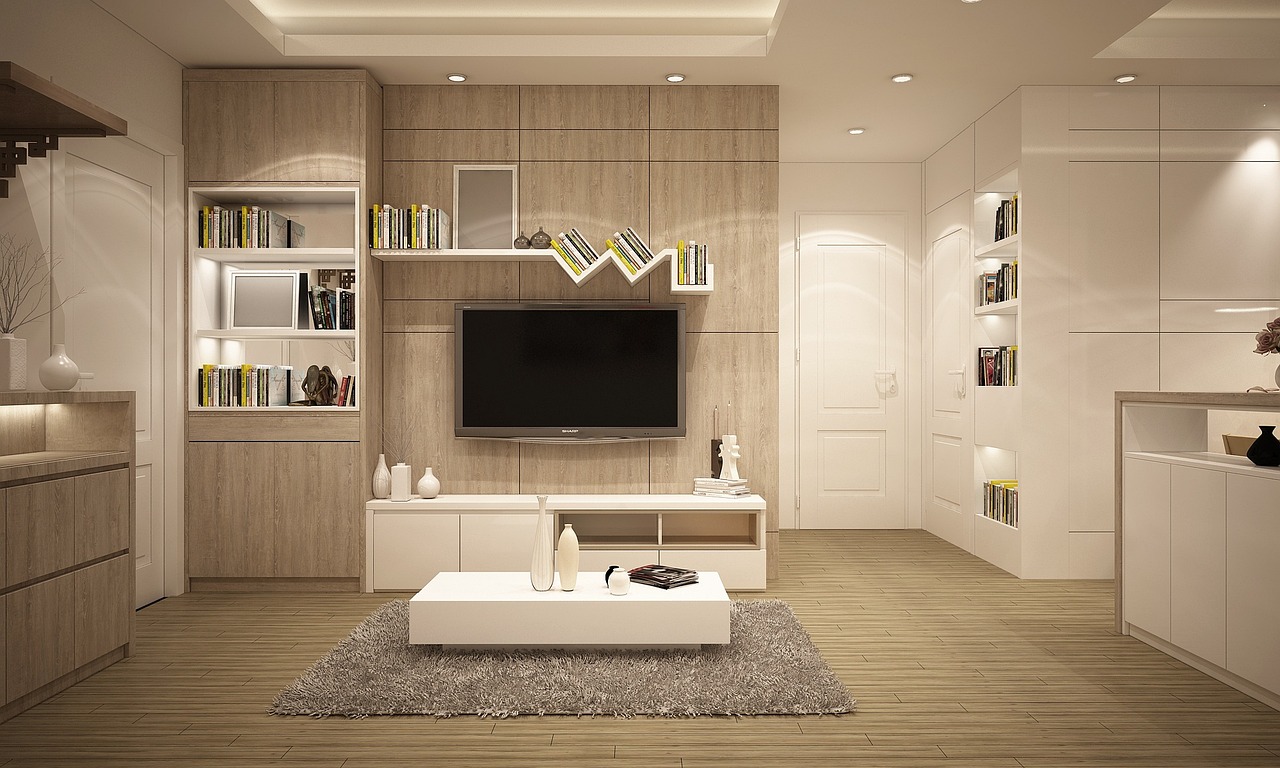
Every room has one wall that does the heavy lifting. In a living room it is usually the longest unbroken wall, the one your seating already faces. Whatever anchors that wall sets the tone for everything else, so the piece you choose for it deserves more thought than the throw pillows will ever get.
Curated is a method, not a mood board
Curated room designs look effortless in photos, yet the calm is not coming from the amount of stuff. It comes from sequence. Designers work big to small, and the sequence is what you are actually admiring when a photo stops you mid-scroll. The mood board approach runs backwards. It collects objects first and hopes the room shows up. A method asks what the room needs, in what order, and skips anything that does not answer that question. That is also why curated rooms lean on clean lines; lines stay clean when the editing already happened, not because someone bought minimal furniture.
The console is the anchor, and everything else orients to it
So why start with the console and not the sofa? The sofa is usually the larger investment, but the console wall is the visual center of gravity. Your TV lives there, your storage lives there, and the sofa will orient toward it whether you plan for it or not. The console also does the most work. It holds the doors, the drawers, and the cable ports, and its top surface collects clutter in direct proportion to how open it is. Get the console wall right and the rest of the room has a direction to follow. Get it wrong and you will spend years rearranging around the mistake. There is a budget argument too. Median renovation spending held at $20,000 in 2025 (2026 U.S. Houzz & Home Study), and a console that locks in the layout protects far more of that spend than another accent chair ever will. I think of the console as the load-bearing wall of the room. It is cheap to get right early and expensive to fix late.
What Should You Measure Before You Shop for a Media Console?
Measure before you browse. That advice sounds obvious, yet most sizing mistakes happen because someone fell for a console that was two inches too deep or a foot too wide, then tried to negotiate with the room afterward. Four numbers and a plan for cables will prevent nearly all of it, and none of it requires more than a tape measure and ten quiet minutes.
One width table to end the conflicting size advice
Start with the wall, not the TV. Measure it in three spots, because baseboards, radiators, and door swings eat width unevenly. Then measure the sofa, since width relative to the seating matters as much as width relative to the screen. TV width comes last, and it is simple geometry. A 65-inch television is only about 57 inches across the bezel because the diagonal number flatters. The table below converts diagonal to real width and matches it to console sizes that exist in the POVISON catalog today.
| TV diagonal | Approx. bezel width | Console width that fits |
|---|---|---|
| 55 inches | about 48 inches | 63 inches (the catalog’s floating console is sized for 55-inch TVs) |
| 65 inches | about 57 inches | 71 inches (the standard size for 65-inch screens) |
| 85 inches | about 74 inches | 71 inches and up (one slatted catalog console is rated for 85-inch TVs) |
I once sized a console from the TV diagonal alone. It looked fine under the screen and swallowed a third of a twelve-foot wall, and the sofa side stayed cramped for a year until I finally swapped it. The wall number would have caught that in advance.
Plan cable routing and closed storage before you buy
Count what actually plugs in. A soundbar, a game system, a streaming box, maybe a subwoofer: each one needs a reachable outlet and a path that does not cross an open shelf. Check rear cable cutouts and ventilation before you fall for a silhouette, because a beautiful console with no cord plan becomes a visible wire nest within a week. Then decide the closed-to-open ratio. Doors and drawers keep the top clear; open shelving invites display, and display invites clutter. If wall-mounted storage appeals to you, a floating media console solves both problems at once, hiding cables in the wall channel while keeping the floor line visible. Whatever you choose, lean toward mostly closed storage so the surface stays reserved for the few objects worth seeing.
One console that already answers most of this checklist is the Aether 71-inch media console with its black matte sintered stone top. The drop-down doors and drawers give every box and controller a closed home, the stone top handles everyday heat and spills, and it ships fully assembled, so the doors sit square on day one instead of six weekends later.
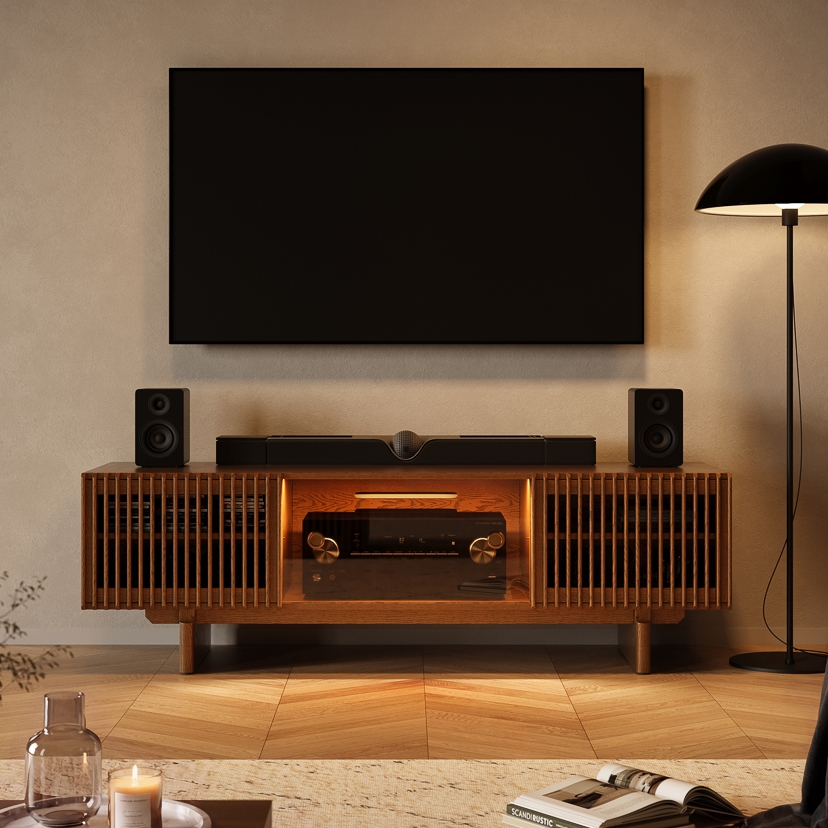
The 71″ Mid-Century Modern TV Stand with storage earns anchor status through discipline: 70.86 inches wide but just over 22 inches tall, it keeps sightlines low so nothing competes with your wall. Warm walnut over plywood, storage that tucks away consoles and clutter, a 250-lb top—and it arrives with only the legs to assembled.
How Do You Get Proportion and Sightline Right?
Two relationships decide whether a console wall feels calm or slightly off: how wide the console reads next to the seating, and where the screen lands relative to your eyes. Both are fixable before purchase, and neither requires a designer, just a sofa, a tape measure, and ten minutes.
Match console width to the sofa, not the TV alone
A console that matches or slightly exceeds the sofa’s width makes the whole wall read as one composition. When the console is much narrower, the TV appears to perch on an afterthought, and the eye registers the imbalance even if it cannot name it. With an 84-inch sofa, a console in the low seventies works well; with a compact 72-inch loveseat, a 63-inch console keeps the ratio honest. Proportion also lives in height and depth. Low and wide reads calmer than tall and deep, and a shallower cabinet protects walkway space in smaller rooms, where every inch of traffic path matters more than a shelf of display.
Set console height from seated eye level
Sit on your actual sofa, not a showroom stool, and notice where your eyes land. That line, not the console’s styling, should drive screen height. The American Optometric Association advises that the top of the screen sit slightly below horizontal eye level (American Optometric Association), which is why a low console under a low-mounted TV feels right the moment you sit down. A console that pushes the screen too high forces a tilted neck within an episode. If your eye level lands high because the sofa sits tall, pick a lower console rather than raising the screen. In a small room this rule matters even more, because a high screen in a tight space dominates everything around it.
The Restraint Pass: Curated Rooms Subtract Before They Style
Once the console is chosen and placed, the instinct is to style it immediately, and that instinct is where curated rooms go to die. Restraint is the step everyone skips, and it is the only step that turns a furnished room into one of those curated room designs you keep saving. Work through it in this order.
Give the console top a negative-space budget
Decide what the top is for before anything goes on it. A workable budget looks like this. The wall art or the screen takes the visual lead, the console top holds two to three objects, and at least half the surface stays empty. Negative space is what lets a single vase or a stack of two books register at all. Every object past the budget spends attention the room does not have. If the top currently holds a speaker, a plant, two candles, a bowl, and a charging pile, the console is working as a shelf, not an anchor, and no amount of styling will fix that.
Edit first: remove one thing before you add another
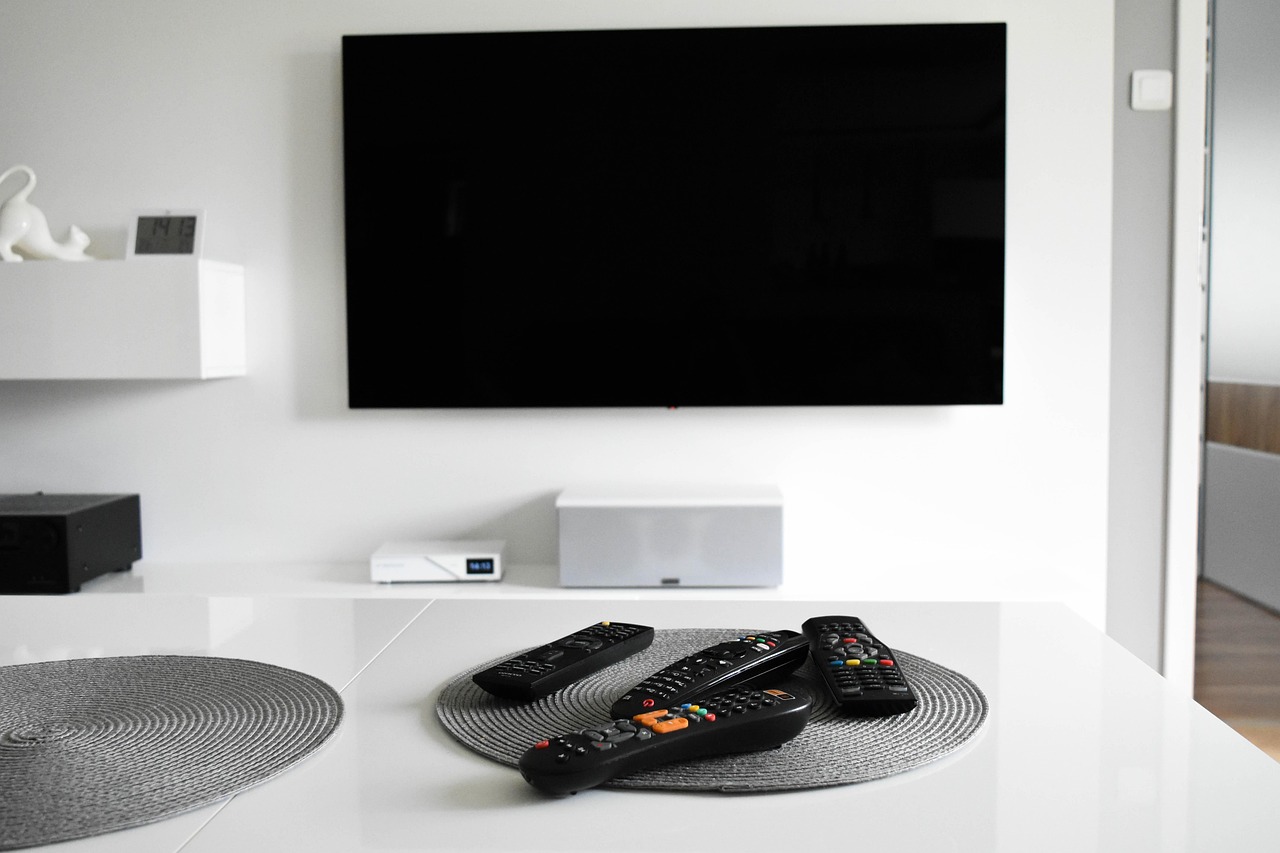
Run one subtraction pass before any shopping trip. Take everything off the console top and the shelves around it, then put back only what you would genuinely miss. In my own living room the honest test was the remote control pile: once it moved into a drawer, the two objects I actually liked on that surface finally registered. Apply the same rule going forward, one in, one out. If a new candle comes home, an old one retires. Closed storage is what makes this sustainable; when cabinets absorb the daily clutter, the surface stays clear without willpower, and living room storage ideas like labeled bins and drawer dividers keep the inside as calm as the outside.
Why Fully Assembled Construction Protects the Composition
Everything in this method assumes the console itself stays true: doors square, shelves level, lines clean. That is exactly where flat-pack assembly fails. Fully assembled construction is therefore a design decision as much as a delivery convenience.
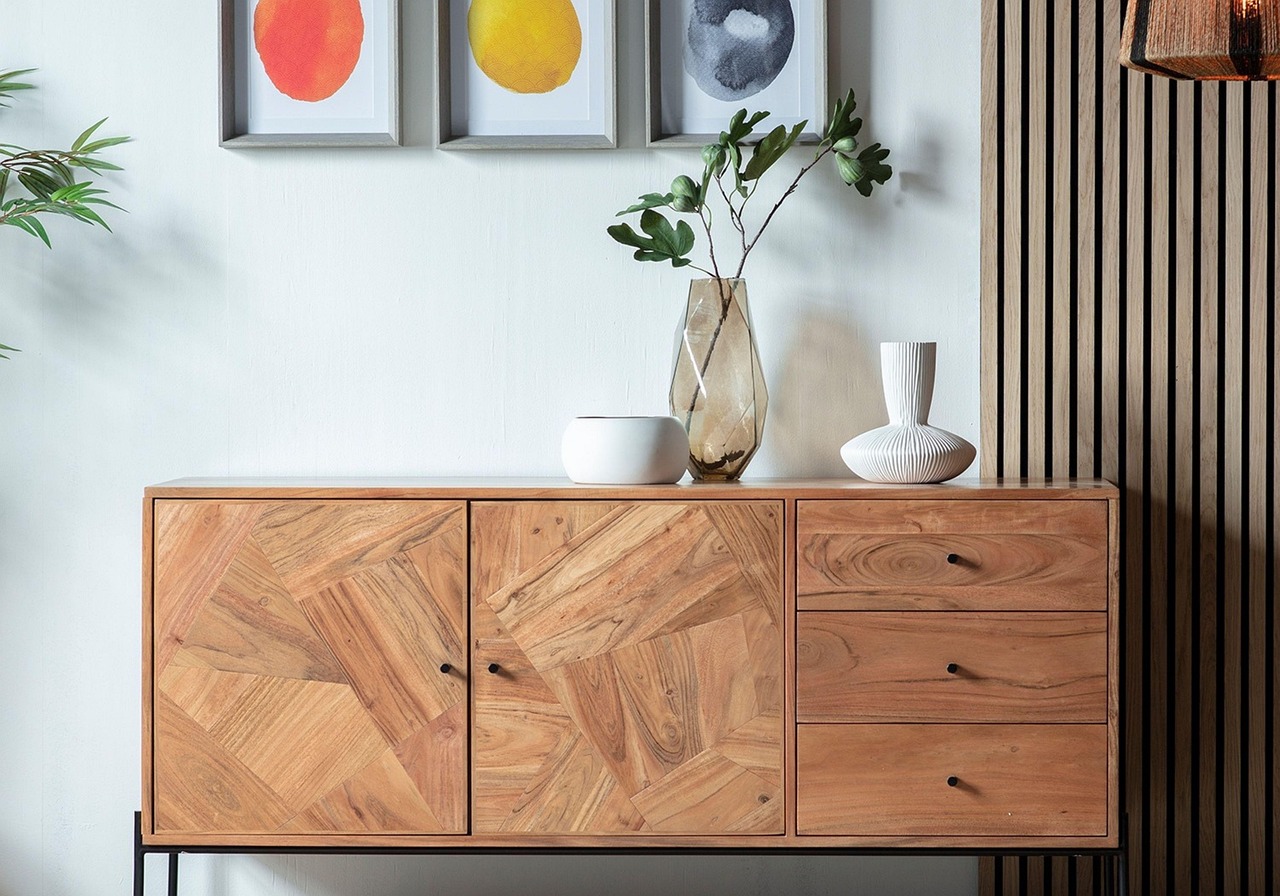
A console that arrives as a stack of panels and an Allen key gives every joint a chance to go wrong. Cam locks sit a half-turn loose, doors hang a few millimeters off square, and a shelf bows under a receiver it was rated to hold. None of it is dramatic, but a curated wall depends on straight lines, and slightly off is enough to break the effect. Fully assembled furniture skips that risk because someone with jigs and press equipment did the joining before the piece ever shipped. Doors align because they were aligned once, correctly, and stayed that way through transit. POVISON builds its whole catalog this way, and the difference shows up in small moments: the gap between doors runs even, LED strips sit straight, and nothing racks after a year of daily use.
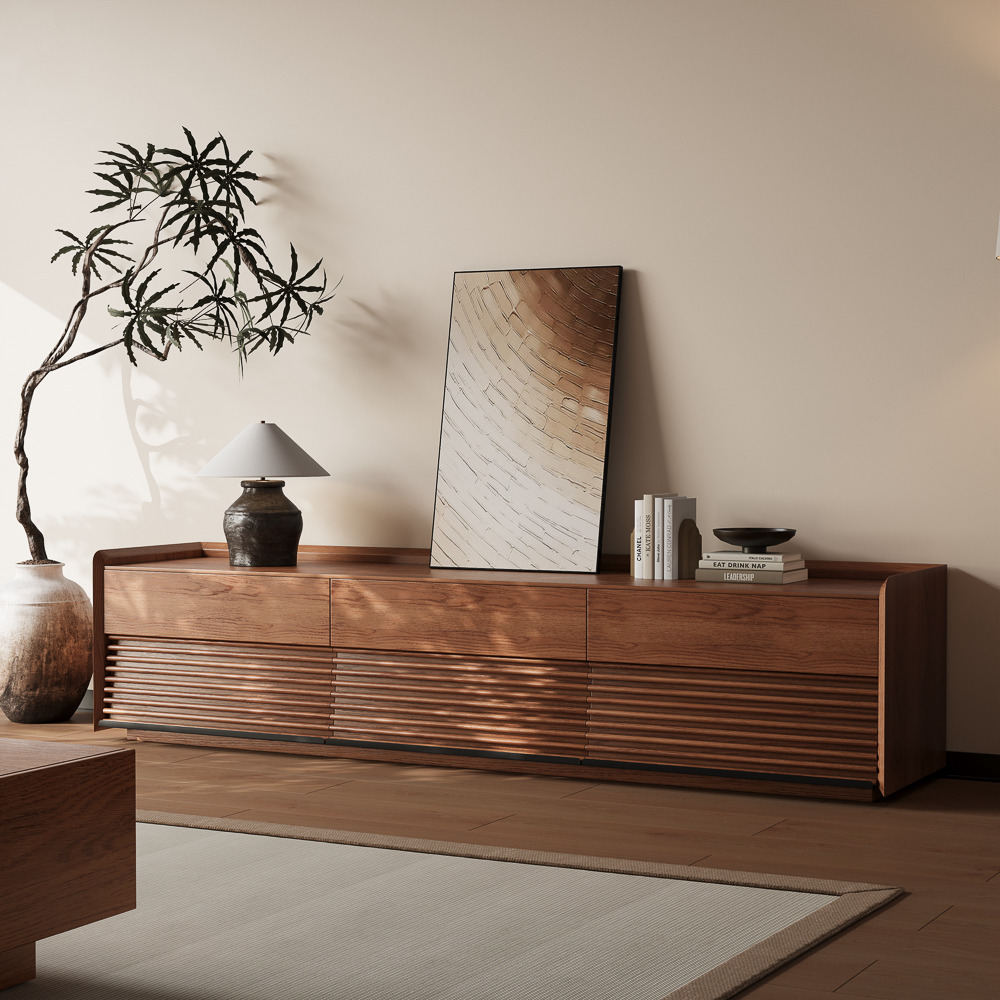
If you want the difference spelled out on a spec sheet, the Ansel 70.87-inch walnut TV console is a clean case. It arrives fully assembled with fluted doors, an adjustable light behind the front panel, and a low, wide footprint sized for 65-inch screens. Nothing needs tightening, aligning, or second-guessing on delivery day. One more thing worth checking while you compare listings: what a brand means by fully assembled. Practices vary across the industry. On POVISON listings it means the complete cabinet, doors aligned and hardware fitted, ready to place and plug in.
Conclusion
Curated room designs come from sequence, not shopping stamina. Measure the wall and the sofa before you browse, pick a console width that holds the proportion, set the screen at seated eye level, then subtract until the top has room to breathe. Choose construction that protects the result, which is where fully assembled pieces quietly earn their keep. Run the four steps in order and the room stops looking arranged and starts looking decided. The console you pick this month will still be setting the tone a decade from now, so it deserves the first decision and the longest look.
Q&A
Should we buy new curated room designs right away?
Only after inventory and shared criteria. Sell or donate duplicates first, then buy one hero piece you both like.
What if our styles clash?
Pick a shared palette and one bridging material. Keep the best piece from each style rather than forcing a total match.
Is fully assembled furniture worth it?
Yes when your timeline is tight. You skip tool time and missing-parts delays during a merge weekend.
How do we split costs fairly?
Inventory what each person owns, then split new purchases by who needs the item most—or 50/50 for shared living-room pieces.
What about duplicates?
Keep better condition or better fit. Photograph the rest, list locally within a week, and donate what does not sell.


