 By Kelvin
Introduction
A receiver rarely operates alone. A complete home theater may also include a power amplifier, streaming box, Blu-ray player, game console, network hub, and media collection. A cabinet that fits one component can quickly become too shallow, difficult to control with the doors closed, or frustrating to service once every cable is connected. The best home theater cabinet should organize the entire system, not merely hide it. This guide compares five cabinets by usable equipment zones, connected depth, remote access, rear serviceability, and the flexibility to accommodate future upgrades.
Table of Contents
What Should a Home Theater Cabinet Handle Beyond a Receiver?
Start by listing every component that must live near the TV. Americans spent an average of 2.6 hours per day watching television in 2025, accounting for half of their leisure time, so equipment access affects a frequently used part of the home (U.S. Bureau of Labor Statistics).
Prioritize these requirements:
- Equipment zoning: Separate heavy components from smaller source devices.
- Connected depth: Include plugs, cable bends, front knobs, and door clearance.
- Control access: Check whether IR remotes work through closed doors.
- Service path: Make sure cables can be reached without unloading the cabinet.
- Expansion space: Reserve an adjustable bay for future devices.
- Shelf capacity: Confirm the limit of each shelf, not only the cabinet top.
Quick Summary Table
| Product Name | Best For | Key AV Features | Price | Rating |
| POVISON Delven Verse Mid-Century Modern TV Stand | Flexible mixed-component systems | Adjustable zones, IR-friendly doors, multiple cable routes | $1,699 ($1,535 with coupon) | 4.93/5 |
| POVISON Delven Axis Deep Vented Rolling Media Console | Heavy systems requiring rear service | Deep interior, removable rear panels, hidden wheels | $1,799 ($1,699 with coupon) | 4.89/5 |
| BDI Corridor Media 8179 | Large premium AV collections | 8–12-component capacity, rear panels, hidden wheels | $3,999 | 4.82/5 |
| Salamander Designs Synergy System Quad 245 | Modular systems with a center speaker | Modular chassis, removable back, dedicated speaker bay | $2,499 | 4.75/5 |
| Burrow Opera Media Console | Streamers and compact game systems | Slatted doors, open-back bays, compact profile | $575 (50% off; regular $1,149) | 4.61/5 |
Prices may vary by region, configuration, and available discounts. Ratings are subjective editorial scores based on each product’s relevant features, usability, and overall value, rather than customer review averages.
5 Best Home Theater Cabinets for Multi-Component AV Systems
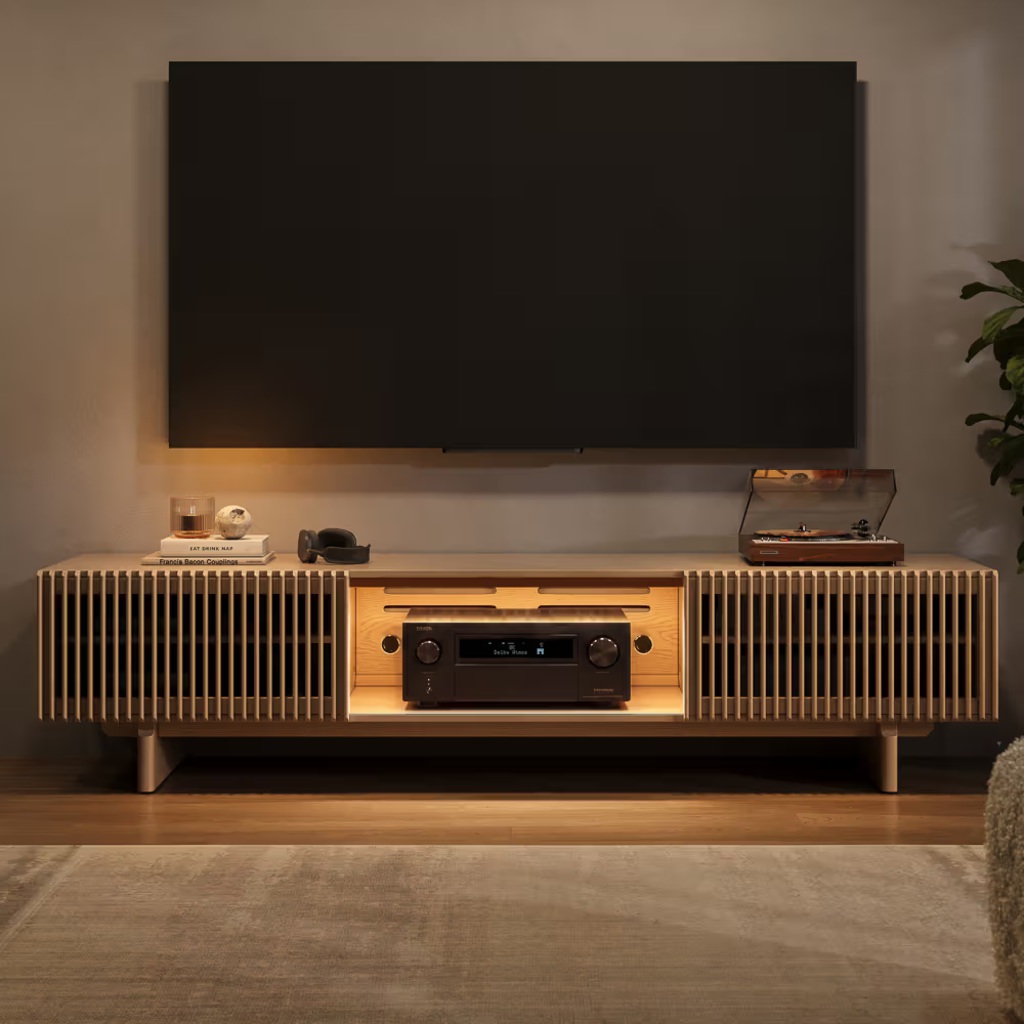
🥇 1. POVISON Delven Verse Mid-Century Modern TV Stand
💲 Price: $1,699 ($1,535 with coupon)
📊 Rating: 4.93/5
👍 Best For: Flexible systems with mixed AV source devices
✨ Highlights
- Three equipment cabinets with two removable shelves
- Six internal and three rear cable openings
- IR-friendly slatted and tempered-glass doors
- 250-pound desktop capacity
- Main cabinet arrives assembled; only the legs require attachment
‼️ Limitations
- The exterior depth needs more floor space than a slim TV stand
- The package requires two adults for easier handling
🎯 Why This Rating: The Delven Verse treats a home theater as a group of differently sized components. Its removable shelves can create taller receiver or speaker bays while retaining smaller zones for streaming boxes, disc players, or game consoles. Multiple cable paths also let connected devices reach power and signal routes without sharing one crowded opening. The Delven principle—“Every Device. One Home.”—is especially clear here: the cabinet adapts to the system instead of forcing every component into identical compartments.
🗨️ Buyer review:“The larger depth and spacious cabinets allow for plenty of room for A/V Receiver, Blu-Ray Player, Turntable, Cable box…” — Jim
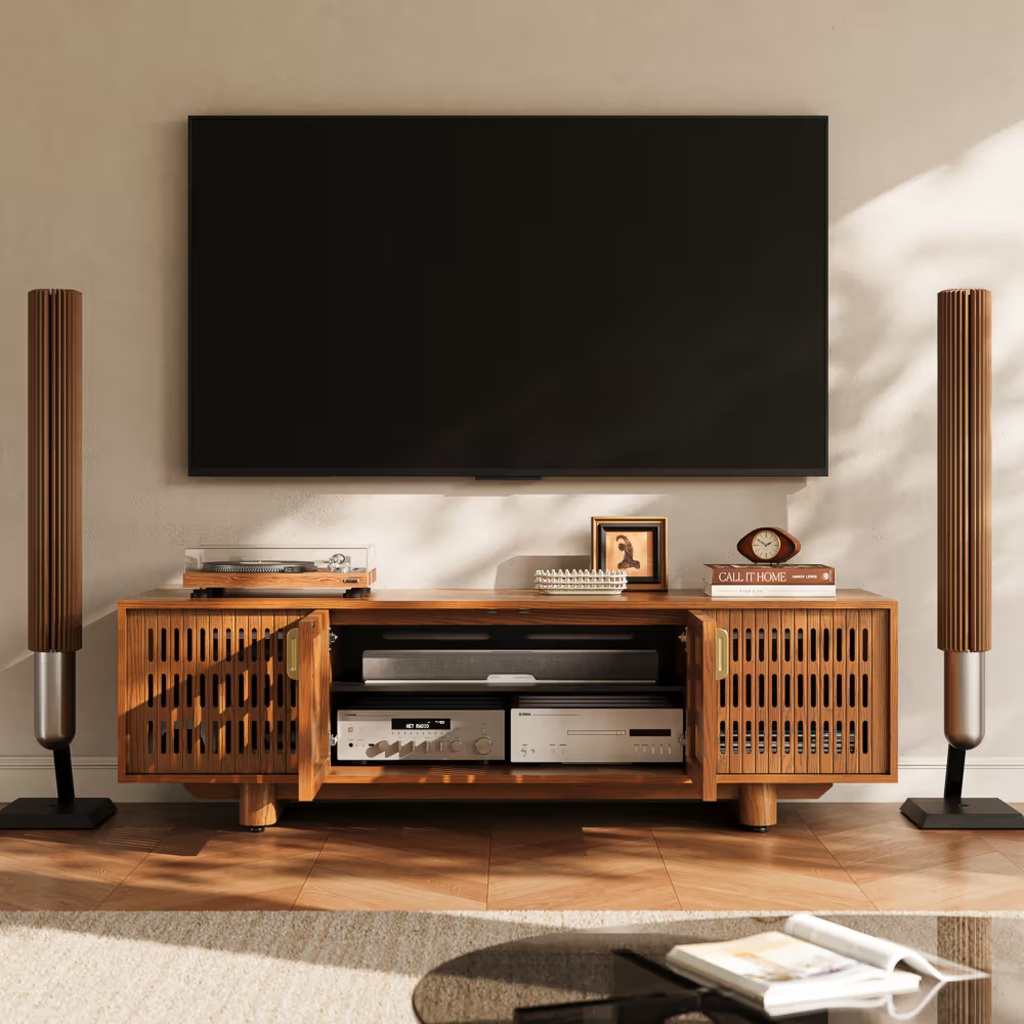
🥈 2. POVISON Delven Axis Deep Vented Rolling Media Console
💲 Price: $1,799 ($1,699 with coupon)
📊 Rating: 4.89/5
👍 Best For: Heavy AV systems needing frequent rear access
✨ Highlights
- 18.7-inch interior depth for larger components
- Removable rear panels
- Hidden high-capacity locking wheels
- Metal shelving and all-around slotted ventilation
- IR-friendly slatted doors
- Six internal and three rear cable openings
‼️ Limitations
- The 20.5-inch exterior depth is unsuitable for very shallow media walls
- Its 143.3-pound packaged weight makes two-person placement advisable
🎯 Why This Rating: The Delven Axis prioritizes the part of ownership that many cabinets neglect: servicing a fully connected system. In a setup containing a receiver, separate amp, console, and disc player, the removable panels and hidden wheels reduce the need to unload the cabinet before changing HDMI or speaker cables. Compared with many specialist AV cabinets, it combines deep storage, rear access, and concealed mobility at a lower listed price, giving POVISON an advantage in practical daily use and long-term value.
🗨️ Buyer review:“The slatted doors hide all my components without blocking the remote signal, so I never have to leave the doors open.” — Selah
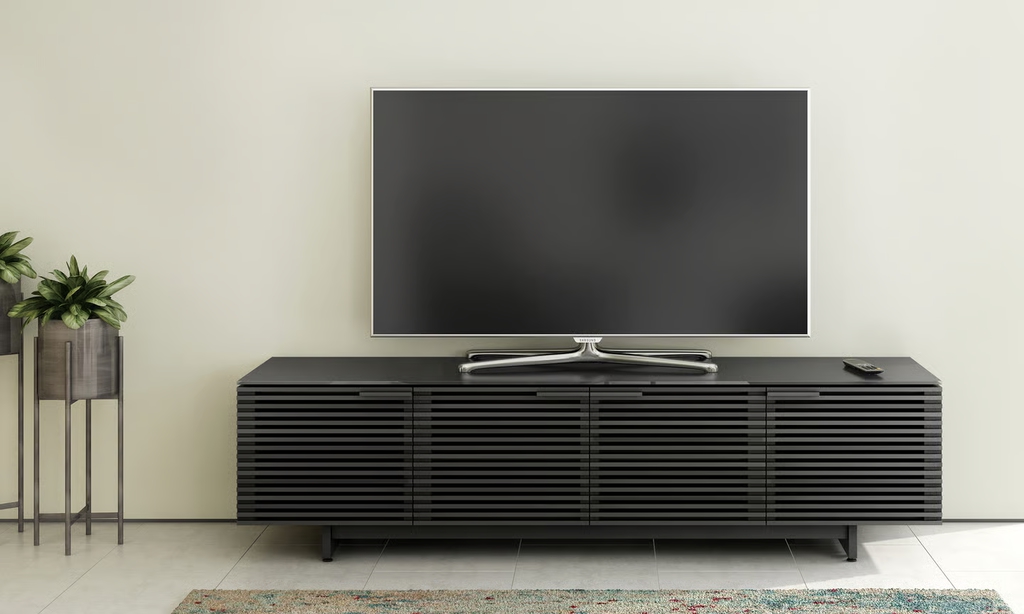
🥉 3. BDI Corridor Media 8179
💲 Price: $3,999
📊 Rating: 4.82/5
👍 Best For: Large premium systems with many components
✨ Highlights
- Published capacity for 8–12 components
- Three adjustable shelves
- 18.25-inch-deep side compartments
- Removable rear access panels and cable channels
- Flow-through ventilation
- Hidden wheels with integrated levelers
‼️ Limitations
- The cabinet weighs 216 pounds
- Its 28.25-inch height can raise a tabletop TV above a low seating position
- The 16-inch-deep center compartment is shallower than the side bays
🎯 Why This Rating: Corridor 8179 offers enough horizontal space to separate a receiver, amplifier, disc player, streamer, and accessories rather than stacking them. The side compartments provide the better location for deeper equipment, while rear panels and hidden wheels simplify connection changes. Its hardwood louvers, tempered-glass top, and steel base give it a more furniture-focused finish. It is a strong premium choice for buyers who need substantial capacity and are prepared for its height and considerable installed weight.
🗨️ Buyer review:“Very high quality and high functioning piece of furniture.” — PostComa
4. Salamander Designs Synergy System Quad 245
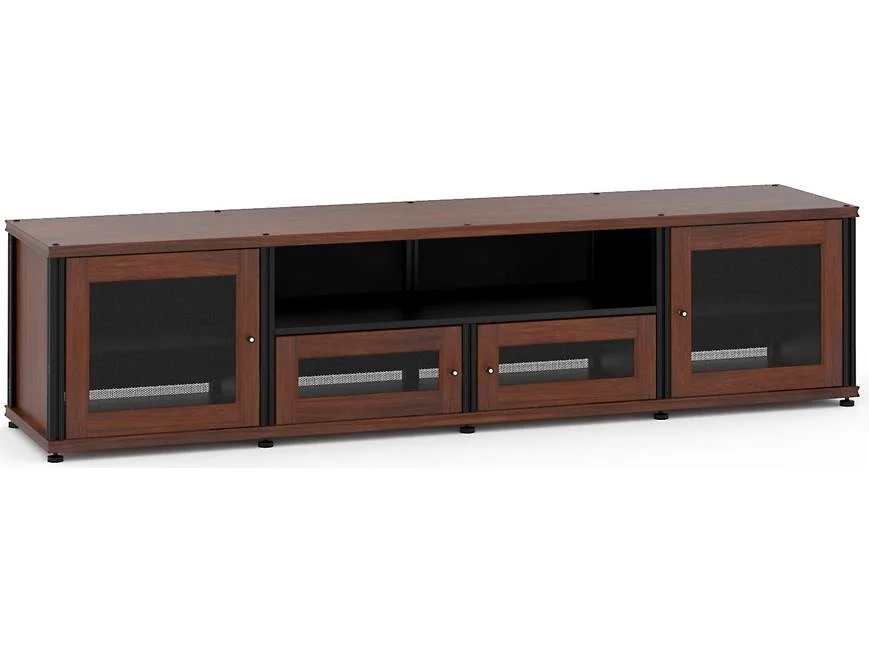
💲 Price: $2,499
📊 Rating: 4.75/5
👍 Best For: Modular systems requiring a center-speaker bay
✨ Highlights
- Four component compartments
- Open compartment for a center-channel speaker
- Adjustable interior shelves
- Removable doors and rear panels
- IR-friendly perforated metal doors
- Aluminum support chassis
‼️ Limitations
- Full assembly is required
- The 87-inch width needs a long media wall
- Several owners report inaccurate assembly instructions
🎯 Why This Rating: Synergy Quad 245 is most useful when the speaker layout determines the cabinet layout. Its open center section gives a large center-channel speaker a dedicated position, while four surrounding compartments divide source devices and amplification. Removable panels make equipment changes more manageable, and the modular frame supports future reconfiguration. The tradeoff is a more involved installation process, so it suits enthusiasts who value modularity and speaker integration enough to accept additional setup work.
🗨️ Buyer review:“The cabinet holds a ton of gear, wood in walnut is beautiful but subtle and it’s very easy to assemble.” — Eric
5. Burrow Opera Media Console
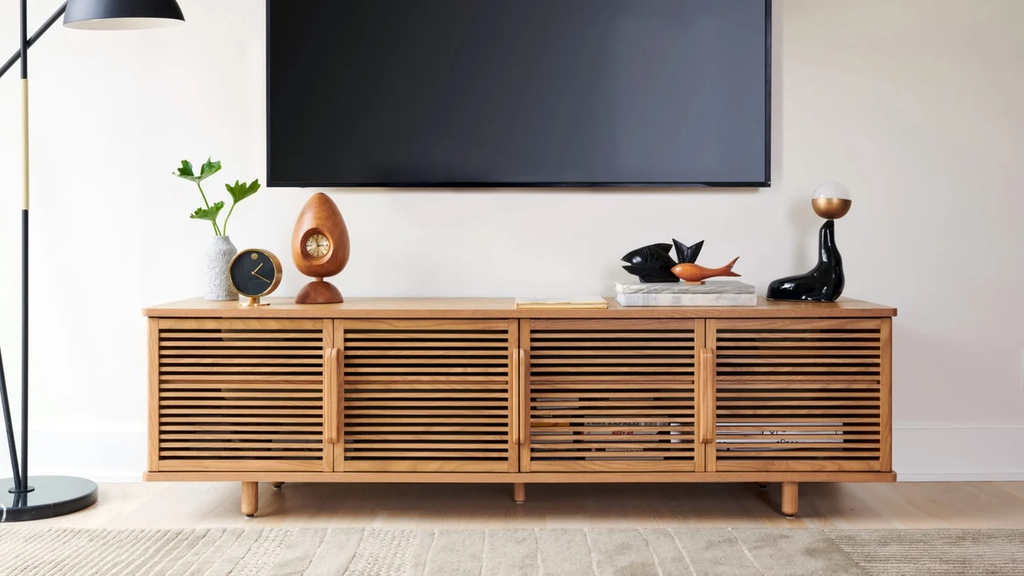
💲 Price: $575 (50% off; regular $1,149)
📊 Rating: 4.61/5
👍 Best For: Compact streaming and game-console setups
✨ Highlights
- 70-inch-wide furniture-style design
- Ventilated slatted doors
- Open-back equipment bays
- Integrated cord organization
- Compact 17-inch overall depth
‼️ Limitations
- The interior is only 15 inches deep
- Eight-inch shelf height restricts taller components
- Assembly is required
🎯 Why This Rating: Opera works best when the system consists of compact streamers, game consoles, controllers, and a modest audio device. Its slatted doors and open-back bays address airflow and cable access without giving the cabinet a technical appearance. However, its 15-inch interior depth leaves limited room for a full-size receiver once rear connectors are installed. Buyers planning a receiver-plus-amplifier system should choose a purpose-built deeper cabinet instead of relying on Opera’s wider but shallower storage.
🗨️ Buyer review:“This console is solid and well made. The packaging was impressive and protected the furniture. Assembly was simple.” — Amy Scott
How Should You Match Cabinet Zones to Your AV System?
A cabinet’s total storage volume matters less than whether each usable zone matches a real component. Assign the deepest and strongest positions first, then place lighter source devices where they remain easy to operate. If a center speaker will share the furniture, settle its center channel speaker placement below the TV before assigning the remaining compartments.
| Equipment Combination | Recommended Zoning | Main Buying Concern |
| Streamer + Blu-ray player + game console | Separate accessible shelves for each source | Remote and controller access |
| AVR + Blu-ray player + game console | AVR in the deepest supported bay | Connected depth |
| AVR + power amp + multiple sources | One heavy component per supported zone | Individual shelf capacity |
| Frequently upgraded system | Adjustable bays with one reserved position | Rear access and expansion |
Measure installed depth as:
Component chassis + rear connector + cable bend + front-control clearance
That total is more useful than the bare chassis measurement. A component that fits before connection may still press against the back panel or prevent the front door from closing.
What Should You Check Before the Cabinet Reaches the Wall?
Run a dry layout before placing or loading the cabinet. This catches conflicts while the rear remains accessible and helps protect the surrounding floor space. Cabinet position can also affect subwoofer placement beside the media console, so avoid turning the adjacent floor area into a permanent cable-service aisle.
- Measure every device with its normal rear connectors attached.
- Assign each heavy component to a shelf with a confirmed load rating.
- Map the power strip, HDMI connections, speaker wires, and network cables.
- Trace how each cable could be replaced after installation.
- Test IR, Wi-Fi, and Bluetooth performance with all doors closed.
- Confirm that doors, panels, and wheels can operate without striking the wall.
- Follow each component manufacturer’s required operating clearances.
- Reserve usable depth and shelf capacity for at least one future device.
Conclusion
The right home theater cabinet makes a multi-component system easier to use without turning the living room into an equipment area. Start with the devices, measure them after connections are attached, and choose zones that support both daily control and future access. A well-planned cabinet keeps the room visually calmer, makes upgrades less disruptive, and creates a more comfortable entertainment space for everyday viewing, gaming, and listening.
Find the Right Media Console
Explore designs for different room sizes, layouts, and everyday needs.
FAQ
When Is an AV Rack Better Than a Cabinet?
An AV rack is better for rack-mountable equipment, dedicated equipment rooms, or systems requiring frequent four-sided access. Choose a home theater cabinet when components must remain concealed beneath the TV in a finished living space.
Will Wi-Fi Work Behind Closed Cabinet Doors?
Wi-Fi may work behind closed doors, but IR-friendly openings do not guarantee wireless reliability. Metal panels and router distance can weaken reception. If performance drops, relocate the network hub outside the cabinet or connect fixed streaming devices through Ethernet.
Can a Game Console Stand Vertically Inside a Cabinet?
A game console can stand vertically only when its manufacturer supports that orientation and the cabinet leaves every intake and exhaust opening clear. Measure the required height with the original stand, cables, and connectors attached.
Should a Home Theater Cabinet Be Anchored?
Anchor the cabinet whenever its manufacturer requires it, especially when a television sits on top or children and pets use the room. Install the supplied anti-tip hardware into the wall structure specified by the instructions.
Can a Rolling Home Theater Cabinet Sit on Carpet?
It can sit on carpet, but thick pile may restrict movement and reduce caster stability. Keep the cabinet stationary during normal use and treat hidden wheels as occasional service access rather than a daily mobility feature.


[…] cabinet passes a fit test for depth, ventilation, and cable clearance. This guide helps first-time home theater buyers compare deep media consoles before they buy and choose a setup that looks calm and works […]
[…] extra-wide or deeper media console can bridge the gap between a basic stand and a full wall unit, adding equipment storage while […]
[…] cabinet can be low but deep enough for home theater equipment, or shallow while still being too tall for a large television. Check each dimension […]
[…] increases the need for deeper storage, ventilation, and accessible rear connections. Choosing a home theater cabinet for multi-component AV systems becomes more important as the setup […]