 By Stephanie
Table of Contents
A center speaker can sound wrong even when the rest of your home theater is set up well. The usual problem is not the speaker itself—it is the conflict between TV height, furniture, and where the speaker actually fits. Good center channel speaker placement keeps dialogue connected to the screen without forcing your TV too high or burying the speaker inside a cabinet. This guide shows how to choose between above-TV, below-TV, and media-console placement, then adjust height, angle, and furniture fit for a real living room.
What Makes a Good Center Channel Speaker Position?
For most rooms, start with three placement checks:
- Center it with the screen. Avoid shifting the speaker to one side just to make room for decor or another device.
- Keep it close to the picture. A large vertical gap can make voices feel disconnected from the people speaking on screen.
- Aim it toward the main listening position. The speaker should direct dialogue toward where you normally sit.
In most living rooms, the screen occupies the space where the center speaker would ideally sit. The practical goal is to find the closest workable position without blocking the screen or compromising comfortable viewing.
Should the Center Speaker Go Above or Below the TV?
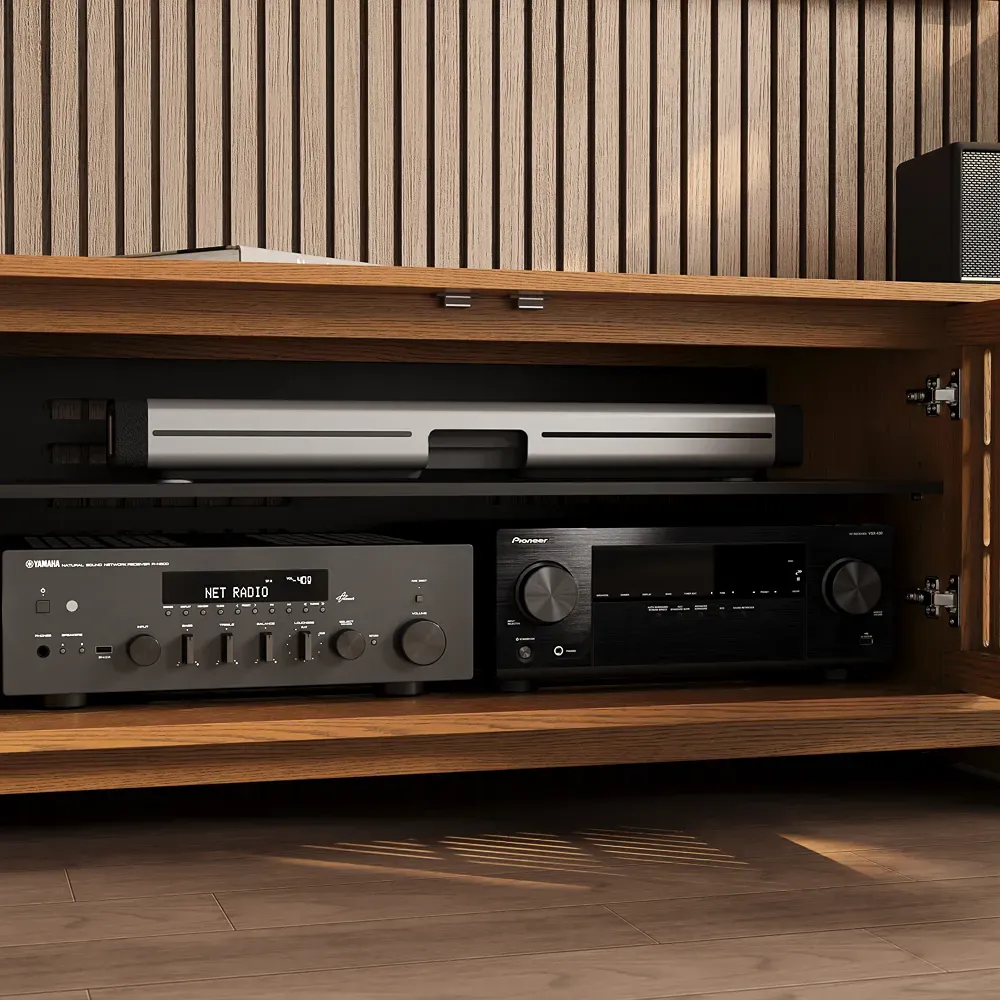
Either position can be appropriate, but the better one depends on your TV height, furniture, and whether the speaker can stay unobstructed and aimed toward the seating area. Dolby recommends placing the center speaker just above or below the TV so dialogue stays closely connected to the action on screen (Dolby).
Below the TV is often easier in a conventional living room because the speaker can sit on a console and remain close to the screen. Above-TV placement becomes more useful when furniture blocks the lower position or when fitting the speaker underneath would force the television uncomfortably high.
| Your Setup | Better Starting Point | What to Check |
| Wall-mounted TV over a low console | Below TV | Angle the speaker upward |
| TV sitting directly on the console | Below TV if clearance allows | Make sure the speaker does not block the screen |
| Console or furniture blocks the lower position | Above TV | Angle downward toward listeners |
| TV is already mounted high | Below TV | Avoid raising the screen farther |
| Acoustically transparent projector screen | Behind screen | Follow the screen and speaker maker’s instructions |
For center channel speaker placement below TV, avoid raising the screen simply to bring the speaker closer to ear level. Keep the TV at a comfortable viewing height first, then use the available space below it for the speaker.
This matters with deep sectionals and recliners, where your relaxed viewing position may already be lower than expected. If the furniture is pushing the screen too high, a low-profile TV stand for large TVs and low seating can create more usable space beneath the TV without making the entire setup taller.
How High and How Far Forward Should It Sit?
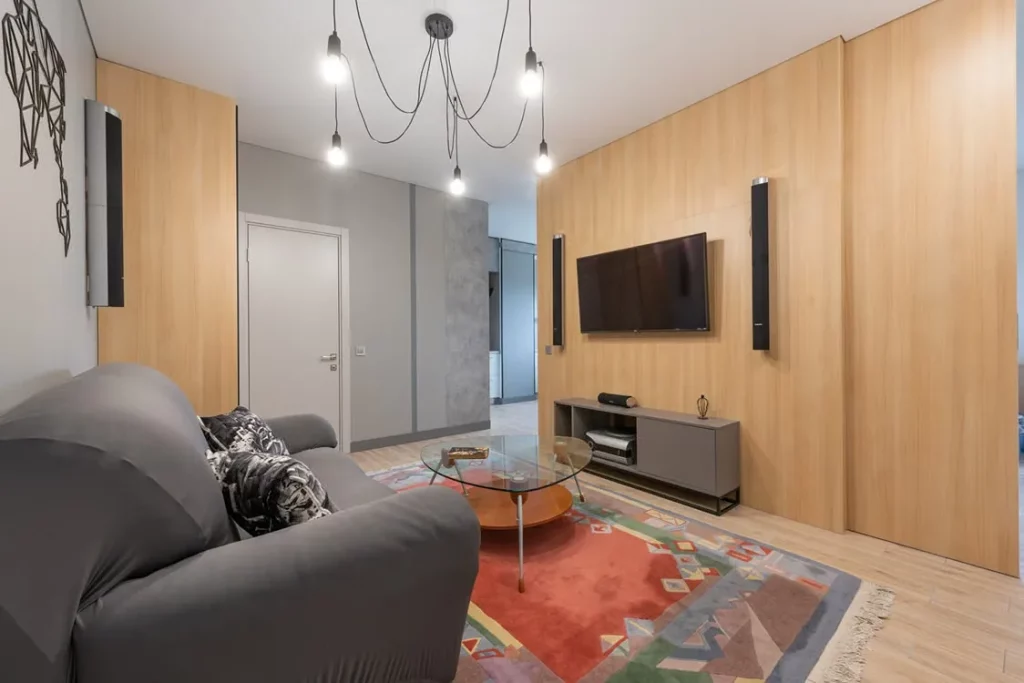
Height and shelf position solve different problems. Aim the speaker toward your normal seated position, then make sure the console does not push it too far back.
Measure Your Real Listening Height
Sit where you normally watch TV and settle into your usual posture. If you lean back into a sectional or recline while watching, measure from the floor to your ears in that position rather than while sitting unusually upright.
Compare that height with the center speaker’s tweeter. If the speaker sits well below your ears, angle it upward; if it sits above the TV, angle it downward. The goal is not to match a universal height number but to direct the speaker toward the position where you actually listen.
If the screen itself is creating the mismatch, start by choosing the right TV stand height before making larger changes to the speaker setup.
Keep the Front of the Speaker Clear
Do not push a center speaker deep onto a console simply because the surface gives you extra room. SVS recommends positioning a center channel flush with the front edge of the furniture rather than recessing it farther back (SVS).
Bring the speaker’s front face close to the console edge while keeping it stable and fully supported. If framed photos, a game console, or decor are taking up that space, move those items first instead of pushing the speaker backward. For an enclosed shelf, check the usable depth with the speaker connected so cables do not force it deeper into the cabinet.
Can a Center Speaker Go Inside a Media Console?
Yes, but “it fits inside” is not enough. The speaker needs a clear path toward the room, enough usable depth for its cabinet and connections, and a position that does not leave it recessed behind a shelf lip or solid door.
Use this hierarchy when you have several options:
- On top of the console: usually the simplest furniture placement because the front of the speaker stays open.
- Fully open front shelf: workable when the opening fits the speaker and lets you bring it forward.
- Slatted or perforated front: potentially workable, but do not assume it is acoustically transparent.
- Solid closed door: generally avoid during listening because the front of the speaker is obstructed.
Door construction varies, so treat a slatted or perforated front as something to verify rather than a guarantee of unobstructed sound.
The same cabinet may also hold a receiver, game console, or streaming hardware. In that case, choose a media console that fits an AV receiver without letting those components or their cables force the center speaker farther backward.
When larger AV components start crowding the center speaker, the furniture should adapt—not the speaker position. The POVISON Delven Axis Deep Vented Rolling Media Console gives oversized AV receivers 18.7 inches of interior depth, while ventilated metal shelves and removable rear panels make heat and cable management easier without forcing the speaker deeper into the cabinet.
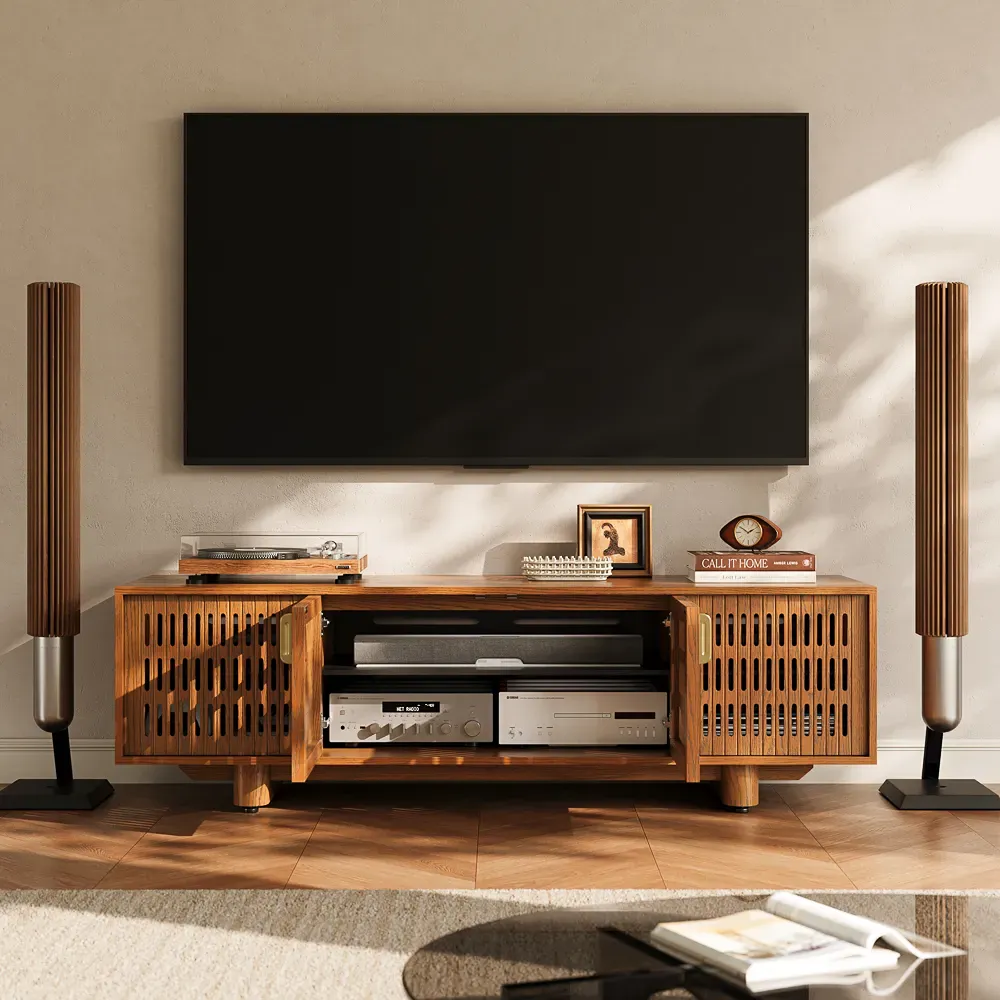
Delven Axis Deep Vented Rolling Media Console
Keep your center speaker where it belongs while the rest of your AV setup stays organized and easy to access.
Will Your TV Stand Preserve the Center Speaker Position?
When choosing a TV stand for a center channel speaker, look beyond whether the speaker simply fits. Once the TV, receiver, cables, and other components are installed, the furniture should still let the center speaker stay forward, unobstructed, and properly positioned.
Check these five points before buying:
- Clear opening: Measure the usable width and height inside the shelf, including door frames and dividers.
- Screen clearance: If the speaker sits on top, include any isolation pad or angled support when checking clearance below the TV.
- Usable placement depth: Check that the speaker and its connected cables fit without requiring the front face to sit far behind the cabinet edge.
- Rear connection room: Allow for plugs, cable bends, and any rear clearance required by the speaker manufacturer.
- Space after other gear is installed: Confirm that the receiver, game console, and cables will not take over the position reserved for the center speaker.
If the center speaker and other AV components need to share one console, the POVISON Delven Verse 71″ Mid-Century Modern TV Stand gives you more control over which equipment gets the taller bay. Its two internal shelves can be repositioned or removed, so you can make room for taller components without sacrificing the open, forward-facing area reserved for the center speaker.
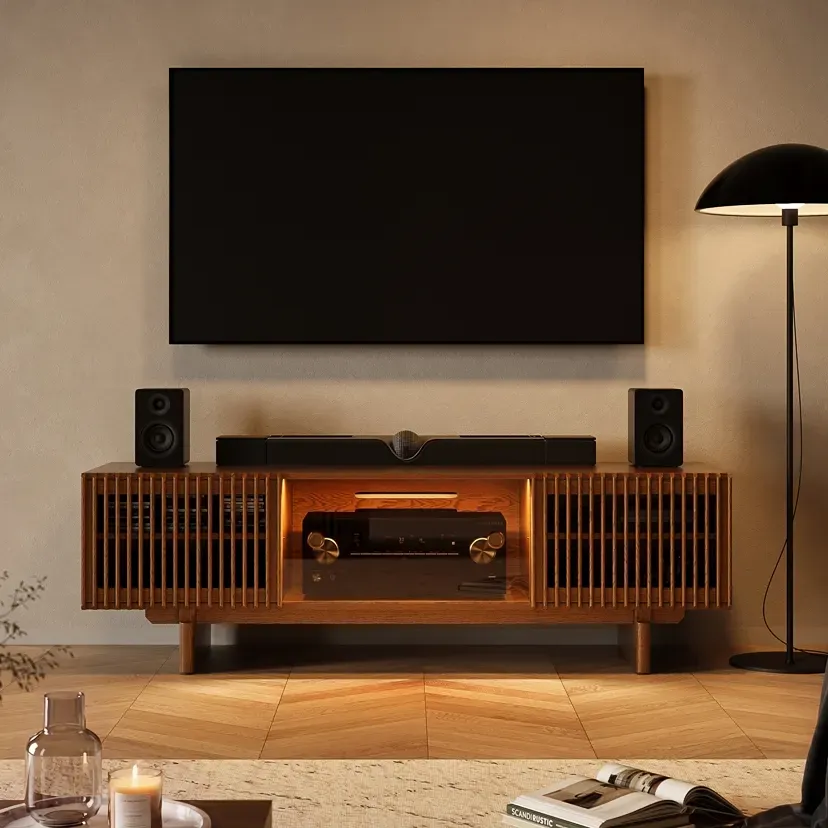
Delven Verse 71″ Mid-Century Modern TV Stand
Adjust the interior around your AV gear without giving up the space your center speaker needs.
How Do You Test the Placement Before You Finalize It?
A setup that looks correct still needs a listening check. Before permanently mounting anything or rerunning room correction, use the same dialogue-heavy scene and change only one variable at a time. This makes it easier to tell whether the speaker’s height, angle, shelf position, or cabinet is actually affecting what you hear.
- Start from your normal seat. Voices should feel connected to the screen rather than obviously coming from above or below it.
- Test the angle. Make a small upward or downward adjustment without moving the speaker sideways.
- Test the front edge. If it sits on a shelf, move it forward and listen again.
- Compare cabinet doors open and closed. If the speaker sits behind a slatted or perforated front, use the same scene for both tests.
- Check a second seat. Make sure improving the main listening position has not made dialogue noticeably worse for the rest of the sofa.
Once the physical placement is settled, rerun your AV receiver’s room-correction or speaker-calibration process if available. Calibration should refine a workable physical setup, not compensate for an obstructed speaker.
Conclusion
Good center channel speaker placement does not require every dimension to be acoustically ideal. Start with a clear, centered position close to the screen, then correct a low or high speaker by aiming it toward the seats rather than sacrificing comfortable TV height. If furniture is part of the setup, make sure the speaker can stay forward and unobstructed after every component is connected. The right media console should preserve that position—not force the speaker to adapt to the cabinet.
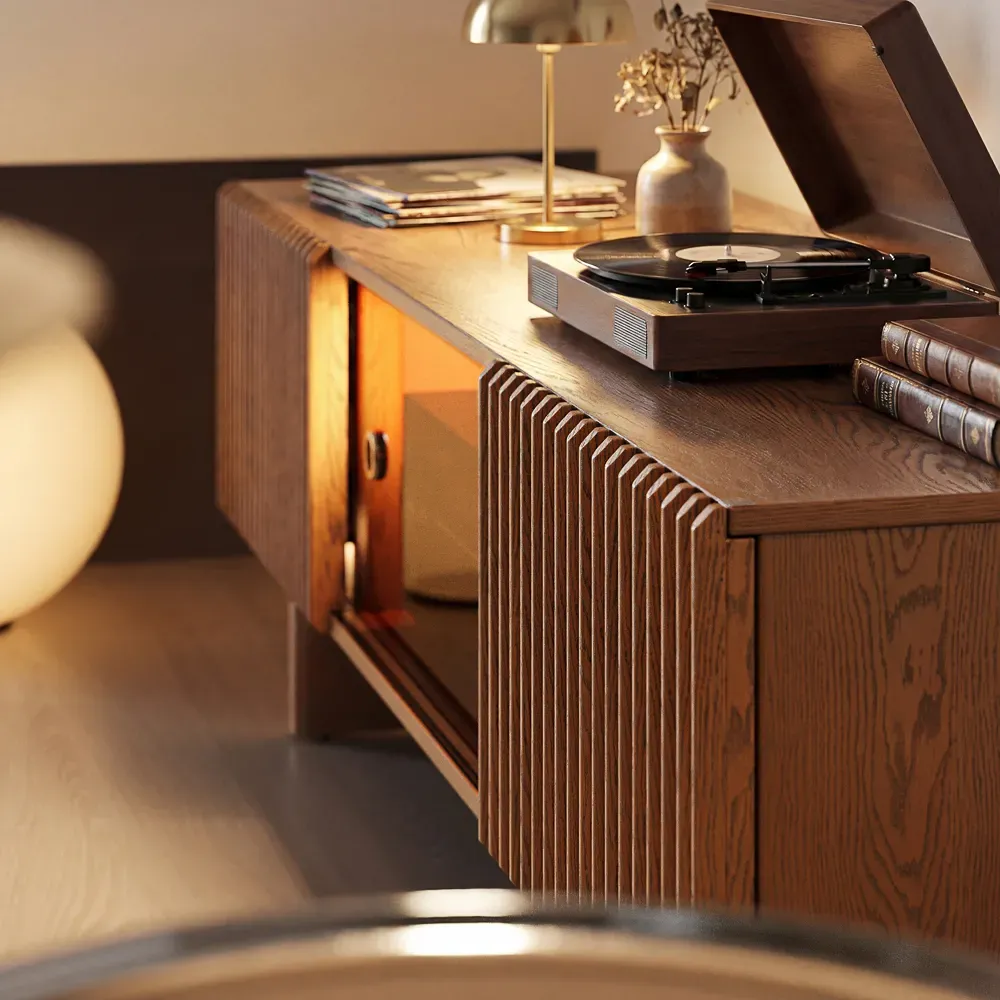
Build a Better Entertainment Setup
Explore media consoles designed for organized storage, ventilation, and modern entertainment equipment.
Q&A
Does a tilted center speaker need extra shelf height?
Yes. Measure the speaker after placing it on the wedge, isolation pad, or angled support you plan to use. The highest edge—not the speaker’s un-tilted height—determines the opening you need. Leave enough clearance to adjust the angle without the speaker touching the shelf above it.
Should I use isolation pads on a wood media console?
Use them when the speaker causes audible cabinet vibration or resonance. Correct the position and angle first, then choose isolation supports rated for the speaker’s weight and wide enough to keep it stable. Wood alone is not a reason to add pads; an actual vibration problem is.
What if the TV pedestal blocks the center speaker?
If a center pedestal occupies the space where the speaker needs to sit, do not squeeze the speaker around the base or shift it noticeably off-center. Check whether the TV can be safely wall-mounted or used with a compatible stand, or move the center speaker above the screen instead.
Can I put a center speaker on the floor?
Use the floor mainly for temporary testing. The low position requires a steep upward angle and leaves the speaker exposed to feet, pets, vacuums, and everyday traffic. A stable console, shelf, rated speaker stand, or manufacturer-approved mount is usually safer for permanent placement.
Which seat should I aim the center speaker toward?
Aim toward the main viewing position. For a sectional used by several people, use the center of the primary seating zone rather than one end seat. If one recliner is used most often, set the angle for that person’s normal reclined position instead of an artificially upright posture.


[…] devices where they remain easy to operate. If a center speaker will share the furniture, settle its center channel speaker placement below the TV before assigning the remaining […]
[…] Center speaker or compact soundbar […]