 By Stephanie
Introduction
Choosing a coffee table for reclining sofa seating is less about following a standard size rule and more about protecting the room’s moving parts. A table may look perfectly proportioned when the sofa is upright, then become an obstacle the moment the footrest extends. The right setup gives you a place for drinks, remotes, laptops, and snacks without blocking comfort, walking space, or a sofa bed conversion. Start with how your seating moves, then choose the table shape, depth, and mobility that support the way your living room is actually used.
Can You Use a Coffee Table With a Reclining Sofa?
Yes, but the table has to be planned around how the sofa moves—not just how the room looks when everything is upright. A reclining sofa needs room for the footrest to extend, for someone to stand up comfortably, and for other people to walk through the space without squeezing around furniture. That means a coffee table can look perfectly proportioned beside a closed sofa and still feel wrong the moment someone reclines.
The safest approach is to treat the fully open recliner as the sofa’s true working size. Before choosing a table, check whether the layout still supports everyday reach, full footrest extension, and a clear path through the room. The next section breaks that decision down into a simple three-zone test.
Coffee Table Clearance for Reclining Sofas
A reclining sofa needs more than a standard sofa-to-table gap. The layout has to work when you are sitting upright, when the footrest is open, and when someone walks through the room. Use the Three-Zone Rule to test those moments before you buy, so the room feels comfortable in use—not just balanced in a photo.
Zone 1: Create a Comfortable Reach Zone
Start with the sofa in its closed position. This is when the coffee table should feel easy to use for coffee, remotes, books, phones, and snacks.
For most living rooms, start with about 14–18 inches between the front of the seat and the table edge. A shallower sofa may feel comfortable closer to 14 inches, while a deep reclining sofa may need more room. Sit where you normally sit and reach for the table. You should not have to slide forward on the cushion or stretch across your knees to set down a drink.
Zone 2: Protect the Full Recline Zone
Next, open the recliner fully and measure from the front of the footrest to the nearest table edge. Avoid using contact alone as a test. A table can clear the footrest and still make the seating feel cramped.
The layout works only when you can:
- Rest your legs naturally without bending around the table.
- Lean forward and stand up without twisting around a corner.
- Use a throw blanket without it catching on the table.
- Keep toys, pet beds, and loose items out of the footrest path.
Wall-hugger recliners need less room behind the sofa, but they can still move forward as they open. Plan around the sofa’s fully extended depth, not its closed depth. The same principle applies when measuring front clearance for a recliner sofa and sofa bed.
If the table has to move every time someone reclines, treat the room as a movable-table layout rather than a fixed coffee table layout.
Zone 3: Keep the Walkway Zone Open
Finally, test the path through the room with the footrest open. Walk from the sofa to the kitchen, hallway, doorway, or TV console. If people have to turn sideways, step over furniture, or wait for the recliner to close, the layout is too tight.
When space allows, aim for about 36 inches along the main path. That gives people room to move comfortably while someone is reclining.
A coffee table works only when it passes all three tests: easy reach, full recline, and a clear walkway. If one test fails, choose a shallower table, nesting tables, a wheeled design, or side tables that keep the center of the room open.
Coffee Table Shapes for Reclining Sofas
The right shape depends on how many seats recline, how often they recline, and how much traffic moves through the room. Shape affects more than style. It determines where corners land, how easily people can pass by, and how much floor space remains available when the footrest is open.
| Table Type | Best For | Main Benefit | Watch Out For |
| Round or oval | Tight rooms and reclining loveseats | Softer traffic flow and fewer sharp corners | May feel too small for long sofas |
| Slim rectangular | Long power reclining sofas | Gives several seats a shared surface | Depth must stay outside the footrest path |
| Nesting tables | Flexible rooms and shared seating | Expands when needed, tucks away daily | May not suit frequent large-scale hosting |
| Lift-top table | Laptop use and casual meals | Raises the surface closer to the seat | Does not solve clearance on its own |
| Side tables or C-tables | Narrow rooms and compact recliners | Keeps the center floor open | Provides less shared surface space |
Round and Oval Tables for Tighter Rooms
Round and oval tables are often the easiest choice when walkways are tight. Their curved edges make it easier to move around the seating area, especially when a recliner opens near a path.
They work well with reclining loveseats, two recliners facing a TV, compact apartments, and family rooms where children or pets move through the space often. For long power sofas, a round table may feel undersized; a slim rectangle or nesting pair usually provides more shared surface space.
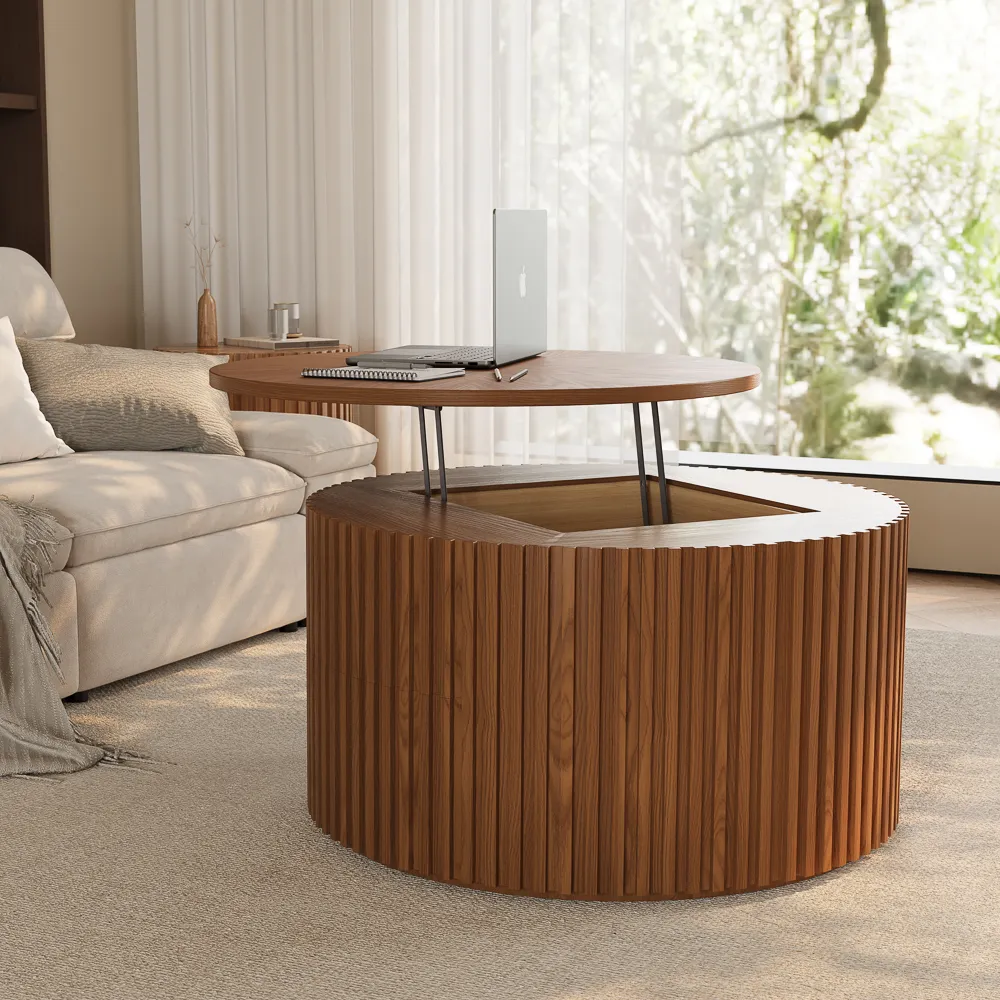
For a compact reclining loveseat that passes the full-extension test, the Silva Lifting Top Round Coffee Table keeps the center of the room soft and practical. Its 31.5-inch round form, smooth edges, drawers, hidden storage, and lift-top surface support laptop time or casual meals. Because it is a substantial fixed piece, it works best where the table can stay in place when the recliner opens.
Slim Rectangular Tables for Long Reclining Sofas
Slim rectangular tables suit long power reclining sofas, especially when only the end seats recline. They create one shared surface for drinks, remotes, and snacks without making the room feel broken into smaller zones.
Choose this shape when:
- The sofa is long and needs a horizontal visual anchor.
- The middle seat stays upright most of the time.
- The footrests open only from the outer seats.
- The room has enough depth for a shallow table and a clear walkway.
Prioritize shallow depth over extra tabletop space. A narrower table is usually more useful than a deep one that limits footrest clearance.
Nesting Tables for Shared and Flexible Seating
Nesting tables work well when people use the same sofa differently. One person may recline with the footrest open while another still needs a place for a drink, laptop, or snack.
Choose nesting tables when one seat needs to recline while another person still needs a usable surface. They are especially helpful in rooms where the sofa faces the TV but the main path runs along one side of the seating area.
Keep the smaller table tucked underneath for everyday use, then pull it out for guests, game nights, or an upright seat that still needs a surface.
Test Your Coffee Table Layout Before You Buy
The Three-Zone Rule tells you what a successful reclining-sofa layout needs to do: keep essentials within reach, leave room for the footrest to open, and protect the main walkway. Before ordering a coffee table, test those conditions on the floor. A painter’s tape layout turns product dimensions into something you can sit in, walk around, and evaluate in real life.
Use painter’s tape to mark the sofa’s closed position and its fully extended recline position. Then tape out the exact length and depth of the coffee table you are considering.
Run through the room as you normally would. Sit down with a drink, open the footrest, stand up, and walk toward the kitchen, doorway, hallway, or TV console. The layout should work for real routines — not only when the room is empty.
Before ordering, make sure:
- The footrest opens without entering the table footprint.
- You can stand up without hitting the table edge.
- The main walkway stays usable when the recliner is open.
- The table still holds the things you use every day.
- The layout does not require you to move the table every time someone reclines.
If one of these tests fails, choose a shallower table, nesting tables, a wheeled design, or side tables instead.
Coffee Table Placement for Sofa Beds
A sofa bed adds a second layout challenge: the coffee table must work when the room is used for lounging, then get out of the way when the seating converts into a sleeping surface. The best setup is not the one that looks best when the sofa is closed. It is the one that lets the room shift from daytime use to overnight comfort without heavy lifting, blocked walkways, or last-minute furniture storage.
Plan for Day, Transition, and Night Modes
A sofa bed layout should work in three moments. During the day, the table should hold drinks, remotes, laptops, and casual meals without crowding the sofa. During the transition, it should move aside without being lifted over a rug or parked in a hallway. At night, the open bed should still leave room to reach a door, walk around the sleeping surface, and set down a phone or glass of water.
If opening the sofa bed means rearranging half the room, the coffee table is too large, too heavy, or in the wrong place.
Measure the Full Sleeping Footprint
Once the reclining layout works, test the sofa again in its fully open sleeping position. Mark the full bed footprint with painter’s tape, then check the remaining space around the bed—not just the space directly in front of it.
Make sure there is a practical route to the doorway, bathroom, hallway, or TV console. Someone should be able to get in and out of bed without stepping over furniture or squeezing between the mattress and a table.
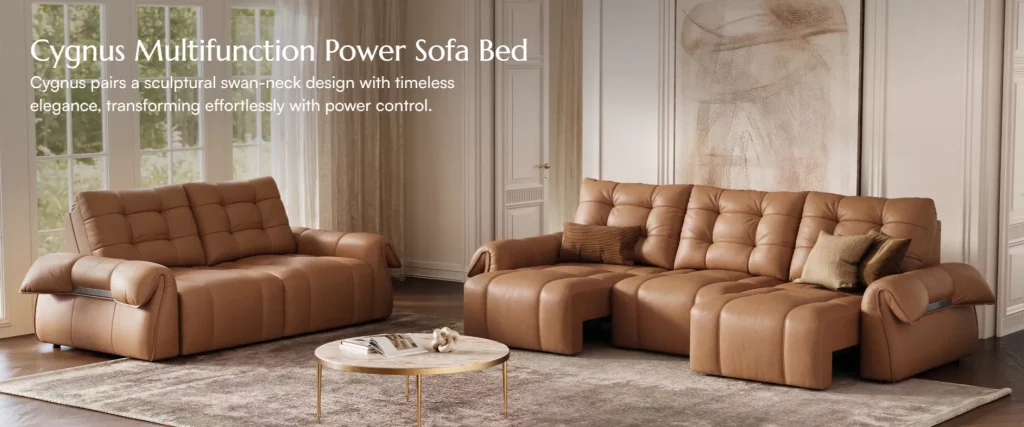
That distinction matters even more with a power sleeper sofa. The Cygnus Power Sofa Bed shifts between sitting, reclining, and sleeping with remote control, while its listed dimensions are 92 × 44 × 38 inches. Those measurements are only the starting point; coffee table placement should be based on the clear floor space needed once the sleeping surface is fully extended.
Picture a guest staying after dinner. The ideal setup should let you slide the table aside, open the bed, add bedding, and keep a clear path to the door.
Choose a Table That Supports Fast Room Changes
For a sofa bed, prioritize mobility first, footprint second, and storage third. Look for locking wheels, nesting construction, lightweight materials, compact depth, or lift-top storage for remotes, chargers, and bedding essentials.
A fixed coffee table can work when the open bed does not overlap with the table area and there is a clear route around it. If the bed extends into the center of the room, a wheeled, nesting, or split-table setup is usually better.
Quick decision guide: Choose a fixed coffee table when the footrest clears it, the walkway stays open, and the sofa bed does not need the center floor. Choose nesting tables or a wheeled design when the room shifts between movie nights, laptop time, and overnight guests. Use side tables or C-tables when the center area needs to stay almost completely clear.
Conclusion
The best coffee table for a reclining sofa is the one that supports comfort before style. Measure the sofa in its fully reclined position, protect the footrest’s movement zone, and keep your main walkway open. Then choose the shape and feature set that match your real routine—whether that means a slim fixed table, a round lift-top design, nesting tables, or side tables. A good layout should make movie nights, casual work, and overnight guests feel easy, not like a furniture puzzle.
FAQs
How Wide Should a Coffee Table Be for a Reclining Sofa?
Choose width after you confirm recline clearance and the main walkway. For a long sofa, a coffee table can often be about one-half to two-thirds of the sofa length. However, a narrower table is usually the better choice when footrests open forward. Never add depth simply to fill visual space.
Should a Coffee Table Be Lower Than a Reclining Sofa Seat?
Usually, the tabletop should sit level with the seat cushion or up to two inches lower. This keeps drinks and remotes within easy reach. A lift-top surface can raise temporarily for laptop use or meals, but it should be lowered before the recliner opens.
Can a Thick Rug Affect Coffee Table Clearance?
Yes. A thick rug can make wheels harder to roll, cause a table to shift, or affect stability. Test the layout with the actual rug in place, especially if the table needs to move before reclining or opening a sofa bed.
Where Should Power Recliner Cords Go?
Route cords along the wall or under a cable cover, never across the main walkway or beneath a moving table. Keep the outlet accessible and leave enough slack for safe reclining movement. Avoid placing cords where a table leg, footrest, or rug edge can pinch them.


