 By Charles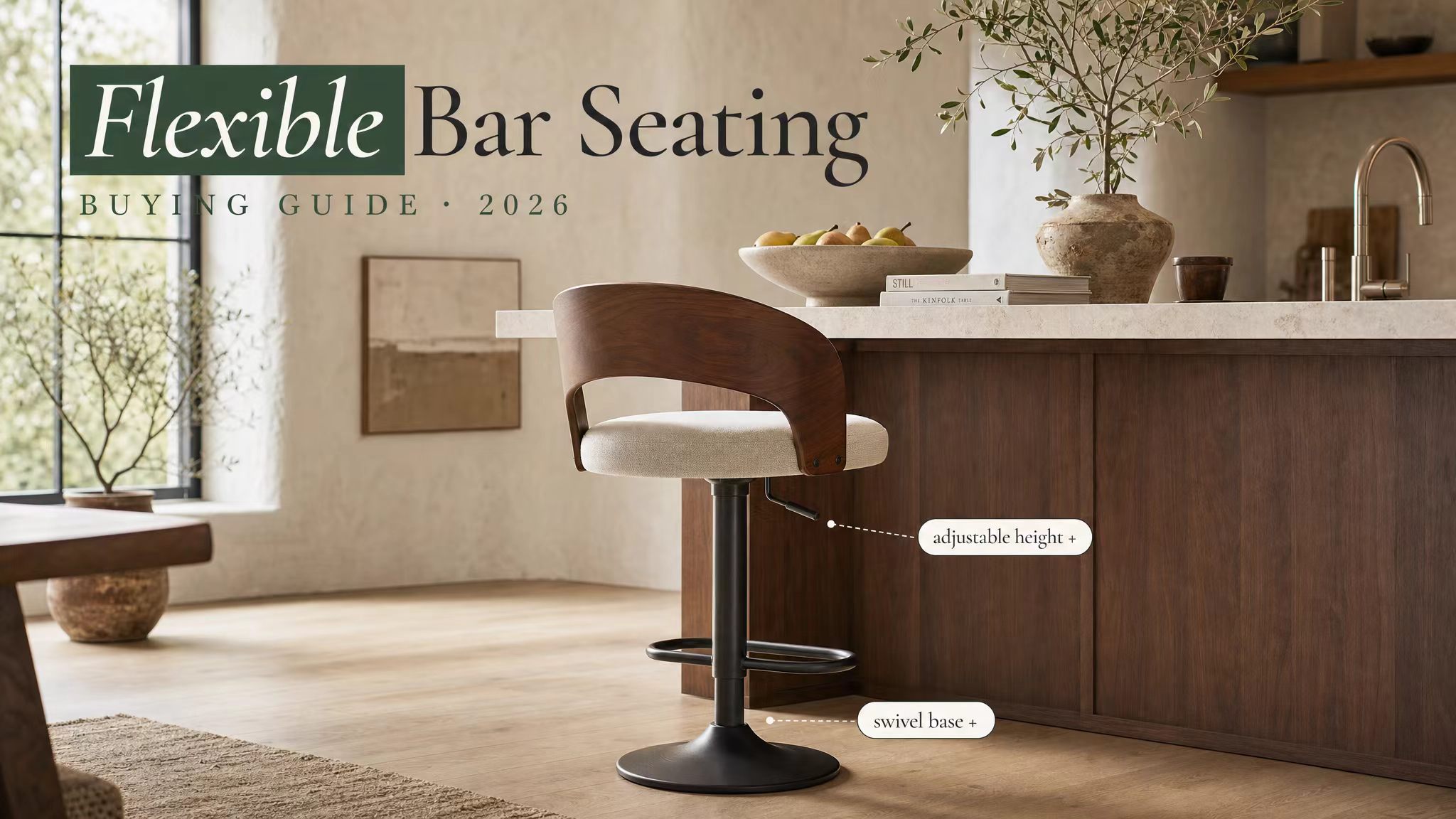
I almost bought a set of adjustable bar stools last spring. My sister was moving out of her Bushwick walk-up into a new place in Jersey City, and her old counter-height stools wouldn’t work in the new kitchen — the breakfast bar was a full bar-height 42 inches. She asked me, “Should I just get adjustable ones so this never happens again?”
I told her: maybe. Maybe not. It depends on three things most people never check before adding to cart — and one of them has nothing to do with looks.
If you’re renting, moving frequently, or shopping for a kitchen with mixed counter heights, adjustable bar stools can absolutely earn their keep. But they’re not the universal solution Pinterest makes them look like. Here’s what to actually weigh.
What Adjustable Bar Stools Solve
Adjustable bar stools exist because counter heights aren’t standard. They look standard — but they’re not.
Most U.S. kitchen counters land between 34 and 37 inches off the floor. Most home bars land between 40 and 42 inches. But once you start looking at older buildings, custom islands, renovated brownstones, and rental units that have been “updated” by three different landlords, the numbers drift. I’ve taped out countertops in five apartments over the last decade and seen 35.5″, 36.25″, 37″, 41″, and one bizarre 38.5″ (still don’t know what that was supposed to be).
A fixed-height stool gives you exactly one seat height. If the counter doesn’t match — and the NKBA Kitchen Planning Guidelines call for 15 inches of clear knee space at a 36-inch counter and 12 inches at a 42-inch bar — you’re either eating with your knees jammed against the underside, or perched too low like a kid at the adult table.
Adjustable stools solve that with a gas cylinder under the seat. Pull a lever, the seat moves. Per Dimensions’ stool height reference, most adjustable models cover a 24″–32″ range — which conveniently spans the entire counter-to-bar height window. One stool, two heights. That’s the appeal.
What they don’t solve: comfort during long sits, visual consistency across a coordinated dining setup, and the long-term reliability question every gas-lift mechanism eventually has to answer.
Best Homes for Adjustable Stools
Some households genuinely benefit. Most don’t. Here’s the honest breakdown.
Renters and Movers
This is the strongest case. If you’re moving every 1–3 years, you have no idea what your next counter height will be. I taped out three apartments before signing my current lease and the counter heights varied by 2.5 inches across them. A 25″ fixed counter stool that worked in apartment A becomes painfully short in apartment B.
The math here: one set of adjustable stools at $300–$450 (typical residential range) replaces what could otherwise be two sets of fixed stools across two moves. At average set prices, you’re saving roughly $250–$400 on furniture you’d otherwise need to sell at a loss on Facebook Marketplace.
One caveat I learned the hard way: gas cylinders don’t love repeated moving. Every time the stool gets carried out of a moving truck, dropped slightly, or stored in a humid basement for two weeks between leases, the seal life shortens. If you’re a true nomad, factor in that the gas lift may need replacement around year 5–6 instead of year 8.
Mixed-Height Counters
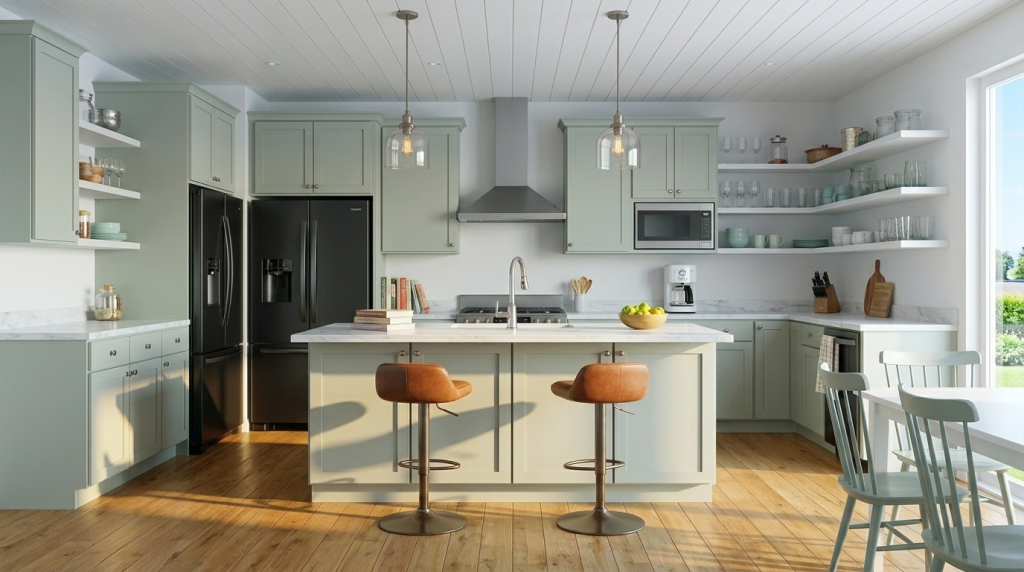
The second-best case is a kitchen with two surfaces — say, a 36″ main counter and a raised 42″ eating ledge behind it. Or an open-plan room where the island handles breakfast and a separate bar cart handles cocktails. Adjustable stools let one matching set serve both zones without buying two complete sets in two different heights.
If your household also has adults of significantly different heights — say, a 5’2″ partner and a 6’3″ partner — adjustable becomes useful for a different reason: each person can dial in their own seat height. Per the Dimensions seated reference, comfortable seat height shifts roughly an inch for every 4–5 inches of difference in user height. Fixed stools force a compromise; adjustables don’t.
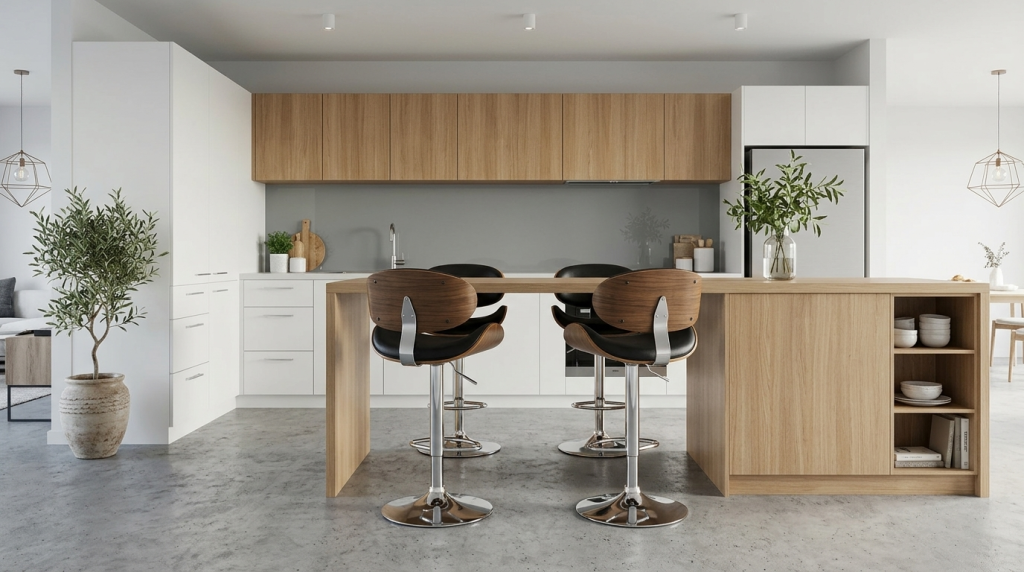
What I’ll add here, because the brand actually delivers on this part: if you want the stools and your existing dining chairs to read as one coordinated set instead of three separate purchases, look at the POVISON bar and counter stool collection — they publish seat-height range, weight capacity, and finish family on every product page, which matters more for adjustable stools than for any other type because the spec sheet is the only thing telling you whether the mechanism is residential-grade or commercial-grade.

Adjustable vs Fixed-Height Stools
The trade-off table I wish I’d had two apartments ago:
| Factor | Adjustable Stools | Fixed-Height Stools |
| Initial cost (per stool) | $150–$225 typical | $100–$175 typical |
| Long-term reliability | Gas cylinder = wear part; expect ~5–8 yr lifespan | No moving parts; lifespan = wood/metal lifespan (15–20+ yr) |
| Stability | 4–5 star base required; some wobble vs. 4-leg fixed | Generally steadier; 4-leg geometry is inherently rigid |
| Weight capacity (residential) | Typically 250–300 lbs | Often 300–350+ lbs |
| Aesthetic flexibility | Mostly modern/industrial silhouettes | Available in all styles incl. mid-century, farmhouse, Japandi |
| Best for | Renters, mixed heights, big height differences | Owners, standard counter height, longer sits |
The honest takeaway: adjustable stools optimize for flexibility, fixed stools optimize for reliability and aesthetics. If you don’t need the flexibility, you’re paying a premium for a wear part you’ll eventually have to replace.
Stability, Mechanism, and Comfort Trade-Offs
This is the section the friendlier guides skip. Adjustable stools have failure modes fixed stools don’t.
The mechanism question. Most residential adjustable bar stools use a hydraulic gas cylinder — the same general technology as an office chair gas lift. The good news: when these are tested under BIFMA X5.1 — the U.S. standard for office and adjustable seating durability — they’re subjected to cycle tests simulating thousands of seat-height adjustments and load impacts. The standard tests up to 275 lbs and includes both static and cyclic loading.
The bad news: most discount adjustable stools sold on Amazon and similar marketplaces don’t meet that standard. The cylinder is rated for office use (8 hours of mostly-stationary sitting) and gets pressed into kitchen duty (rapid climb-and-pivot motions, kids spinning, weight shifts) — and the seal wears faster than anyone tells you at checkout.
The Consumer Product Safety Commission has issued recalls on pneumatic-lift seating specifically because the weld between the seat plate and the gas lift can fail, causing the seat to separate from the base. That’s not a freak event — it’s a known failure mode of underspec’d gas-lift seating. Before you buy any adjustable stool, the questions to ask are: what’s the gas cylinder rating? Is it covered by the warranty? And what’s the replacement cost if it fails at year 5?
The base geometry. A 5-star base (the spider-leg pedestal you see on office chairs) is more stable than a 4-star, but both are less stable than a true 4-leg stool. The center of gravity sits higher and the wobble margin is thinner. Most residential adjustable stools handle 250–300 lbs comfortably; I wouldn’t trust an unbranded one past 250.
The assembly question. This one matters more than people realize. Self-installed gas cylinders are where most user-side failures happen — cylinder pressed in crooked, base bolts under-torqued, the swivel bearing seated wrong. Pre-assembled stools eliminate every one of those failure points because the gas lift is press-fitted and cycle-tested at the factory before it ships. If you’re shopping adjustable, the “fully assembled” spec isn’t a convenience feature — it’s a safety feature.
The comfort trade. A gas cylinder under the seat means a hollow column instead of a solid leg. That’s where the slight bounce comes from — perceptible during quick weight shifts. Fine for 30-minute meals. Noticeable after an hour. If your stool is going to be your home-office-during-Zoom-calls seat, fixed-height with a structural backrest is the better long-term call.
FAQ
Are adjustable bar stools worth it if I move frequently?
Yes, adjustable bar stools can be a smart investment if you rent or move regularly. Since kitchen counters and bars vary in height from one home to another, a fixed-height stool that fits your current space may not work in your next one.
Most adjustable bar stools offer a seat height range of approximately 24–32 inches, allowing them to accommodate both standard counter-height and bar-height surfaces. Instead of replacing your stools every time you move, one adjustable set can adapt to different kitchens and potentially save you hundreds of dollars over time.
However, frequent moving can put extra wear on the gas-lift mechanism, so it’s worth choosing a model with a durable cylinder and replacement parts availability.
Are adjustable bar stools good for kitchen islands with different heights?
Adjustable bar stools work well for kitchen islands with mixed heights — for example, a 36″ prep counter that flows into a 42″ eating ledge. One adjustable set can serve both zones, which is the main reason these stools exist. The catch is that you’ll be re-adjusting them constantly if people use both surfaces in the same meal. For islands where the height is consistent, fixed stools are steadier and cheaper.
Do adjustable stools become wobbly after repeated use?
Adjustable stools can become wobbly over time, mostly at three points: the gas cylinder seal (which loses pressure and causes the seat to sink slowly), the swivel bearing if the stool spins, and the base bolts where the cylinder seats. Quality adjustable stools tested under BIFMA X5.1 standards handle 60,000+ adjustment cycles before noticeable degradation. Cheap unbranded stools sometimes show wobble within the first year.
Are gas lift adjustable bar stools safe and stable for daily use?
Gas lift adjustable bar stools are safe for daily residential use when the cylinder meets BIFMA X5.1 or equivalent commercial standards and the base is a 5-star pedestal with weight rating clearly published. The CPSC has recalled pneumatic seating products where the cylinder-to-seat weld failed under load, so avoid unbranded discount stools that don’t disclose cylinder rating. Check the warranty specifically covers the gas mechanism — many warranties exclude it.
Conclusion
Adjustable bar stools aren’t the universal answer to flexible seating. They’re a specific solution to a specific problem: counter heights you can’t predict, household members at very different heights, or a single room that needs to serve two seating surfaces.
If that’s you — rent, move, mixed heights — they earn their place. Buy a set with a cycle-tested gas cylinder, a 5-star base, a published weight rating, and a warranty that explicitly covers the mechanism. Factor in one cylinder replacement around year 5–8.
If your counter is fixed at a standard height, you own your home, and you sit at the stool through real meals — fixed-height wins on stability, looks, and long-term cost. Don’t pay a premium for flexibility you’re not using.
The honest test: tape out your counter, write down the height, and ask yourself whether that number is going to change in the next five years. If yes — adjustable. If no — fixed, and put the saved money toward a stool with a backrest you actually want to sit in.
Related Reading:


