 By Charles
Last December, my cousin called me three days before Christmas. Eight people were now coming to her two-bedroom in Brooklyn instead of the four she had planned for. Her current table seated four — barely. She was about to do what people in panic mode do: buy a giant rectangular table she’d resent for the other 360 days of the year.
I told her to stop. There’s a better answer for households that live small most of the time but need to scale up four or five times a year. It’s called an extendable dining table, and 2026 is the first year I’d say the category has matured enough — mechanically and aesthetically — to actually recommend it without a long list of caveats.
But here’s the catch: not every extendable table is worth the compromise. The mechanism matters more than the finish. The stability after three years matters more than the marketing copy. And whether you can operate it alone, in a dress, holding a wine glass — that matters most of all.
This guide is for people who eat as 2–4 most weeks and host 6–8 occasionally. Let me show you what I learned testing the category over the last year.
Is an Extendable Dining Table Right for You?
Here’s the cleanest decision rule I’ve found:
The gap test. If your everyday headcount and your peak hosting headcount differ by more than two seats, an extendable table earns its keep. If the gap is one or two seats, just add folding chairs and skip the mechanism.
That’s it. Most of the dithering in this category comes from people who think they host more than they actually do. Be honest with yourself. Pull up your calendar. Count the dinners with 6+ people last year. If you got to four, you’re a candidate. If you got to one, you don’t need this — you need a smaller fixed table and one nice extra chair tucked in a closet.
The trade-offs of extending versus a fixed table are real:
| Trade-off | What you give up | What you gain |
| Visible seam | Top has a hairline join, especially in raking light | Two table sizes for the price of one |
| Slightly heavier base | Pedestals and frames are beefier to handle off-center loads | Stability when extended (if designed right) |
| Mechanism complexity | One more thing to maintain | 4-to-8-seat flexibility without a second table |
| Storage logistics | Leaves need a home (or live under the table) | No permanent giant table eating your room |
| Price premium | Typically 15–25% over a fixed table of the same size | The smaller daily footprint |
If you read that and shrugged at the seam — you’re fine. The seam on a well-built table is barely visible unless you’re looking for it. If the idea of a visible seam bothers you a lot, get a fixed table or pick a mechanism (more on this below) that conceals it under a removable insert.
Best Homes for Extendable Tables
Small Homes That Host Occasionally
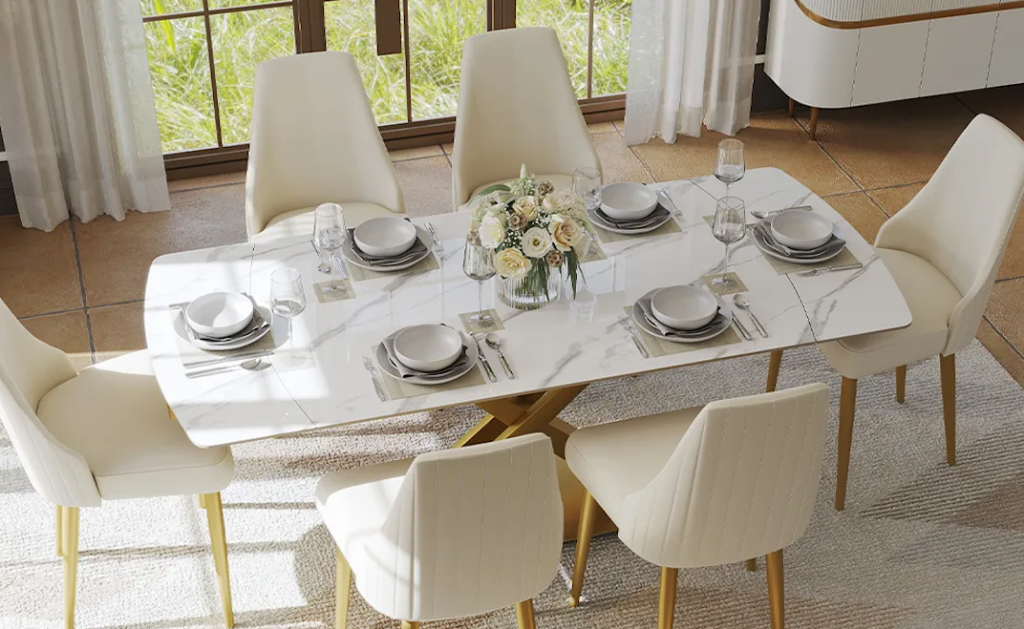
This is the killer use case. You have an apartment, a condo, or a small dining strip in a townhouse. Your daily reality is 2–4 people. Twice a quarter you host parents, in-laws, or college friends and you need to seat 6 or 8 without it feeling cramped.
My cousin’s Brooklyn apartment is the archetype. The dining “room” is really one end of a 13-by-18-foot living space. A permanent 72-inch rectangle would eat the whole flow. A 48-inch round that opens to 66 inches gives her four seats on a Tuesday and six (with a slight squeeze) at Thanksgiving — same footprint, twice the seating capacity.
If you’re in a footprint under 11 by 12 feet, the math gets tight. Here’s what I’d verify with painter’s tape before you click buy:
- Tape the closed dimensions on the floor.
- Tape the extended dimensions on the floor.
- Add chairs at both positions, fully pulled out.
- Walk the room normally for two days at both configurations.
If you keep tripping over the tape in extended mode, you don’t have room — even occasionally. The 36-inch chair clearance from the National Kitchen & Bath Association planning guidelines is non-negotiable. That’s the minimum to pull a chair out and edge past someone seated; if traffic is actually moving behind a diner, NKBA bumps that to 44 inches.
Family Dining Rooms
For families with a real dining room — separated from the living room, 12 by 14 feet or larger — extendable tables solve a different problem. You’re not maximizing footprint. You’re maximizing flexibility for life stages.
Two examples of how this plays out in real households:
- Couples with toddlers don’t need to seat 10 for the next five years. But they will, eventually — when the kids are teenagers with friends over, or when they start hosting holidays themselves. An extendable 60-to-84-inch table buys you the daily intimacy of a small table now, plus the capacity you’ll grow into.
- Empty nesters going the other direction: kids gone, but they still come home with partners and grandkids. A daily 6-seater opens to 10 a few times a year. No need to keep a permanent monster.
In a larger room, the seam concern almost disappears (raking window light is what makes seams visible, and dining rooms usually have more controlled lighting). What matters more here is whether the table looks balanced at both sizes. A poorly designed extendable table looks short and squat closed, then weirdly stretched open. The good ones look intentional at every length.
If you’re shopping the category, POVISON’s collection of fully assembled extendable dining tables is a useful reference point — every piece arrives pre-built, so the mechanism gets factory-tested and calibrated before it leaves the warehouse. (More on why that matters in the mechanism section below.)
Round vs Rectangular Extendable Tables
Shape changes both how the table extends and how it feels at every seat count. Here’s the honest breakdown:
| Seat count | Round (extends to oval) | Rectangular (extends longer) |
| Closed size | 42–54″ diameter | 55–66″ length |
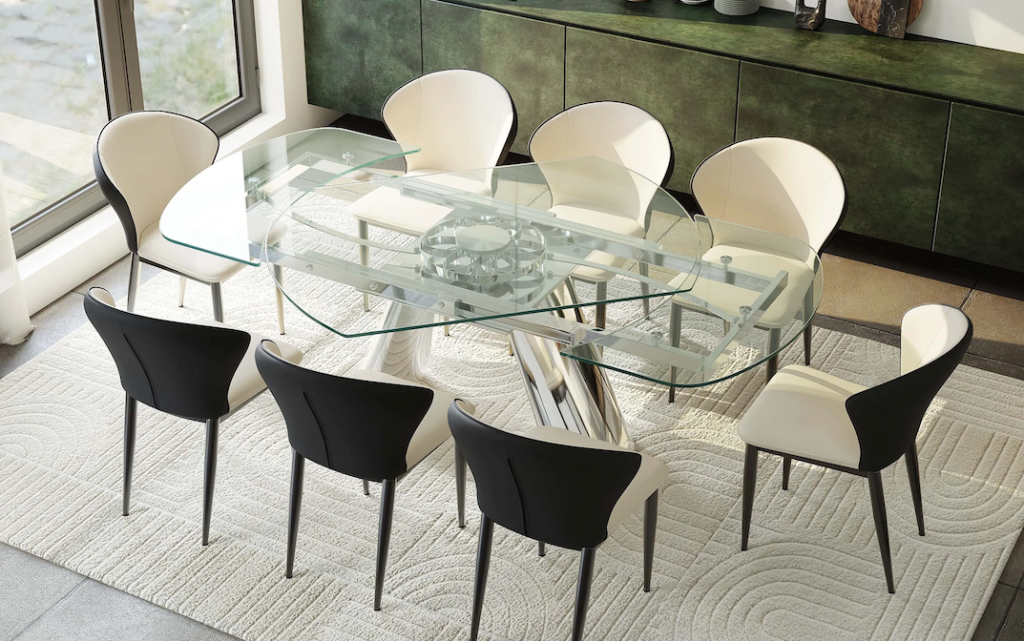
| Extended size | Adds 18–24″ via center leaf, becomes oval | Adds 18–36″ via end leaves or center |
| Best for room shape | Square rooms, open-plan corners | Long narrow rooms, traditional dining rooms |
| Conversation flow | Easier — everyone faces center | Harder at full length — ends feel cut off |
| Daily seating | 4 (round) | 4–6 |
| Peak seating | 6 (oval) | 6–10 |
| Base type | Usually pedestal | Pedestal or four-leg |
| Tape-out trick | Mark both diameters | Mark closed length + extension on both ends |
My take after testing both: Round-to-oval is the smarter choice for occasional hosting in tight rooms, full stop. The reason is geometry. Four corner legs on a rectangle are the enemy of flexible seating — they eat knee space and dictate exactly where every chair has to go. A pedestal base on a round/oval extendable lets you slide chairs anywhere along the perimeter, which is what you want when you suddenly have six people instead of four.
Rectangular extendables make sense in two situations: when your room is genuinely long and narrow (think old brownstone dining rooms), or when your peak hosting is 8+ and you need the linear capacity. Otherwise, round wins.
Reference point on body clearance: Dimensions’ seating ergonomics data puts comfortable elbow room at 24 inches per diner. That means a 60-inch round seats six only if everyone agrees to be a little cozy. A 66-inch oval at the extended position seats six with genuine comfort.
Mechanism, Storage, and Stability Trade-Offs
This is where extendable tables earn or lose their reputation. The top can look beautiful and the legs can be solid walnut, but if the mechanism is sloppy, the whole thing feels like a kids’ toy after 18 months.
Three mechanism types dominate the category. Let me break them down by how I actually evaluate them.
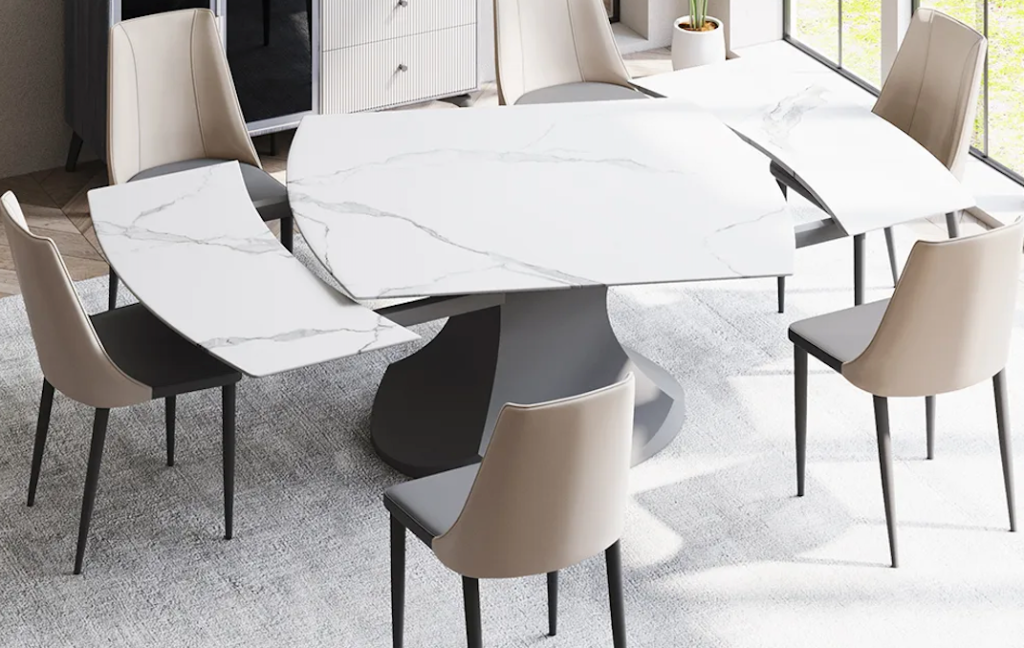
Butterfly Leaf vs Track vs Insert Leaf Mechanisms
Butterfly leaf (self-storing)
How it works: You pull the two halves of the tabletop apart along a track. A folded leaf, hinged underneath the table, unfolds upward and locks into place. Close it by reversing — the leaf folds back down and disappears under the closed top.
- Pros: No separate leaf to store. One-person operation in about 15 seconds. The leaf is always at the table when you need it.
- Cons: The folding leaf adds thickness under the table, so leg space when closed is slightly reduced. The mechanism is the most complex of the three, which means more things that can go wrong over time.
- Best for: Small spaces where you have nowhere to store a separate leaf. Households that extend frequently.
Track + insert leaf (most common)
How it works: The two halves of the table separate along a track (gears, ball bearings, or wooden runners). A separate leaf — stored in a closet, under a bed, or behind the table — drops into the gap and locks down with alignment pins.
- Pros: The simplest mechanism mechanically, which means the longest lifespan and easiest repair. The table is thinner and lighter when closed because there’s no hidden leaf. Insert leaves can be removed for storage when not needed.
- Cons: You need somewhere to put the leaf when it’s not on the table. A 24-inch leaf takes real closet space. Two-person operation is easier than solo.
- Best for: Households with closet or storage space nearby. Tables that get extended a few times a year.
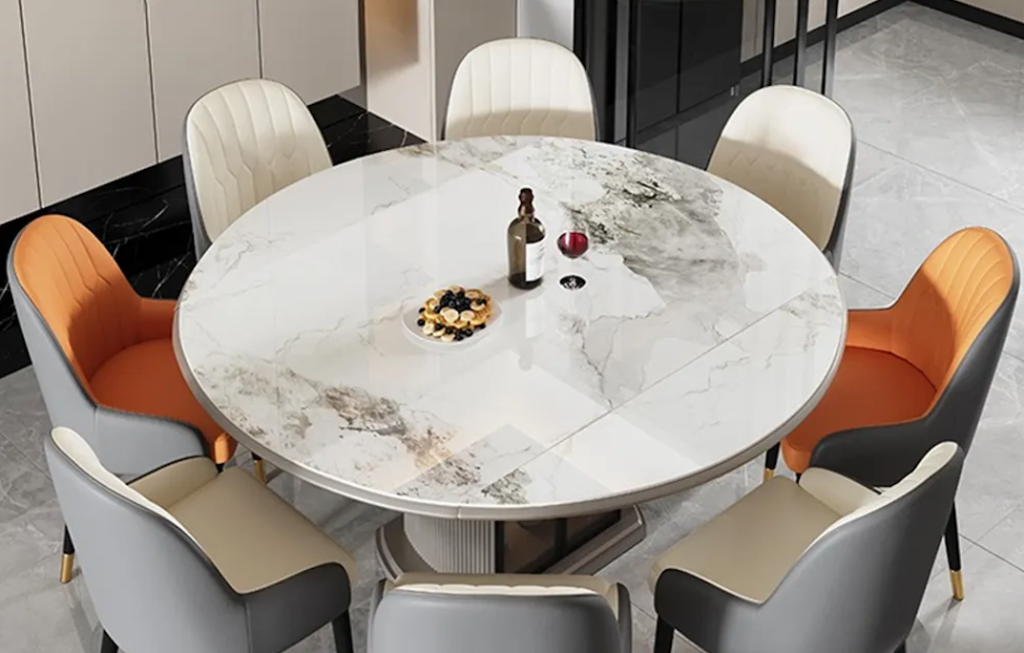
Center extension with concealed mechanism
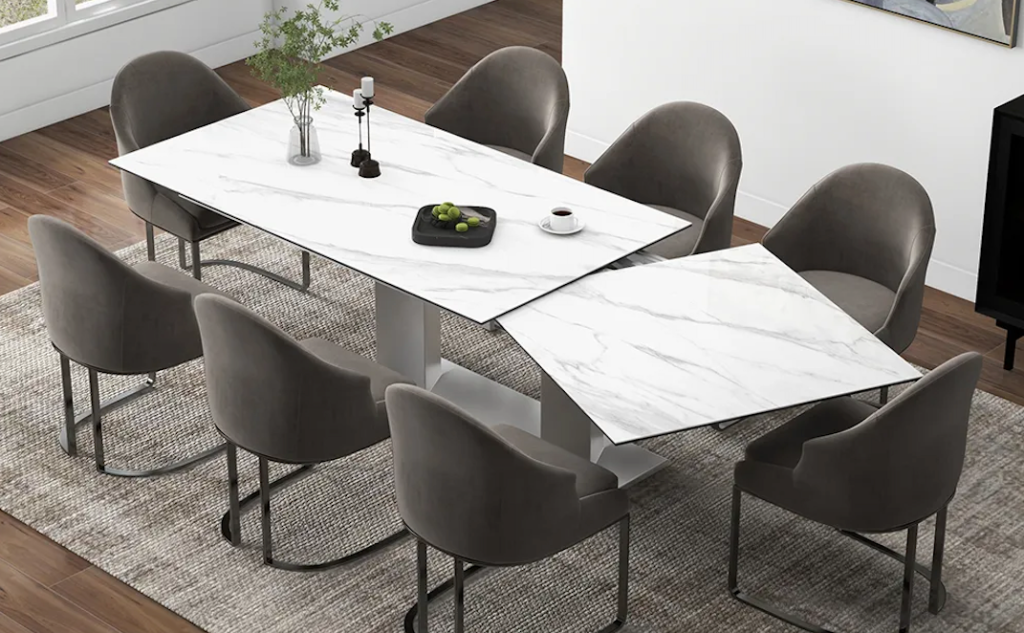
How it works: The top splits at the center, the two halves slide apart on a precisely engineered track, and either a hidden leaf rises up or you drop an insert leaf in. The most premium mechanism in the category.
- Pros: Smoothest operation. Tightest seam fit when closed (often almost invisible). One-person operation is genuinely easy.
- Cons: Most expensive. If the mechanism ever fails, repair is harder.
- Best for: Buyers prioritizing aesthetics and don’t mind paying for engineering.
A reality check on stability across all three types: the ANSI/BIFMA X5.5 standard for desk and table products is the industry benchmark for structural performance. Tables tested to this standard go through stability checks, leg strength tests, and cycle testing of moving parts — exactly the kind of validation that separates a table that stays solid for ten years from one that develops a wobble in two. If a manufacturer doesn’t reference any third-party testing standard at all, ask why.
What I actually check before I trust a mechanism:
- Lock points. When extended, is there a positive lock — a metal latch or a pin that engages — that prevents the halves from separating under load? Or is it just friction? Friction-only mechanisms loosen over time. Walk away.
- Leveling mechanism. When the leaf goes in, are there alignment pins, magnetic guides, or a tongue-and-groove fit that ensures the leaf sits flush with the main top? You shouldn’t be able to feel a seam with your hand.
- Weight rating when extended. A good extendable table should handle 150–200 lbs of distributed load when fully open. If the spec sheet doesn’t mention it, that’s a flag.
- Operation time. The extension should take 10–30 seconds, solo. If the marketing video shows two people grunting, your dinner party doesn’t have time for that.
One more thing: extendable tables are mechanically more sensitive than fixed tables. A misaligned track during DIY assembly can permanently affect how smoothly the extension operates. That’s why I tend to recommend pre-assembled extendable tables in this category specifically — not because flat-pack is always bad, but because mechanism calibration belongs at the factory, not on your dining room floor at 9pm.
What to Check Before Buying Online
You can’t sit at the table before you buy it. Here’s the checklist I’d use to compensate.
Specs to verify in writing before clicking buy:
- [ ] Closed dimensions (length × width × height) — and confirm height is 28–30 inches, the comfortable seated standard
- [ ] Fully extended dimensions
- [ ] Leaf storage method (self-storing? separate? how big?)
- [ ] Mechanism type (butterfly / track / center extension)
- [ ] Total weight (most extendable tables run 90–140 lbs — confirm you have the people to move it)
- [ ] Tabletop material and finish (solid wood, veneer, sintered stone, glass)
- [ ] Base type and footprint (pedestal vs. four-leg)
- [ ] Weight capacity (look for both closed and extended ratings)
- [ ] Warranty length and what it covers — specifically, does it cover the mechanism
The tape-out test (don’t skip this):
Before ordering, tape the closed and extended footprints on your floor. Add four chairs at each position. Walk the room normally for 48 hours. If you keep bumping the tape, the table is too big. If the tape outline feels invisible, you have room to size up.
Delivery and assembly questions to ask:
- How is the table delivered — curbside, threshold, or room of choice?
- Is it fully assembled, or does the mechanism need to be aligned on-site?
- What’s the return policy if the table doesn’t fit through your doorway? (This happens more than you’d think with 65″+ closed dimensions.)
- Is there a damage protection process if anything arrives chipped?
POVISON’s extendable tables ship fully assembled with white-glove delivery available — meaning the table arrives at your room of choice, gets placed where you want it, and you test the extension before the delivery team leaves. For a 100+ lb table with a precision mechanism, that’s the version of the buying experience I’d want.
FAQ
Is an extendable dining table worth it if I only host large groups a few times a year?
Yes, if the difference between your daily seating (2–4 people) and occasional peak (6–8 people) is more than two seats. It’s ideal for small apartments or condos where a permanent large table would crowd the space most of the year. However, if you rarely go above 4–5 people, a fixed table plus extra folding chairs might be simpler and more cost-effective. Be honest about your actual hosting frequency from last year’s calendar.
Should I choose a round (to oval) or rectangular extendable dining table?
For most small homes and occasional hosting, a round-to-oval extendable table is the smarter choice. It offers better conversation flow, more flexible chair placement with a pedestal base, and works well in square or open-plan spaces. Rectangular extendables are better only if you have a long, narrow room or regularly need to seat 8–10 people. Always tape out both closed and extended sizes on your floor to test real movement and clearance.
How do I maintain an extendable dining table so the mechanism keeps working smoothly?
Regular maintenance is key for long-term performance. Clean the tracks and moving parts occasionally with a dry cloth to prevent dust buildup. Avoid overloading the table when extended, and always lift (don’t drag) when moving items. For butterfly or center-extension mechanisms, gentle operation prevents wear. Many owners find that following the manufacturer’s care instructions keeps the table stable and smooth for many years.
What should I do if the extension mechanism starts to feel loose or unstable over time?
First, check that all locks, pins, and alignment guides are properly engaged. Minor issues can often be fixed by tightening screws or cleaning the tracks. For more serious wobbles, contact the brand’s support — quality tables usually have 1–3 year warranties that cover the mechanism. This is why buying a pre-assembled model with factory-tested mechanisms (like those from POVISON) reduces the chance of early problems.
Conclusion
The category has come a long way. Five years ago I’d have told most people to skip extendable tables — the mechanisms were either flimsy or expensive, the aesthetics were dated, and the seams were obvious. In 2026, the better tables in the category solve all three problems if you know what to look for.
Here’s the quick decision matrix one more time:
- Daily 2–4, peak 6–8, room under 14 feet on a side? Round-to-oval extendable, pedestal base, track or center mechanism.
- Daily 4–6, peak 8–10, room over 14 feet on a side? Rectangular extendable, pedestal or four-leg, butterfly or center mechanism.
- Daily 2–4, peak 4–5? Skip the extendable. Get a fixed table and one good folding chair.
- Daily 6+? You don’t need extendable. You need a real dining table, properly sized.
The single biggest mistake I see in this category is people buying for a fantasy version of their hosting life. The dinner party that happens twice a year doesn’t justify a permanent giant table you trip over for the other 363 days. That’s exactly the problem a well-designed extendable table solves — and 2026 is the year I’d actually trust the category to do it.
When you’re ready to start narrowing options, look at the extendable dining table options at POVISON — fully assembled, white-glove delivery available, with the mechanism types and stability standards I’ve laid out above so you can compare directly against what your room and your hosting pattern actually need.
Related Reading:


