 By Charles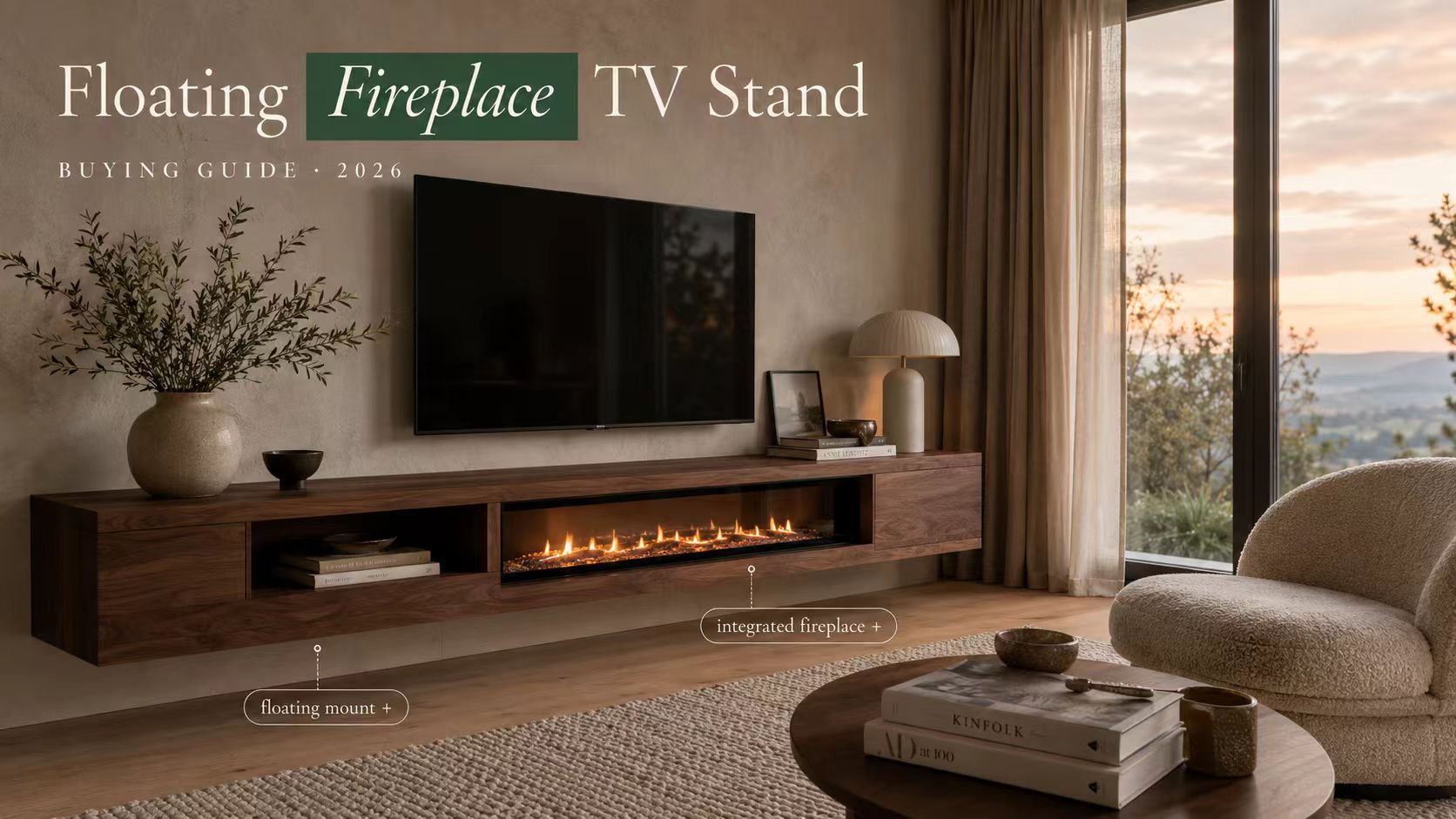
A friend texted me a photo last month. Two-bedroom condo, exposed brick on the accent wall, a floating media console hovering eight inches off the floor with a thin strip of orange flame glowing underneath the TV. Caption: “Found my dream setup. Do I just… buy it?”
I asked her three questions. What’s behind the drywall? What’s the heater wattage on the unit? What’s on the breaker behind that wall?
She sent back a confused emoji.
That’s the situation almost every shopper is in when they fall for the floating fireplace TV stand look. The Pinterest version is gorgeous. The execution involves drywall, wood studs, a 1,500-watt heating element, and a TV that costs more than most laptops — all sharing the same vertical real estate. The aesthetic decision and the engineering decision are two different decisions, and most product pages let you skip the second one entirely.
This guide is the second decision. If you’re going to spend $800 to $2,000 on a wall-mounted media unit that also produces heat, you should know exactly what you’re committing to before the truck shows up.
What a Floating TV Stand With Fireplace Adds
The pitch is straightforward: you collapse three things — a media console, a heat source, and a focal point — into one wall-mounted unit. The floor stays clear. The TV gets its dedicated zone. The room reads as designed rather than assembled.
When it works, it works beautifully. A glowing flame element under a 65-inch TV adds visual weight to the lower half of the wall, balancing the screen and grounding the composition. Even when the TV is off, the fireplace gives the room something to do at night besides stare at a black rectangle.
What’s less obvious is that the floating version introduces problems the floor version never has. A traditional floor-standing fireplace console sits on its own base, with the floor catching any weight, and the heating element pointing forward into open air. A floating fireplace TV stand puts all of that mass and all of that heat against your wall — and depending on the design, sometimes directly underneath a thousand-dollar television.
So before you click order, work through what’s actually happening behind that pretty product photo.
Fireplace Function, Heat, and Safety Questions
Electric Fireplace Expectations
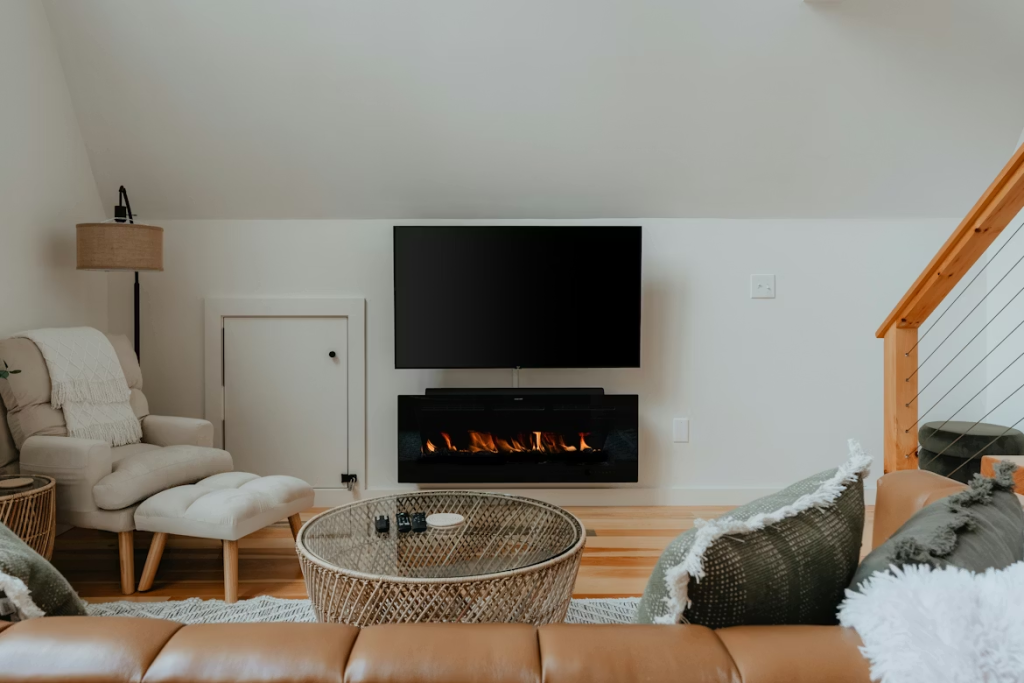
Most electric fireplaces built into TV stands offer two modes: flame-only (visual effect, no heat) and flame-plus-heat. The heater is almost always a forced-air element rated between 750 and 1,500 watts, typically with two settings.
A few realities I want to be honest about because product pages soft-pedal them:
- Heating capacity is modest. A 1,500-watt unit will warm a 400 to 500 square-foot room by a few degrees in 30 to 45 minutes. It’s supplemental heat, not a primary heat source. If your goal is to lower your gas bill, this isn’t the move.
- The flame effect is LED-driven. Some are convincing. Some look like a smartphone screensaver from 2014. The only way to know which you’re buying is to find video reviews, not still photos.
- Heat and flame are independent controls. This matters more in summer than people expect. You’ll use flame-only mode for nine months of the year and the heater for maybe eight evenings.
- Power draw is real. A 1,500-watt heater pulls roughly 12.5 amps on a standard 120-volt circuit. That’s most of the available current on a typical 15-amp residential circuit. If your living room outlet is also running a soundbar, a router, a gaming console, and three lamps, you can absolutely trip the breaker.
This is where electrical safety becomes a planning question, not an afterthought. The unit needs to be UL or ETL certified for indoor residential use — that’s the minimum bar. The certification mark on the spec sheet confirms the heating element, wiring, and thermal cutoff have been tested for the intended use case. Trustworthy manufacturers publish this clearly; sketchy ones bury it.
POVISON’s floating TV stand collection lists wattage, certification, and recommended circuit type on each unit’s spec sheet — that’s the level of detail you want before purchase. Brands that publish “fireplace included” without amperage, wattage, or certification data are asking you to take on a risk you can’t evaluate.
Heat Clearance and Wall-Mounting Concerns
This is the part that separates floating fireplace TV stands from their floor-mounted cousins, and almost no buying guide addresses it directly.
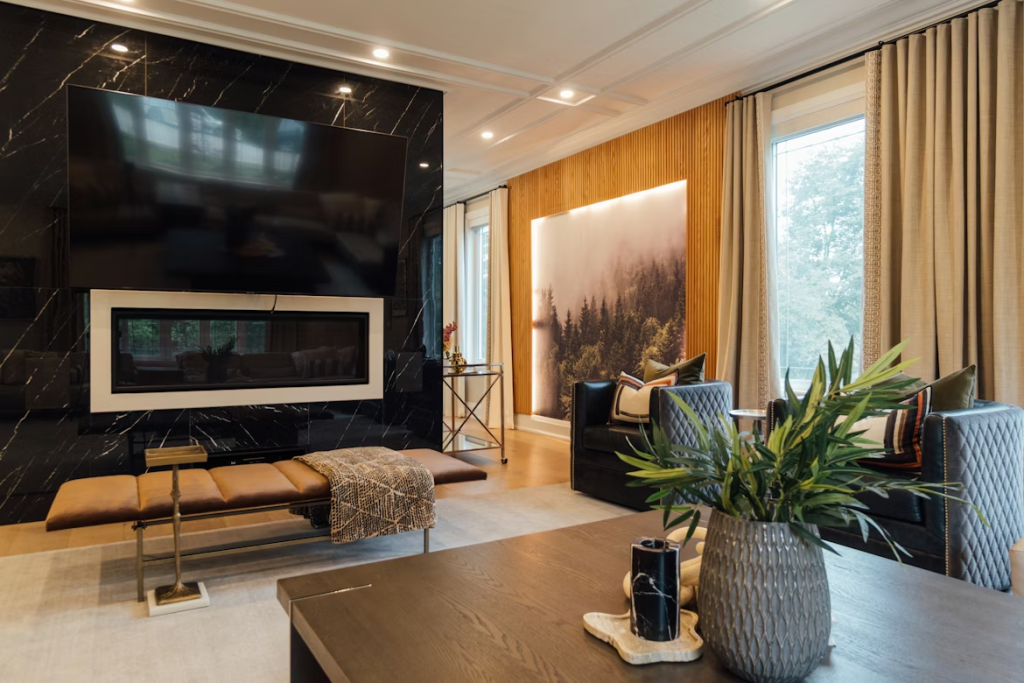
A floor-mounted fireplace TV stand vents heat forward, into the room. A floating fireplace TV stand has the same forward-venting design, but it’s now anchored to a wall, with drywall directly behind it — and often a flat-screen TV directly above it. Three specific heat-related concerns come up:
- Heat output direction. Reputable units vent heat downward and forward, never upward. Why downward and forward matters: hot air rises naturally, so directing the forced-air exhaust toward the floor and out into the room prevents the heat plume from drifting straight up into your TV. If a spec sheet doesn’t tell you which direction the unit vents, assume the worst and ask before buying.
- Wall and TV clearance. Most manufacturers specify a minimum clearance — typically 4 to 8 inches between the top of the heater outlet and the bottom of the TV, and a similar gap from the back of the unit to the wall surface (built into the unit’s frame). National fire and electrical codes generally require any heat-producing appliance to maintain manufacturer-specified clearances from combustibles, which in a residential context means drywall, wood trim, and electronics. Cutting that clearance to make the install look cleaner is exactly how thermal damage to TV electronics happens over years of use.
- Wall material. Drywall over wood studs is the default, and that’s fine — fire codes do not classify standard residential drywall as a hazard at the temperatures these units produce. Brick, concrete, or stone walls are also fine but introduce mounting complexity (more on this in the next section). What you absolutely want to avoid is mounting one of these units to a wall with hidden insulation gaps, foam backing, or unknown framing — that’s where the small risk of long-term thermal accumulation becomes worth taking seriously.
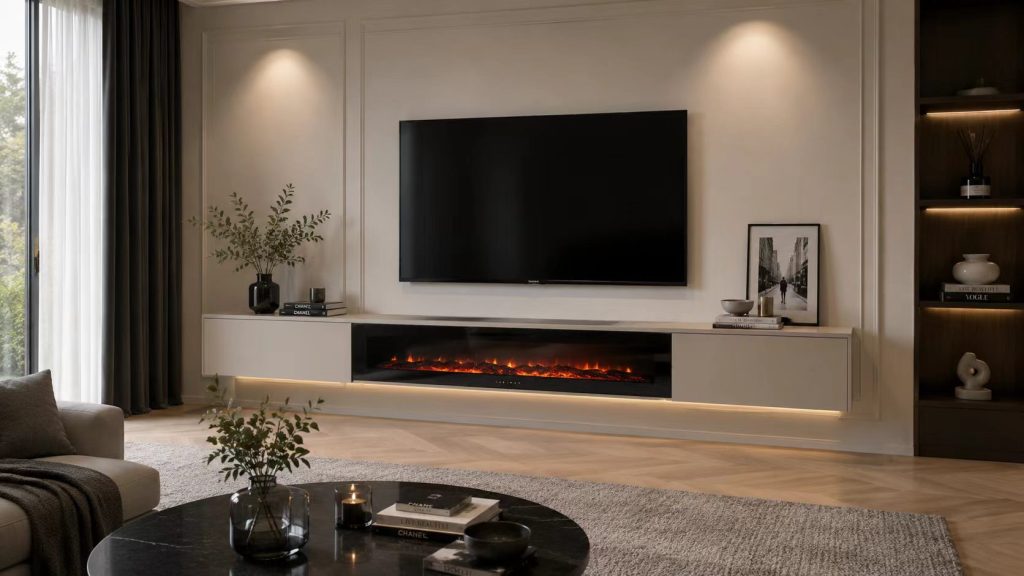
A practical rule that’s saved me: if the spec sheet doesn’t tell you the heater wattage, the vent direction, and the minimum TV clearance, don’t buy that unit. Three data points. They should be on the product page. If a manufacturer omits them, that’s the answer.
Floating vs Floor Fireplace TV Stands
For most buyers, the meaningful comparison isn’t “fireplace or no fireplace” — it’s “floating fireplace or floor fireplace.” Here’s the honest breakdown:
| Factor | Floating Fireplace TV Stand | Floor Fireplace TV Stand |
| Wall mounting | Required; needs studs or masonry anchors | Not required |
| Installation complexity | High (drill, level, anchor into structure) | Low (set in place, plug in) |
| Floor clearance | 8–18 inches below unit | None — unit rests on floor |
| TV mounting | Almost always wall-mounted TV above unit | TV can sit on top of unit or wall-mount above |
| Heat handling | More demanding — vents into wall + TV zone | Easier — vents into open floor area |
| Weight on wall | Bears full unit + electrical + fireplace load | None — floor bears all weight |
| Best for | Apartments, modern interiors, clean floors | Family rooms, easier moves, rentals |
| Heat tolerance margin | Tighter — TV usually closer above | Looser — TV typically higher above heater |
A clarifying note: the floating version is genuinely better-looking for many rooms, and it makes the floor under it usable (robot vacuum territory, kid play space, easier cleaning). But it’s also the more demanding install, and the heating margin around the TV is tighter than with a floor version.
Installation, Weight, and Storage Trade-Offs
This is where most people underestimate the project. A floating fireplace TV stand is heavier than a regular floating media console — usually 60 to 120 pounds for the unit itself, not counting your TV. The heating element adds weight in the front center of the unit, which means the load isn’t evenly distributed.
Three things to verify before you commit:
Wall type and anchor strategy. Standard 2×4 wood studs spaced 16 inches on center will hold a properly anchored 100-pound floating unit easily — when at least two studs are caught by the mounting hardware. The math you actually need: a 3/8-inch lag bolt into a wood stud has a shear strength of roughly 400 pounds and a pull-out strength of roughly 300 pounds. Multiply that by the number of anchor points in the mounting bracket, then divide by a safety factor of 4. That’s your real working load. For a 100-pound unit plus a 50-pound TV, you want a minimum of three solid stud anchors. Drywall anchors alone — toggle bolts, hollow-wall anchors, butterfly bolts — are not sufficient for a unit that produces heat and bears 150+ pounds of combined load. They’re rated for static decorative loads, not dynamic structural use.
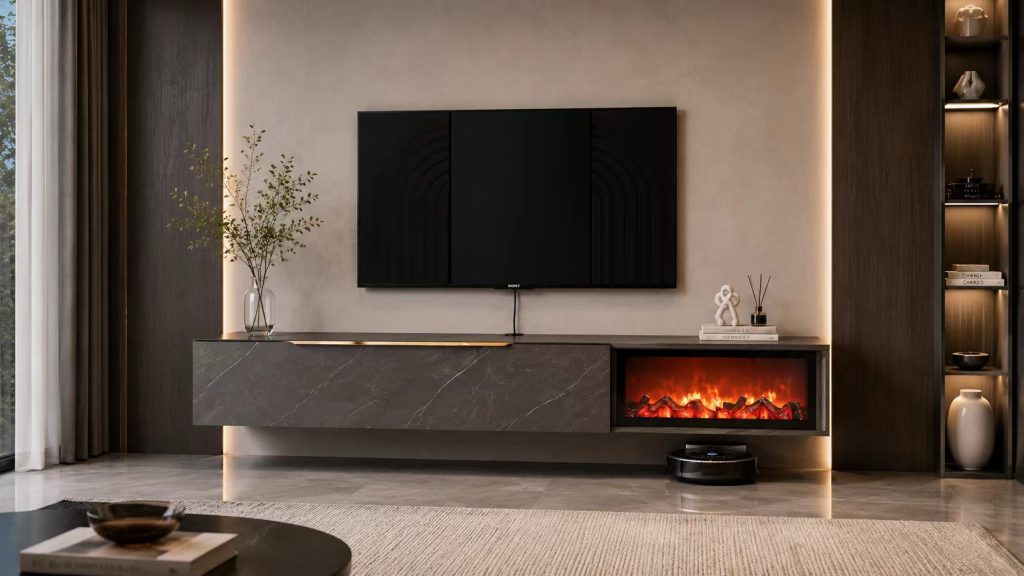
Outlet placement. This is the detail that breaks more installs than any other. A floating fireplace TV stand needs its power cord to reach an outlet without dangling visibly down to the floor. The right answer is having an electrician install a new outlet behind where the unit will mount, recessed so the plug sits flush. If you’re not willing or able to do that, you’ll either look at a cord running down the wall (which kills the entire floating aesthetic) or you’ll use a horizontal cord cover (which is the visual compromise nobody mentions in product photos).
TV anchoring above. This one matters even more than usual. The U.S. Consumer Product Safety Commission’s Anchor It! campaign is direct about the leading cause of preventable TV injuries to children: improperly mounted televisions, especially in households with kids under 5. When you wall-mount a TV above a floating fireplace unit, you’re committing to a setup that requires the TV to be anchored separately into wall studs — never into the media unit itself, and never relying on the unit to support the TV’s weight. The two mountings should be structurally independent. This is also worth understanding alongside the broader furniture-stability conversation that ASTM F2057 and the STURDY Act brought into focus — wall-mounted units don’t tip, but TVs above them absolutely can if the mount isn’t right.
Storage trade-off worth flagging: most floating fireplace TV stands give up internal storage volume to make room for the fireplace insert. You typically lose 30 to 40 percent of the interior cavity compared to a non-fireplace version of the same width. If you have a soundbar, game console, streaming box, router, and modem to hide, measure the interior depth and shelf height carefully. “60-inch unit” and “60-inch unit with usable cabinet space” are very different things.
What to Confirm Before Buying Online
A checklist worth running through before the order confirmation:
- UL or ETL certification listed on the spec sheet (not just the marketing copy)
- Heater wattage clearly stated (typically 750W or 1,500W)
- Required circuit specified (15-amp standard residential is the norm; verify nothing else heavy shares it)
- Vent direction stated (forward and/or downward — never upward toward the TV)
- Minimum clearance between the heater outlet and the bottom of the TV
- Mounting hardware included — and whether it’s designed for wood studs, masonry, or both
- Unit weight (so you can verify your wall structure can hold it)
- Maximum supported TV size and weight that the manufacturer recommends mounting above the unit
- Power cord length and exit point (top, side, or rear — affects whether you need a new outlet)
- Pre-assembled or self-assembly — a unit with a fireplace insert and electrical components is the worst category to self-assemble; pre-assembled removes the most common point of installation failure
Pre-assembled is a meaningful detail here. Self-assembling a wall-mounted unit with an integrated electrical heating element introduces three failure modes that a factory-assembled unit avoids: insufficient torque on internal fasteners (the heating element vibrates slightly during use), miswiring of the heater connection, and misalignment of the vent channels. A factory-built unit arrives with all of these handled. POVISON’s floating units in this category ship with the electrical components pre-installed and tested — you’re mounting an enclosure, not building one.
FAQ
Is a floating TV stand with fireplace actually worth buying in 2026?
A floating TV stand with fireplace is worth buying in 2026 when you want both the visual benefit of a wall-mounted, floor-free design and the ambiance of an electric flame element — and you’re willing to commit to the installation requirements that come with it. The aesthetic payoff is real for modern, minimal living rooms with clear sight lines. The trade-off is install complexity (studs, anchors, outlet placement, TV anchoring above) plus reduced internal storage compared to non-fireplace versions of the same width. For renters or households planning to move within two years, skip the floating version and choose floor-standing instead.
Can a floating fireplace TV stand safely hold a large TV?
A floating fireplace TV stand cannot safely hold a large TV directly on the unit, and shouldn’t be expected to. The unit itself anchors to wall studs and bears its own weight; the TV above it must be wall-mounted separately into structural studs, never resting on top of the floating unit or relying on it for support. The two mountings stay structurally independent — this is the safe design pattern and matches CPSC anchoring guidance for both furniture and televisions.
Does a floating TV stand with fireplace require special installation?
A floating TV stand with fireplace requires special installation in three areas: structural anchoring (locate at least two wood studs and use lag bolts rated for the unit weight), electrical (a dedicated or lightly-loaded 15-amp circuit, ideally with a recessed outlet behind the unit so no cord shows), and heat clearance (verify the manufacturer’s minimum gap between the heater outlet and the bottom of the TV above). It’s not a DIY project for someone uncomfortable using a stud finder and a drill — but it’s also not specialized enough to require contractor pricing if you know what you’re doing.
Is it safe to wall-mount a fireplace TV stand in terms of heat and weight?
Wall-mounting a fireplace TV stand is safe in terms of heat and weight when three conditions are met: the unit is UL or ETL listed for indoor residential use, the mounting hardware catches at least two wood studs (or appropriate masonry anchors for brick/concrete walls), and the manufacturer’s minimum clearance between the heater outlet and the TV above is respected. The combined load of the unit plus a typical 65-inch TV — roughly 150 pounds total — sits well within the working strength of properly installed lag bolts into wood studs. Heat-related risk drops to near zero when the unit vents forward and downward (never upward) and the TV mount keeps the screen above the manufacturer-specified clearance zone.
Conclusion
The floating TV stand with fireplace earns its place in 2026 for the right buyer: someone who’s committed to the modern wall-mounted aesthetic, has a wall with solid studs behind drywall (or knows how to handle masonry), can plan around outlet placement, and understands that the TV above the unit is a separate mounting project that needs to be done correctly.
For everyone else — renters, frequent movers, anyone hesitant about drilling into structural studs, households where the install will be DIY without confidence — the floor-standing version of the same product category gives you 80 percent of the visual benefit with 20 percent of the install complexity. The fireplace ambiance doesn’t depend on the unit floating; it depends on the flame effect and the placement.
Either way, the three numbers worth memorizing before you order: wattage of the heater, certification mark on the spec sheet, and minimum clearance from the heater outlet to the TV above. Those three data points tell you whether the unit on your screen is engineered for the install you’re about to do — or whether you’re buying a Pinterest photo that will become a long-term project.
Related Reading:


