 By Charles
There’s a pattern I see all the time. A family of four — two adults, two kids — outgrows their loveseat. The natural next move feels obvious: get bigger. Buy a sectional. Take up the whole wall, give everyone their corner, declare victory.
Then the sectional shows up, doesn’t fit through the entry, gets returned, and the family ends up with whatever the second-pick option was. Usually less seating, more regret.
The 4-seater sofa exists in the middle of that story. It’s the answer for families who want enough room for everyone without committing to an L-shaped piece that eats half the room and won’t fit up the stairs. I’ve spent the last few years watching friends and clients make this exact decision — including my sister in Brooklyn, who almost bought a 110-inch sectional for a room that physically wouldn’t accept one — and I want to walk through what actually matters before you click order.
What Is a 4-Seater Sofa Best For
A 4-seater sofa is a straight (or very gently curved) sofa long enough to seat four people side by side. No chaise, no return piece, no corner. It’s the bigger cousin of the standard 3-seater, not a smaller cousin of the sectional. That distinction matters more than it sounds.
The 4-seater earns its place in three specific scenarios:
- A family of four where everyone actually sits together on the sofa most evenings — homework, movies, the after-dinner crash.
- A household that hosts often but not large groups, where one or two extra adults need a place to land.
- A long, narrow room where a sectional would create a corner you’d have to walk around constantly.
What it’s not built for: serving as a guest bed, anchoring an open-plan room where two seating zones need defining, or maxing out lounging surface for a household of teenage sprawlers. Those use cases push you toward a sectional or a sleeper sofa, and trying to force a 4-seater to do them ends in compromise.
One thing I want to say plainly because the internet won’t: bigger isn‘t automatically better. A 4-seater in a room that wants a 3-seater is just a 3-seater with worse walkways and a more expensive price tag. The size has to earn its place.
Common 4-Seater Sofa Sizes and Seating Reality
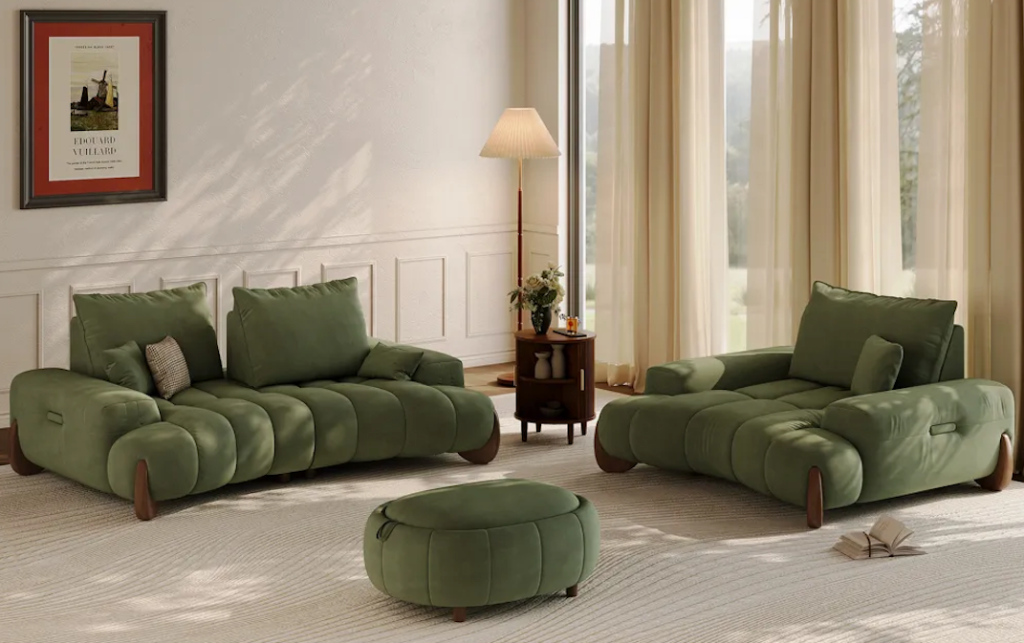
Most 4-seater sofas on the market fall between 95 and 115 inches in overall length, with the bulk of options clustered at 96, 104, and 112 inches. Depth typically runs 35 to 40 inches. Height varies more — anywhere from 30 to 36 inches at the back, depending on whether the silhouette is low-slung modern or higher-backed traditional.
Here’s the part nobody tells you upfront: a “4-seater” doesn’t always seat four adults comfortably.
Industry guidance puts comfortable per-person width at around 24 inches for relaxed seating. Do the math on a 96-inch sofa — that’s exactly 24 inches per seat, but only after subtracting arm width on both sides. Real-world usable seat width on a 96-inch model is closer to 84 inches, which gives each adult about 21 inches. That’s tight. Possible, but tight. Two adults plus two small kids? Totally fine. Four adult-sized humans for a three-hour movie? Someone’s going to start rotating off.
If you want four adults to actually sit comfortably, look at 104 inches or longer. That gets you closer to 26 inches per seat after arm subtraction, which crosses the line from “manageable” to “you don’t even think about it.”
A few other dimensions to pay attention to:
- Seat depth: 21–24 inches is the practical comfort range. Architectural Digest and other design references generally place the standard sofa seat depth at 21–22 inches, with anything past 23 inches counting as “deep seat” territory. Deep seats look lounge-y and feel great if you’re tall or like to curl up; they’re murder if you’re 5’2″ and want your feet on the floor.
- Seat height: 17–19 inches is standard. Lower than that and getting up off the sofa starts feeling like an exit strategy.
- Arm width: The single most-overlooked variable. Chunky 8-inch arms on a 96-inch sofa eat 16 inches of usable seat. Slim 3-inch arms give you back 10 inches of bench. Same external footprint, very different actual capacity.
One spec worth checking that almost no buying guide mentions: upholstered sofas sold in the US are required to carry a label confirming compliance with CPSC’s federal flammability standard for upholstered furniture. The label is usually tucked under a cushion or on the underside of the frame. It’s not a luxury feature — it’s federally mandated, and its absence on a sofa being sold in the US is a red flag. For a 4-seater that will live in a family room with kids, this is one of the easier safety checks to make.
POVISON’s 4-seater sofa collection lists complete dimensions on every model — overall width, depth, height, seat depth, arm width — which is what you actually need to compare apples to apples. Brands that publish only “L: 96 inches” and call it a day are hiding the variables that determine whether you’ll be comfortable in five years.
Best Rooms for a 4-Seater Sofa
Family Living Rooms
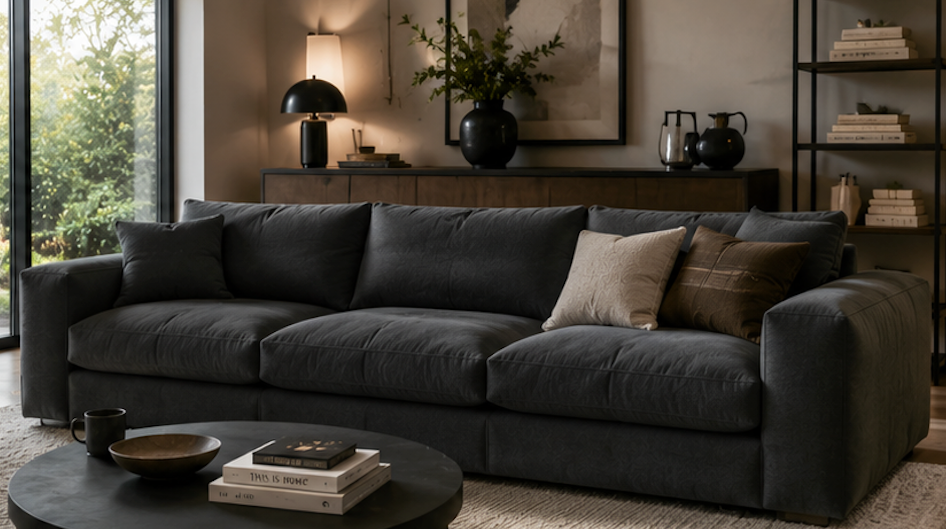
A family living room with one main wall between 12 and 16 feet long is the natural habitat for a 4-seater. The math works: a 96–104-inch sofa lands at roughly two-thirds the wall length, which is the proportion designers reach for when they want a sofa to anchor the room without dominating it.
The use case here is almost always the same: a household of three to five people who all want to be on the same piece of furniture in the evenings. Not spread across separate chairs. Not split between a loveseat and an accent chair. On the sofa, together. For families with kids under 12, this is everyday reality. Homework happens on the sofa. After-school decompression happens on the sofa. The post-dinner cartoon block happens on the sofa.
A few practical notes for family rooms specifically:
- Stain-friendly upholstery matters more than fabric prestige. Performance fabrics, leather, or removable washable covers will outlast cotton-linen blends by a factor of five in households with kids and pets. The fabric you fall in love with in the showroom isn’t the fabric that will survive grape juice in week three.
- Cushion construction determines longevity. Bench seats (a single long cushion) look cleaner but sag faster under heavy daily use; multi-cushion designs distribute wear better and let you rotate. For a 4-seater that will be sat on every single day for years, multi-cushion is the boring but correct answer.
- Leave 14 to 18 inches between the sofa front and the coffee table. Less than that and you’ll bash your knees getting up. More than that and you can’t reach your coffee. This is one of those design rules that sounds fussy until you live with the wrong distance for six months.
If your room won’t tolerate a 104-inch piece but you still need real seating for four, POVISON’s broader sofa lineup covers the full range from 78-inch 3-seaters up through 4-seater and sectional options — useful for comparing footprints side by side before committing.
Long Narrow Rooms
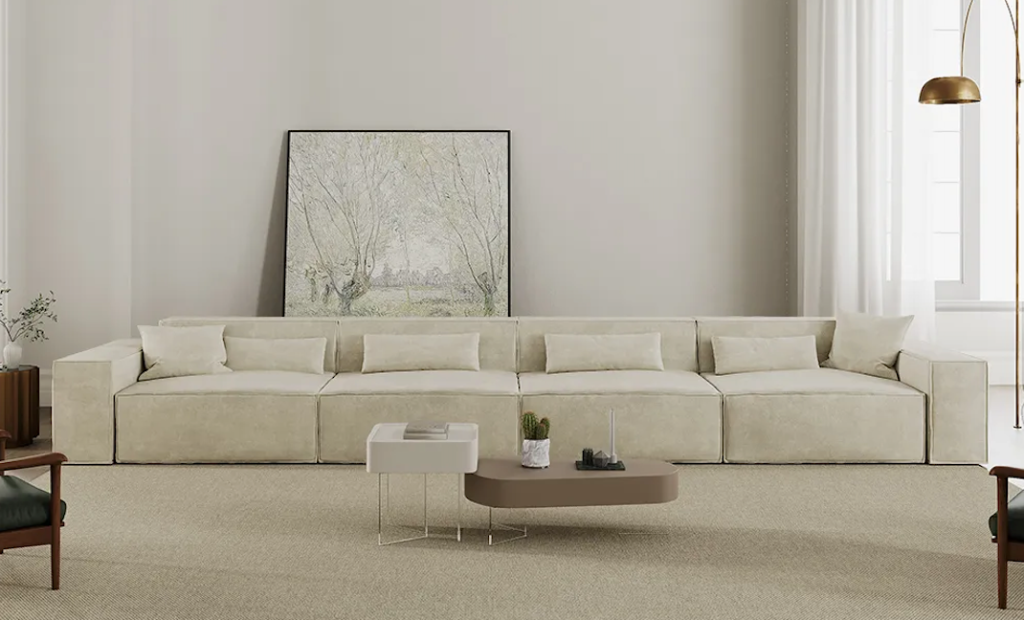
This is the 4-seater’s stealth superpower: long, narrow rooms that look impossible. If your living room is 11 feet wide by 18 feet long, a sectional with a chaise is going to fight you. The chaise extension will block the path to the kitchen, or jut into the dining area, or eat the doorway. A straight 4-seater sits flat against the long wall and lets the rest of the room breathe.
Brownstones, railroad apartments, narrow ranch-style family rooms, finished basements with one usable wall — these all want a 4-seater, not a sectional, and most people pick the wrong one because the showroom never sets up the comparison.
The rule of thumb for narrow rooms: the long dimension of your sofa should be less than 65% of the room’s long dimension, and the path on either side of the sofa should clear 30 inches minimum. For an 18-foot-long room, that means your sofa tops out around 110 inches — fitting a 4-seater perfectly while a typical 130-inch sectional would not.
4-Seater Sofa vs Sectional
This is the decision everyone’s actually wrestling with, so let me be direct about the trade-offs.
| Factor | 4-Seater Sofa | Sectional |
| Footprint shape | Straight line | L-shape or U-shape |
| Typical length | 95–115 inches | 100–140 inches (one side) |
| Best for | Long narrow rooms, single-wall layouts | Open-plan rooms, corner-anchored layouts |
| Doorway risk | Lower (single piece, slimmer profile) | Higher (often multi-piece or larger components) |
| Movability | Easier — moves as one piece | Harder — but modular pieces help |
| Lounging surface | Sit-up oriented | Chaise allows full-stretch lounging |
| Reconfiguration | Fixed shape | Modular options swap layouts |
The honest version: if your room has a corner that begs to be filled with seating, a sectional makes sense. If your room is essentially a rectangle with the sofa against one wall, a 4-seater is the more flexible piece. You can move it, rearrange around it, replace it later without re-buying an entire system.
The other thing worth saying: sectionals look more impressive in photos. Real life is different. A 4-seater straight sofa with two well-chosen accent chairs nearby gives you the same total seating, more conversational geometry, and infinitely better flexibility when you redecorate or move. I’ve watched people buy sectionals for the photo and regret them for the friction.
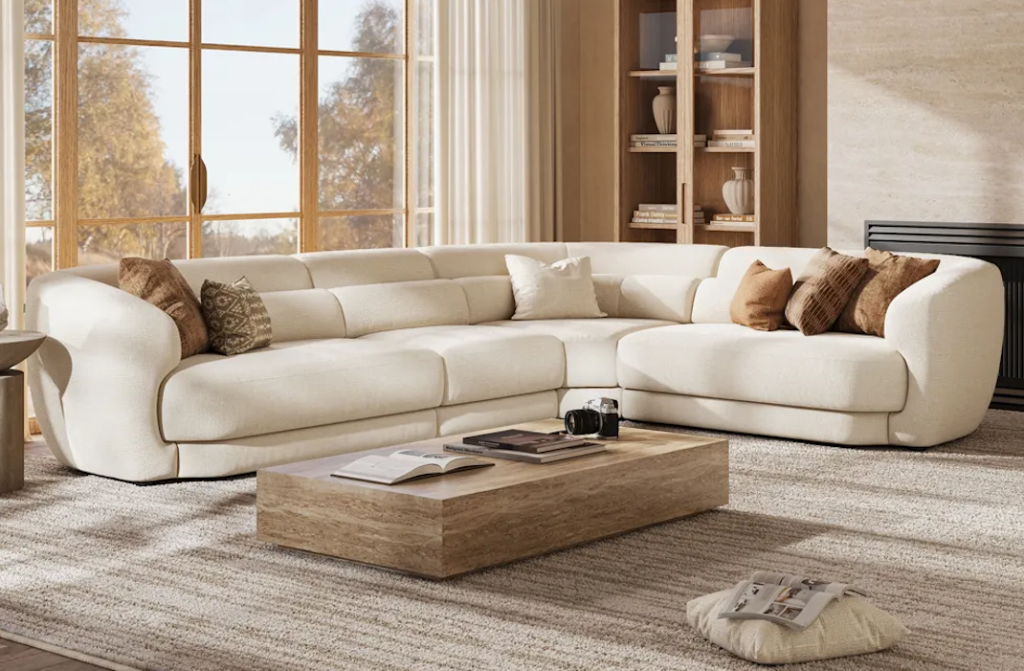
Delivery, Doorway, and Scale Trade-Offs
Here’s where most 4-seater purchases actually go wrong: not in the showroom, but on delivery day. The sofa is fine. The doorway is the problem.
Standard interior residential doors are typically 30 to 32 inches wide. ADA design standards require a minimum clear opening width of 32 inches for accessible doorways, which gives you a useful benchmark for what most newer homes provide — but older homes, walk-ups, and apartment buildings often run narrower. Pre-war buildings in particular can have entries as tight as 28 inches once you account for the door thickness and hinge geometry.
A 4-seater sofa with a 38-inch depth is going to clear a 32-inch doorway only if it can pivot through. That’s the four-door check:
- Building entry door — clear width, measured open.
- Apartment or interior entry — same measurement.
- Hallway turns — diagonal clearance, not just width.
- Living room doorway — the final pinch point.
If any of these is tighter than the sofa’s depth (which is the dimension you’ll pivot on), you have a problem. Either the legs come off, the sofa breaks down into modular pieces, or it doesn’t make it inside.
Hallways add another layer worth checking. The 2024 International Residential Code requires a minimum 36-inch clear width for hallways in new residential construction — but older homes, walk-ups, and conversions frequently come in narrower than that, and the 36-inch dimension is wall-to-wall, not accounting for baseboards, light fixtures, or that one weird radiator. If your delivery path includes a hallway turn, what matters is the diagonal across the turn, which is always tighter than the straight width suggests.
This is the single biggest reason I recommend pre-assembled sofas with detachable legs and modular construction for larger pieces. POVISON’s sofas ship with legs unattached — you screw them on after the sofa is inside the room, which gives you about 4 inches of additional clearance during delivery. For a 4-seater on the larger end of the spectrum, those 4 inches are often the difference between “fits” and “going back on the truck.”
A few other delivery realities:
- Weight matters for stairs. A typical 4-seater weighs 120–180 pounds. Walking that up three flights of stairs in a city walk-up is a two-person job at minimum, and not all delivery services include stairs without an extra fee.
- Packaging is a separate problem. The shipping crate or box adds 4–6 inches in every direction. Confirm the as-delivered dimensions, not the assembled ones.
- White-glove delivery isn’t a luxury for a 4-seater — it’s a practical requirement. Confirm what’s included before ordering: in-home placement, packaging removal, leg attachment. A sofa dropped at the curb is a problem you don’t want.
The painter’s-tape exercise applies double here. Before ordering, tape out the sofa’s overall footprint on your living room floor, then tape out the path from your building entry to that footprint. Walk it. Pivot at the corners. If your path includes a stairwell turn or a tight doorway, measure the diagonal — that’s the real constraint, not the straight-through width.
FAQ
How long is a typical 4-seater sofa and what does it actually seat?
A typical 4-seater sofa runs 95 to 115 inches long overall, with most options clustered at 96, 104, and 112 inches. Realistic seating depends heavily on arm width — a 96-inch model with chunky arms gives each person about 21 inches of seat width, which fits four small adults or two adults plus two kids comfortably. For four full-sized adults to relax without rotating, look at 104 inches or longer.
Is a 4-seater sofa a good choice for a family living room?
A 4-seater sofa is a good choice for family living rooms where the main wall is 12 to 16 feet long and where the household actually sits together — homework, movies, after-dinner downtime — rather than spreading across multiple chairs. Prioritize multi-cushion construction over bench-seat designs (better wear under daily use), performance fabric or leather upholstery, and confirm 14–18 inches between the sofa and your coffee table.
Should I buy a 4-seater sofa or go for a sectional instead?
Buy a 4-seater sofa if your room is long and narrow, your main wall has a single sofa-anchoring spot, your delivery path includes tight doorways or stairs, or you anticipate moving within a few years. Choose a sectional if your room has a natural corner that needs filling, your floor plan is open with multiple zones to define, or full-stretch lounging on a chaise is a daily priority. A 4-seater plus two accent chairs often delivers the same seating capacity with more flexibility.
Will a 4-seater sofa fit comfortably in my apartment?
A 4-seater sofa fits comfortably in an apartment when your living room measures at least 12 by 14 feet, your tightest doorway clears 32 inches, and you have a clear delivery path that includes corner pivots and any stairwell turns. In compact urban apartments, opt for a 96-inch 4-seater with slim arms over a 110-inch model — same usable seating, smaller footprint, easier delivery. Always tape out both the sofa footprint and the delivery path before ordering.
Conclusion
The 4-seater sofa isn’t a bigger 3-seater and it isn’t a smaller sectional. It’s a specific answer to a specific question: how do you seat a whole family or accommodate hosting without committing to an L-shaped piece that controls the room’s geometry?
For long narrow rooms, family living rooms with a clear main wall, and households that want flexibility for future moves or rearrangements, the 4-seater is genuinely the right call — not a compromise. The keys are matching the length to your wall (two-thirds rule), confirming usable seat width past the arms, verifying every doorway and corner in the delivery path, and choosing upholstery and cushion construction that will survive daily use.
Tape it out. Measure the doorways. Walk the delivery path with a tape measure in hand. Five minutes of that exercise saves you the entire delivery-day disaster — and gets you a sofa that actually fits the room you actually have.
Related Reading:


