 By Charles
Last spring I helped a friend pick a coffee table for her new Brooklyn apartment. She’d already bought a low-slung walnut sofa, a vintage rug, a brass floor lamp — every piece chosen with intent. Then she put a chunky farmhouse coffee table in the middle of it all, and her whole living room collapsed visually. The table wasn’t bad. It just had no idea what conversation it was in.
That’s the thing nobody tells you about mid-century coffee tables. The style itself is forgiving — clean lines, tapered legs, warm wood. But the scale is unforgiving. Get the height wrong by two inches, or the shape wrong for your room, and you’ve got an expensive piece of furniture starring in the wrong movie.
So here’s everything I wish someone had told my friend before she clicked “buy.” We’re going to talk about height, shape, wood tone, and how a mid-century coffee table actually has to fit your room — not just match a Pinterest board.
What Makes a Coffee Table Mid-Century Modern
Before we get into proportions, let’s settle the definition — because half the tables sold as “mid-century” online aren’t really. Britannica describes mid-century design as “clean lines, organic shapes, and functionality” — three traits that should show up in any honest mid-century coffee table.
In practice, that means:
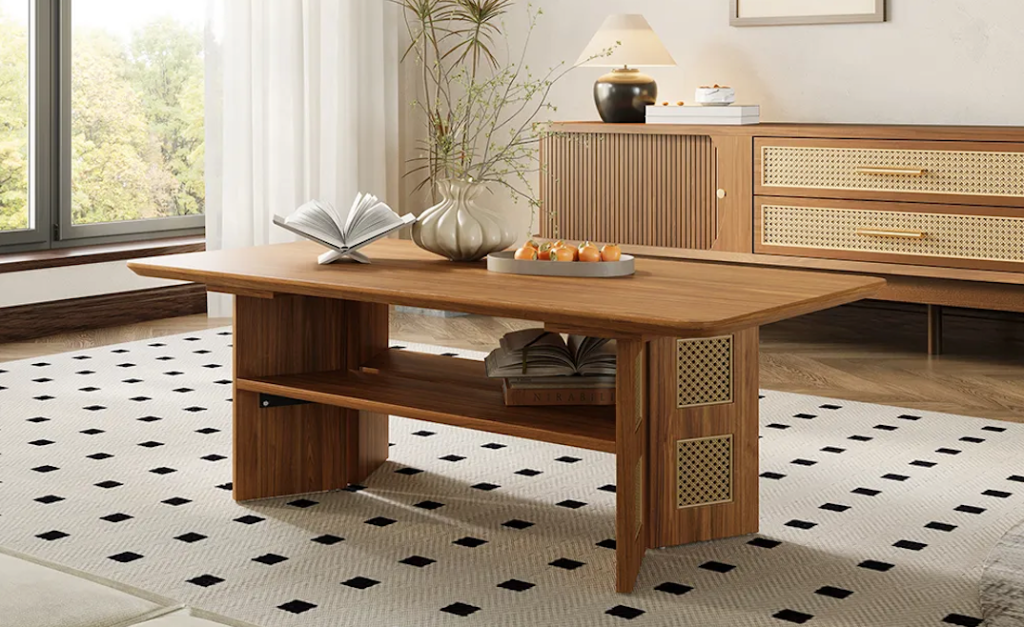
- Tapered legs. Often splayed slightly outward, often in solid wood (walnut and oak are classic). No bulky pedestal bases, no carved feet.
- Low, horizontal profile. Mid-century tables sit low. Most fall between 14 and 18 inches tall. This is intentional — they’re meant to support a low, lounge-ready sofa silhouette.
- Honest materials. Wood that looks like wood. Glass that does a job, not glass that just decorates. Mid-century preservation group a2modern’s documentation of authentic MCM characteristics describes how “materials look authentic, unadorned, and beautiful in their natural state” — which is why a thick particle-board top with a glossy plastic finish reads instantly as a knockoff.
- Functional shapes. Either clean rectangles, soft ovals, or honest circles. No fussy asymmetry, no decorative trim.
If you see a “mid-century” table with thick chunky legs, ornate hardware, or a heavy glossy lacquer finish — it’s probably mid-century inspired, which is fine, but don’t expect it to play well with actual mid-century pieces around it.
Match Coffee Table Height to Sofa Height
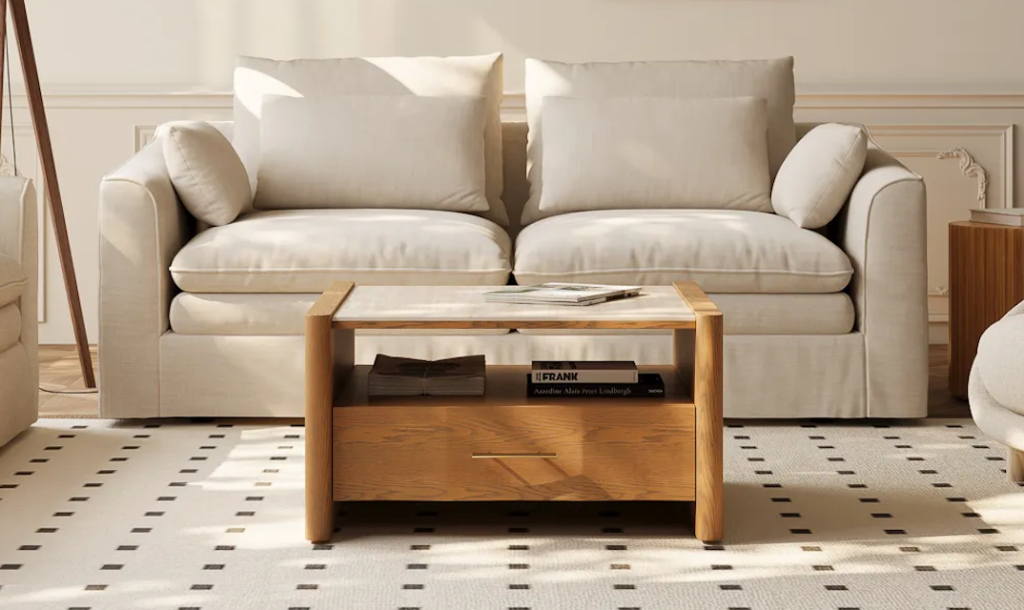
This is the rule that fixes more living rooms than any other: your coffee table top should sit within two inches of your sofa’s seat cushion height — level or slightly lower, never taller.
Why does this matter so much? Because a mid-century sofa is designed to sit low. The whole aesthetic — the long horizontal line, the relaxed lounge feeling — comes from keeping the eye sweeping low across the room. The moment your coffee table rises above the sofa seat, that line breaks. Your living room starts to feel choppy and short. Drinks become awkward to reach. Your knees hit something every time you lean forward.
According to Architectural Digest, a standard sofa seat is typically around 20–22 inches deep, and most sofa seat heights land between 17 and 19 inches from the floor. So for most living rooms, a coffee table between 15 and 18 inches tall is the safe zone.
The simple version is this: measure your sofa seat from floor to cushion top, then pick a table that’s that height or up to 2 inches shorter.
Low-Profile Sofas
If you’ve gone with a true mid-century-style sofa — think tapered wooden legs, shallow cushions, that classic low-slung Danish profile — your seat height is probably closer to 15–17 inches. That means you want a coffee table in the 14–16 inch range. Anything taller will dominate the sofa visually.
This is where a lot of people get burned. They see a 19-inch table they love online, assume “low coffee table = mid-century,” and end up with something that looms over their cushions. I did the painter’s-tape test for my friend in Brooklyn — taped out a rectangle at 16″ and another at 18″ on the floor, then sat on her sofa with a mug. The 16″ version was clearly the right one. Took five minutes; saved a return shipment.
Standard-Height Sofas and Sectionals
Most modern American sofas sit a bit higher — seat heights around 18–19 inches, with deeper cushions. Sectionals especially run on the deeper, plusher side. For these, a 16–18 inch coffee table works best. You also want to add a bit more length: aim for a table that’s roughly half to two-thirds of the sofa’s overall length. POVISON’s own design guidance suggests a table about 40–54 inches long for a typical 3-seater around 78–86 inches.
For sectionals specifically, leave more breathing room — 16 to 18 inches between the sofa front and the table, sometimes 20 if the sectional has very deep seat cushions. Otherwise you’re climbing in and out every time you stand up.
Round vs Rectangular Mid-Century Tables
This is the question I get most often, and the honest answer is: your room shape decides, not your taste. Let me break it down.
Choose a rectangular mid-century coffee table when:
- Your living room is long and narrow (think railroad apartments, traditional living rooms with the sofa parallel to the longest wall).
- You have a standard three-seater sofa, no sectional. A rectangular table mirrors the sofa’s line and uses the rug efficiently.
- You want maximum surface area — for laptops, board games, snack trays during movie night.
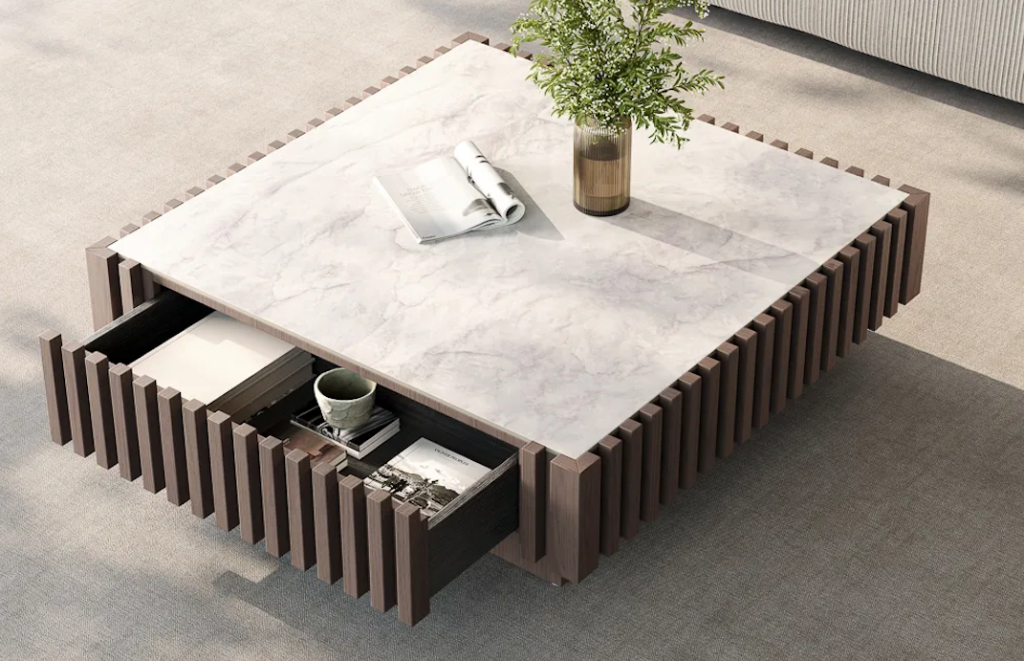
- Example fit: POVISON’s 55-inch rectangular mid-century coffee table with tempered glass works in this exact setup — long enough to anchor a full-size sofa, with two solid wood drawers that handle the daily remote-and-coaster clutter without showing it.
Choose a round or oval mid-century coffee table when:
- Your space is open-plan, where seating connects to a dining or kitchen zone and people need to walk around the table constantly.
- You have an L-shaped sectional. A round table tucked into the inside of the “L” gives every seat equal reach.
- You have small kids or pets — no corners to ram a hip or knee into, and circulation stays smooth.
- Your living room is small (under about 180 sq ft). A round table visually frees up the floor and softens the room’s edges.
- Example fit: POVISON’s 31.5-inch lifting-top round coffee table in walnut ships fully assembled with a hidden storage compartment and lift-top — handy for a small open-plan apartment where the table doubles as a laptop desk during the day.
If you’re still torn, here’s the gut-check question: Do people walk around this table more than they sit at it? If yes, go round. If the table mostly serves people sitting on one big sofa facing it, rectangular is fine.
Wood Tone, Storage, and Room Balance
The last piece of the puzzle is wood tone — and this is where mid-century coffee tables get fun, because the exact shade you pick has a real effect on how your room reads.
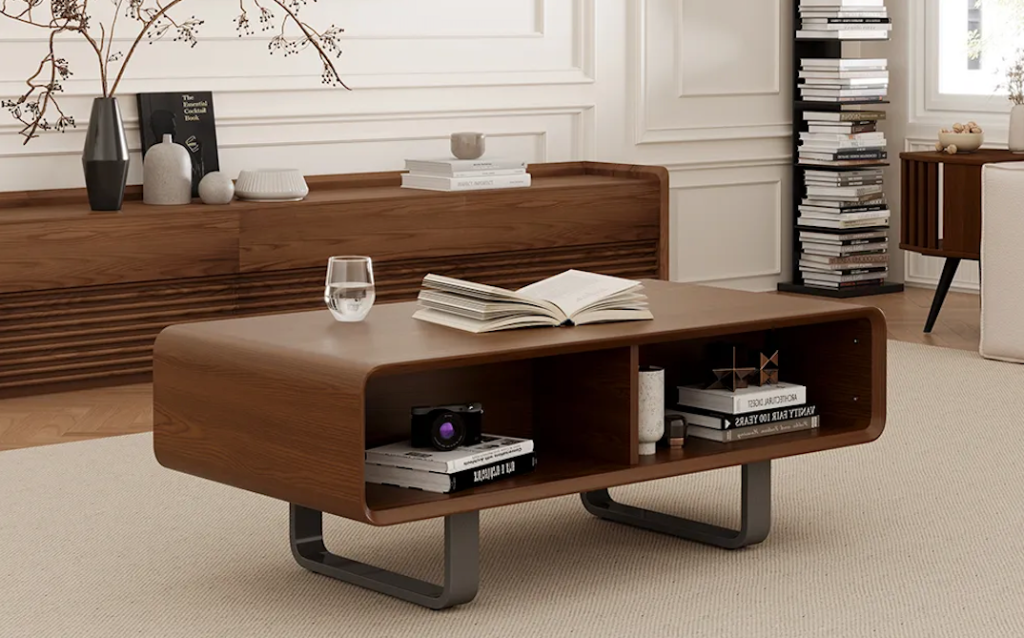
Walnut is the iconic mid-century wood. Rich, warm, slightly reddish-brown. According to the American Hardwood Information Center, walnut is valued precisely for its strength, tight grain, and exceptional finishing qualities — which is why furniture makers have favored it for everything from cabinets to fine tables.It’s the default for a reason: it grounds a room without dominating it, and it plays well with almost any sofa fabric — gray, navy, cream, mustard, olive. If you’re starting from scratch, walnut is the safest bet. Most POVISON mid-century tables use a walnut veneer over engineered cores with solid wood drawers and trim — which keeps weight (and price) reasonable while keeping the grain authentic on the surfaces you actually touch.
Light oak or natural ash leans more Scandinavian. Better for rooms with lots of natural light, cooler color palettes (whites, light grays, pale blues), and minimalist furniture overall. Pairs especially well with bouclé or linen sofas.
Dark walnut or espresso anchors rooms with stronger colors and more visual contrast. Works in living rooms with darker walls, leather sofas, or layered textile patterns. Be careful with this one in small rooms — too much dark wood and the space can start to feel heavy.
Storage built into the table. This isn’t optional anymore for most households. Mid-century designers originally championed function, and a coffee table that hides remotes, throws, chargers, and kid clutter earns its place faster than a beautiful empty surface. Drawer-style tables (like the 55-inch rectangular I mentioned earlier, with two solid wood drawers and 440-lb weight capacity) work well for organized small items. Open-shelf or lift-top designs work better for blankets and larger items.
One quick check on assembly. POVISON’s product pages note assembly requirements on each item — some round tables ship ready to use straight out of the box, while some larger rectangular pieces require partial assembly (typically attaching legs, not the full flat-pack ordeal). Always check the spec sheet before clicking buy. If you’ve been burned by hours of hex-key labor, you’ll appreciate that this brand actually labels it.
FAQ
What exactly makes a coffee table mid-century modern?
A genuine mid-century modern coffee table has three signatures: tapered legs (often splayed in solid wood), a low horizontal profile (typically 14–18 inches tall), and honest materials with minimal ornament. Per Britannica, the style is built on “clean lines, organic shapes, and functionality”. If you see chunky pedestal bases, glossy plastic finishes, or decorative carved trim, you’re looking at “mid-century inspired” at best, not the real thing.
Does a mid-century coffee table work well in small living rooms?
Yes — arguably better than most other styles. Mid-century tables tend to have slim tapered legs that visually lighten the floor, and low profiles that don’t crowd a small room. For under 180 sq ft, go round (no corners to bump into) and stay around 30–36 inches in diameter. A lift-top round table also doubles as a laptop or snack surface, which earns its keep in a studio or small apartment.
Should a mid-century coffee table be wood, or can it be other materials?
Wood is the default — walnut, oak, and ash are most authentic — but mid-century design did embrace mixed materials. Tempered glass tops over wood frames, sintered stone or travertine on walnut bases, and metal accents (brass, brushed steel) are all historically accurate. What feels wrong: heavy stone slabs, ornate marble inlays, or anything with a high-gloss plastic feel. Mid-century is about honest materials used cleanly.
Which sofa styles pair best with a mid-century coffee table?
The best matches are sofas with tapered wooden legs, clean rectangular frames (track arms are ideal), and shallow-to-medium seat depths. Neutral upholstery (gray, beige, navy, cream) is safest; classic mid-century accent colors (mustard, olive, burnt orange) also work beautifully. Avoid pairing with deeply tufted Chesterfields, oversized lounge sofas with bulky arms, or anything in heavy ornate styles — the proportions will fight each other.
Conclusion
A mid-century coffee table looks deceptively simple, but it carries a lot of structural weight in your living room — literally and visually. Get the height right (within two inches of your sofa seat), match the shape to your floor plan rather than your mood board, and pick a wood tone that works with your room’s light and palette. Do that, and a $400 walnut table will outperform a $1,200 designer piece that’s the wrong scale.
The one shortcut I’ll leave you with: before you buy anything, tape out the footprint on your floor. Painter’s tape, two minutes, no commitment. Sit on your sofa, reach forward like you’re grabbing a mug. If it feels natural — you’ve got the right size. If it doesn’t, the tape comes up clean and you keep looking.
If you want to compare full options side-by-side, POVISON’s ultimate coffee table buying guide walks through every variable in more detail. Otherwise, go measure your sofa, grab the tape, and trust the rules above. Your living room will thank you.
Related Reading:


